Page 433 of 576
This section will guide you in the
proper loading of your vehicle and/or
trailer, to keep your loaded vehicle
weight within its design rating capa-
bility, with or without a trailer.
Properly loading your vehicle will
provide maximum return of the vehi-
cle design performance. Before load-
ing your vehicle, familiarize yourself
with the following terms for determin-
ing your vehicle's weight ratings, with
or without a trailer, from the vehicle's
specifications and the certification
label:
Base curb weight
This is the weight of the vehicle
including a full tank of fuel and all
standard equipment. It does not
include passengers, cargo, or option-
al equipment.
Vehicle curb weight
This is the weight of your new vehicle
when you picked it up from your deal-
er plus any aftermarket equipment.
Cargo weight
This figure includes all weight added
to the Base Curb Weight, including
cargo and optional equipment.
GAW (Gross axle weight)
This is the total weight placed on
each axle (front and rear) - including
vehicle curb weight and all payload.
GAWR
(Gross axle weight rating)
This is the maximum allowable
weight that can be carried by a single
axle (front or rear). These numbers
are shown on the certification label.
The total load on each axle must
never exceed its GAWR.
GVW (Gross vehicle weight)
This is the Base Curb Weight plus
actual Cargo Weight plus passen-
gers.
GVWR
(Gross vehicle weight rating)
This is the maximum allowable
weight of the fully loaded vehicle
(including all options, equipment,
passengers and cargo). The GVWR
is shown on the certification label
located on the driver’s door sill.
VEHICLE WEIGHT GLOSSARY
5120
Driving your vehicle
Page 441 of 576

What to do in an emergency
86
IF YOU HAVE A FLAT TIRE
Jack and tools
The jack and wheel lug nut wrench
are stored in the luggage compart-
ment.
Remove the panel indicated in the
illustration.
(1) Jack handle
(2) Jack
(3) Wheel lug nut wrench
(4) Socket
Jacking instructions
The jack is provided for emergency
tire changing only.
To prevent the jack from “rattling”
while the vehicle is in motion, store it
properly.
Follow jacking instructions to reduce
the possibility of personal injury. Always move the vehicle complete-
ly off the road and onto the shoul-
der before trying to change a tire.
The jack should be used on a firm
level ground. If you cannot find a
firm, level place off the road, call a
towing service company for assis-
tance.
Be sure to use the correct front and rear jacking positions on the vehi-
cle; never use the bumpers or any
other part of the vehicle for jack
support.
Do not allow anyone to remain in the vehicle while it is on the jack.
Make sure any children present are in a secure place away from
the road and from the vehicle to be
raised with the jack.
WARNING- Changingtires
Never attempt vehicle repairs in
the traffic lanes of a public road
or highway.
OUM064003
WARNING- Tire Jack
Do not place any portion of your
body under a vehicle that is
only supported by a jack since
the vehicle can easily roll off the
jack. Use vehicle support
stands.
Page 444 of 576
611
What to do in an emergency
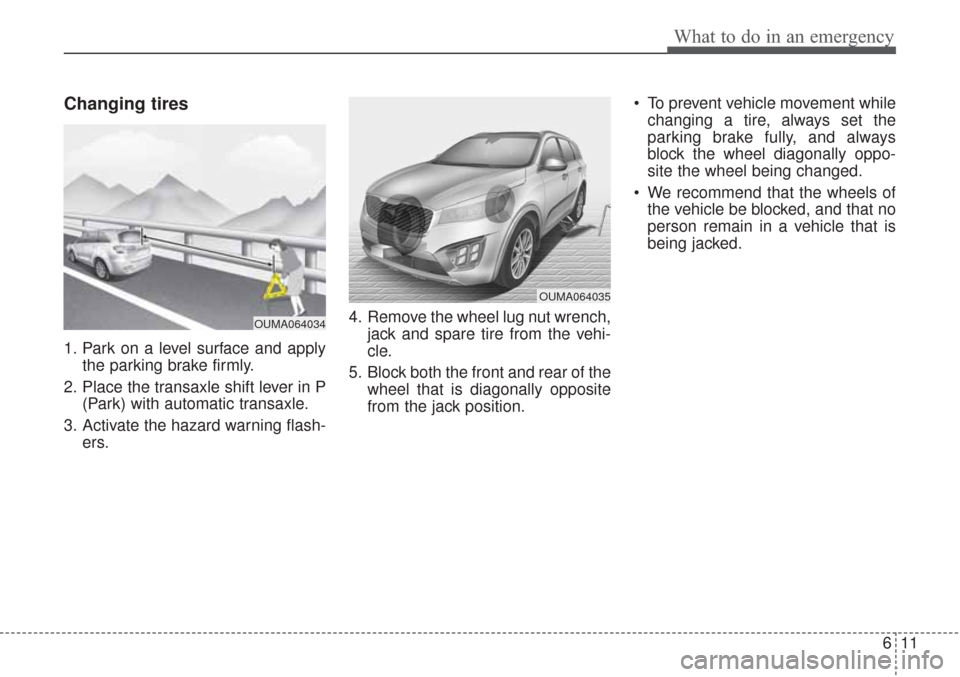
Changing tires
1. Park on a level surface and applythe parking brake firmly.
2. Place the transaxle shift lever in P (Park) with automatic transaxle.
3. Activate the hazard warning flash- ers. 4. Remove the wheel lug nut wrench,
jack and spare tire from the vehi-
cle.
5. Block both the front and rear of the wheel that is diagonally opposite
from the jack position. To prevent vehicle movement while
changing a tire, always set the
parking brake fully, and always
block the wheel diagonally oppo-
site the wheel being changed.
We recommend that the wheels of the vehicle be blocked, and that no
person remain in a vehicle that is
being jacked.
OUMA064035
OUMA064034
Page 445 of 576
What to do in an emergency
12
6
6. Loosen the wheel lug nuts coun-
terclockwise one turn each, but do
not remove any nut until the tire
has been raised off the ground.
7. Place the jack at the front (1) orrear (2) jacking position closest to
the tire you are changing. Place
the jack at the designated loca-
tions under the frame. The jacking
positions are plates welded to the
frame with two tabs and a raised
dot to index with the jack. 8. Insert the wheel lug nut wrench
into the jack and turn it clockwise,
raising the vehicle until the tire just
clears the ground. This measure-
ment is approximately 30 mm (1
in.).
Before removing the wheel lug
nuts, make sure the vehicle is sta-
ble and that there is no chance for
movement or slippage.
OUM064008
OUM064021
OUM064009
OUM064010
Page 451 of 576

What to do in an emergency
18
6
TOWING
Towing service
If emergency towing is necessary,
we recommend having it done by an
authorized Kia dealer or a commer-
cial tow-truck service. Proper lifting
and towing procedures are neces-
sary to prevent damage to the vehi-
cle. The use of wheel dollies or
flatbed is recommended.
For trailer towing guidelines informa-
tion, refer to “Trailer towing” in sec-tion 5.
On AWD vehicles, your vehicle must
be towed with a wheel lift and dollies
or flatbed equipment with all the
wheels off the ground.
On FWD vehicles, it is acceptable to
tow the vehicle with the rear wheels
on the ground (without dollies) and
the front wheels off the ground.
If any of the loaded wheels or sus-
pension components are damaged
or the vehicle is being towed with the
front wheels on the ground, use a
towing dolly under the front wheels.
When being towed by a commercial
tow truck and wheel dollies are not
used, the front of the vehicle should
always be lifted, not the rear.
OUM064022 dolly
dolly
WARNING - Side and
curtain Air bag
If your vehicle is equipped with
side and curtain air bag, set the
ignition switch to LOCK or ACC
position when the vehicle is
being towed.
The side and curtain air bag
may deploy when the ignition is
ON, and the rollover sensor
detects the situation as a
rollover.
CAUTION
The AWD vehicle should never be towed with the wheels on theground. This can cause seriousdamage to the transaxle or theAWD system.
Page 454 of 576

Fuses . . . . . . . . . . . . . . . . . . . . . . . . . . . . . . . . . . . . \
7-66
• Inner panel fuse replacement . . . . . . . . . . . . . . . . . . . 7-67
• Engine compartment fuse replacement. . . . . . . . . . . 7-69
• Fuse/relay panel description. . . . . . . . . . . . . . . . . . . . 7-71
Light bulbs . . . . . . . . . . . . . . . . . . . . . . . . . . . . . . . 7-82
• Front lamp bulb replacement . . . . . . . . . . . . . . . . . . 7-83
• Side repeater lamp replacement . . . . . . . . . . . . . . . . 7-87
• Rear combination lamp bulb replacement . . . . . . . . 7-88
• High mounted stop lamp replacement . . . . . . . . . . . 7-90
• License plate light bulb replacement. . . . . . . . . . . . . 7-91
• Interior light bulb replacement . . . . . . . . . . . . . . . . . 7-92
Appearance care . . . . . . . . . . . . . . . . . . . . . . . . . . . 7-93
• Exterior care . . . . . . . . . . . . . . . . . . . . . . . . . . . . . . . . 7-93
• Interior care . . . . . . . . . . . . . . . . . . . . . . . . . . . . . . . . . 7-98
Emission control system . . . . . . . . . . . . . . . . . . . 7-101
• Crankcase emission control system . . . . . . . . . . . . . 7-101
• Evaporative emission control (including ORVR: Onboard refueling vapor recovery) system . . . . . 7-101
• Exhaust emission control system . . . . . . . . . . . . . . . 7-102
7
Page 463 of 576

711
Maintenance
NORMAL MAINTENANCE SCHEDULE
The following maintenance services must be performed to ensure good emission control and performance.
Keep receipts for all vehicle emission services to protect your warranty. Where both mileage and time are shown, the
frequency of service is determined by whichever occurs first.
*
1: If TOP TIER Detergent Gasoline is not available, onebottle of additive is recommended. Additives are avail-
able from your authorized Kia dealer along with infor-
mation on how to use them. Do not mix other addi-
tives.
*
2: Fuel tank air filter are considered to be maintenance free but periodic inspection is recommended for this
maintenance schedule depends on fuel quality.
*
3: Transfer case oil and rear axle oil should be changed anytime they have been submerged in water.
*
4: Inspect for excessive tappet noise and/or engine vibration and adjust if necessary.
*
5: The drive belt should be replaced when cracks occur or tension is reduced excessively.
*
6: Engine oil (2.0 TGDI) Replace every 10,000km
(6,500miles) or 6 months
Page 464 of 576

Maintenance
12
7
24,000 km (15,000 miles) or 12 months
❑ Rotate tire
❑ Inspect battery condition
❑ Inspect air cleaner filter
❑ Inspect vacuum hose
❑ Inspect air conditioning refrigerant
❑ Inspect brake hoses and lines
❑ Inspect drive shafts and boots
❑ Inspect exhaust pipe and muffler
❑ Inspect front brake disc/pads, calipers
❑ Inspect propeller shaft (AWD)
❑ Inspect rear brake disc/pads
❑ Inspect steering gear box, linkage & boots/lower arm ball
joint, upper arm ball joint
❑ Inspect suspension mounting bolts
❑ Replace climate control air filter
(for evaporator and blower unit)
❑ Replace engine oil and filter *
6
(Every 12,000 km (7,500 miles) or 12 months)
❑ Add fuel additive *1
(Every 12,000 km (7,500 miles) or 12 months)
❈ Inspect : Inspect and if necessary, adjust, correct, clean or
replace.
*
6: Engine oil (2.0 TGDI) Replace every 10,000km
(6,500miles) or 6 months
NORMAL MAINTENANCE SCHEDULE
12,000 km (7,500 miles) or 6 months
❑ Rotate tire
❑ Inspect battery condition
❑ Inspect air cleaner filter
❑ Inspect vacuum hose
❑ Replace engine oil and filter *
6
(Every 12,000 km (7,500 miles) or 12 months)
❑ Add fuel additive *1
(Every 12,000 km (7,500 miles) or 12 months)
❈ Inspect : Inspect and if necessary, adjust, correct, clean or
replace.
*
6: Engine oil (2.0 TGDI) Replace every 10,000km
(6,500miles) or 6 months