2017 KIA SEDONA viscosity
[x] Cancel search: viscosityPage 169 of 586

467
Features of your vehicle
Power steering (if equipped)
Power steering uses energy from the
engine to assist you in steering the
vehicle. If the engine is off or if the
power steering system becomes
inoperative, the vehicle may still be
steered, but it will require increased
steering effort.
Should you notice any change in the
effort required to steer during normal
vehicle operation, have the power
steering checked by an authorized
Kia dealer.If the power steering drive belt
breaks or if the power steering pump
malfunctions, the steering effort will
greatly increase.
✽ ✽
NOTICE
• If the vehicle is parked for extend-
ed periods outside in cold weather
(below -10°C/14°F), the power
steering may require increased
effort when the engine is first
started. This is caused by
increased fluid viscosity due to the
cold weather and does not indicate
a malfunction.
When this happens, increase the
engine RPM by depressing the
accelerator until the RPM reaches
1,500 rpm then release or let the
engine idle for two or three min-
utes to warm up the fluid.
Electric power steering
(if equipped)
Power steering uses the motor to
assist you in steering the vehicle. If
the engine is off or if the power steer-
ing system becomes inoperative, the
vehicle may still be steered, but it will
require increased steering effort.
The motor driven power steering is
controlled by the power steering con-
trol unit which senses the steering
wheel torque and vehicle speed to
command the motor.
The steering wheel becomes heavier
as the vehicle’s speed increases and
becomes lighter as the vehicle’s
speed decreases for better control of
the steering wheel.
Should you notice any change in the
effort required to steer during normal
vehicle operation, have the power
steering checked by an authorized
Kia dealer.
STEERING WHEEL
CAUTION - Power
steering pump
Never hold the steering wheel to
the extreme right or left for morethan 5 seconds with the enginerunning. Holding the steeringwheel for more than 5 seconds ineither position may cause dam-age to the power steering pump.
Page 433 of 586

589
Driving your vehicle
Use high quality ethylene gly-
col coolant
Your vehicle is delivered with high qual-
ity ethylene glycol coolant in the cool-
ing system. It is the only type of coolant
that should be used because it helps
prevent corrosion in the cooling sys-
tem, lubricates the water pump and
prevents freezing. Be sure to replace
or replenish your coolant in accor-
dance with the maintenance schedule
in section 7. Before winter, have your
coolant tested to assure that its freez-
ing point is sufficient for the tempera-
tures anticipated during the winter.
Check battery and cables
Winter puts additional burdens on
the battery system. Visually inspect
the battery and cables as described
in section 7. The level of charge in
your battery can be checked by an
authorized Kia dealer or a service
station.
Change to "winter weight" oil
if necessary
In some climates it is recommended
that a lower viscosity "winter weight"
oil be used during cold weather. See
section 8 for recommendations. If
you aren't sure what weight oil you
should use, consult an authorized
Kia dealer.
Check spark plugs and igni-
tion system
Inspect your spark plugs as
described in section 7 and replace
them if necessary. Also check all
ignition wiring and components to be
sure they are not cracked, worn or
damaged in any way.
To keep locks from freezing
To keep the locks from freezing,
squirt an approved de-icer fluid or
glycerine into the key opening. If a
lock is covered with ice, squirt it with
an approved de-icing fluid to remove
the ice. If the lock is frozen internally,
you may be able to thaw it out by
using a heated key. Handle the heat-
ed key with care to avoid injury.
Use approved window washer
anti-freeze in system
To keep the water in the window
washer system from freezing, add an
approved window washer anti-freeze
solution in accordance with instruc-
tions on the container. Window wash-
er anti-freeze is available from an
authorized Kia dealer and most auto
parts outlets. Do not use engine
coolant or other types of anti-freeze
as these may damage the paint finish.
Page 568 of 586

Specifications & Consumer information
Dimensions . . . . . . . . . . . . . . . . . . . . . . . . . . . . . . . . 8-2
Engine . . . . . . . . . . . . . . . . . . . . . . . . . . . . . . . . . . . . \
8-2
Bulb wattage . . . . . . . . . . . . . . . . . . . . . . . . . . . . . . . 8-3
Tires and wheels . . . . . . . . . . . . . . . . . . . . . . . . . . . . 8-4
Gross vehicle weight. . . . . . . . . . . . . . . . . . . . . . . . . 8-5
Luggage volume . . . . . . . . . . . . . . . . . . . . . . . . . . . . 8-5
Air conditioning system . . . . . . . . . . . . . . . . . . . . . . 8-5
Recommended lubricants and capacities . . . . . . . 8-6
• Recommended sae viscosity number . . . . . . . . . . . . . . 8-7
Vehicle identification number (VIN) . . . . . . . . . . . 8-8
Vehicle certification label. . . . . . . . . . . . . . . . . . . . . 8-8
Tire specification and pressure label . . . . . . . . . . . 8-9
Engine number . . . . . . . . . . . . . . . . . . . . . . . . . . . . . 8-9
8
Page 573 of 586
68
Specifications & Consumer information
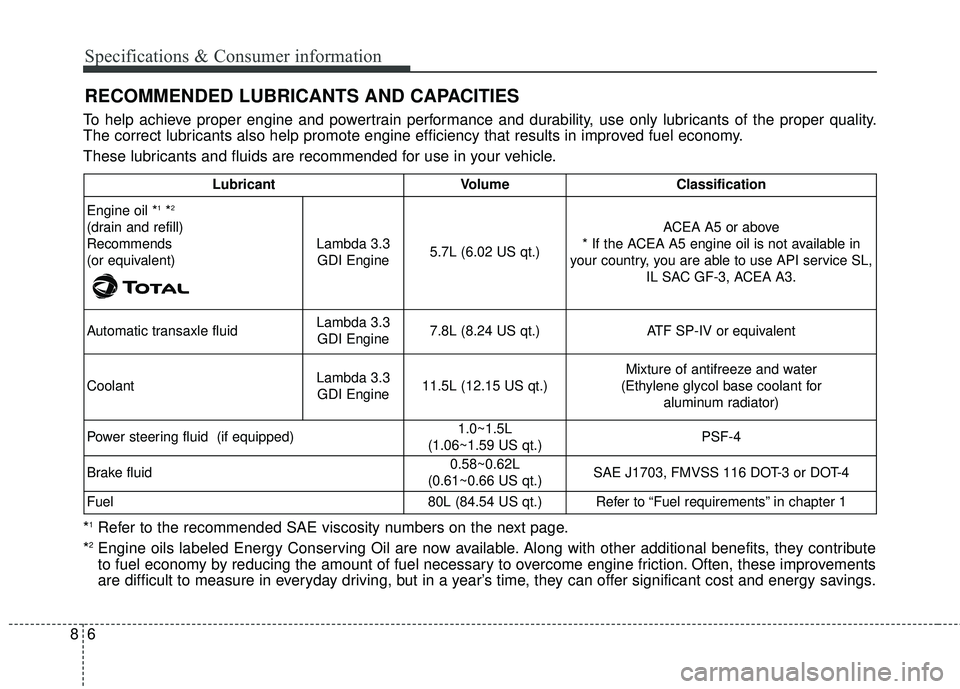
RECOMMENDED LUBRICANTS AND CAPACITIES
To help achieve proper engine and powertrain performance and durability, use only lubricants of the proper quality.
The correct lubricants also help promote engine efficiency that results in improved fuel economy.
These lubricants and fluids are recommended for use in your vehicle.
*
1Refer to the recommended SAE viscosity numbers on the next page.
*2Engine oils labeled Energy Conserving Oil are now available. Along with other additional benefits, they contribute
to fuel economy by reducing the amount of fuel necessary to overcome engine friction. Often, these improvements
are difficult to measure in everyday driving, but in a year’s time, they can offer significant cost and energy savings.
Lubricant Volume Classification
Engine oil *
1*2
(drain and refill)
Recommends
(or equivalent) Lambda 3.3
GDI Engine 5.7L (6.02 US qt.) ACEA A5 or above
* If the ACEA A5 engine oil is not available in
your country, you are able to use API service SL, IL SAC GF-3, ACEA A3.
Automatic transaxle fluid Lambda 3.3
GDI Engine 7.8L (8.24 US qt.) ATF SP-IV or equivalent
Coolant Lambda 3.3
GDI Engine 11.5L (12.15 US qt.) Mixture of antifreeze and water
(Ethylene glycol base coolant for aluminum radiator)
Power steering fluid (if equipped) 1.0~1.5L
(1.06~1.59 US qt.) PSF-4
Brake fluid 0.58~0.62L
(0.61~0.66 US qt.) SAE J1703, FMVSS 116 DOT-3 or DOT-4
Fuel 80L (84.54 US qt.) Refer to “Fuel requirements” in chapter 1
Page 574 of 586
Recommended SAE viscosity
number
Always be sure to clean the area
around any filler plug, drain plug, or
dipstick before checking or draining
any lubricant. This is especially
important in dusty or sandy areas
and when the vehicle is used on
unpaved roads. Cleaning the plug
and dipstick areas will prevent dirt
and grit from entering the engine and
other mechanisms that could be
damaged.Engine oil viscosity (thickness) has
an effect on fuel economy and cold
weather operating (engine start and
engine oil flowability). Lower viscosi-
ty engine oils can provide better fuel
economy and cold weather perform-
ance, however, higher viscosity
engine oils are required for satisfac-
tory lubrication in hot weather.
Using oils of any viscosity other than
those recommended could result in
engine damage.
When choosing an oil, consider the
range of temperature your vehicle
will be operated in before the next oil
change.
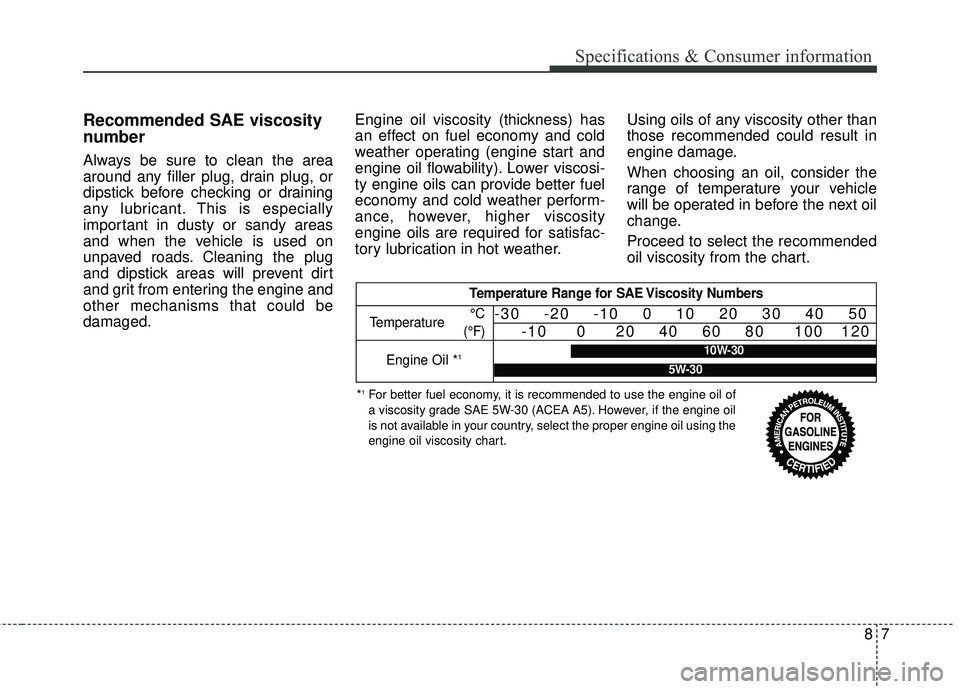
Proceed to select the recommended
oil viscosity from the chart.
Temperature Range for SAE Viscosity Numbers
Temperature
Engine Oil *
1
°C
(°F)-30 -20 -10 0 10 20 30 40 50 -10 0 20 40 60 80 100 120
*1For better fuel economy, it is recommended to use the engine oil of
a viscosity grade SAE 5W-30 (ACEA A5). However, if the engine oil
is not available in your country, select the proper engine oil using the
engine oil viscosity chart.
10W-30
5W-30
87
Specifications & Consumer information
Page 583 of 586
I7
Index
Owner maintenance . . . . . . . . . . . . . . . . . . . . . . . . . . . . 7-6Owner maintenance schedule . . . . . . . . . . . . . . . . . . 7-6
Parking assist system . . . . . . . . . . . . . . . . . . . . . . . . . 4-125 Non-operational conditions of parking assistsystem. . . . . . . . . . . . . . . . . . . . . . . . . . . . . . . . . . 4-12\
7
Operation of the parking assist system . . . . . . . . . 4-125
Self-diagnosis . . . . . . . . . . . . . . . . . . . . . . . . . . . . . 4-128
Parking brake . . . . . . . . . . . . . . . . . . . . . . . . . . . . . . . . 7-37 Checking the parking brake . . . . . . . . . . . . . . . . . . . 7-37
Power sliding door and power tailgate . . . . . . . . . . . . . 4-34 Automatic stop and reversal . . . . . . . . . . . . . . . . . . . 4-36
Emergency tailgate safety release . . . . . . . . . . . . . . 4-45
How to reset the power sliding door and powertailgate . . . . . . . . . . . . . . . . . . . . . . . . . . . . . . . . . . 4-36\
Power door ON/OFF button . . . . . . . . . . . . . . . . . . . 4-37
Power sliding door operation . . . . . . . . . . . . . . . . . . 4-38
Power tailgate non-opening conditions . . . . . . . . . . 4-44
Power tailgate opening height user setting . . . . . . . 4-44
Power tailgate operation . . . . . . . . . . . . . . . . . . . . . . 4-42
Smart Tailgate. . . . . . . . . . . . . . . . . . . . . . . . . . . . . . 4-46
Power steering fluid . . . . . . . . . . . . . . . . . . . . . . . . . . . 7-36 Checking the power steering fluid level . . . . . . . . . 7-36
Checking the power steering hose . . . . . . . . . . . . . . 7-36 Rear parking assist system . . . . . . . . . . . . . . . . . . . . . 4-121
Non-operational conditions of rear parkingassist system . . . . . . . . . . . . . . . . . . . . . . . . . . . . . 4-122
Operation of the rear parking assist system . . . . . . 4-121
Rear parking assist system precautions . . . . . . . . . 4-123
Self-diagnosis . . . . . . . . . . . . . . . . . . . . . . . . . . . . . 4-124
Rearview camera. . . . . . . . . . . . . . . . . . . . . . . . . . . . . 4-129
Recommended lubricants and capacities . . . . . . . . . . . . 8-6 Recommended SAE viscosity number. . . . . . . . . . . . 8-7
Road warning . . . . . . . . . . . . . . . . . . . . . . . . . . . . . . . . . 6-2 Hazard warning flasher . . . . . . . . . . . . . . . . . . . . . . . 6-2
Scheduled maintenance service . . . . . . . . . . . . . . . . . . . 7-8
Seat belts . . . . . . . . . . . . . . . . . . . . . . . . . . . . . . . . . . . . \
3-34 Care of seat belts . . . . . . . . . . . . . . . . . . . . . . . . . . . 3-50
Pre-tensioner seat belt . . . . . . . . . . . . . . . . . . . . . . . 3-45
Seat belt precautions . . . . . . . . . . . . . . . . . . . . . . . . 3-47
Seat belt restraint system . . . . . . . . . . . . . . . . . . . . . 3-34
Seats . . . . . . . . . . . . . . . . . . . . . . . . . . . . . . . . . . . . \
. . . . 3-2 Driver position memory system (for power seat) . . 3-10
Front seat adjustment - manual . . . . . . . . . . . . . . . . . 3-6
Front seat adjustment - power . . . . . . . . . . . . . . . . . . 3-8
Headrest (for front seat) . . . . . . . . . . . . . . . . . . . . . . 3-12
Headrest (for rear seat). . . . . . . . . . . . . . . . . . . . . . . 3-30
O
P
R
S