2017 KIA SEDONA trailer
[x] Cancel search: trailerPage 445 of 586
5101
Driving your vehicle
Cargo capacity:
The cargo capacity of your vehicle
will increase or decrease depending
on the weight and the number of
occupants and the tongue load, if
your vehicle is equipped with a trailer.
Steps for determining correctload limit
1.Locate the statement "The com- bined weight of occupants and
cargo should never exceed XXX kg
or XXX lbs.'' on your vehicle's plac-
ard.
2.Determine the combined weight of the driver and passengers that will
be riding in your vehicle.
3.Subtract the combined weight of the driver and passengers from
XXX kg or XXX lbs.
4. The resulting figure equals the available amount of cargo and lug-
gage load capacity. For example, if
the "XXX" amount equals 635 kg
(1400 lbs.) and there will be five
68 kg (150 lbs.) passengers in
your vehicle, the amount of avail-
able cargo and luggage load
capacity is 295 kg (650 lbs).
(635-340 (5 x 68) = 295 kg or
1400-750 (5 x 150) = 650 lbs.) 5.Determine the combined weight of
luggage and cargo being loaded
on the vehicle. That weight may not
safely exceed the available cargo
and luggage load capacity calcu-
lated in Step 4.
6.If your vehicle will be towing a trail- er, load from your trailer will be
transferred to your vehicle. Consult
this manual to determine how this
reduces the available cargo and
luggage load capacity of your vehi-
cle.
Page 449 of 586
5105
Driving your vehicle
This section will guide you in the
proper loading of your vehicle and/or
trailer, to keep your loaded vehicle
weight within its design rating capa-
bility, with or without a trailer.
Properly loading your vehicle will
provide maximum return of the vehi-
cle design performance. Before load-
ing your vehicle, familiarize yourself
with the following terms for determin-
ing your vehicle's weight ratings, with
or without a trailer, from the vehicle's
specifications and the certification
label:
Base curb weight
This is the weight of the vehicle
including a full tank of fuel and all
standard equipment. It does not
include passengers, cargo, or option-
al equipment.
Vehicle curb weight
This is the weight of your new vehicle
when you picked it up from your deal-
er plus any aftermarket equipment.
Cargo weight
This figure includes all weight added
to the Base Curb Weight, including
cargo and optional equipment.
GAW (Gross axle weight)
This is the total weight placed on
each axle (front and rear) - including
vehicle curb weight and all payload.
GAWR
(Gross axle weight rating)
This is the maximum allowable
weight that can be carried by a single
axle (front or rear). These numbers
are shown on the certification label.
The total load on each axle must
never exceed its GAWR.
GVW (Gross vehicle weight)
This is the Base Curb Weight plus
actual Cargo Weight plus passen-
gers.
GVWR
(Gross vehicle weight rating)
This is the maximum allowable
weight of the fully loaded vehicle
(including all options, equipment,
passengers and cargo). The GVWR
is shown on the certification label
located on the driver’s door sill.
VEHICLE WEIGHT GLOSSARY
Page 465 of 586
What to do in an emergency
16
6
When using a compact spare tire,
observe the following precautions:
Under no circumstances should
you exceed 80 km/h (50 mph); a
higher speed could damage the
tire.
Ensure that you drive slowly enough for the road conditions to
avoid all hazards. Any road hazard,
such as a pothole or debris, could
seriously damage the compact
spare.
Any continuous road use of this tire could result in tire failure, loss of
vehicle control, and possible per-
sonal injury.
Do not exceed the vehicle’s maxi- mum load rating or the load-carry-
ing capacity shown on the sidewall
of the compact spare tire.
Avoid driving over obstacles. The compact spare tire diameter is
smaller than the diameter of a con-
ventional tire and reduces the
ground clearance approximately
25 mm (1 inch), which could result
in damage to the vehicle. Do not take this vehicle through an
automatic vehicle wash while the
compact spare tire is installed.
Do not use the compact spare tire on any other vehicle because this
tire has been designed especially
for your vehicle.
The compact spare tire’s tread life is shorter than a regular tire.
Inspect your compact spare tire
regularly and replace worn com-
pact spare tires with the same size
and design, mounted on the same
wheel.
The compact spare tire should not be used on any other wheels, nor
should standard tires, snow tires,
wheel covers or trim rings be used
with the compact spare wheel. If
such use is attempted, damage to
these items or other vehicle com-
ponents may occur.
Do not use more than one compact spare tire at a time.
Do not tow a trailer while the com- pact spare tire is installed.
Page 467 of 586

What to do in an emergency
18
6
TOWING
Towing service
If emergency towing is necessary,
we recommend having it done by an
authorized Kia dealer or a commer-
cial tow-truck service. Proper lifting
and towing procedures are neces-
sary to prevent damage to the vehi-
cle. The use of wheel dollies or
flatbed is recommended.
For trailer towing guidelines informa-
tion, refer to “Trailer towing” in sec-tion 5.
It is acceptable to tow the vehicle
with the rear wheels on the ground
(without dollies) and the front wheels
off the ground.
If any of the loaded wheels or sus-
pension components are damaged
or the vehicle is being towed with the
front wheels on the ground, use a
towing dolly under the front wheels.
When being towed by a commercial
tow truck and wheel dollies are not
used, the front of the vehicle should
always be lifted, not the rear.
OYP064024N dolly
dolly
WARNING - Side and
curtain Air bag
If your vehicle is equipped with
side and curtain air bag, set the
ignition switch to LOCK or ACC
position when the vehicle is
being towed.
The side and curtain air bag
may deploy when the ignitions
is ON, and the rollover sensor
detects the situation as a
rollover.
Page 478 of 586
Maintenance
87
SCHEDULED MAINTENANCE SERVICE
Follow the Normal Maintenance Schedule if the vehicle is usually operated where none of the following conditions
apply. If any of the following conditions apply, follow the Maintenance Under Severe Usage Conditions.
Repeated driving short distance of less than 8 km (5 miles) in normal temperature or less than 16 km(10 miles) infreezing temperature
Extensive engine idling or low speed driving for long distances
Driving on rough, dusty, muddy, unpaved, graveled or salt-spread roads
Driving in areas using salt or other corrosive materials or in very cold weather
Driving in heavy dust condition
Driving in heavy traffic area
Driving on uphill, downhill, or mountain road repeatedly
Towing a trailer or using a camper, or roof rack
Driving as a patrol car, taxi, other commercial use of vehicle towing
Driving over 170 km/h (106 mph)
Frequently driving in stop-and-go condition
If your vehicle is operated under the above conditions, you should inspect, replace or refill more frequently than the following Normal Maintenance Schedule. After 120 months or 240,000 km (150,000 miles) continue to follow the pre-scribed maintenance intervals.
Page 495 of 586
725
Maintenance
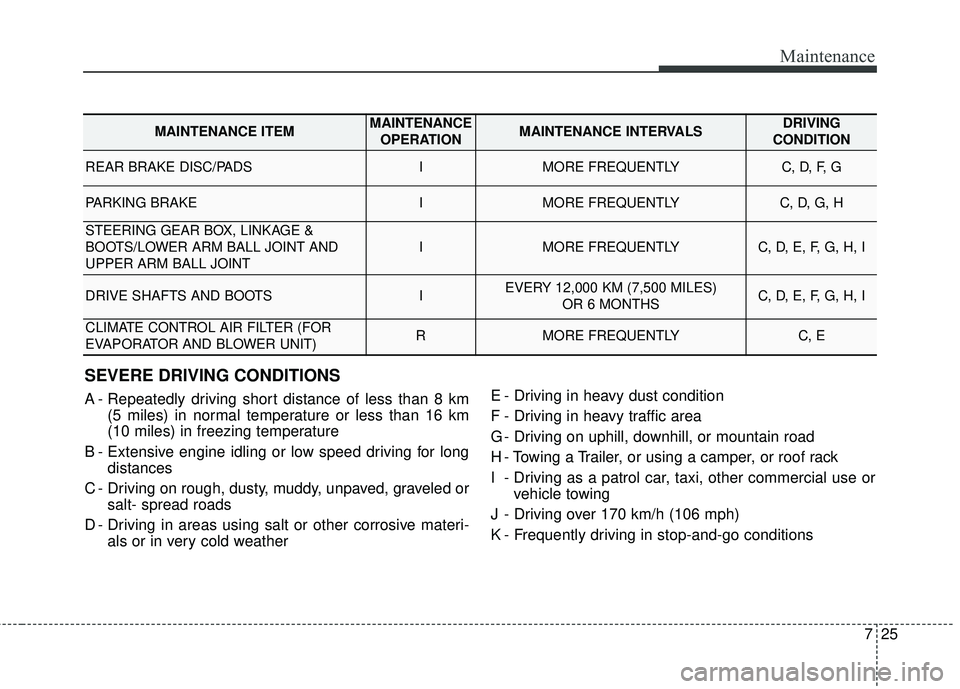
SEVERE DRIVING CONDITIONS
A - Repeatedly driving short distance of less than 8 km(5 miles) in normal temperature or less than 16 km
(10 miles) in freezing temperature
B - Extensive engine idling or low speed driving for long distances
C - Driving on rough, dusty, muddy, unpaved, graveled or salt- spread roads
D - Driving in areas using salt or other corrosive materi- als or in very cold weather E - Driving in heavy dust condition
F - Driving in heavy traffic area
G - Driving on uphill, downhill, or mountain road
H - Towing a Trailer, or using a camper, or roof rack
I - Driving as a patrol car, taxi, other commercial use or
vehicle towing
J - Driving over 170 km/h (106 mph)
K - Frequently driving in stop-and-go conditions
MAINTENANCE ITEMMAINTENANCE OPERATIONMAINTENANCE INTERVALSDRIVING
CONDITION
REAR BRAKE DISC/PADSIMORE FREQUENTLYC, D, F, G
PARKING BRAKEIMORE FREQUENTLYC, D, G, H
STEERING GEAR BOX, LINKAGE &
BOOTS/LOWER ARM BALL JOINT AND
UPPER ARM BALL JOINT
IMORE FREQUENTLYC, D, E, F, G, H, I
DRIVE SHAFTS AND BOOTSIEVERY 12,000 KM (7,500 MILES) OR 6 MONTHSC, D, E, F, G, H, I
CLIMATE CONTROL AIR FILTER (FOR
EVAPORATOR AND BLOWER UNIT)RMORE FREQUENTLYC, E
Page 542 of 586

Maintenance
72
7
Engine compartment fuse panel
Fuse Name Fuse rating Circuit Protected
ABS1 40A ESC Module, Multipurpose Check Connector
ABS2 40A ESC Module
INVERTER 30A AC Inverter Unit
IDB 15A Injector Drive Box
S/HEATER RR 25A Rear Seat Heater Control Module
FOG LAMP FRONT 15A Fog Lamp Front Relay P/SEAT (PASS) 30A Passenger Manual Switch
COOLING FAN1 60A Cooling Fna1 Relay
COOLING FAN2 50A Cooling Fna2 Relay B+4 50A Smart Junction Block (IPS Control Module, IPS3, IPS4, IPS5, IPS6, Fuse - MODULE7)
POWER TAIL GATE 40A Power Tail Gate Module B+2 50A Smart Junction Block (Leak Current Autocut Device, Fuse - P/SEAT DRV, P/WDW RH)
IG1 40A With Smart Key : PDM1/2 Relay, W/O Smart Key : Ignition Switch
IG2 40A Start Relay, With Smart Key : PDM3 Relay, W/O Smart Key : Ignition Switch,
B+1 50A Smart Junction Block (IPS Control Module, Fuse - P/WDW LH, S/HEATER FRT, DR LOCK)
TRAILER 30A Trailer Power Outlet
B+5 50ASmart Junction Block (Motor Driver, Power Outlet Relay, Fuse - S/ROOF FRT, S/ROOF RR, BRAKE
SWITCH, SMART KEY1, SMART KEY3, AMP)
PSD1 40A Power Sliding Door Module
PSD2 40A Power Sliding Door Module
B+3 50A Smart Junction Block (IPS Control Module, IPS1, IPS2)
MDPS 125A MDPS Unit (Rack)
Page 585 of 586
I9
Index
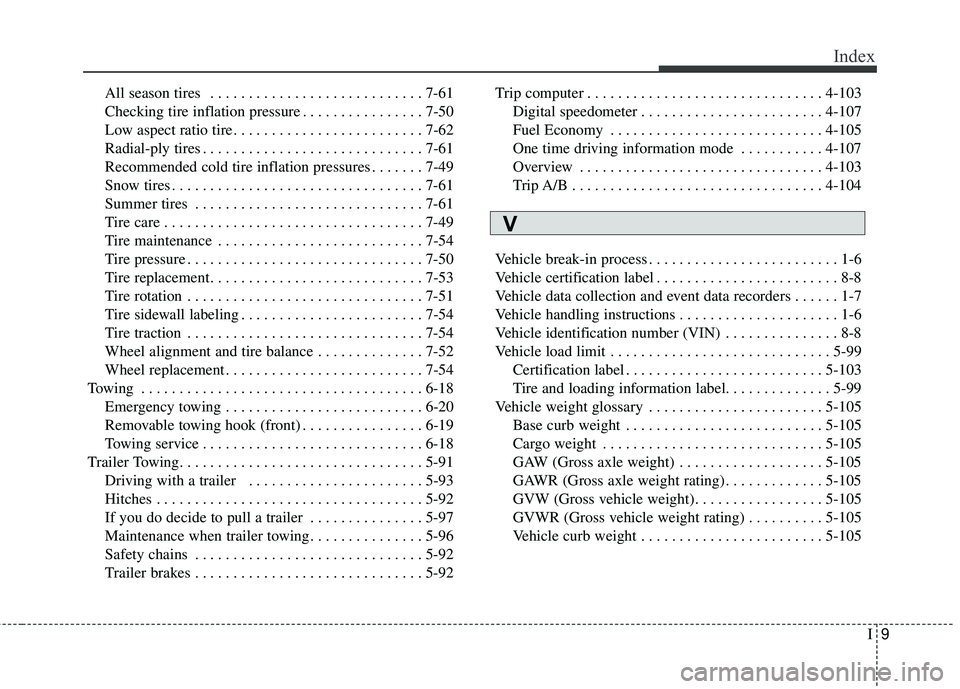
All season tires . . . . . . . . . . . . . . . . . . . . . . . . . . . . 7-61
Checking tire inflation pressure . . . . . . . . . . . . . . . . 7-50
Low aspect ratio tire. . . . . . . . . . . . . . . . . . . . . . . . . 7-62
Radial-ply tires . . . . . . . . . . . . . . . . . . . . . . . . . . . . . 7-61
Recommended cold tire inflation pressures . . . . . . . 7-49
Snow tires . . . . . . . . . . . . . . . . . . . . . . . . . . . . . . . . . 7-61
Summer tires . . . . . . . . . . . . . . . . . . . . . . . . . . . . . . 7-61
Tire care . . . . . . . . . . . . . . . . . . . . . . . . . . . . . . . . . . 7-49\
Tire maintenance . . . . . . . . . . . . . . . . . . . . . . . . . . . 7-54
Tire pressure . . . . . . . . . . . . . . . . . . . . . . . . . . . . . . . 7-50
Tire replacement . . . . . . . . . . . . . . . . . . . . . . . . . . . . 7-53
Tire rotation . . . . . . . . . . . . . . . . . . . . . . . . . . . . . . . 7-51
Tire sidewall labeling . . . . . . . . . . . . . . . . . . . . . . . . 7-54
Tire traction . . . . . . . . . . . . . . . . . . . . . . . . . . . . . . . 7-54
Wheel alignment and tire balance . . . . . . . . . . . . . . 7-52
Wheel replacement . . . . . . . . . . . . . . . . . . . . . . . . . . 7-54
Towing . . . . . . . . . . . . . . . . . . . . . . . . . . . . . . . . . . . . \
. 6-18 Emergency towing . . . . . . . . . . . . . . . . . . . . . . . . . . 6-20
Removable towing hook (front) . . . . . . . . . . . . . . . . 6-19
Towing service . . . . . . . . . . . . . . . . . . . . . . . . . . . . . 6-18
Trailer Towing. . . . . . . . . . . . . . . . . . . . . . . . . . . . . . . . 5-91 Driving with a trailer . . . . . . . . . . . . . . . . . . . . . . . 5-93
Hitches . . . . . . . . . . . . . . . . . . . . . . . . . . . . . . . . . . . 5-\
92
If you do decide to pull a trailer . . . . . . . . . . . . . . . 5-97
Maintenance when trailer towing . . . . . . . . . . . . . . . 5-96
Safety chains . . . . . . . . . . . . . . . . . . . . . . . . . . . . . . 5-92
Trailer brakes . . . . . . . . . . . . . . . . . . . . . . . . . . . . . . 5-92 Trip computer . . . . . . . . . . . . . . . . . . . . . . . . . . . . . . . 4-103
Digital speedometer . . . . . . . . . . . . . . . . . . . . . . . . 4-107
Fuel Economy . . . . . . . . . . . . . . . . . . . . . . . . . . . . 4-105
One time driving information mode . . . . . . . . . . . 4-107
Overview . . . . . . . . . . . . . . . . . . . . . . . . . . . . . . . . 4-103
Trip A/B . . . . . . . . . . . . . . . . . . . . . . . . . . . . . . . . . 4-104
Vehicle break-in process . . . . . . . . . . . . . . . . . . . . . . . . . 1-6
Vehicle certification label . . . . . . . . . . . . . . . . . . . . . . . . 8-8
Vehicle data collection and event data recorders . . . . . . 1-7
Vehicle handling instructions . . . . . . . . . . . . . . . . . . . . . 1-6
Vehicle identification number (VIN) . . . . . . . . . . . . . . . 8-8
Vehicle load limit . . . . . . . . . . . . . . . . . . . . . . . . . . . . . 5-99 Certification label . . . . . . . . . . . . . . . . . . . . . . . . . . 5-103
Tire and loading information label. . . . . . . . . . . . . . 5-99
Vehicle weight glossary . . . . . . . . . . . . . . . . . . . . . . . 5-105 Base curb weight . . . . . . . . . . . . . . . . . . . . . . . . . . 5-105
Cargo weight . . . . . . . . . . . . . . . . . . . . . . . . . . . . . 5-105
GAW (Gross axle weight) . . . . . . . . . . . . . . . . . . . 5-105
GAWR (Gross axle weight rating) . . . . . . . . . . . . . 5-105
GVW (Gross vehicle weight). . . . . . . . . . . . . . . . . 5-105
GVWR (Gross vehicle weight rating) . . . . . . . . . . 5-105
Vehicle curb weight . . . . . . . . . . . . . . . . . . . . . . . . 5-105
V