Page 437 of 449
87
Specifications, Consumer information, Reporting safety defects
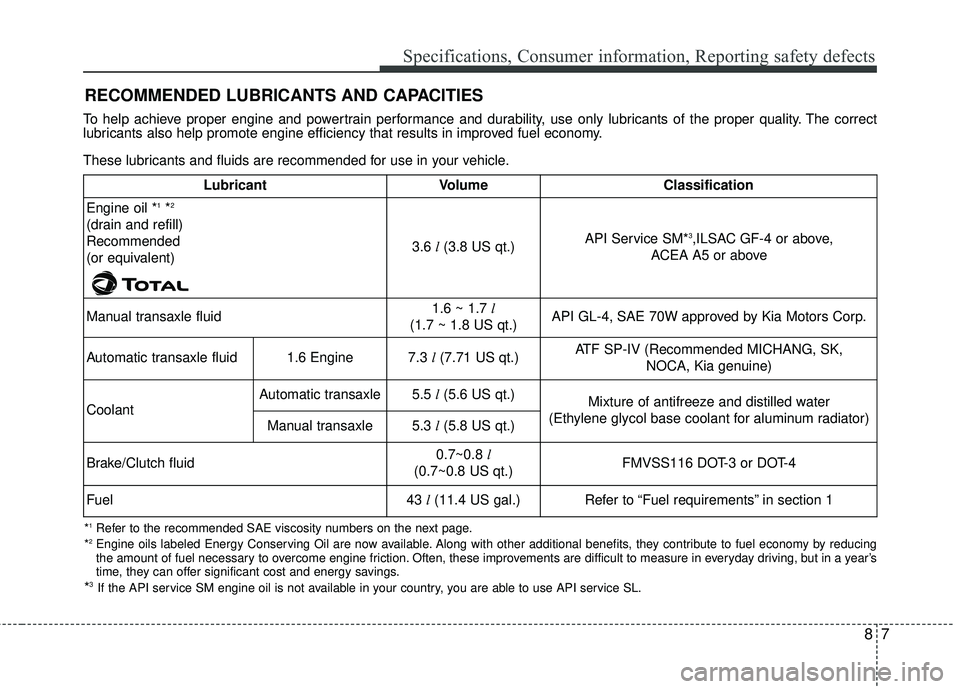
RECOMMENDED LUBRICANTS AND CAPACITIES
To help achieve proper engine and powertrain performance and durability, use only lubricants of the proper quality. The correct
lubricants also help promote engine efficiency that results in improved fuel economy.
These lubricants and fluids are recommended for use in your vehicle.
*1Refer to the recommended SAE viscosity numbers on the next page.
*2Engine oils labeled Energy Conserving Oil are now available. Along with other additional benefits, they contribute to fuel econo my by reducing
the amount of fuel necessary to overcome engine friction. Often, these improvements are difficult to measure in everyday driving, but in a year’s
time, they can offer significant cost and energy savings.
*3If the API service SM engine oil is not available in your country, you are able to use API service SL.
LubricantVolume Classification
Engine oil *
1*2
(drain and refill)
Recommended
(or equivalent)
3.6 l(3.8 US qt.) API Service SM*3,ILSAC GF-4 or above,
ACEA A5 or above
Manual transaxle fluid
1.6 ~ 1.7 l
(1.7 ~ 1.8 US qt.) API GL-4, SAE 70W approved by Kia Motors Corp.
Automatic transaxle fluid 1.6 Engine
7.3 l(7.71 US qt.) ATF SP-IV (Recommended MICHANG, SK,
NOCA, Kia genuine)
Coolant Automatic transaxle
5.5
l(5.6 US qt.)
Mixture of antifreeze and distilled water
(Ethylene glycol base coolant for aluminum radiator)
Manual transaxle
5.3 l(5.8 US qt.)
Brake/Clutch fluid
0.7~0.8 l
(0.7~0.8 US qt.) FMVSS116 DOT-3 or DOT-4
Fuel
43 l(11.4 US gal.)
Refer to “Fuel requirements” in section 1
Page 438 of 449

Specifications, Consumer information, Reporting safety defects
88
Recommended SAE viscosity
number
Always be sure to clean the area around
any filler plug, drain plug, or dipstick
before checking or draining any lubricant.
This is especially important in dusty or
sandy areas and when the vehicle is
used on unpaved roads. Cleaning the
plug and dipstick areas will prevent dirt
and grit from entering the engine and
other mechanisms that could be dam-
aged.Engine oil viscosity (thickness) has an
effect on fuel economy and cold weather
operation (engine start and engine oil
flowability). Lower viscosity engine oils
can provide better fuel economy and cold
weather performance, however, higher
viscosity engine oils are required for sat-
isfactory lubrication in hot weather. Using
oils of any viscosity other than those rec-
ommended could result in engine dam-
age.
When choosing an oil, consider the range
of temperature your vehicle will be oper-
ated in before the next oil change.
Proceed to select the recommended oil
viscosity from the chart.
Temperature Range for SAE Viscosity Numbers
Temperature
Gasoline
Engine Oil *
1
°C
(°F)-30 -20 -10 0 10 20 30 40 50 -10 0 20 40 60 80 100 120
1. For better fuel economy, it is recommended to use the engine oil of
a viscosity grade SAE 5W-20 (API SM / ILSAC GF-4). However, if
the engine oil is not available in your country, select the proper
engine oil using the engine oil viscosity chart.
10W-30
5W-20, 5W-30
Page 446 of 449

Index
6I
Interior light bulb replacement ··················\
··················\
7-85
Interior light bulb replacement ··················\
··················\
7-85
License plate light bulb replacement ··················\
········7-84
Rear combination light bulb replacement ··················\
·7-79
Side repeater light bulb replacement ··················\
········7-78
Lights ··················\
··················\
··················\
··················\
·····4-73 Battery saver function··················\
··················\
··············4-73
Daytime running light ··················\
··················\
·············4-73
Front fog light··················\
··················\
··················\
········4-76
High beam operation ··················\
··················\
··············4-75
Lighting control ··················\
··················\
··················\
·····4-73
Turn signals and lane change signals ··················\
········4-76
Maintenance services ··················\
··················\
··················\
·7-3 Owner maintenance precautions ··················\
·················7-4
Owner’s responsibility ··················\
··················\
·············7-3
Manual climate control system··················\
··················\
··4-84 Checking the amount of air conditioner refrigerant andcompressor lubricant ··················\
··················\
·············4-93
Climate control air filter ··················\
··················\
··········4-92
Heating and air conditioning ··················\
··················\
···4-85
System operation ··················\
··················\
··················\
···4-90
Manual Transaxle··················\
··················\
··················\
·····5-13 Good driving practices ··················\
··················\
············5-15
Manual transaxle operation ··················\
··················\
·····5-13 Mirrors ··················\
··················\
··················\
··················\
···4-40
Inside rearview mirror ··················\
··················\
·············4-40
Outside rearview mirror ··················\
··················\
··········4-40
Owner maintenance ··················\
··················\
··················\
···7-5 Owner maintenance schedule ··················\
··················\
····7-5
Parking brake ··················\
··················\
··················\
···········7-41 Checking the parking brake··················\
··················\
·····7-41
Rear-Camera Display··················\
··················\
·················4-71\
Recommended lubricants and capacities ··················\
·······8-7 Recommended SAE viscosity number ··················\
········8-7
Remote keyless entry ··················\
··················\
··················\
·4-8 Battery replacement ··················\
··················\
·················4-10\
Immobilizer system ··················\
··················\
·················4-11\
Limp home (override) procedure ··················\
··············4-12
Remote keyless entry system operations··················\
·····4-8
Transmitter precautions ··················\
··················\
·············4-9
Road warning ··················\
··················\
··················\
·············6-2 Hazard warning flasher ··················\
··················\
·············6-2
M
O
P
R