2017 KIA RIO water
[x] Cancel search: waterPage 373 of 449
737
Maintenance
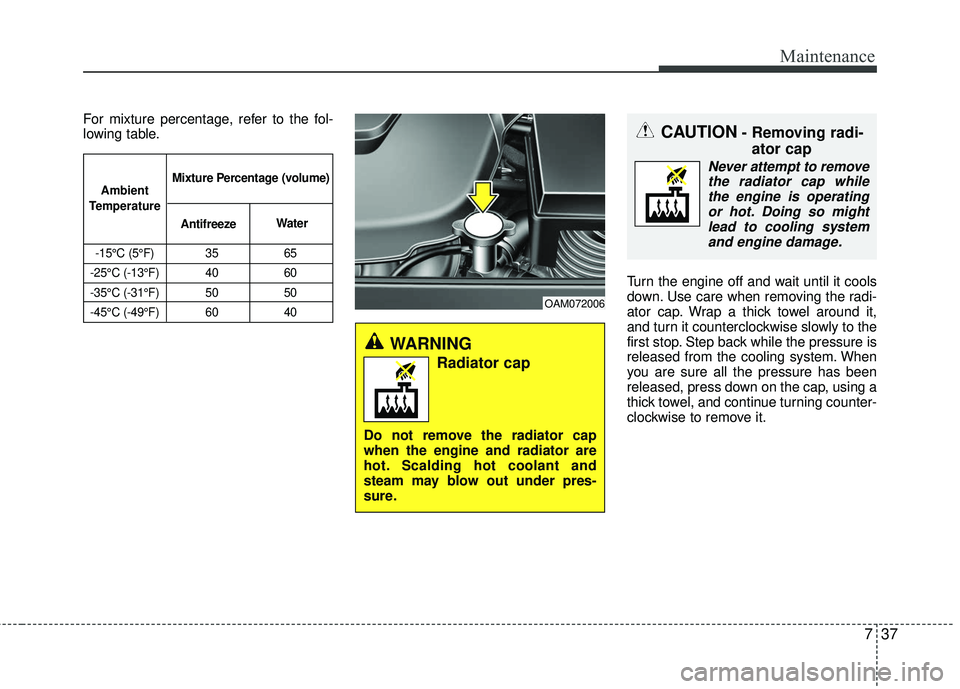
For mixture percentage, refer to the fol-
lowing table.Turn the engine off and wait until it cools
down. Use care when removing the radi-
ator cap. Wrap a thick towel around it,
and turn it counterclockwise slowly to the
first stop. Step back while the pressure is
released from the cooling system. When
you are sure all the pressure has been
released, press down on the cap, using a
thick towel, and continue turning counter-
clockwise to remove it.
-15°C (5°F) 3565
-25°C (-13°F) 40 60
-35°C (-31°F) 50 50
-45°C (-49°F) 60 40
Ambient
Temperature Mixture Percentage (volume)
Antifreeze Water
WARNING
Radiator cap
Do not remove the radiator cap
when the engine and radiator are
hot. Scalding hot coolant and
steam may blow out under pres-
sure.
OAM072006
CAUTION- Removing radi-
ator cap
Never attempt to remove
the radiator cap while the engine is operatingor hot. Doing so mightlead to cooling systemand engine damage.
Page 375 of 449

739
Maintenance
BRAKE/CLUTCH (IF EQUIPPED) FLUID
Checking the brake/clutch* fluid
level
Check the fluid level in the reservoir peri-
odically. The fluid level should be
between MAX and MIN marks on the
side of the reservoir.
Before removing the reservoir cap and
adding brake/clutch* fluid, clean the area
around the reservoir cap thoroughly to
prevent brake/clutch* fluid contamina-
tion.
* if equippedIf the level is low, add fluid to the MAX
level. The level will fall with accumulated
mileage. This is a normal condition asso-
ciated with the wear of the brake linings
and/or clutch disc (if equipped). If the
fluid level is excessively low, have the
brake/clutch* system checked by an
authorized Kia dealer.
Use only the specified brake/clutch* fluid.
(Refer to “Recommended lubricants and capacities” in section 8.)
Never mix different types of fluid.
In the event the brake/clutch* system
requires frequent additions of fluid, the
vehicle should be inspected by an
authorized Kia dealer. When changing and adding brake/clutch*
fluid, handle it carefully. Do not let it come
in contact with your eyes. If brake/clutch*
fluid should come in contact with your
eyes, immediately flush them with a large
quantity of fresh tap water. Have your
eyes examined by a doctor as soon as
possible.
Brake/clutch* fluid, which has been
exposed to open air for an extended time
should never be used as its quality can-
not be guaranteed. It should be disposed
of properly.
CAUTION - Brake/clutch
fluid
Do not allow brake/clutch* fluid to
contact the vehicle's body paint, aspaint damage will result.
CAUTION - Proper fluid
Only use brake/clutch fluid in brake/clutch system. Smallamounts of improper fluids (suchas engine oil) can cause damage tothe brake/clutch system.
OUB071007
Page 376 of 449
Maintenance
40
7
It is recommended that the automatic
transaxle fluid should be checked by an
authorized Kia dealer.
In severe conditions, the fluid should be
changed at an authorized Kia dealer in
accordance to the scheduled mainte-
nance at the beginning of this chapter.
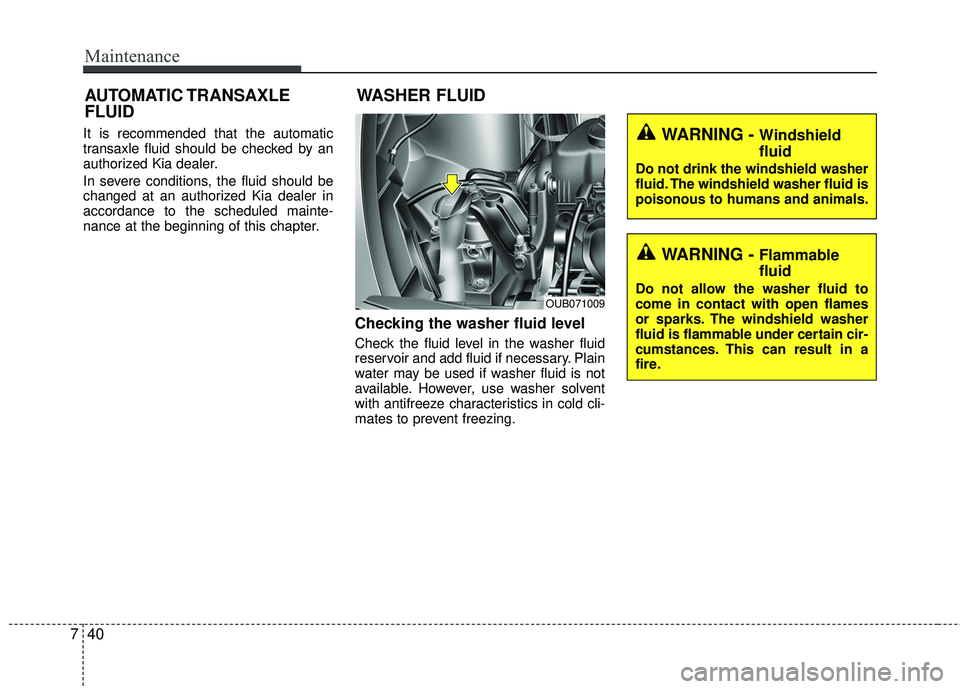
Checking the washer fluid level
Check the fluid level in the washer fluid
reservoir and add fluid if necessary. Plain
water may be used if washer fluid is not
available. However, use washer solvent
with antifreeze characteristics in cold cli-
mates to prevent freezing.
WARNING - Windshield
fluid
Do not drink the windshield washer
fluid. The windshield washer fluid is
poisonous to humans and animals.
WARNING - Flammable
fluid
Do not allow the washer fluid to
come in contact with open flames
or sparks. The windshield washer
fluid is flammable under certain cir-
cumstances. This can result in a
fire.
WASHER FLUID
AUTOMATIC TRANSAXLE
FLUID
OUB071009
Page 378 of 449
Maintenance
42
7
Filter inspection
The climate control air filter should be
replaced according to the Maintenance
Schedule. If the vehicle is operated in
severely air-polluted cities or on dusty
rough roads for a long period, it should
be inspected more frequently and
replaced earlier. When you replace the
climate control air filter, replace it per-
forming the following procedure, and be
careful to avoid damaging other compo-
nents.
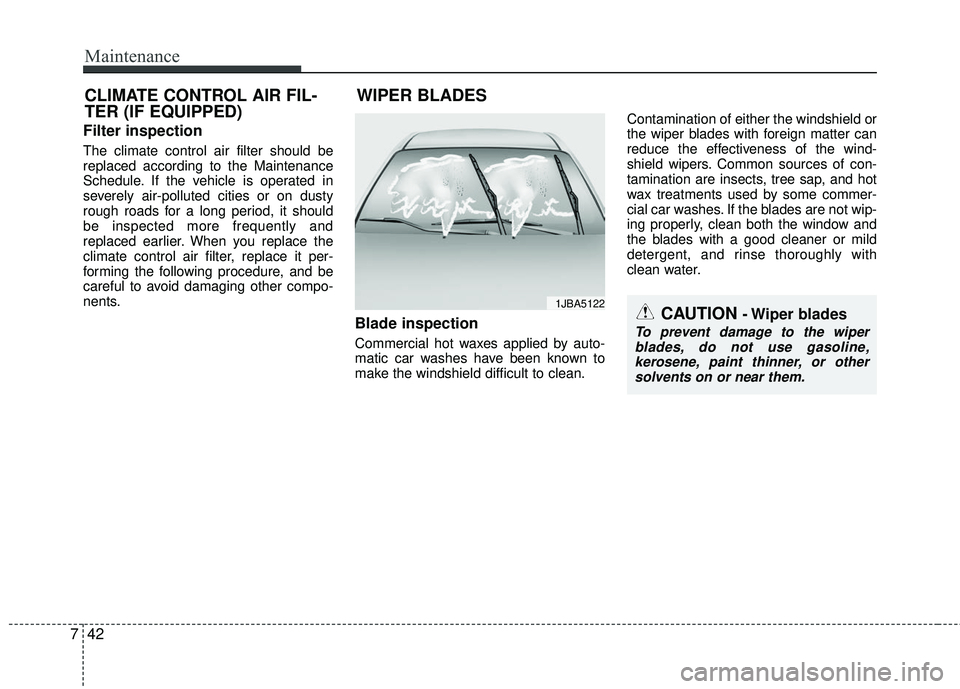
Blade inspection
Commercial hot waxes applied by auto-
matic car washes have been known to
make the windshield difficult to clean. Contamination of either the windshield or
the wiper blades with foreign matter can
reduce the effectiveness of the wind-
shield wipers. Common sources of con-
tamination are insects, tree sap, and hot
wax treatments used by some commer-
cial car washes. If the blades are not wip-
ing properly, clean both the window and
the blades with a good cleaner or mild
detergent, and rinse thoroughly with
clean water.
CLIMATE CONTROL AIR FIL-
TER (IF EQUIPPED)
WIPER BLADES
1JBA5122CAUTION - Wiper blades
To prevent damage to the wiper
blades, do not use gasoline,kerosene, paint thinner, or other solvents on or near them.
Page 381 of 449
745
Maintenance
BATTERY
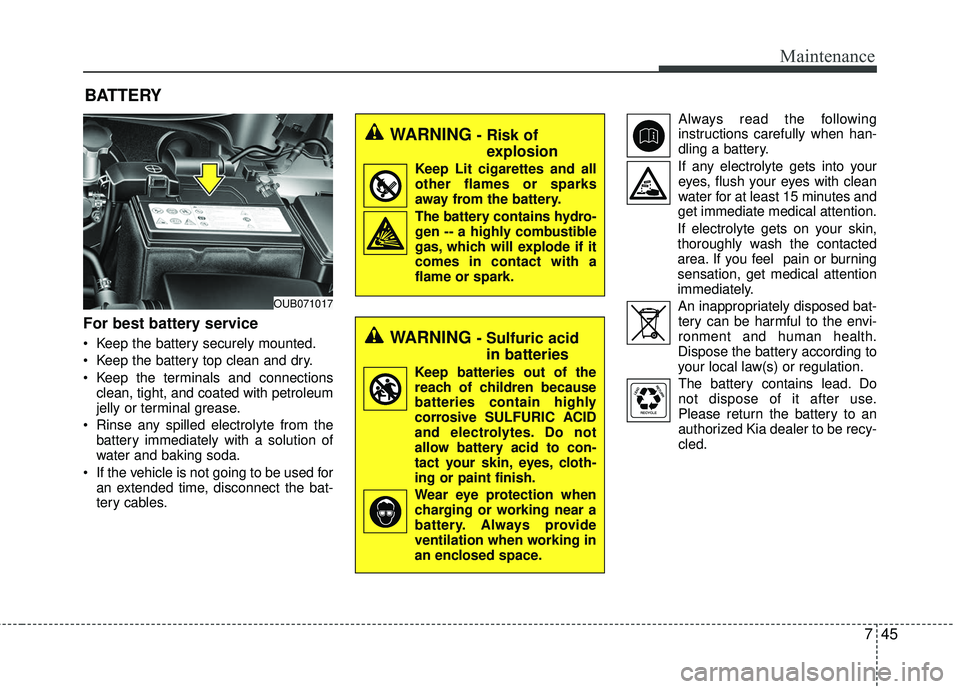
For best battery service
Keep the battery securely mounted.
Keep the battery top clean and dry.
Keep the terminals and connectionsclean, tight, and coated with petroleum
jelly or terminal grease.
Rinse any spilled electrolyte from the battery immediately with a solution of
water and baking soda.
If the vehicle is not going to be used for an extended time, disconnect the bat-
tery cables. Always read the following
instructions carefully when han-
dling a battery.
If any electrolyte gets into your eyes, flush your eyes with clean
water for at least 15 minutes and
get immediate medical attention.
If electrolyte gets on your skin,
thoroughly wash the contacted
area. If you feel pain or burning
sensation, get medical attention
immediately. An inappropriately disposed bat-tery can be harmful to the envi-
ronment and human health.
Dispose the battery according to
your local law(s) or regulation.
The battery contains lead. Do
not dispose of it after use.
Please return the battery to an
authorized Kia dealer to be recy-
cled.
OUB071017
WARNING - Risk of explosion
Keep Lit cigarettes and all
other flames or sparks
away from the battery.
The battery contains hydro-
gen -- a highly combustible
gas, which will explode if it
comes in contact with a
flame or spark.
WARNING - Sulfuric acidin batteries
Keep batteries out of the
reach of children because
batteries contain highly
corrosive SULFURIC ACID
and electrolytes. Do not
allow battery acid to con-
tact your skin, eyes, cloth-
ing or paint finish.
Wear eye protection when charging or working near a
battery. Always provide
ventilation when working in
an enclosed space.
Page 400 of 449

Maintenance
64
7
Engine compartment panel fuse
replacement
1. Turn the ignition switch and all other switches off.
2. Remove the fuse box cover by press- ing the tap and pulling up the cover.
When the blade type fuse is discon-
nected, remove it by using the clip
designed for changing fuses located in
the engine room fuse box. Upon
removal, securely insert reserve fuse
of equal quantity. 3. Check the removed fuse; replace it if it
is blown. To remove or insert the fuse,
use the fuse puller in the engine com-
partment fuse panel.
4. Push in a new fuse of the same rating, and make sure it fits tightly in the clips.
If it fits loosely, consult an authorized
Kia dealer.
Multi fuse
If the multi fuse is blown, consult an
authorized Kia dealer.
OUB071022
CAUTION - Fuse panel covers
After checking the fuse panel in the
engine compartment, securelyinstall the fuse panel cover to pre-vent electrical failures which mayoccur from water leaking in.OUB071023N
Page 422 of 449

Maintenance
86
7
APPEARANCE CARE
Exterior care
Exterior general caution
It is very important to follow the label
directions when using any chemical
cleaner or polish. Read all warning and
caution statements that appear on the
label.
Finish maintenance
Washing
To help protect your vehicle’s finish from
rust and deterioration, wash it thoroughly
and frequently at least once a month with
lukewarm or cold water.
If you use your vehicle for off-road driv-
ing, you should wash it after each off-
road trip. Pay special attention to the
removal of any accumulation of salt, dirt,
mud, and other foreign materials. Make
sure the drain holes in the lower edges of
the doors and rocker panels are kept
clear and clean.
Insects, tar, tree sap, bird droppings,
industrial pollution and similar deposits
can damage your vehicle’s finish if not
removed immediately.
Even prompt washing with plain water
may not completely remove all these
deposits. A mild soap, safe for use on
painted surfaces, may be used.
After washing, rinse the vehicle thor-
oughly with lukewarm or cold water. Do
not allow soap to dry on the finish.
After washing the vehicle, test the brakes
while driving slowly to see if they have
been affected by water. If braking per-
formance is impaired, dry the brakes by
applying them lightly while maintaining a
slow forward speed.
High-pressure washing
When using high-pressure wash-
ers, make sure to maintain suffi-
cient distance from the vehicle.
Insufficient clearance or excessive
pressure can lead to component
damage or water penetration.
Do not spray the camera, sensors or its surrounding area directly with
a high pressure washer. Shock
applied from high pressure water
may cause the device to not oper-
ate normally.
Do not bring the nozzle tip close to boots (rubber or plastic covers) or
connectors as they may be dam-
aged if they come into contact with
high pressure water.
Page 423 of 449
787
Maintenance
Waxing
Wax the vehicle when water will no
longer bead on the paint.
Always wash and dry the vehicle before
waxing. Use a good quality liquid or
paste wax, and follow the manufacturer’s
instructions. Wax all metal trim to protect
it and to maintain its luster.
Removing oil, tar, and similar materials
with a spot remover will usually strip the
wax from the finish. Be sure to re-wax
these areas even if the rest of the vehicle
does not yet need waxing.Finish damage repair
Deep scratches or stone chips in the
painted surface must be repaired
promptly. Exposed metal will quickly rust
and may develop into a major repair
expense.
If your vehicle is damaged and requires
any metal repair or replacement, be sure
the body shop applies anti-corrosion
materials to the parts repaired or
replaced.
Bright-metal maintenance
To remove road tar and insects, use atar remover, not a scraper or other
sharp object.
To protect the surfaces of bright-metal parts from corrosion, apply a coating of
wax or chrome preservative and rub to
a high luster.
During winter weather or in coastal areas, cover the bright metal parts with
a heavier coating of wax or preserva-
tive. If necessary, coat the parts with
non-corrosive petroleum jelly or other
protective compound.
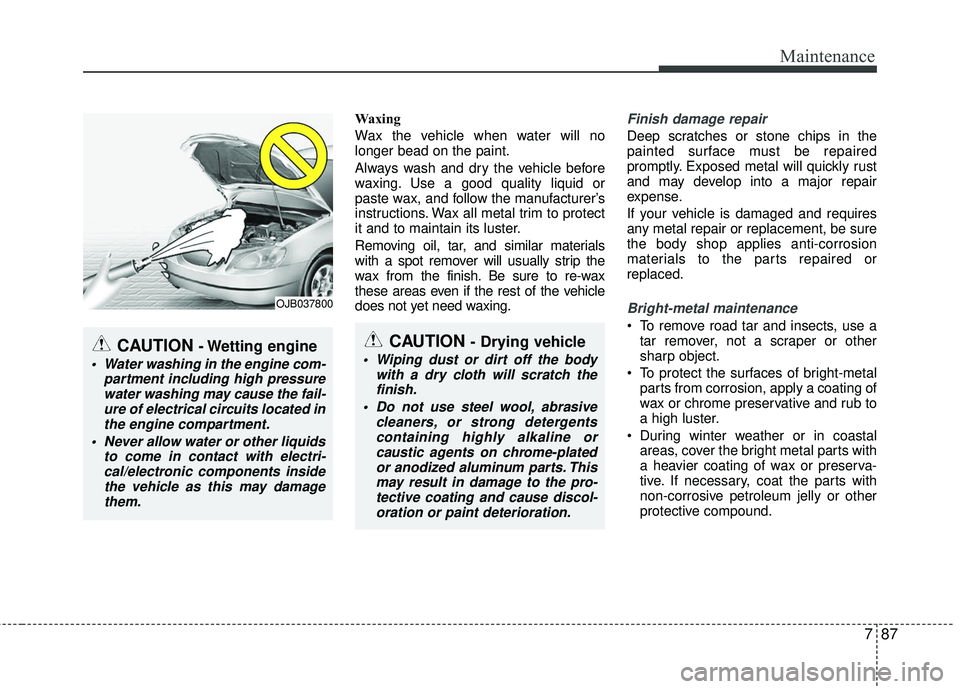
CAUTION - Wetting engine
Water washing in the engine com- partment including high pressurewater washing may cause the fail-ure of electrical circuits located in the engine compartment.
Never allow water or other liquids to come in contact with electri-cal/electronic components insidethe vehicle as this may damagethem.
OJB037800
CAUTION - Drying vehicle
Wiping dust or dirt off the body with a dry cloth will scratch thefinish.
Do not use steel wool, abrasive cleaners, or strong detergentscontaining highly alkaline orcaustic agents on chrome-platedor anodized aluminum parts. Thismay result in damage to the pro- tective coating and cause discol-oration or paint deterioration.