2017 KIA RIO engine oil
[x] Cancel search: engine oilPage 382 of 449

Maintenance
46
7
When you don’t use the vehicle for a long
time in the low temperature area, sepa-
rate the battery and keep it indoors.
Battery recharging
Your vehicle has a maintenance-free,
calcium-based battery.
If the battery becomes discharged in a
short time (because, for example, the
headlights or interior lights were left on
while the vehicle was not in use),
recharge it by slow charging (trickle)
for 10 hours.
If the battery gradually discharges because of high electric load while the
vehicle is being used, recharge it at no
more than 20-30A for two hours. When recharging the battery, observe
the following precautions:
The battery must be removed from the
vehicle and placed in an area with
good ventilation.
Watch the battery during charging, and stop or reduce the charging rate if the
battery cells begin gassing (boiling)
violently or if the temperature of the
electrolyte of any cell exceeds 49°C
(120°F).
Wear eye protection when checking the battery during charging.
Disconnect the battery charger in the following order.
1. Turn off the battery charger main switch.
2. Unhook the negative clamp from the negative battery terminal.
3. Unhook the positive clamp from the positive battery terminal.
Before performing maintenance or recharging the battery, turn off all
accessories and stop the engine.
The negative battery cable must be removed first and installed last when
the battery is disconnected.WARNING - Recharging
battery
Never attempt to recharge the bat-
tery when the battery cables are
connected.
WARNING - Risk of elec-
trocution
Never touch the electrical ignition
system while the vehicle is run-
ning. This system works with high
voltage which can "zap" you.
Page 397 of 449

761
Maintenance
FUSES
A vehicle’s electrical system is protected
from electrical overload damage by
fuses.This vehicle has 2 fuse panels, one locat-
ed in the driver’s side panel bolster, the
other in the engine compartment near
the battery.
If any of your vehicle’s lights, acces-
sories, or controls do not work, check the
appropriate circuit fuse. If a fuse has
blown, the element inside the fuse will
melt.
If the electrical system does not work,
first check the driver’s side fuse panel.
Always replace a blown fuse with one of
the same rating.
If the replacement fuse blows, this indi-
cates an electrical problem. Avoid using
the system involved and immediately
consult an authorized Kia dealer.
Three kinds of fuses are used: blade type
for lower amperage rating, cartridge type, and multi fuse for higher amperage rat-ings.
OTA070039
Blade type
Cartridge type
Fusible link B B
B B
l l
l l
o o
o o
w w
w w
n n
n n
B B
B B
l l
l l
o o
o o
w w
w w
n n
n n
B B
B B
l l
l l
o o
o o
w w
w w
n n
n n
WARNING - Fuse replace-
ment
Never replace a fuse with any-
thing but another fuse of the
same rating.
A higher capacity fuse could cause damage and possibly a
fire.
Never install a wire or aluminum foil instead of the proper fuse -
even as a temporary repair. It may
cause extensive wiring damage
and a possible fire.
Do not arbitrarily modify or add- on electric wiring of the vehicle.
CAUTION - Fuse replace-ment
Do not use a screwdriver or any
other metal object to remove fuses because it may cause a short circuitand damage the system.
Page 408 of 449

Maintenance
72
7
Engine compartment main fuse panel
Fuse Name Fuse rating Circuit Protected
IG2 40APCB Fuse & Relay Box (Start Relay), W/O Smart Key - Ignition Switch,
With Smart Key - PDM Relay Box (ESCL (IG2) Relay)
ECU1 30A PCB Fuse & Relay Box (Engine Control Relay, ECU2 10A)
ECU3 10A Not Used
BLOWER 40A PCB Fuse & Relay Box (Blower Relay)
C/FAN 40A PCB Fuse & Relay Box (Cooling Fan (Low) Relay, Cooling Fan (Hi) Relay)
F/PUMP 20A PCB Fuse & Relay Box (Fuel Pump #1 Relay)
H/LAMP HI 20A PCB Fuse & Relay Box (Head Lamp (HI) Relay)
H/LAMP 20A PCB Fuse & Relay Box (Head Lamp (LO) Relay)
HORN 10A PCB Fuse & Relay Box (Horn Relay, Burglar Alarm Horn Relay)
ECU2 10A M/T - ECM, A/T - E/R Junction Box (ECU_VM 10A)
B/UP LAMP 10A A/T - PCM, Transaxle Range Switch
WIPER 10A ECM/PCM, Rain Sensor
ECU4 20A ECM/PCM
INJECTOR 15A ECM/PCM, PCB Fuse & Relay Box (Fuel Pump #1 Relay)
H/LAMP LH 10A Head Lamp LH
SENSOR 10APurge Control Solenoid Valve, Oil Control Valve #1/#2, Oxygen Sensor(Up/Down), Variable Intake
Solenoid Valve, Canister Close Valve
IGN COIL 20A CONDENSOR, IGNITION COIL #1/#2/#3/#4
H/LAMP RH 10A Head Lamp RH
Page 411 of 449
775
Maintenance
Always handle them carefully, and avoid
scratches and abrasions. If the bulbs are
lit, avoid contact with liquids. Never touch
the glass with bare hands. Residual oil
may cause the bulb to overheat and burst
when lit. A bulb should be operated only
when installed in a headlight.
If a bulb becomes damaged or cracked,
replace it immediately and carefully dis-
pose of it.
Wear eye protection when changing a
bulb. Allow the bulb to cool down before
handling it.1. Turn off the engine and open the hood.
If you can reach the bulb without
removing the headlight assembly, con-
tinue to step 4.
2. Remove the front bumper upper cover.
3. Remove the headlight assembly from the body of the vehicle.
4. Disconnect the power connector(s) from the back of the headlight assem-
bly.
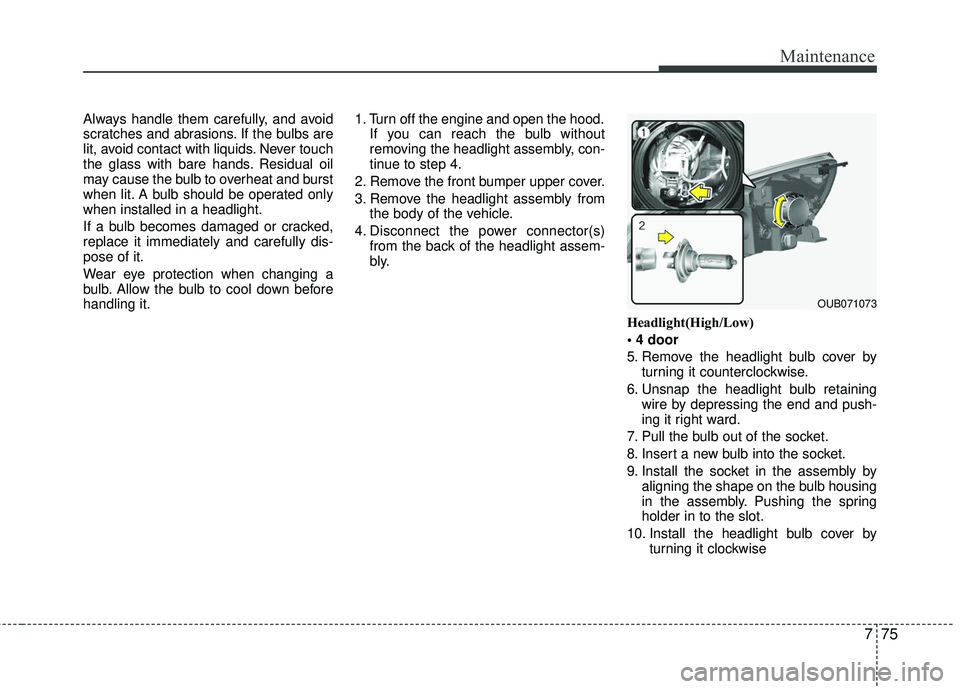
Headlight(High/Low)
5. Remove the headlight bulb cover byturning it counterclockwise.
6. Unsnap the headlight bulb retaining wire by depressing the end and push-
ing it right ward.
7. Pull the bulb out of the socket.
8. Insert a new bulb into the socket.
9. Install the socket in the assembly by aligning the shape on the bulb housing
in the assembly. Pushing the spring
holder in to the slot.
10. Install the headlight bulb cover by turning it clockwise
OUB071073
Page 423 of 449
787
Maintenance
Waxing
Wax the vehicle when water will no
longer bead on the paint.
Always wash and dry the vehicle before
waxing. Use a good quality liquid or
paste wax, and follow the manufacturer’s
instructions. Wax all metal trim to protect
it and to maintain its luster.
Removing oil, tar, and similar materials
with a spot remover will usually strip the
wax from the finish. Be sure to re-wax
these areas even if the rest of the vehicle
does not yet need waxing.Finish damage repair
Deep scratches or stone chips in the
painted surface must be repaired
promptly. Exposed metal will quickly rust
and may develop into a major repair
expense.
If your vehicle is damaged and requires
any metal repair or replacement, be sure
the body shop applies anti-corrosion
materials to the parts repaired or
replaced.
Bright-metal maintenance
To remove road tar and insects, use atar remover, not a scraper or other
sharp object.
To protect the surfaces of bright-metal parts from corrosion, apply a coating of
wax or chrome preservative and rub to
a high luster.
During winter weather or in coastal areas, cover the bright metal parts with
a heavier coating of wax or preserva-
tive. If necessary, coat the parts with
non-corrosive petroleum jelly or other
protective compound.
CAUTION - Wetting engine
Water washing in the engine com- partment including high pressurewater washing may cause the fail-ure of electrical circuits located in the engine compartment.
Never allow water or other liquids to come in contact with electri-cal/electronic components insidethe vehicle as this may damagethem.
OJB037800
CAUTION - Drying vehicle
Wiping dust or dirt off the body with a dry cloth will scratch thefinish.
Do not use steel wool, abrasive cleaners, or strong detergentscontaining highly alkaline orcaustic agents on chrome-platedor anodized aluminum parts. Thismay result in damage to the pro- tective coating and cause discol-oration or paint deterioration.
Page 437 of 449
87
Specifications, Consumer information, Reporting safety defects
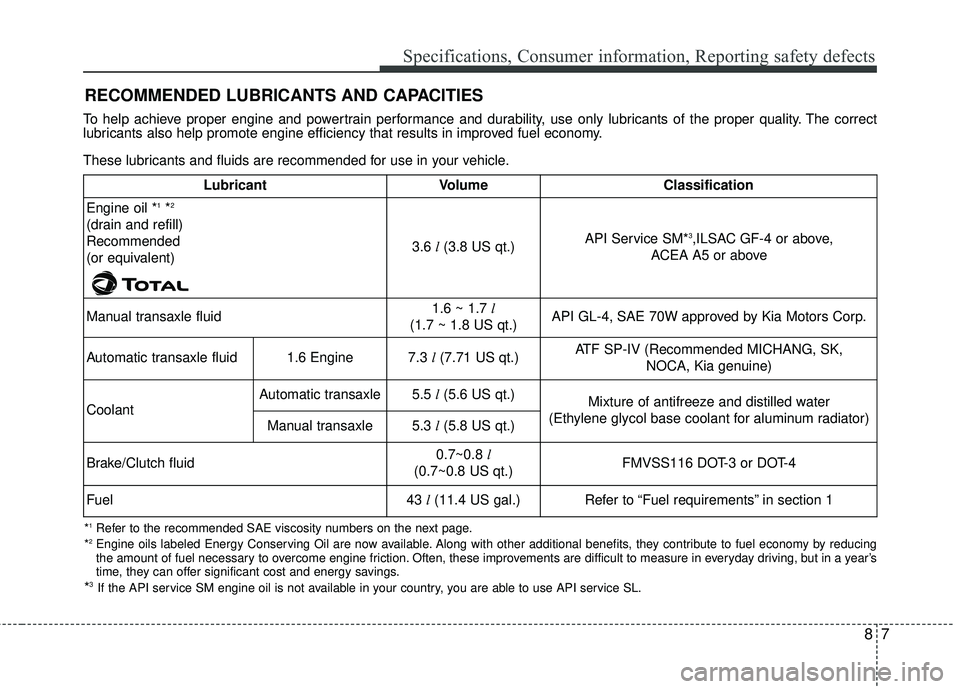
RECOMMENDED LUBRICANTS AND CAPACITIES
To help achieve proper engine and powertrain performance and durability, use only lubricants of the proper quality. The correct
lubricants also help promote engine efficiency that results in improved fuel economy.
These lubricants and fluids are recommended for use in your vehicle.
*1Refer to the recommended SAE viscosity numbers on the next page.
*2Engine oils labeled Energy Conserving Oil are now available. Along with other additional benefits, they contribute to fuel econo my by reducing
the amount of fuel necessary to overcome engine friction. Often, these improvements are difficult to measure in everyday driving, but in a year’s
time, they can offer significant cost and energy savings.
*3If the API service SM engine oil is not available in your country, you are able to use API service SL.
LubricantVolume Classification
Engine oil *
1*2
(drain and refill)
Recommended
(or equivalent)
3.6 l(3.8 US qt.) API Service SM*3,ILSAC GF-4 or above,
ACEA A5 or above
Manual transaxle fluid
1.6 ~ 1.7 l
(1.7 ~ 1.8 US qt.) API GL-4, SAE 70W approved by Kia Motors Corp.
Automatic transaxle fluid 1.6 Engine
7.3 l(7.71 US qt.) ATF SP-IV (Recommended MICHANG, SK,
NOCA, Kia genuine)
Coolant Automatic transaxle
5.5
l(5.6 US qt.)
Mixture of antifreeze and distilled water
(Ethylene glycol base coolant for aluminum radiator)
Manual transaxle
5.3 l(5.8 US qt.)
Brake/Clutch fluid
0.7~0.8 l
(0.7~0.8 US qt.) FMVSS116 DOT-3 or DOT-4
Fuel
43 l(11.4 US gal.)
Refer to “Fuel requirements” in section 1
Page 438 of 449

Specifications, Consumer information, Reporting safety defects
88
Recommended SAE viscosity
number
Always be sure to clean the area around
any filler plug, drain plug, or dipstick
before checking or draining any lubricant.
This is especially important in dusty or
sandy areas and when the vehicle is
used on unpaved roads. Cleaning the
plug and dipstick areas will prevent dirt
and grit from entering the engine and
other mechanisms that could be dam-
aged.Engine oil viscosity (thickness) has an
effect on fuel economy and cold weather
operation (engine start and engine oil
flowability). Lower viscosity engine oils
can provide better fuel economy and cold
weather performance, however, higher
viscosity engine oils are required for sat-
isfactory lubrication in hot weather. Using
oils of any viscosity other than those rec-
ommended could result in engine dam-
age.
When choosing an oil, consider the range
of temperature your vehicle will be oper-
ated in before the next oil change.
Proceed to select the recommended oil
viscosity from the chart.
Temperature Range for SAE Viscosity Numbers
Temperature
Gasoline
Engine Oil *
1
°C
(°F)-30 -20 -10 0 10 20 30 40 50 -10 0 20 40 60 80 100 120
1. For better fuel economy, it is recommended to use the engine oil of
a viscosity grade SAE 5W-20 (API SM / ILSAC GF-4). However, if
the engine oil is not available in your country, select the proper
engine oil using the engine oil viscosity chart.
10W-30
5W-20, 5W-30
Page 444 of 449

Index
4I
Engine number ··················\
··················\
··················\
·········8-10
Engine oil ··················\
··················\
··················\
·················7-34\
Changing the engine oil and filter ··················\
·············7-35
Checking the engine oil level ··················\
··················\
7-34
ENGINE START/STOP button ··················\
··················\
···5-7 ENGINE START/STOP button position ··················\
·····5-7
Illuminated ENGINE START/STOP button·················\
·5-7
Explanation of scheduled maintenance items ···············7-31
Exterior overview I ··················\
··················\
··················\
····2-2
Exterior overview II ··················\
··················\
··················\
···2-3
Fuel filler lid ··················\
··················\
··················\
············4-30 Closing the fuel filler lid ··················\
··················\
·········4-30
Fuel requirements ··················\
··················\
··················\
····1-3
Fuel requirements Opening the fuel filler lid ··················\
··················\
········4-30
Fuses ··················\
··················\
··················\
··················\
······7-61 Engine compartment fuse panel ··················\
················7-67
Fuse/relay panel description ··················\
··················\
····7-65
Instrument panel fuse panel··················\
··················\
·····7-66
Memory fuse··················\
··················\
··················\
··········7-63 Hazard warning flasher ··················\
··················\
··············4-72
Hood··················\
··················\
··················\
··················\
·······4-28
Closing the hood··················\
··················\
··················\
····4-29
Opening the hood ··················\
··················\
··················\
·4-28
How to use this manual ··················\
··················\
···············1-2
If the engine overheats··················\
··················\
·················6-8
If the engine will not start ··················\
··················\
···········6-4 If engine turns over normally but does not start ···········6-4
If the engine doesn't turn over or turns over slowly······6-4
If you have a flat tire ··················\
··················\
·················6-14\
Changing tires ···············\
··················\
··················\
··········6-15
Jack and tools ··················\
··················\
··················\
········6-14
Removing and storing the spare tire ··················\
·······6-15
If you have a flat tire (Tire Mobility Kit) ··················\
····6-22 Components of the Tire Mobility Kit··················\
········6-24
Distributing the sealant ··················\
··················\
············6-26
Introduction ··················\
··················\
··················\
···········6-22
Notes on the safe use of the Tire Mobility Kit ···········6-23
Using the Tire Mobility Kit ··················\
··················\
·····6-25
In case of an emergency while driving ··················\
··········6-3 If engine stalls while driving ··················\
··················\
·····6-3H
F
I