Page 41 of 514

Safety features of your vehicle
24
3
Seat belt warning
■■
Type A
As a reminder to the driver, the seat
belt warning light will blink for
approximately 6 seconds each time
you turn the Engine Start/Stop but-
ton ON regardless of belt fastening.
If the driver’s seat belt is unfastened
after the Engine Start/Stop button is
ON, the seat belt warning light blinks
again for approximately 6 seconds.
If the driver's seat belt is not fastened
when the Engine Start/Stop button is
turned ON or if it is unfastened after
the Engine Start/Stop button is ON,
the seat belt warning chime will
sound for approximately 6 seconds. At this time, if the seat belt is fas-
tened, the chime will stop at once. (ifequipped)
■
■
Type B
As a reminder to the driver, the dri-
ver’s seat belt warning lights will illu-
minate for approximately 6 seconds
each time you turn the Engine
Start/Stop button ON regardless of
belt fastening.
If the driver’s seat belt is not fastened
when the Engine Start/Stop button is
turned ON or if it is disconnected after
the Engine Start/Stop button is turned
ON, the seat belt warning light will illu-
minate until the belt is fastened.
If you continue not to fasten the seat
belt and you drive over 9 km/h, the
illuminated warning light will start to
blink until you drive under 6 km/h.
If you continue not to fasten the seat
belt and you drive over 20 km/h (12
mph) the seat belt warning chime will
sound for approximately 100 sec-
onds and the corresponding warning
light will blink.
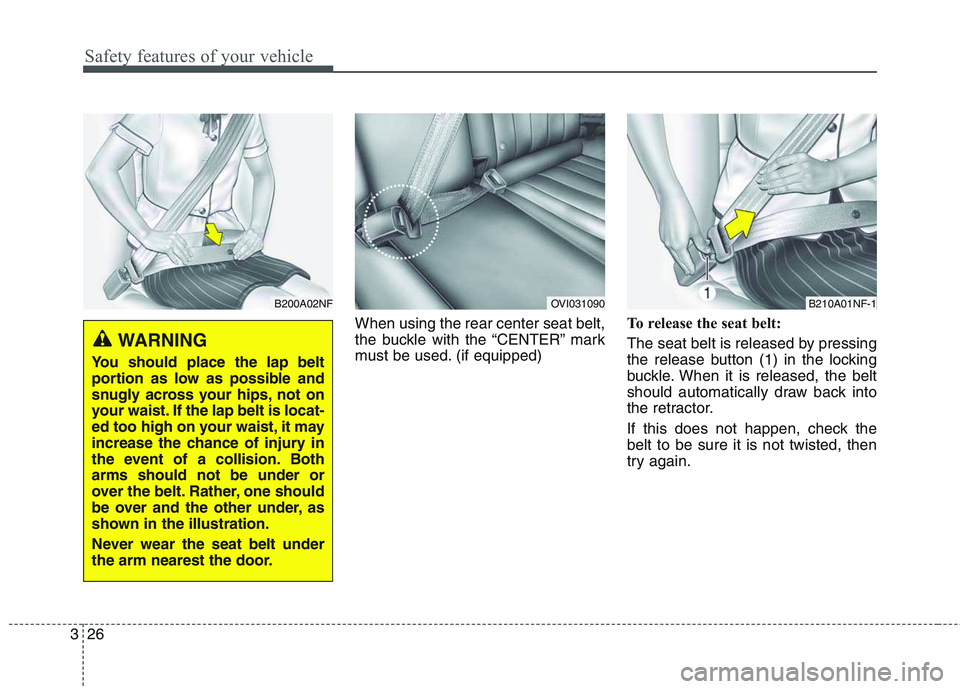
Lap/shoulder belt
To fasten your seat belt:
To fasten your seat belt, pull it out of
the retractor and insert the metal tab
(1) into the buckle (2). There will be
an audible "click" when the tab locks
into the buckle.The seat belt automatically adjusts tothe proper length only after the lap
belt portion is adjusted manually so
that it fits snugly around your hips. If
you lean forward in a slow, easy
motion, the belt will extend and let
you move around. If there is a sud-
den stop or impact, however, the belt
will lock into position. It will also lock
if you try to lean forward too quickly.
1GQA2083B180A01NF-1
Page 42 of 514
325
Safety features of your vehicle
✽✽NOTICE
If you are not able to pull out the
seat belt from the retractor, firmly
pull the belt out and release it. Then
you will be able to pull the belt out
smoothly.
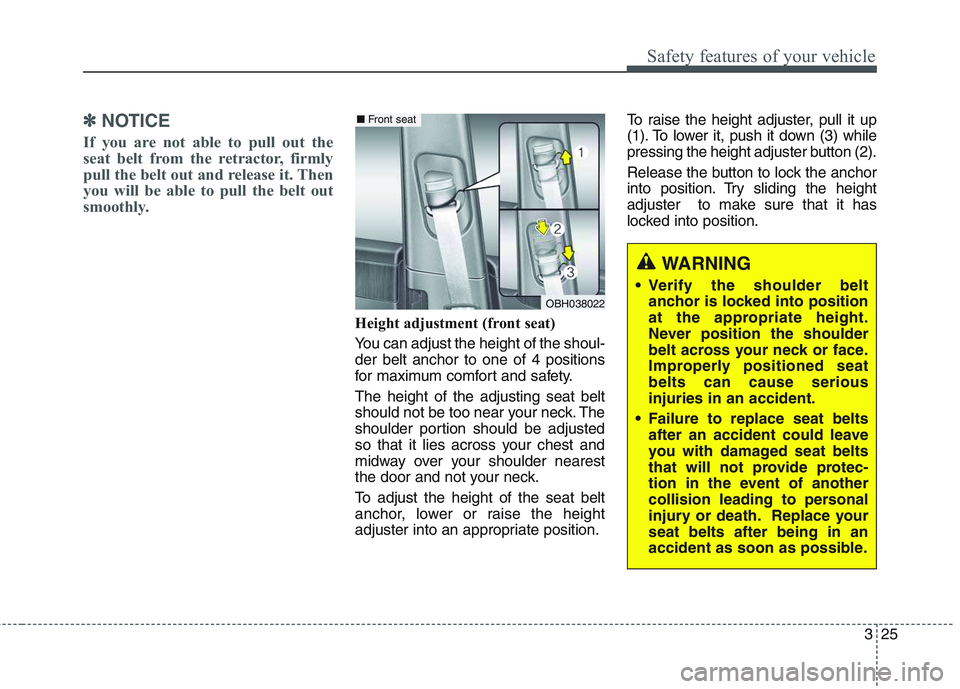
Height adjustment (front seat)
You can adjust the height of the shoul- der belt anchor to one of 4 positions
for maximum comfort and safety. The height of the adjusting seat belt
should not be too near your neck. The
shoulder portion should be adjusted
so that it lies across your chest and
midway over your shoulder nearest
the door and not your neck.
To adjust the height of the seat belt
anchor, lower or raise the height
adjuster into an appropriate position. To raise the height adjuster, pull it up
(1). To lower it, push it down (3) while
pressing the height adjuster button (2).
Release the button to lock the anchor
into position. Try sliding the height
adjuster to make sure that it has
locked into position.
WARNING
Verify the shoulder belt anchor is locked into position
at the appropriate height.
Never position the shoulder
belt across your neck or face.
Improperly positioned seatbelts can cause seriousinjuries in an accident.
Failure to replace seat belts after an accident could leave
you with damaged seat belts
that will not provide protec-
tion in the event of another
collision leading to personal
injury or death. Replace yourseat belts after being in an
accident as soon as possible.
OBH038022
■Front seat
Page 43 of 514
Safety features of your vehicle
26
3
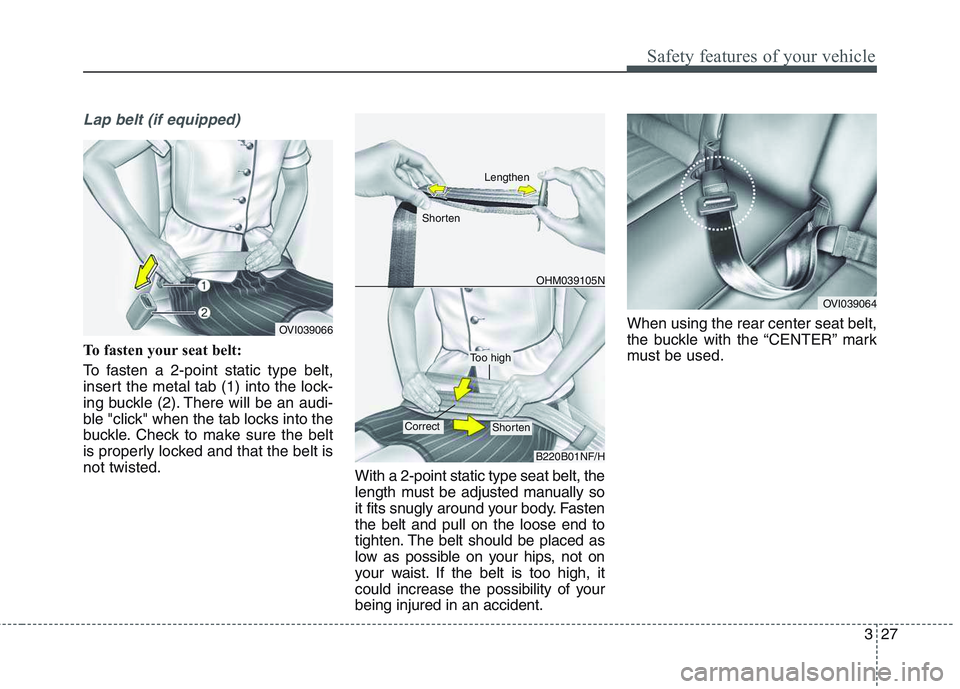
When using the rear center seat belt,
the buckle with the “CENTER” mark
must be used. (if equipped) To release the seat belt:
The seat belt is released by pressing
the release button (1) in the locking
buckle. When it is released, the belt
should automatically draw back into
the retractor.
If this does not happen, check the belt to be sure it is not twisted, then
try again.
B200A02NF
WARNING
You should place the lap belt
portion as low as possible and
snugly across your hips, not on
your waist. If the lap belt is locat-
ed too high on your waist, it may
increase the chance of injury in
the event of a collision. Botharms should not be under or
over the belt. Rather, one should
be over and the other under, as
shown in the illustration.
Never wear the seat belt under
the arm nearest the door.
B210A01NF-1OVI031090
Page 44 of 514
327
Safety features of your vehicle
Lap belt (if equipped)
To fasten your seat belt:
To fasten a 2-point static type belt,
insert the metal tab (1) into the lock-
ing buckle (2). There will be an audi-
ble "click" when the tab locks into the
buckle. Check to make sure the belt
is properly locked and that the belt isnot twisted.With a 2-point static type seat belt, the
length must be adjusted manually so
it fits snugly around your body. Fastenthe belt and pull on the loose end to
tighten. The belt should be placed as
low as possible on your hips, not on
your waist. If the belt is too high, it
could increase the possibility of yourbeing injured in an accident.When using the rear center seat belt,
the buckle with the “CENTER” mark
must be used.
OVI039066
OVI039064
OHM039105N
B220B01NF/H
Too high
ShortenCorrect
Lengthen
Shorten
Page 45 of 514
Safety features of your vehicle
28
3
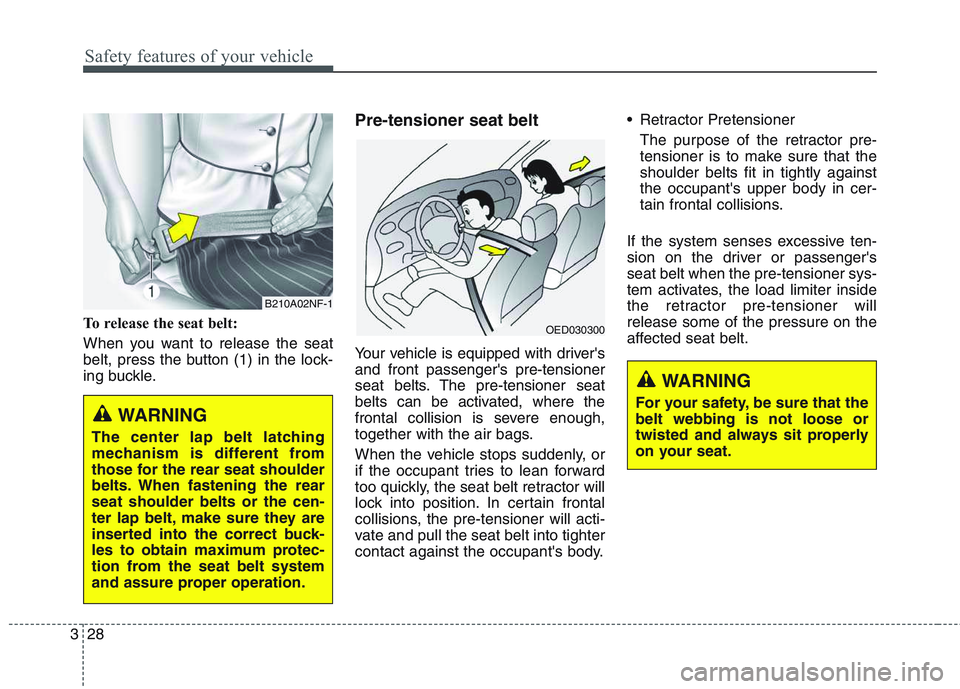
To release the seat belt:
When you want to release the seat
belt, press the button (1) in the lock-
ing buckle. Pre-tensioner seat belt
Your vehicle is equipped with driver's and front passenger's pre-tensioner
seat belts. The pre-tensioner seat
belts can be activated, where thefrontal collision is se
vere enough,
together with the air bags.
When the vehicle stops suddenly, or
if the occupant tries to lean forward
too quickly, the seat belt retractor will
lock into position. In certain frontal
collisions, the pre-tensioner will acti-
vate and pull the seat belt into tighter
contact against the occupant's body. Retractor Pretensioner
The purpose of the retractor pre-tensioner is to make sure that theshoulder belts fit in tightly againstthe occupant's upper body in cer-
tain frontal collisions.
If the system senses excessive ten-
sion on the driver or passenger'sseat belt when the pre-tensioner sys-
tem activates, the load limiter inside
the retractor pre-tensioner willrelease some of the pressure on the
affected seat belt.
B210A02NF-1
WARNING
The center lap belt latching
mechanism is different from
those for the rear seat shoulder
belts. When fastening the rearseat shoulder belts or the cen-
ter lap belt, make sure they are
inserted into the correct buck-
les to obtain maximum protec-
tion from the seat belt system
and assure proper operation.
OED030300
WARNING
For your safety, be sure that the belt webbing is not loose or
twisted and always sit properly
on your seat.
Page 54 of 514
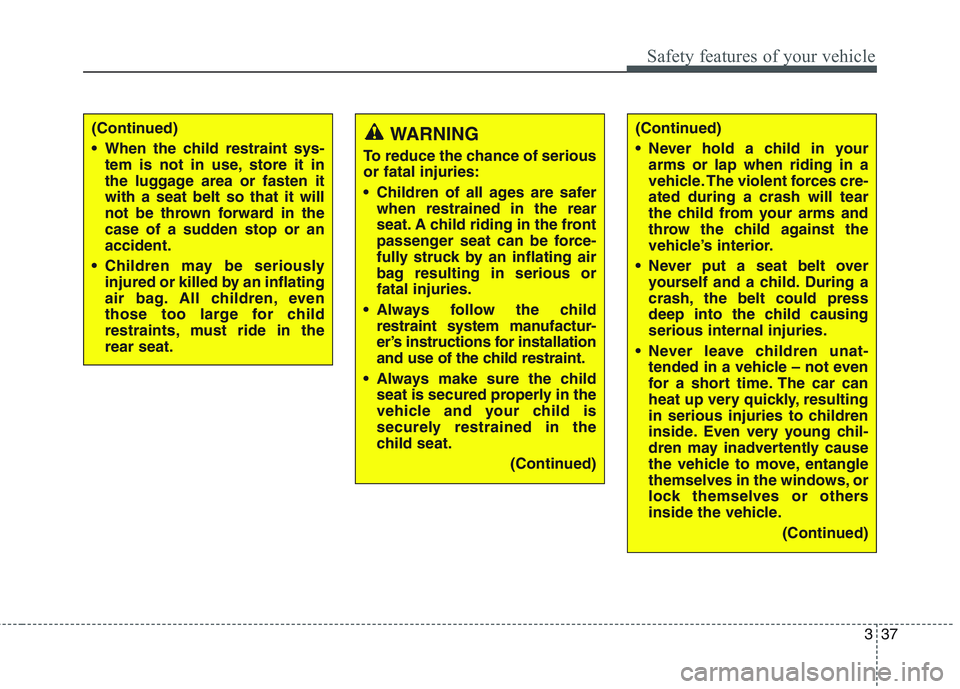
337
Safety features of your vehicle
(Continued)
When the child restraint sys-tem is not in use, store it in
the luggage area or fasten itwith a seat belt so that it will
not be thrown forward in the
case of a sudden stop or anaccident.
Children may be seriously injured or killed by an inflating
air bag. All children, even
those too large for child
restraints, must ride in therear seat.WARNING
To reduce the chance of serious or fatal injuries:
Children of all ages are safer when restrained in the rear
seat. A child riding in the front
passenger seat can be force-
fully struck by an inflating air
bag resulting in serious orfatal injuries.
Always follow the child restraint system manufactur-
er’s instructions for installation
and use of the child restraint.
Always make sure the child seat is secured properly in the
vehicle and your child is
securely restrained in the
child seat.
(Continued)(Continued)
Never hold a child in yourarms or lap when riding in a
vehicle. The violent forces cre-ated during a crash will tear
the child from your arms and
throw the child against the
vehicle’s interior.
Never put a seat belt over yourself and a child. During a
crash, the belt could press
deep into the child causingserious internal injuries.
Never leave children unat- tended in a vehicle – not even
for a short time. The car can
heat up very quickly, resulting
in serious injuries to children
inside. Even very young chil-
dren may inadvertently cause
the vehicle to move, entangle
themselves in the windows, or
lock themselves or others
inside the vehicle.
(Continued)
Page 58 of 514
341
Safety features of your vehicle
2. Fasten the lap/shoulder belt latchinto the buckle. Listen for the dis-
tinct “click” sound.
Position the release button so that it
is easy to access in case of an emer-gency.
3. Buckle the seat belt and allow the seat belt to take up any slack. After
installation of the child restraint
system, try to move it in all direc-
tions to be sure the child restraintsystem is securely installed. If you need to tighten the belt, pull
more webbing toward the retractor.
When you unbuckle the seat belt and
allow it to retract, the retractor will
automatically revert back to its nor-mal seated passenger emergency
locking usage condition.
OEN036101OEN036104
Page 69 of 514

Safety features of your vehicle
52
3
Air bag warning light
The purpose of the air bag warning
light in your instrument panel is to
alert you of a potential problem with
your air bag - Supplemental
Restraint System (SRS).
When the Engine Start/Stop button
is turned ON, the warning light
should illuminate for approximately 6
seconds, then go off. Have the system checked if:
The light does not turn on briefly
when you turn the engine start/stop
button to the ON position.
The light stays on after illuminating for approximately 6 seconds.
The light comes on while the vehi- cle is in motion.
The light blinks when the engine start/stop button is in ON position.
W7-147
WARNING
NEVER use a rearward facing child restraint on a seat pro-
tected by an ACTIVE AIR BAG
in front of it, DEATH or SERI-
OUS INJURY to the CHILD can
occur.
Never put a child restraint in the front passenger’s seat. If
the front passenger air bag
inflates, it can cause serious
or fatal injuries.
When children are seated in the rear outboard seats of a
vehicle equipped with side
and/or curtain air bags, be sure
to install the child restraint sys-
tem as far away from the door
side as possible, and securely
lock the child restraint system
in position. Inflation of side
and/or curtain air bags could
cause serious injury or death
to an infant or child.