2017 KIA OPTIMA heating
[x] Cancel search: heatingPage 380 of 629

Do not use the kickdown mecha-nism to return to normal driving.
Also, temporarily stop the vehicle
at a safe location, when the warn-
ing message illuminates on the
LCD display.
During the first 1,500km (1,000miles), you may feel that the
vehicle may not be smooth when
accelerating at low speed. During
this break-in period, the shift quali-
ty and performance of your new
vehicle is continuously optimized.
Always come to a complete stop before shifting into D (Drive) or R
(Reverse).
Do not put the shift lever in N (Neutral) while driving. The indicator in the instrument clus-
ter displays the shift lever position
when the ignition switch is in the ON
position.
P (Park)
Always come to a complete stop
before shifting into P (Park).
To shift from P (Park), you must
depress firmly on the brake pedal
and make sure your foot is off the
accelerator pedal.
The shift lever must be in P (Park)
before turning the engine off.
R (Reverse)
Use this position to drive the vehicle
backward.
N (Neutral)
The wheels and transmission are not
engaged.
Use N (Neutral) if you need to restart
a stalled engine, or if it is necessary
to stop with the engine ON. Shift into
P (Park) if you need to leave your
vehicle for any reason.
Always depress the brake pedal
when you are shifting from N
(Neutral) to another gear.
623
Driving your vehicle
CAUTION
- Holding the Vehicle Using
Accelerator Pedal
Do not attempt to hold yourvehicle on a hill by applying theaccelerator pedal. This cancause your clutch and transmis-sion to be damaged as a resultof overheating.
WARNING
Shifting into P (Park) while the vehicle is in motion may
cause you to lose control of
the vehicle.
After the vehicle has stopped, always make sure the shift
lever is in P (Park), apply the
parking brake, and turn the
engine off.
Do not use the P (Park) position in place of the parking brake.
CAUTION
Always come to a complete stopbefore shifting into or out of R(Reverse); you may damage thetransmission if you shift into R(Reverse) while the vehicle is inmotion.
JF CAN (ENG) 6.qxp 2016-09-21 11:24 Page 23
Page 457 of 629

Driving your vehicle
100
6
Hazardous driving conditions
When hazardous driving conditions
are encountered such as water,
snow, ice, mud, sand, or similar haz-
ards, follow these suggestions:
Drive cautiously and allow extra
distance for braking.
Avoid sudden braking or steering.
When braking with non-ABS brakes pump the brake pedal with
a light up-and-down motion until
the vehicle is stopped.
Do not pump the brake pedal on a
vehicle equipped with ABS. If stalled in snow, mud, or sand,
use the second gear. Accelerate
slowly to avoid spinning the drive
wheels.
Use sand, rock salt, or other non- slip material under the drive
wheels to provide traction when
stalled in ice, snow, or mud.
Rocking the vehicle
If it is necessary to rock the vehicle
to free it from snow, sand, or mud,
first turn the steering wheel right and
left to clear the area around your
front wheels. Then, shift back and
forth between R (Reverse) and any
forward gear in vehicles equipped
with an Automatic Transaxle / Dual
clutch transmission. Do not race the
engine, and spin the wheels as little
as possible. If you are still stuck after
a few tries, have the vehicle pulled
out by a tow vehicle to avoid engine
overheating and possible damage to
the transaxle.
SPECIAL DRIVING CONDITIONS
WARNING- Downshifting
Do not downshift with an auto-
matic transaxle while driving on
slippery surfaces. The sudden
change in tire speed could
cause the tires to skid and
result in an accident.
WARNING- Sudden
Vehicle Movement
Do not attempt to rock the vehi-
cle if people or objects are near-
by. The vehicle may suddenly
move forward or backwards as it
becomes unstuck.
JF CAN (ENG) 6.qxp 2016-09-21 11:28 Page 100
Page 458 of 629

6101
Driving your vehicle
The ESC system should be turned
OFF prior to rocking the vehicle.
Smooth cornering
Avoid braking or gear changing in
corners, especially when roads are
wet. Ideally, corners should always
be taken under gentle acceleration. If
you follow these suggestions, tire
wear will be held to a minimum.
Driving at night
Because night driving presents more
hazards than driving in the daylight,
here are some important tips to
remember:
Slow down and keep more dis-tance between you and other vehi-
cles, as it may be more difficult to
see at night, especially in areas
where there may not be any street
lights.
CAUTION- Vehicle rocking
Prolonged rocking may causeengine overheating, transaxledamage or failure, and tire dam-age.
CAUTION- Spinning tires
Do not spin the wheels, espe-cially at speeds more than 56km/h (35 mph). Spinning thewheels at high speeds when thevehicle is stationary couldcause a tire to overheat whichcould result in tire damage thatmay injure bystanders.
OJF055062LOJF055063L
JF CAN (ENG) 6.qxp 2016-09-21 11:28 Page 101
Page 460 of 629

6103
Driving your vehicle
Driving in flooded areas
Avoid driving through flooded areas
unless you are sure the water is no
higher than the bottom of the wheel
hub. Drive through any water slowly.
Allow adequate stopping distance
because brake performance may be
affected.
After driving through water, dry the
brakes by gently applying them sev-
eral times while the vehicle is moving
slowly.
Driving off-road
Drive carefully off-road because your
vehicle may be damaged by rocks or
roots of trees. Become familiar with
the off-road conditions where you
are going to drive before you begin
driving.
Highway driving
Tires
Adjust the tire inflation pressures to
specification. Low tire inflation pres-
sures will result in overheating and
possible failure of the tires.
Avoid using worn or damaged tires
which may result in reduced traction
or tire failure.
Never exceed the maximum tire
inflation pressure shown on the tires.
Fuel, engine coolant and engine oil
High speed travel consumes more
fuel than urban motoring. Do not for-
get to check both the engine coolant
and engine oil.
Drive belt
A loose or damaged drive belt may
result in overheating of the engine.
WARNING- Under/overinflated tires
Always check the tires for proper
inflation before driving.
Underinflated or overinflated
tires can cause poor handling,
loss of vehicle control, and sud-
den tire failure leading to acci-
dents, injuries, and even death.
For proper tire pressures, refer to
“Tires and wheels” in chapter 9.
WARNING- Tire tread
Always check the tire tread
before driving your vehicle.
Worn-out tires can result in loss
of vehicle control. Worn-out tires
should be replaced as soon as
possible. For further information
and tread limits, refer to "Tires
and wheels" in chapter 8.
JF CAN (ENG) 6.qxp 2016-09-21 11:28 Page 103
Page 476 of 629

77
What to do in an emergency
IF THE ENGINE OVERHEATS
If your temperature gauge indicates
overheating, you experience a loss
of power, or hear loud pinging or
knocking, the engine will probably be
too hot. If this happens, you should:
1.Pull off the road and stop as soonas it is safe to do so.
2.Place the shift lever in P (for Automatic transaxle / Dual clutch
transmission) and set the parking
brake. If the air conditioning is on,
turn it off.
3.If engine coolant is running out under the vehicle or steam is com-
ing out from underneath the hood,
stop the engine. Do not open the
hood until the coolant has stopped
running or the steaming has
stopped. If there is no visible loss
of engine coolant and no steam,
leave the engine running and
check to be sure the engine cool-
ing fan is operating. If the fan is not
running, turn the engine off. 4.Check to see if the water pump
drive belt is missing. If it is not
missing, check to see that it is
tight. If the drive belt seems to be
satisfactory, check for coolant leak-
ing from the radiator, hoses or
under the vehicle. (If the air condi-
tioning had been in use, it is nor-
mal for cold water to be draining
from it when you stop).
5.If the water pump drive belt is bro- ken or engine coolant is leaking
out, stop the engine immediately
and call the nearest authorized Kia
dealer for assistance. 6.If you cannot find the cause of the
overheating, wait until the engine
temperature has returned to nor-
mal. If coolant has been lost, care-
fully add coolant to the reservoir to
bring the fluid level in the reservoir
up to the halfway mark.
7.Proceed with caution, keeping alert for further signs of overheat-
ing. If overheating happens again,
call an authorized Kia dealer for
assistance.
Serious loss of coolant indicates
there is a leak in the cooling system
and this should be checked as soon
as possible by an authorized Kia
dealer.
WARNING - Under the hood
While the engine is running, keep hair,
hands and clothing
away from moving
parts such as the fan
and drive belts to pre-
vent injury.
WARNING - Radiator cap
Do not remove the
radiator cap when the
engine is hot. This may
result in coolant being
blown out of the open-
ing and cause serious
burns.
JF CAN (ENG) 7.qxp 8/25/2016 5:22 PM Page 7
Page 621 of 629
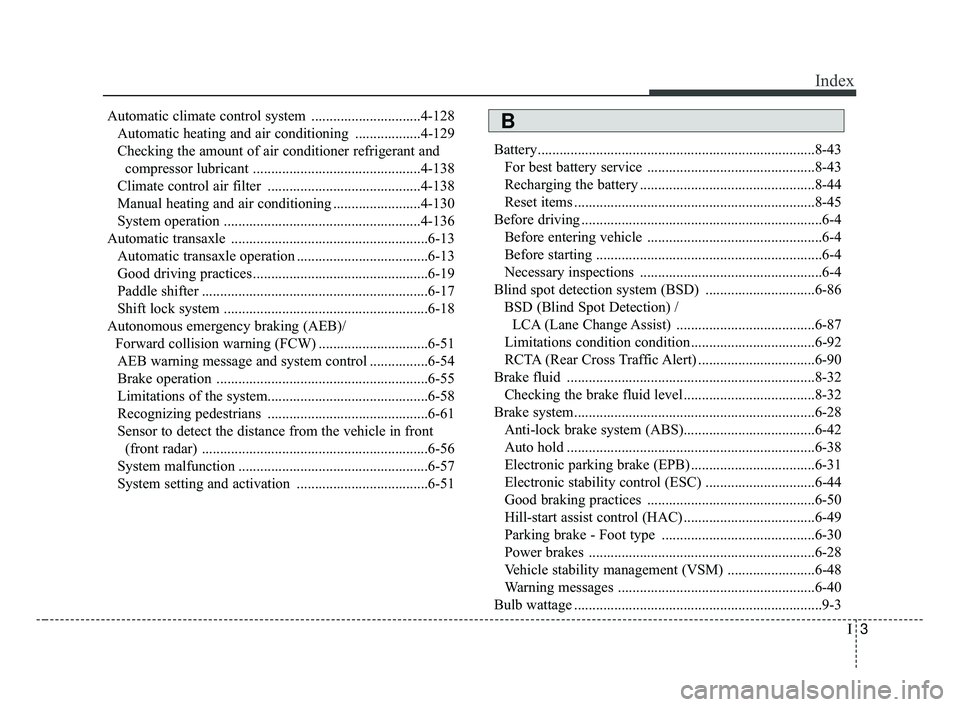
I3
Index
Automatic climate control system ..............................4-128Automatic heating and air conditioning ..................4-129
Checking the amount of air conditioner refrigerant and compressor lubricant ..............................................4-138
Climate control air filter ..........................................4-138
Manual heating and air conditioning ........................4-130
System operation ......................................................4-136
Automatic transaxle ......................................................6-13 Automatic transaxle operation ....................................6-13
Good driving practices ................................................6-19
Paddle shifter ..............................................................6-17
Shift lock system ........................................................6-18
Autonomous emergency braking (AEB)/ Forward collision warning (FCW) ..............................6-51AEB warning message and system control ................6-54
Brake operation ..........................................................6-55
Limitations of the system............................................6-5\
8
Recognizing pedestrians ............................................6-61
Sensor to detect the distance from the vehicle in front (front radar) ..............................................................6-56
System malfunction ....................................................6-57
System setting and activation ....................................6-51 Battery........................................................................\
....8-43
For best battery service ..............................................8-43
Recharging the battery ................................................8-44
Reset items ..................................................................8-45
Before driving ..................................................................6-4 Before entering vehicle ................................................6-4
Before starting ..............................................................6-4
Necessary inspections ..................................................6-4
Blind spot detection system (BSD) ..............................6-86 BSD (Blind Spot Detection) / LCA (Lane Change Assist) ......................................6-87
Limitations condition condition ..................................6-92
RCTA (Rear Cross Traffic Alert) ................................6-90
Brake fluid ....................................................................8-32\
Checking the brake fluid level ....................................8-32
Brake system..................................................................6-28 Anti-lock brake system (ABS)....................................6-42
Auto hold ....................................................................6-38\
Electronic parking brake (EPB) ..................................6-31
Electronic stability control (ESC) ..............................6-44
Good braking practices ..............................................6-50
Hill-start assist control (HAC) ....................................6-49
Parking brake - Foot type ..........................................6-30
Power brakes ..............................................................6-28
Vehicle stability management (VSM) ........................6-48
Warning messages ......................................................6-40
Bulb wattage ....................................................................9-3B
JF CAN (ENG) Index.qxp 8/30/2016 6:11 PM Page 3
Page 626 of 629

Index
8I
Maintenance services ......................................................8-5Owner maintenance precautions ..................................8-6
Owner’s responsibility ..................................................8-5
Manual climate control system ....................................4-118 Checking the amount of air conditioner refrigerant and compressor lubricant ..............................................4-126
Climate control air filter ..........................................4-126
Heating and air conditioning ....................................4-119
System operation ......................................................4-124
Mirrors ........................................................................\
..4-51 Inside rearview mirror ................................................4-51
Outside rearview mirror ..............................................4-53
Owner maintenance ........................................................8-7 Owner maintenance schedule ......................................8-7
Panoramic sunroof ........................................................4-41 Closing the sunroof ....................................................4-45
Resetting the sunroof ..................................................4-46
Sliding the sunroof ....................................................4-43
Sunroof open warning ................................................4-42 Sunshade ....................................................................4-43\
Tilting the sunroof ......................................................4-45
Parking brake ................................................................8-34 Checking the parking brake ........................................8-34
Rear parking assist system ............................................4-97 Non-operational conditions of rear parking assist system ................................................4-98
Operation of the rear parking assist system................4-97
Rear parking assist system precautions ......................4-99
Self-diagnosis............................................................4-100
Rearview camera ........................................................4-101
Recommended lubricants and capacities ........................9-7 Recommended SAE viscosity number ........................9-9
Scheduled maintenance service ......................................8-9
Seat ........................................................................\
..........3-4 Driver position memory system (for power seat) ......3-11
Front seat adjustment - manual ....................................3-7
Front seat adjustment - power ......................................3-8
Headrest (for front seat) ..............................................3-13
Rear seat adjustment ..................................................3-16
Seatback pocket ..........................................................3-16
M
P
O
R
S
JF CAN (ENG) Index.qxp 8/30/2016 6:11 PM Page 8