2017 KIA NIRO engine coolant
[x] Cancel search: engine coolantPage 451 of 552

Maintenance
28
8
Engine coolant
Check the condition and connections
of all cooling system hoses and
heater hoses. Replace any swollen
or deteriorated hoses.
The coolant level should be filled
between MAX and MIN marks on the
side of the coolant reservoir when
the engine is cool.
If the coolant level is low, add enough
specified coolant to provide protec-
tion against freezing and corrosion.
Bring the level to MAX, but do not
overfill. If frequent additions are
required, see an authorized Kia deal-
er for a cooling system inspection.
Inverter coolant
The coolant level should be filled
between MAX and MIN marks on the
side of the coolant reservoir when
the engine is cool.
If the coolant level is low, add enough
specified coolant to provide protec-
tion against freezing and corrosion.
Bring the level to MAX, but do not
overfill. If frequent additions are
required, see an authorized Kia deal-
er for a cooling system inspection.
WARNING- Cooling fan
Use caution when
working near the
blade of the cooling
fan. The electric
motor (cooling fan) is
controlled by engine coolant
temperature, refrigerant pres-
sure and vehicle speed. it may
sometimes operate even when
the engine is not running.
ODE076005ODE076053
Page 452 of 552
829
Maintenance
Recommended coolant
When adding coolant, use onlydeionized water or soft water for
your vehicle and never mix hard
water in the coolant filled at the fac-
tory. An improper coolant mixture
can result in serious malfunction or
engine damage.
The engine in your vehicle has alu- minum engine parts and must be
protected by an ethylene-glycol
with phosphate based coolant to
prevent corrosion and freezing.
DO NOT USE alcohol or methanol coolant or mix them with the spec-
ified coolant.
Do not use a solution that contains more than 60% antifreeze or less
than 35% antifreeze. This would
reduce the effectiveness of the
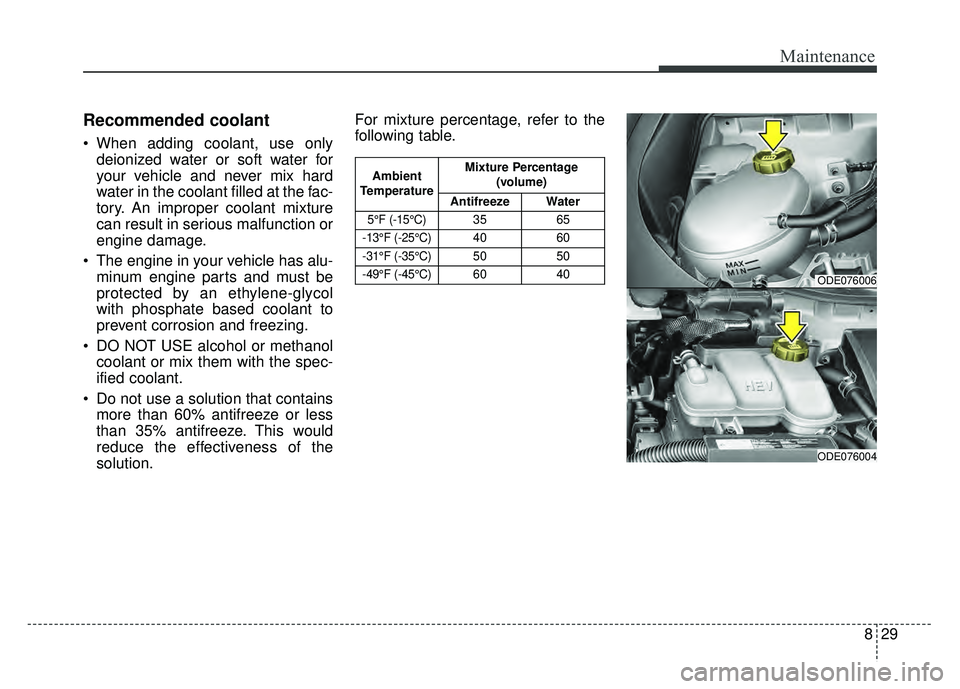
solution. For mixture percentage, refer to the
following table.
Ambient
Temperature Mixture Percentage
(volume)
Antifreeze Water
5°F (-15°C)35 65
-13°F (-25°C)4060
-31°F (-35°C)5050
-49°F (-45°C)6040ODE076006
ODE076004
Page 453 of 552
Maintenance
30
8
Changing the coolant
Have the coolant changed by an
authorized Kia dealer according to
the Maintenance Schedule at the
beginning of this chapter.
Put a thick cloth around the radiator
cap before refilling the coolant in
order to prevent the coolant from
overflowing into engine parts such as
the alternator.
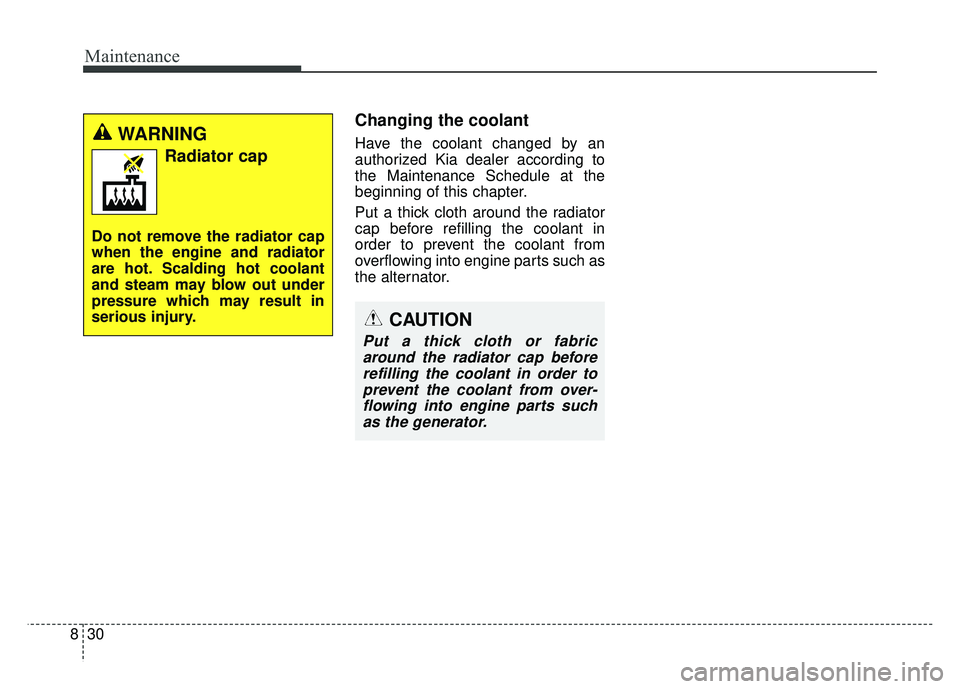
CAUTION
Put a thick cloth or fabric
around the radiator cap beforerefilling the coolant in order toprevent the coolant from over-flowing into engine parts suchas the generator.
WARNING
Radiator cap
Do not remove the radiator cap
when the engine and radiator
are hot. Scalding hot coolant
and steam may blow out under
pressure which may result in
serious injury.
Page 520 of 552

897
Maintenance
Canister
Fuel vapors generated inside the fuel
tank are absorbed and stored in the
onboard canister. When the engine is
running, the fuel vapors absorbed in
the canister are drawn into the surge
tank through the purge control sole-
noid valve.
Purge Control Solenoid Valve(PCSV)
The purge control solenoid valve is
controlled by the Engine Control
Module (ECM); when the engine
coolant temperature is low during
idling, the PCSV closes so that evap-
orated fuel is not taken into the
engine. After the engine warms up
during ordinary driving, the PCSV
opens to introduce evaporated fuel to
the engine.
3. Exhaust emission control system
The Exhaust Emission Control
System is a highly effective system
which controls exhaust emissions
while maintaining good vehicle per-
formance.
Vehicle modifications
This vehicle should not be modified.
Modification of your vehicle could
affect its performance, safety or
durability and may even violate gov-
ernmental safety and emissions reg-
ulations.
In addition, damage or performance
problems resulting from any modifi-
cation may not be covered under
warranty.
If you use unauthorized electronic
devices, it may cause the vehicle to
operate abnormally, wire damage,
battery discharge and fire. For your
safety, do not use unauthorized
electronic devices.
Engine exhaust gas precautions
(carbon monoxide)
Carbon monoxide can be present with other exhaust fumes.
Therefore, if you smell exhaust
fumes of any kind inside your vehi-
cle, have it inspected and repaired
immediately. If you ever suspect
exhaust fumes are coming into
your vehicle, drive it only with all
the windows fully open. Have your
vehicle checked and repaired
immediately.
WARNING - Exhaust
Engine exhaust gases contain
carbon monoxide (CO). Though
colorless and odorless, it is
dangerous and could be lethal if
inhaled. Follow the instructions
on this page to avoid CO poi-
soning.
Page 528 of 552
Specifications, Consumer information, Reporting safety defects
69
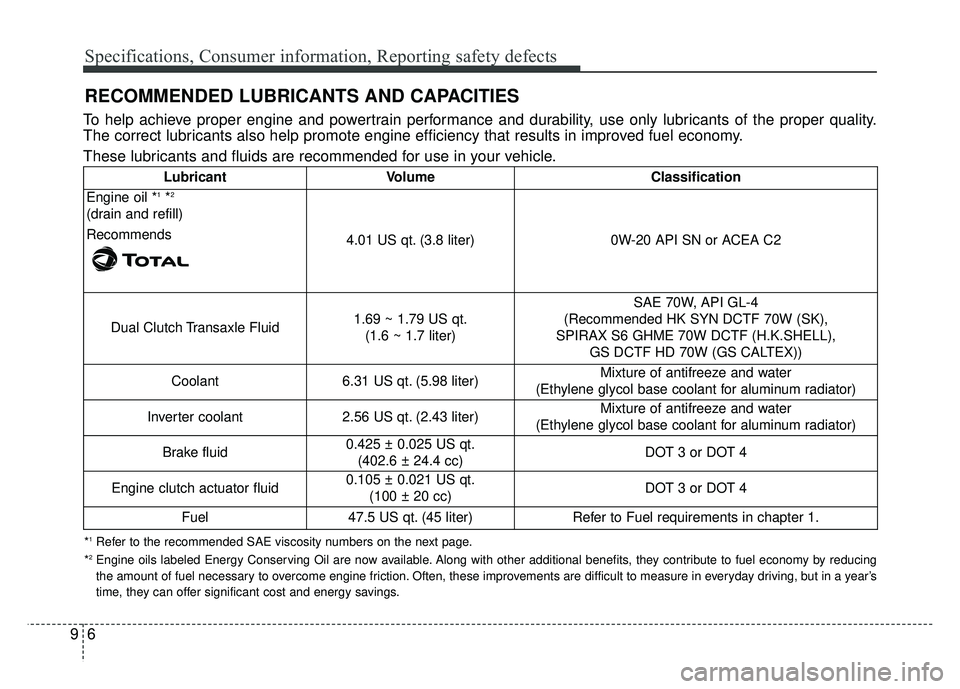
RECOMMENDED LUBRICANTS AND CAPACITIES
To help achieve proper engine and powertrain performance and durability, use only lubricants of the proper quality.
The correct lubricants also help promote engine efficiency that results in improved fuel economy.
These lubricants and fluids are recommended for use in your vehicle.
*1Refer to the recommended SAE viscosity numbers on the next page.
*2Engine oils labeled Energy Conserving Oil are now available. Along with other additional benefits, they contribute to fuel econo my by reducing
the amount of fuel necessary to overcome engine friction. Often, these improvements are difficult to measure in everyday driving, but in a year’s
time, they can offer significant cost and energy savings.
Lubricant VolumeClassification
Engine oil *1*2
(drain and refill)
Recommends
4.01 US qt. (3.8 liter)0W-20 API SN or ACEA C2
Dual Clutch Transaxle Fluid1.69 ~ 1.79 US qt. (1.6 ~ 1.7 liter)
SAE 70W, API GL-4
(Recommended HK SYN DCTF 70W (SK),
SPIRAX S6 GHME 70W DCTF (H.K.SHELL), GS DCTF HD 70W (GS CALTEX))
Coolant6.31 US qt. (5.98 liter)Mixture of antifreeze and water
(Ethylene glycol base coolant for aluminum radiator)
Inverter coolant2.56 US qt. (2.43 liter)Mixture of antifreeze and water
(Ethylene glycol base coolant for aluminum radiator)
Brake fluid0.425 ± 0.025 US qt. (402.6 ± 24.4 cc)DOT 3 or DOT 4
Engine clutch actuator fluid0.105 ± 0.021 US qt. (100 ± 20 cc)DOT 3 or DOT 4
Fuel47.5 US qt. (45 liter)Refer to Fuel requirements in chapter 1.
Page 541 of 552

Index
4I
Climate control air filter . . . . . . . . . . . . . . . . . . . . . . . . 8-38Filter inspection . . . . . . . . . . . . . . . . . . . . . . . . . . . . 8-38
Filter replacement. . . . . . . . . . . . . . . . . . . . . . . . . . . 8-38
Clothes hanger . . . . . . . . . . . . . . . . . . . . . . . . . . . . . . 4-145
Coasting guide . . . . . . . . . . . . . . . . . . . . . . . . . . . . . . . 4-70
Combined instrument, see instrument cluster . . . . . . . 4-51
Compact spare tire . . . . . . . . . . . . . . . . . . . . . . . . . . . . 7-24
Consumer assistance . . . . . . . . . . . . . . . . . . . . . . . . . . . 9-11
Coolant . . . . . . . . . . . . . . . . . . . . . . . . . . . . . . . . . . . . \
. 8-27 Changing the coolant . . . . . . . . . . . . . . . . . . . . . . . . 8-30
Checking the coolant level . . . . . . . . . . . . . . . . . . . . 8-27
Engine coolant . . . . . . . . . . . . . . . . . . . . . . . . . . . . . 8-28
Inverter coolant. . . . . . . . . . . . . . . . . . . . . . . . . . . . . 8-28
Recommended coolant . . . . . . . . . . . . . . . . . . . . . . . 8-29
Cooling fluid, see engine coolant . . . . . . . . . . . . . . . . . 8-27
Crankcase emission control system . . . . . . . . . . . . . . . 8-96
Cruise control system . . . . . . . . . . . . . . . . . . . . . . . . . . 6-47 To cancel cruise control . . . . . . . . . . . . . . . . . . . . . . 6-49
To decrease the cruising speed . . . . . . . . . . . . . . . . . 6-49
To increase cruise control set speed . . . . . . . . . . . . . 6-48
To resume cruising speed at more thanapproximately 20mph (30 km/h) . . . . . . . . . . . . . . 6-50
To set cruise control speed . . . . . . . . . . . . . . . . . . . . 6-48
To temporarily accelerate with the cruise control on. . 6-49
To turn cruise control off . . . . . . . . . . . . . . . . . . . . . 6-50
Cup holder . . . . . . . . . . . . . . . . . . . . . . . . . . . . . . . . . 4-136
Curtain air bag . . . . . . . . . . . . . . . . . . . . . . . . . . . . . . . 3-62 Dashboard illumination, see instrument panel
illumination. . . . . . . . . . . . . . . . . . . . . . . . . . . . . . . . . 4-52
Dashboard, see instrument cluster . . . . . . . . . . . . . . . . 4-51
Day/night rearview mirror . . . . . . . . . . . . . . . . . . . . . . 4-46
Daytime running light. . . . . . . . . . . . . . . . . . . . . . . . . 4-100
Declaration of Conformity . . . . . . . . . . . . . . . . . . . . . . 5-35
Defogging (Windshield) . . . . . . . . . . . . . . . . . . . . . . . 4-129
Defroster (Rear window) . . . . . . . . . . . . . . . . . . . . . . 4-113
Defrosting (Windshield) . . . . . . . . . . . . . . . . . . . . . . . 4-129
Dimensions . . . . . . . . . . . . . . . . . . . . . . . . . . . . . . . . . . . 9-\
2
Disarmed stage . . . . . . . . . . . . . . . . . . . . . . . . . . . . . . . 4-18
Display illumination, see instrument panel illumination . . 4-52
Displays, see instrument cluster . . . . . . . . . . . . . . . . . . 4-51
Distance to empty . . . . . . . . . . . . . . . . . . . . . . . . . . . . . 4-56
Door locks. . . . . . . . . . . . . . . . . . . . . . . . . . . . . . . . . . . 4-\
20 Central door lock switch . . . . . . . . . . . . . . . . . . . . . 4-22
Child-protector rear door lock . . . . . . . . . . . . . . . . . 4-23
From inside the vehicle . . . . . . . . . . . . . . . . . . . . . . 4-21
From outside the vehicle . . . . . . . . . . . . . . . . . . . . . 4-20
Drinks holders, see cup holders . . . . . . . . . . . . . . . . . 4-136
Driver position memory system . . . . . . . . . . . . . . . . . . . 3-9
"Driver's 3-point systemwith emergency locking retractor" . . . . . . . . . . . . . . . . . . . . . . . . . . . . 3-22
Driver's and passenger's front air bag . . . . . . . . . . . . . . 3-57
Driving at night . . . . . . . . . . . . . . . . . . . . . . . . . . . . . . . 6-82
Driving in flooded areas . . . . . . . . . . . . . . . . . . . . . . . . 6-83D
Page 542 of 552

I5
Index
Driving in the rain. . . . . . . . . . . . . . . . . . . . . . . . . . . . . 6-83
Driving off-road . . . . . . . . . . . . . . . . . . . . . . . . . . . . . . 6-83
Dual clutch transmission . . . . . . . . . . . . . . . . . . . . . . . 6-14Manual mode . . . . . . . . . . . . . . . . . . . . . . . . . . . . . . 6-19
Shift-lock override . . . . . . . . . . . . . . . . . . . . . . . . . . 6-20
Dual clutch transmission shift indicator . . . . . . . . . . . . 4-58
Dual clutch transmission shift indicator in sports mode . . 4-58
Economical operation . . . . . . . . . . . . . . . . . . . . . . . . . . 6-78
Electrical equipment . . . . . . . . . . . . . . . . . . . . . . . . . . . 9-14
Electrochromic mirror (ECM) . . . . . . . . . . . . . . . . . . . 4-47
Electronic power steering . . . . . . . . . . . . . . . . . . . . . . . 4-42
Electronic stability control (ESC) . . . . . . . . . . . . . . . . 6-29
Emergency Liftgatesafety release . . . . . . . . . . . . . . . . . 4-26
Emergency starting . . . . . . . . . . . . . . . . . . . . . . . . . . . . . 7-5 Before Jump Starting . . . . . . . . . . . . . . . . . . . . . . . . . 7-5
Jump starting . . . . . . . . . . . . . . . . . . . . . . . . . . . . . . . 7-7
"Method to disconnect the (-) cable for regularmaintenance" . . . . . . . . . . . . . . . . . . . . . . . . . . . . . . 7-7
Emergency while driving . . . . . . . . . . . . . . . . . . . . . . . . 7-3
Emission control system . . . . . . . . . . . . . . . . . . . . . . . . 8-96 Crankcase emission control system . . . . . . . . . . . . . 8-96
Evaporative emission control (including ORVR:Onboard Refueling Vapor Recovery) system. . . . . 8-96
Exhaust emission control system . . . . . . . . . . . . . . . 8-97
Energy flow. . . . . . . . . . . . . . . . . . . . . . . . . . . . . . . . . . 4-63\
Engine . . . . . . . . . . . . . . . . . . . . . . . . . . . . . . . . . . . . \
. . . 9-2
Engine clutch actuator fluid . . . . . . . . . . . . . . . . . . . . . 8-32
Checking the Engine clutch actuator fluid level . . . 8-32
Engine compartment . . . . . . . . . . . . . . . . . . . . . . . . . . . . 2-6
Engine compartment . . . . . . . . . . . . . . . . . . . . . . . . . . . . 8-3
Engine number . . . . . . . . . . . . . . . . . . . . . . . . . . . . . . . . 9-9
Engine oil . . . . . . . . . . . . . . . . . . . . . . . . . . . . . . . . . . . 8-\
25 Changing the engine oil and filter . . . . . . . . . . . . . . 8-26
Checking the engine oil level . . . . . . . . . . . . . . . . . . 8-25
Engine overheats . . . . . . . . . . . . . . . . . . . . . . . . . . . . . . 7-10
Engine start/stop button . . . . . . . . . . . . . . . . . . . . . . . . . 6-9 Engine start/stop button position . . . . . . . . . . . . . . . . 6-9
Illuminated engine start/stop button. . . . . . . . . . . . . . 6-9
Starting the hybrid system . . . . . . . . . . . . . . . . . . . . 6-11
Engine start/stop button illumination . . . . . . . . . . . . . . . 6-9
Engine start/stop button position . . . . . . . . . . . . . . . . . . 6-9
Engine will not start . . . . . . . . . . . . . . . . . . . . . . . . . . . . 7-4
Evaporative emission control (including ORVR: Onboard Refueling Vapor Recovery) system . . . . . . . 8-96
Exhaust emission control system . . . . . . . . . . . . . . . . . 8-97
Explanation of scheduled maintenance items . . . . . . . 8-21 Air cleaner filter . . . . . . . . . . . . . . . . . . . . . . . . . . . . 8-22
Air conditioning refrigerant . . . . . . . . . . . . . . . . . . 8-24
Brake discs, pads, calipers and rotors . . . . . . . . . . . 8-24
Brake fluid . . . . . . . . . . . . . . . . . . . . . . . . . . . . . . . . 8-24
Brake hoses and lines . . . . . . . . . . . . . . . . . . . . . . . . 8-23
Coolant (Engine / Inverter) . . . . . . . . . . . . . . . . . . . 8-22
Cooling system . . . . . . . . . . . . . . . . . . . . . . . . . . . . . 8-22
E