2017 KIA K900 instrument panel
[x] Cancel search: instrument panelPage 223 of 542

Features of your vehicle
4
4-143
✽NOTICE
If you want to defrost and defog the
front windshield, refer to
“Windshield Defrosting and
Defogging” in this section.
Rear window defroster
The defroster heats the window to
remove frost, fog and thin ice from
the rear window, while the engine is
running.
To activate the rear window
defroster, press the rear window
defroster button located in the center
facia switch panel.
The indicator on the rear window
defroster button illuminates when the
defroster is ON.
To turn off the defroster, press the
rear window defroster button again. If there is heavy accumulation of
snow on the rear window, brush it off
before operating the rear defroster.
The rear window defroster automati-
cally turns off after approximately 20
minutes or when the Engine
Start/Stop Button is turned off. To
turn off the defroster, press the rear
window defroster button again.
Outside rearview mirror defroster
(if equipped)
If your vehicle is equipped with the
outside rearview mirror defrosters,
they will operate at the same time you
turn on the rear window defroster.
Wiper de-icer (if equipped)
If your vehicle is equipped with the
wiper de-icer, it will be operating at
the same time you turn on the rear
window defroster.
DEFROSTER
OKH045207N
Conductors
To prevent damage to the con-
ductors bonded to the inside
surface of the rear window,
never use sharp instruments or
window cleaners containing
abrasives to clean the window.
CAUTION
KH USA 4:2015 12/2/2016 10:28 AM Page 143
Page 226 of 542

Features of your vehicle
4-146
✽NOTICE
Never place anything over the sen-
sor located on the instrument panel
to ensure better control of the heat-
ing and cooling system.
Manual heating and air condi-
tioning
The heating and cooling system can
be controlled manually by pushing
buttons other than the AUTO button.
In this case, the system works
sequentially according to the order of
buttons selected. When pressing any
button except the AUTO button while
using automatic operation, the func-
tions not selected will be controlled
automatically.
1.Start the engine.
2.Set the mode to the desired posi-
tion.
For improving the effectiveness of
heating and cooling;
- Heating:
- Cooling: 3.Set the temperature control to the
desired position.
4.Set the air intake control to the out- side (fresh) air position.
5.Set the fan speed control to the desired speed.
6.If air conditioning is desired, turn the air conditioning system on.
Press the AUTO button in order to
convert to full automatic control of
the system.
OKH043211N
KH USA 4:2015 12/2/2016 10:29 AM Page 146
Page 227 of 542

Features of your vehicle
4
4-147
❈ Rear outlet vents (F)
The air flow of the Rear outlet vents is controlled by the front cli-
mate control system and delivered
through the inside air duct of the
front doors. If the door is open or
not closed completely, the air flow
of the Rear outlet vent is not deliv-
ered properly. Make sure the front
doors are closed completely.
The air flow of the Rear outlet vents may be weaker than the
instrument panel vents for the long
air duct in the front doors.
OKH045213N
KH USA 4:2015 12/2/2016 10:29 AM Page 147
Page 229 of 542
Features of your vehicle
4
4-149
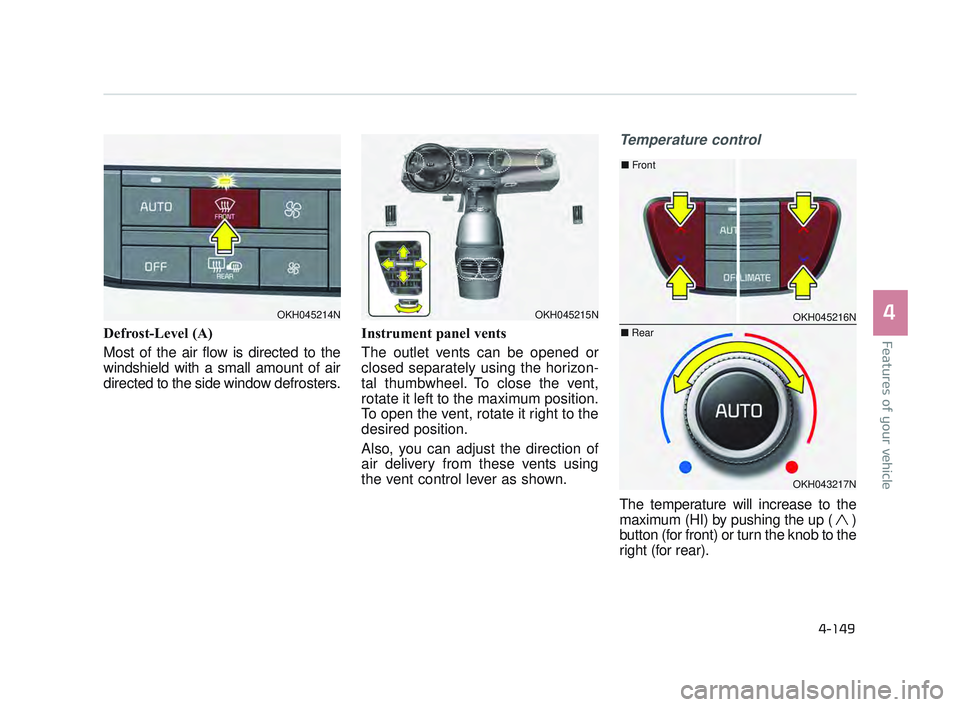
Defrost-Level (A)
Most of the air flow is directed to the
windshield with a small amount of air
directed to the side window defrosters.Instrument panel vents
The outlet vents can be opened or
closed separately using the horizon-
tal thumbwheel. To close the vent,
rotate it left to the maximum position.
To open the vent, rotate it right to the
desired position.
Also, you can adjust the direction of
air delivery from these vents using
the vent control lever as shown.
Temperature control
The temperature will increase to the
maximum (HI) by pushing the up ( )
button (for front) or turn the knob to the
right (for rear).
OKH045214NOKH045215NOKH045216N
OKH043217N
■
Front
■Rear
KH USA 4:2015 12/2/2016 10:29 AM Page 149
Page 387 of 542

6-14
What to do in an emergency
The tire pressure displayed on theinstrument panel may be different
from the tire pressure measured by
a tire pressure gauge.TPMS (Tire Pressure
Monitoring System)
malfunction indicator
The TPMS malfunction indicator will
illuminate after it blinks for approxi-
mately one minute when there is a
problem with the Tire Pressure
Monitoring System.
Have the system checked by an
authorized K900 Kia dealer as soon
as possible to determine the cause
of the problem.
✽ NOTICE
If there is a malfunction with the
TPMS, the low tire pressure position
telltale will not be displayed even
though the vehicle has an under-
inflated tire.
The TPMS malfunction indicator
may blink for approximately 1
minute and then remain continu-
ously illuminated if the vehicle is
moving around electric power sup-
ply cables or radio transmitter such
as at police stations, government
and public offices, broadcasting
stations, military installations, air-
ports, or transmitting towers, etc.
This can interfere with normal
operation of the Tire Pressure
Monitoring System (TPMS).
The TPMS malfunction indicator may blink for approximately 1
minute and then remain continu-
ously illuminated if the snow
chains are used or some separate
electronic devices such as note-
book computer, mobile charger,
remote starter or navigation etc.,
are used in the vehicle. This can
interfere with normal operation of
the Tire Pressure Monitoring
System (TPMS).
Low pressure damage
Significantly low tire pressure
makes the vehicle unstable and
can contribute to loss of vehicle
control and increased braking
distances.
Continued driving on low pres-
sure tires can cause the tires to
overheat and fail.
WARNING
KH USA 6:2016 12/1/2016 11:08 PM Page 14
Page 477 of 542

Maintenance
7
7-71
✽NOTICE
The actual fuse/relay panel label
may differ depending on equipment/
options.
Instrument panel fuse replace-
ment
1.Turn the Engine Start/Stop button
and all other switches off.
OKH073019N
■ Drive side panel
When replacing a blown fuse
or relay, make sure the new
fuse or relay fits tightly into
the clips. Failure to tightly
install the fuse or relay may
cause damage to the wiring
and electric systems.
Do not remove fuses, relays and terminals fastened with
bolts or nuts. The fuses,
relays and terminals may be
not be fastened correctly
which may cause vehicle
damage.
CAUTION
Do not input any other objects
except fuses or relays into
fuse/relay terminals such as a
driver or wiring. It may cause
contact failure and system mal-
function.
CAUTION
Electrical Fire
Always ensure replacements
fuses and relays are securely
fastened when installed. Failure
to do so can result in a vehicle
fire.
WARNING
KH USA 7:2016 12/1/2016 11:20 PM Page 71
Page 482 of 542

7-76
Maintenance
Fuse/relay panel description
Instrument panel fuse panel
Inside the fuse/relay panel covers,
you can find the fuse/relay label
describing fuse/relay name and
capacity.
✽NOTICE
Not all fuse panel descriptions in
this manual may be applicable to
your vehicle. It is accurate at the
time of printing. When you inspect
the fuse panel in your vehicle, refer
to the fuse panel label.OKH075049N
OKH073029N
KH USA 7:2016 12/1/2016 11:21 PM Page 76
Page 533 of 542

Curtain air bag ...............................................................3-55
Dashboard illumination, see instrument panelillumination ...............................................................4-68
Dashboard, see instrument cluster .................................4-67
Daytime running light .................................................4-130
Defogging (Windshield) ..............................................4-158
Defogging logic ...........................................................4-159
Defroster ......................................................................4-\
143 Outside rearview mirror defroster ..........................4-143
Rear window defroster ............................................4-143
Wiper deicer ............................................................4-143
Defrosting (Windshield) ..............................................4-158
Dimensions ......................................................................8-\
2
Display illumination, see instrument panel illumination ....4-68
Displays, see instrument cluster ....................................4-67
Door courtesy lamp .....................................................4-141
Door locks......................................................................4-\
16 Auto door lock/unlock feature ..................................4-19
Central door lock switch ...........................................4-18
Child-protector rear door lock ..................................4-20
Impact sensing door unlock system ..........................4-19
Power Door Latch .....................................................4-17
Rear door lock button................................................4-18
DRIVE mode .................................................................5-54 Conditions that limit active ECO MODE .................5-55 DRIVE MODE indicator screen ...............................5-58
ECO MODE driving .................................................5-55
Drive mode integrated control system ...........................5-54 DRIVE mode / SNOW mode ....................................5-54
Driver Information System (DIS) ................................4-180
Driver position memory system.......................................3-7
Driver's and passenger's front air bag ............................3-51
Driving at night ..............................................................5-97
Driving in flooded areas ................................................5-98
Driving in the rain..........................................................5-98
Driving off-road .............................................................5-99
Economical operation ....................................................5-94
Electric chromic mirror (ECM) .....................................4-48
Electric parking brake (EPB).........................................5-31
Electrical equipment(U.S. only) ....................................8-14
Electronic stability control (ESC) .................................5-43
Emergency starting ..........................................................6-5 Jump starting ...............................................................6-5
Emergency while driving .................................................6-3
Emission control system ..............................................7-104 Crankcase emission control system ........................7-104
Evaporative emission control System .....................7-104
Exhaust emission control system ............................7-105
Engine ........................................................................\
......8-2
Engine compartment ........................................................2-7
I-4
Index
E
D
KH USA Index:2016 4/26/2016 9:51 AM Page 4