Page 441 of 542
Maintenance
7
7-35
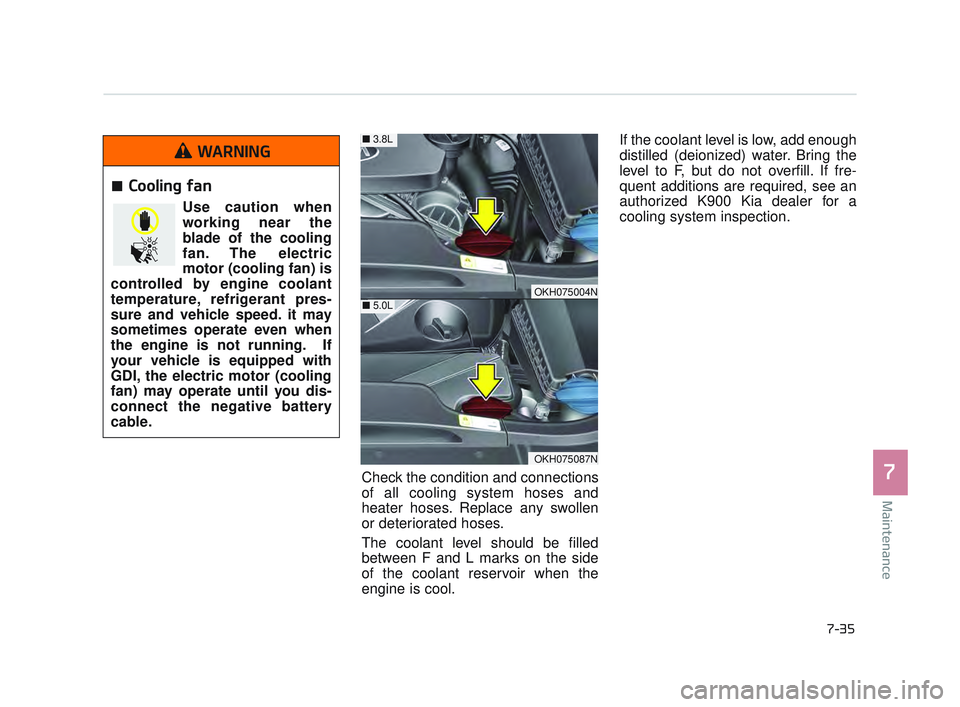
Check the condition and connections
of all cooling system hoses and
heater hoses. Replace any swollen
or deteriorated hoses.
The coolant level should be filled
between F and L marks on the side
of the coolant reservoir when the
engine is cool.If the coolant level is low, add enough
distilled (deionized) water. Bring the
level to F, but do not overfill. If fre-
quent additions are required, see an
authorized K900 Kia dealer for a
cooling system inspection.
Cooling fan
Use caution when
working near the
blade of the cooling
fan. The electric
motor (cooling fan) is
controlled by engine coolant
temperature, refrigerant pres-
sure and vehicle speed. it may
sometimes operate even when
the engine is not running. If
your vehicle is equipped with
GDI, the electric motor (cooling
fan) may operate until you dis-
connect the negative battery
cable.
WARNING
OKH075004N
OKH075087N
■ 3.8L
■ 5.0L
KH USA 7:2016 12/1/2016 11:19 PM Page 35
Page 442 of 542
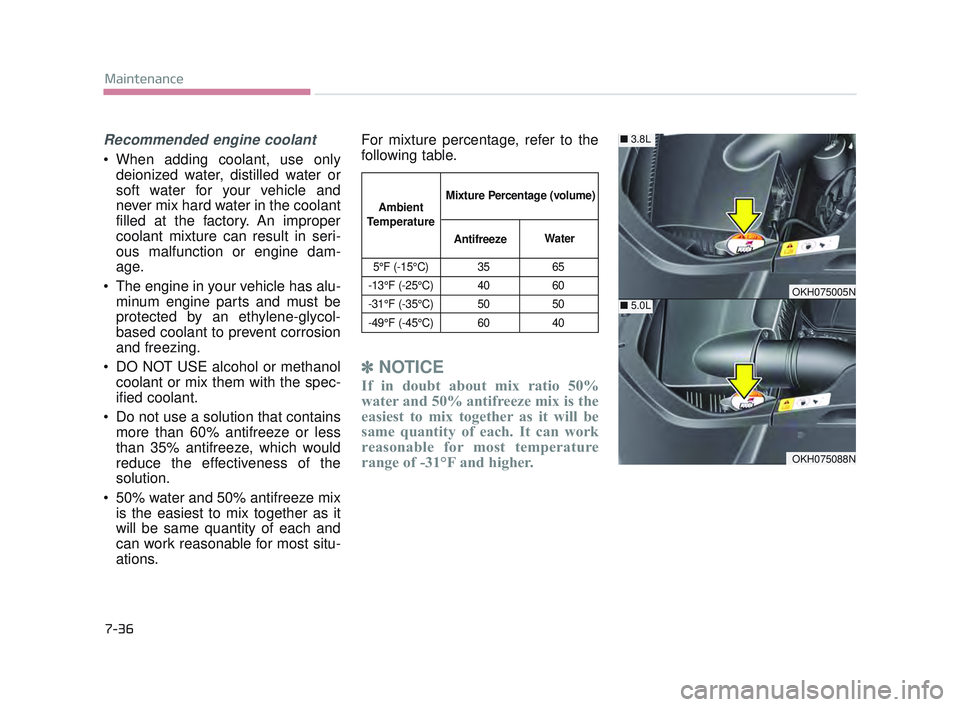
Recommended engine coolant
When adding coolant, use onlydeionized water, distilled water or
soft water for your vehicle and
never mix hard water in the coolant
filled at the factory. An improper
coolant mixture can result in seri-
ous malfunction or engine dam-
age.
The engine in your vehicle has alu- minum engine parts and must be
protected by an ethylene-glycol-
based coolant to prevent corrosion
and freezing.
DO NOT USE alcohol or methanol coolant or mix them with the spec-
ified coolant.
Do not use a solution that contains more than 60% antifreeze or less
than 35% antifreeze, which would
reduce the effectiveness of the
solution.
50% water and 50% antifreeze mix is the easiest to mix together as it
will be same quantity of each and
can work reasonable for most situ-
ations. For mixture percentage, refer to the
following table.
✽
NOTICE
If in doubt about mix ratio 50%
water and 50% antifreeze mix is the
easiest to mix together as it will be
same quantity of each. It can work
reasonable for most temperature
range of -31°F and higher.
7-36
Maintenance
5°F (-15°C) 35 65
-13°F (-25°C) 40 60
-31°F (-35°C) 50 50
-49°F (-45°C) 60 40
Ambient
Temperature Mixture Percentage (volume)
Antifreeze Water
OKH075005N
OKH075088N
■
3.8L
■ 5.0L
KH USA 7:2016 12/1/2016 11:19 PM Page 36
Page 511 of 542

Maintenance
7
7-105
Canister
Fuel vapors generated inside the fuel
tank are absorbed and stored in the
onboard canister. When the engine is
running, the fuel vapors absorbed in
the canister are drawn into the
engine intake manifold through the
purge control solenoid valve.
Purge Control Solenoid Valve(PCSV)
The purge control solenoid valve is
controlled by the Engine Control
Module (ECM); when the engine
coolant temperature is low during
idling, the PCSV closes so that evap-
orated fuel is not taken into the
engine. After the engine warms-up
during ordinary driving, the PCSV
opens to introduce evaporated fuel to
the engine.
3. Exhaust emission control system
The Exhaust Emission Control
System is a highly effective system
which controls exhaust emissions
while maintaining good vehicle per-
formance.
Vehicle modifications
This vehicle should not be modi-
fied. Modification of your vehicle
could affect its performance, safety
or durability and may even violate
governmental safety and emis-
sions regulations.
In addition, damage or perform-
ance problems resulting from any
modification may not be covered
under warranty.
Use of unauthorized electric devices may cause: Abnormal
vehicle operation, Wire damage,
Battery discharge, Fire.
Be careful not to damage your
vehicle by use of unauthorized
electric devices.
Engine exhaust gas precautions
(carbon monoxide)
Carbon monoxide can be present with other exhaust fumes.
Therefore, if you smell exhaust
fumes of any kind inside your vehi-
cle, have it inspected and repaired
immediately. If you ever suspect
exhaust fumes are coming into
your vehicle, drive it only with all
the windows fully open. Have your
vehicle checked and repaired
immediately.
KH USA 7:2016 12/1/2016 11:21 PM Page 105
Page 534 of 542

Engine coolant ...............................................................7-34
Engine Coolant Temperature guage ..............................4-70
Engine number ...............................................................8-10
Engine oil .......................................................................7\
-32
Engine overheats ..............................................................6-9
Engine start/stop button ...................................................5-6Engine start/stop button position.................................5-6
Illuminated engine start/stop button............................5-6
Engine start/stop button illumination ..............................5-6
Engine start/stop button position .....................................5-6
Engine will not start.........................................................6-4
Evaporative emission control System ..........................7-104
Exhaust emission control system.................................7-105
Explanation of scheduled maintenance items ...............7-29
Exterior care...................................................................7-96
Exterior overview.............................................................2-2
Flat tire ........................................................................\
..6-17 Changing tires ...........................................................6-19
Compact spare tire ....................................................6-24
Jack and tools ............................................................6-17
Jack label ...................................................................6-27
Removing and storing the spare tire .........................6-18
Floor mat anchor(s) .....................................................4-175
Fluid Brakes fluid ...............................................................7-38 Power steering fluid ..................................................7-39
Washer fluid ..............................................................7-40
Front blind spot monitoring system.............................4-126
Front fog light ..............................................................4-135
Front lamp switch ........................................................4-139
Front seat adjustment - power .........................................3-4
Fuel Economy ................................................................4-96
Fuel filler lid ..................................................................4-37 Emergency fuel filler lid release ...............................4-39
Fuel Gauge .....................................................................4-6\
9
Fuel requirements ............................................................1-3
Fuse switch ....................................................................7-72\
Fuses ........................................................................\
......7-70 Fuse switch ................................................................7-72
Fuse/relay panel description......................................7-76
Instrument panel fuse ................................................7-71
Main fuse...................................................................7-74
Multi fuse ..................................................................7-75
Gauges ........................................................................\
...4-69
Glove box.....................................................................4-1\
65
Glove box lamp............................................................4-142
Gross vehicle weight........................................................8-4\
Index
I-5
I
F
G
KH USA Index:2016 4/26/2016 9:51 AM Page 5