Page 11 of 595

Your vehicle at a glance
4 2
INTERIOR OVERVIEW
1. Inside door handle ................................4-17
2. Driver position memory system button ...3-8
3. Outside rearview mirror control ............4-55
4. Central door lock switch .......................4-18
5. Power window lock switch ....................4-33
6. Power window switch ............................4-31
7. Hood release lever................................4-35
8. Instrument panel illumination
control switch ........................................4-59
9. LKAS On/Off button ..............................5-64
10. ESC off button ....................................5-37
11. Steering wheel warmer On/Off
Button .................................................4-46
12. BSD On/Off button..............................5-72
13. Steering wheel ....................................4-44
14. Tilt and telescopic steering control
lever ....................................................4-45
15. Trunk lid release lever .........................4-21
16. Fuel filler lid release lever ...................4-37
17. Fuse box .............................................7-70
OYDM016001N❈The actual shape may differ from the illustration.
Page 12 of 595
25
Your vehicle at a glance
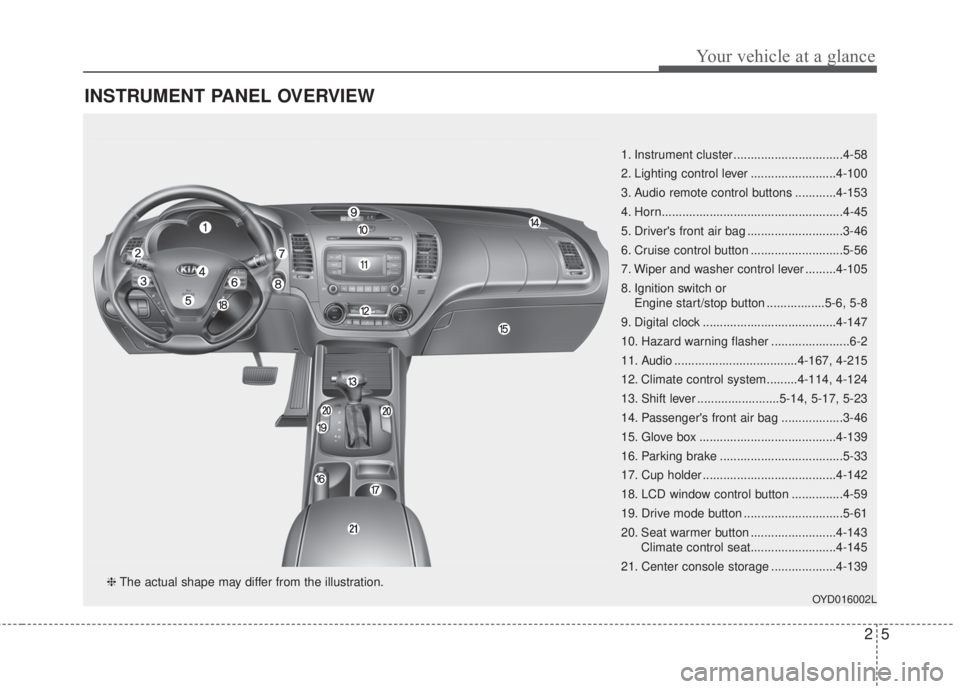
INSTRUMENT PANEL OVERVIEW
1. Instrument cluster ................................4-58
2. Lighting control lever .........................4-100
3. Audio remote control buttons ............4-153
4. Horn.....................................................4-45
5. Driver's front air bag ............................3-46
6. Cruise control button ...........................5-56
7. Wiper and washer control lever .........4-105
8. Ignition switch or
Engine start/stop button .................5-6, 5-8
9. Digital clock .......................................4-147
10. Hazard warning flasher .......................6-2
11. Audio ....................................4-167, 4-215
12. Climate control system.........4-114, 4-124
13. Shift lever ........................5-14, 5-17, 5-23
14. Passenger's front air bag ..................3-46
15. Glove box ........................................4-139
16. Parking brake ....................................5-33
17. Cup holder .......................................4-142
18. LCD window control button ...............4-59
19. Drive mode button .............................5-61
20. Seat warmer button .........................4-143
Climate control seat.........................4-145
21. Center console storage ...................4-139
OYD016002L
❈The actual shape may differ from the illustration.
Page 20 of 595

Safety features of your vehicle
6 3
Front seat adjustment - power
(if equipped)
The front seat can be adjusted by
using the control switch located on
the outside of the seat cushion.
Before driving, adjust the seat to the
proper position so as to easily con-
trol the steering wheel, pedals and
switches on the instrument panel.
When in operation, the power seat-
consumes a large amount of electri-
cal power. To prevent unnecessary
charging system drain, don’t adjust
the power seat longer than neces-
sary while the engine is not running.
Forward and backward
Push the control switch forward or
backward to move the seat to the
desired position. Release the switch
once the seat reaches the desired
position.
OYDDSA2005
CAUTION- Power seat
adjustments
The power seating controls
function by electronic motor.
Excessive operation may cause
damage to the electrical equip-
ment.
CAUTION- Power Seating
Do not operate two or more
power seat control switches at
the same time. Doing so may
damage the power seat motor or
electrical components.WARNING- Unattended
children
Do not leave children unattend-
ed in the vehicle. Children might
operate features of the vehicle
that could injure them.
Page 22 of 595

Safety features of your vehicle
8 3
Driver position memory system
(if equipped, for power seat)
A driver position memory system is
provided to store and recall the driver
seat position with a simple button
operation. By saving the desired posi-
tion into the system memory, different
drivers can reposition the driver seat
based upon their driving preference.
If the battery is disconnected, the
desired seat position memory will
need to be re-saved.
Storing positions into memory
using the buttons on the door
Storing driver’s seat positions
1. Vehicle speed is below 3 km/h (3
mph) and the engine start/stop
button is ON or ignition switch ON.
2. Adjust the driver seat to position
comfortable for the driver.
3. Press SET button on the control
panel. The system will beep once.
4. Press one of the memory buttons
(1 or 2) within 5 seconds after
pressing the SET button. The sys-
tem will beep twice when memory
has been successfully stored.
OYDDSA2014
WARNING- Driver posi-
tion memory system
Never attempt to operate the
driver position memory system
while the vehicle is moving.
This could result in loss of control
of your vehicle, and an accident
causing death, or serious injury.
Page 52 of 595
Safety features of your vehicle
38 3
Air bag warning light
The SRS (Supplement Restraint
System) air bag warning light on the
instrument panel displays the air bag
symbol depicted in the illustration.
The system checks the air bag elec
trical system for malfunctions. The
light indicates that there is a potential
problem with your air bag system,
which could include your side and
curtain air bags used for rollover pro-
tection.Have the system checked by an
authorized Kia dealer if:
• The light does not turn on briefly
when you turn the ignition ON.
• The light stays on after illuminating
for approximately 6 seconds.
• The light comes on while the vehi-
cle is in motion.
SRS components and func-
tions
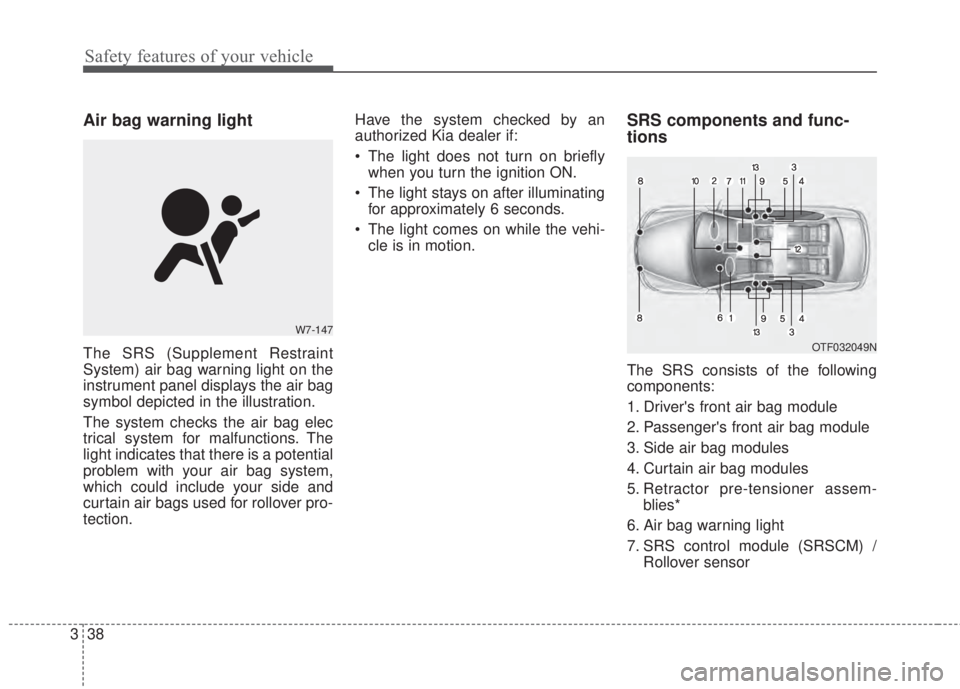
The SRS consists of the following
components:
1. Driver's front air bag module
2. Passenger's front air bag module
3. Side air bag modules
4. Curtain air bag modules
5. Retractor pre-tensioner assem-
blies*
6. Air bag warning light
7. SRS control module (SRSCM) /
Rollover sensor
W7-147
OTF032049N
Page 54 of 595
Safety features of your vehicle
40 3
Upon deployment, tear seams mold-
ed directly into the pad covers will
separate under pressure from the
expansion of the air bags. Further
opening of the covers then allows full
inflation of the air bags.A fully inflated air bag, in combina-
tion with a properly worn seat belt,
slows the driver's or the passenger's
forward motion, reducing the risk of
head and chest injury.
After complete inflation, the air bag
immediately starts deflating,
enabling the driver to maintain for-
ward visibility and the ability to steer
or operate other controls.
B240B03L
Driver’s front air bag (3)
B240B02L
Driver’s front air bag (2)
B240B05L
Passenger’s front air bag
WARNING - Air bag
obstructions
Do not install or place any
accessories on the steering
wheel, instrument panel, or on
the front passenger's panel
above the glove box in a vehicle
Such objects may become dan-
gerous projectiles if the air bag
deploys.
Page 55 of 595

341
Safety features of your vehicle
✽NOTICE
Before you replace a fuse or discon-
nect a battery terminal, turn the igni-
tion switch to the LOCK position
and remove the ignition key. Never
remove or replace the air bag related
fuse(s) when the ignition switch is in
the ON position. Failure to heed this
warning will cause the SRS air bag
warning light to illuminate.
Occupant detection system
Your vehicle is equipped with an occu-
pant detection system in the front
passenger's seat.
The occupant detection system is
designed to detect the presence of a
properly-seated front passenger and
determine if the passenger's front air
bag should be enabled (may inflate)
or not. The driver's front air bag is not
affected or controlled by the occu-
pant detection system.
Main components of occupant
detection system
• A detection device located within
the front passenger seat track.
• Electronic system to determine
whether passenger air bag sys-
tems should be activated or deac-
tivated.
• An indicator light located on the
instrument panel which illuminates
the words PASSENGER AIR BAG
“OFF” indicating the front passen-
ger air bag system is deactivated.
• The instrument panel air bag warn-
ing light is interconnected with the
occupant detection system.
OYD036104N
Page 61 of 595

347
Safety features of your vehicle
The indications of the system's pres-
ence are the letters "AIR BAG"
embossed on the air bag pad cover
in the steering wheel and the pas-
senger's side front panel pad above
the glove box.
The SRS consists of air bags
installed under the pad covers in the
center of the steering wheel and the
passenger's side front panel above
the glove box.
The purpose of the SRS is to provide
the vehicle's driver and/or the front
passenger with additional protection
than that offered by the seat belt sys-
tem alone in case of a frontal impact
of sufficient severity. The SRS uses
sensors to gather information about
the driver's seat position, the driver's
and front passenger's seat belt
usage and impact severity.The advanced SRS offers the ability
to control the air bag inflation with
two levels. A first stage level is pro-
vided for moderate-severity impacts.
A second stage level is provided for
more severe impacts.
The passenger’s front air bag is
designed to help reduce the injury of
children sitting close to the instru-
ment panel in low speed collisions.
However, children are safer if they
are restraint in the rear seat.
According to the impact severity,
seating position and seat belt usage,
the SRSCM (SRS Control Module)
controls the air bag inflation. Failure
to properly wear seat belts can
increase the risk or severity of injury
in an accident.Additionally, your vehicle is equipped
with an occupant detection system in
the front passenger's seat. The occu-
pant detection system detects the
presence of a passenger in the front
passenger's seat and will turn off the
front passenger's air bag under cer-
tain conditions. For more detail, see
"Occupant detection system" in this
section.
Do not place any objects that may
cause magnetic fields near the front
seat. These may cause a malfunction
of the seat track position sensor.
