2017 KIA CEED ECU
[x] Cancel search: ECUPage 98 of 653
Features of your vehicle
14
4
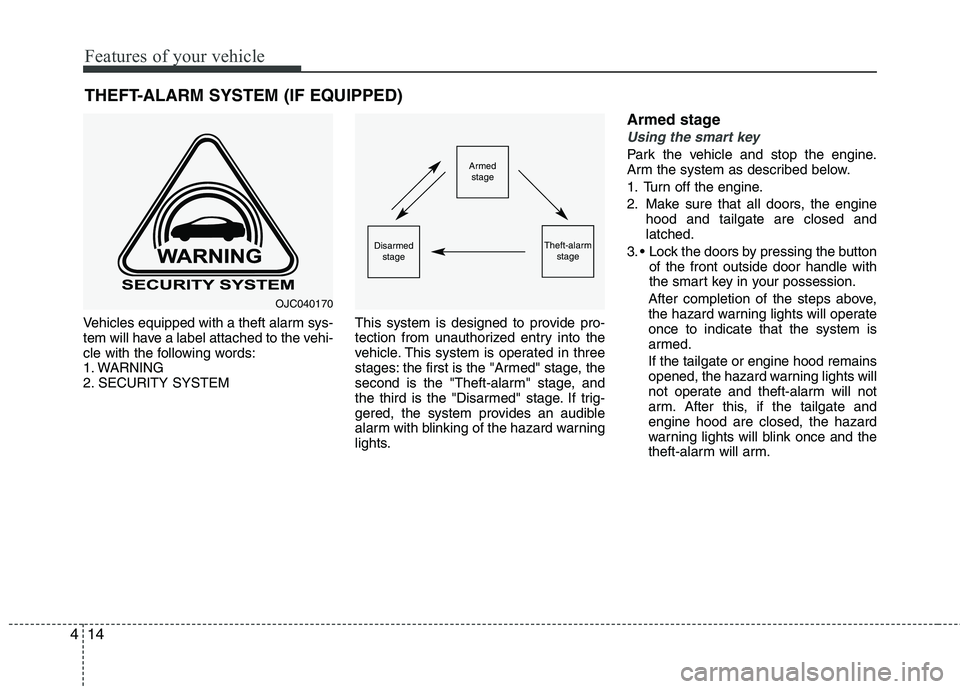
Vehicles equipped with a theft alarm sys-
tem will have a label attached to the vehi-
cle with the following words:
1. WARNING
2. SECURITY SYSTEM This system is designed to provide pro-
tection from unauthorized entry into the
vehicle. This system is operated in three
stages: the first is the "Armed" stage, the
second is the "Theft-alarm" stage, and
the third is the "Disarmed" stage. If trig-
gered, the system provides an audible
alarm with blinking of the hazard warning
lights.Armed stage
Using the smart key
Park the vehicle and stop the engine.
Arm the system as described below.
1. Turn off the engine.
2. Make sure that all doors, the engine
hood and tailgate are closed and latched.
3. Lock the doors by pressing the button of the front outside door handle with
the smart key in your possession.
After completion of the steps above,
the hazard warning lights will operateonce to indicate that the system is
armed. If the tailgate or engine hood remains
opened, the hazard warning lights will
not operate and theft-alarm will not
arm. After this, if the tailgate andengine hood are closed, the hazard
warning lights will blink once and the
theft-alarm will arm.
THEFT-ALARM SYSTEM (IF EQUIPPED)Armed
stage
Theft-alarm stageDisarmedstage
OJC040170
Page 101 of 653

417
Features of your vehicle
Operating door locks from out-
side the vehicle
Transmitter/Smart key
Doors can be locked and unlocked withthe transmitter or smart key.
Doors can be locked and unlocked by pressing the button of the outside door
handle with the smart key in your pos-
session. (vehicles equipped with smart
key system)
Once the doors are unlocked, they may be opened by pulling the door handle.
When closing the door, push the door by hand. Make sure that doors are
closed securely.
Mechanical key
If the transmitter or smart key does not
operate normally, you can lock or unlock
the doors by the mechanical key.
Insert the key into the key hole of the
outside door handle. Turn the key toward
the rear of the vehicle to unlock and
toward the front of the vehicle to lock.
If you lock/unlock the driver’s door with a key while the power door lock switch
does not operate normally, only the dri-
ver’s door will lock/unlock.
Once the door is unlocked, it may be opened by pulling the door handle.
When closing the door, push the door by hand. Make sure that doors are
closed securely.
DOOR LOCKS
OJD043010
ORP042235
■
Type A
OJD042001
■
Type B
Page 102 of 653

Features of your vehicle
18
4
✽✽
NOTICE
In cold and wet climates, door lock and door mechanisms may not work
properly due to freezing conditions.
If the door is locked/unlocked multi-
ple times in rapid succession with
either the vehicle key or door lock
switch, the system may stop operating
temporarily in order to protect the
circuit and prevent damage to system
components.
In case of an emergency
(5 Door and wagon)
If the power door lock switch does not
operate electrically, the only way to lock
the door(s) is with the mechanical key
from the outside key hole.
You can lock the doors without the out-
side key hole as follows:
1. Open the door.
2. Insert the key into the emergency door lock hole and turn the key horizontally
to lock.
3. Close the door securely. Operating door locks from inside
the vehicleWith the door handle
Driver’s door and front passanger’s door
(if equipped) If the inner door handle is pulled when
the door is locked, the door will unlockand open.
Rear door (if equipped) If the inner door handle is pulled once
when the door is locked, the door will
unlock. If the inner door handle is pulled once
more, the door will open.
OJD042012
LLLLoooocccckkkk
OJD042013
UUUUnnnnlllloooocccckkkk
WARNING
If you don't close the door secure- ly, the door may open again.
Be careful that someone's body and hands are not trapped when
closing the door.
WARNING
If people must spend a longer time
in the vehicle while it is very hot or
cold outside, there is risk of
injuries or danger to life. Do not
lock the vehicle from the outsidewhen there are people in it.
Page 104 of 653

Features of your vehicle
20
4
Deadlocks (if equipped)
Some vehicles are equipped with a
deadlock system. Deadlocks preventopening of a door from either inside or
outside the vehicle once the deadlocks
have been activated providing an addi-
tional measure of vehicle security.
To lock the vehicle using the deadlock
function, the doors must be locked by
using the transmitter or smart key. To
unlock the vehicle, the transmitter or
smart key must be used again. Door lock/unlock features
Impact sensing door unlock system
All doors will automatically unlock when
an impact causes the air bags to deploy.
Speed sensing door lock system
(if equipped)
All doors will automatically lock after the
vehicle speed exceeds 15 km/h.
Engine off door unlock system (if equipped)
All doors will automatically unlock:
Without smart key system
When the key is removed from the igni-
tion switch.
With smart key system
When the engine start/stop button is in the OFF position.
Shift lever door lock/unlock system
All doors will automatically lock when the shift lever is moved out of P (Park).
All doors will automatically unlock when the shift lever is moved into P (Park).
You can activate or deactivate the auto
door lock/unlock features in the vehicle.
Refer to "User setting" in this chapter.
WARNING
Do not lock the doors with the
transmitter or the smart key with
anybody left in the vehicle. The pas-
senger in the vehicle cannot unlock
the doors with the door lock button.
For example, if the door is locked
with the transmitter, the passenger
in the vehicle cannot unlock the
door without the transmitter.
WARNING - Unlocked
vehicles
Leaving your vehicle unlocked can
invite theft or possible harm to you
or others from someone hiding in
your vehicle while you are gone.
Always remove the ignition key,
engage the parking brake, close all
windows and lock all doors when
leaving your vehicle unattended.
WARNING - Unattended
children
An enclosed vehicle can become
extremely hot, causing death or
severe injury to unattended chil-dren or animals who cannot escape
the vehicle. Furthermore, children
might operate features of the vehi-
cle that could injure them, or they
could encounter other harm, possi-
bly from someone gaining entry to
the vehicle. Never leave children or
animals unattended in your vehicle.
Page 106 of 653
Features of your vehicle
22
4
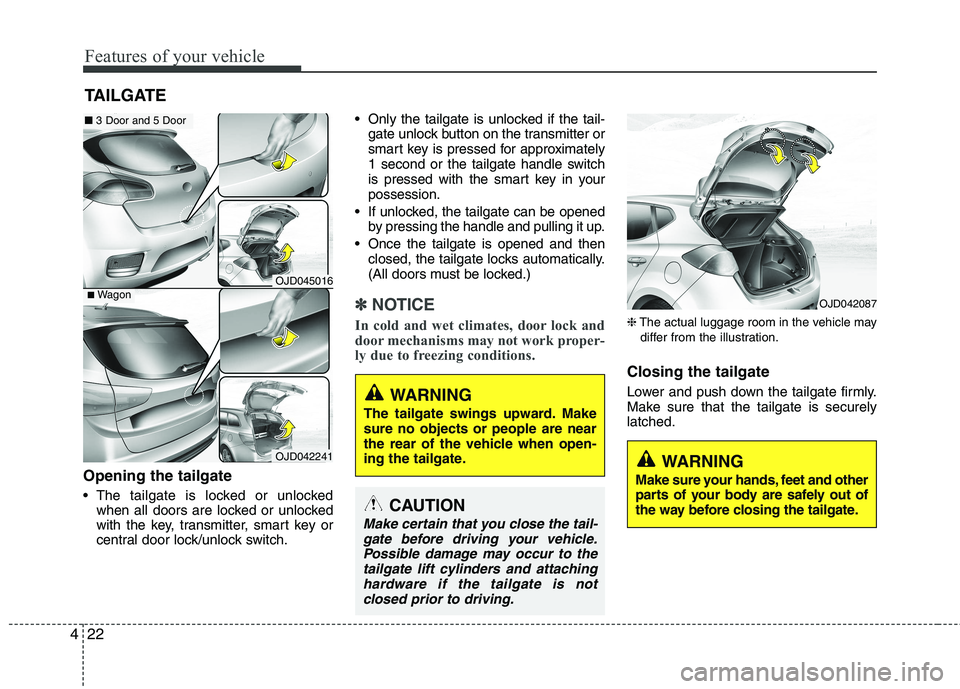
Opening the tailgate
The tailgate is locked or unlocked
when all doors are locked or unlocked
with the key, transmitter, smart key or
central door lock/unlock switch. Only the tailgate is unlocked if the tail-
gate unlock button on the transmitter or
smart key is pressed for approximately
1 second or the tailgate handle switch
is pressed with the smart key in yourpossession.
If unlocked, the tailgate can be opened by pressing the handle and pulling it up.
Once the tailgate is opened and then closed, the tailgate locks automatically.
(All doors must be locked.)
✽✽ NOTICE
In cold and wet climates, door lock and
door mechanisms may not work proper-
ly due to freezing conditions.
❈ The actual luggage room in the vehicle may
differ from the illustration.
Closing the tailgate
Lower and push down the tailgate firmly.
Make sure that the tailgate is securelylatched.
TAILGATE
OJD045016
OJD042241
WARNING
The tailgate swings upward. Make sure no objects or people are near
the rear of the vehicle when open-
ing the tailgate.
CAUTION
Make certain that you close the tail- gate before driving your vehicle.
Possible damage may occur to thetailgate lift cylinders and attachinghardware if the tailgate is not closed prior to driving.
WARNING
Make sure your hands, feet and other
parts of your body are safely out of
the way before closing the tailgate.
OJD042087
■ 3 Door and 5 Door
■Wagon
Page 114 of 653

Features of your vehicle
30
4
Closing the hood
1. Before closing the hood, check the fol-
lowing:
must be correctly installed.
bustible material must be removed
from the engine compartment.
2. Return the support rod to its clip to prevent it from rattling.
3. Lower the hood halfway and push
down to securely lock in place.
hood is secure.
force, open the hood again and close
it more firmly
WARNING - Hood
Before closing the hood, ensure that all obstructions are removed
from the hood opening. Closingthe hood with an obstruction
present in the hood opening may
result in property damage or
severe personal injury.
Do not leave gloves, rags or any other combustible material in the
engine compartment. Doing so
may cause a heat-induced fire.WARNING
Always double check to be sure that the hood is firmly latched
before driving away. If it is not
latched, the hood could fly open
while the vehicle is being driven,
causing a total loss of visibility,
which might result in an accident.
The support rod must be inserted completely into the hole whenev-
er you inspect the engine com-
partment. This will prevent the
hood from falling and possibly
injuring you.
Do not move the vehicle with the hood raised. The view will be
blocked and the hood could fall
or be damaged.
Page 115 of 653

431
Features of your vehicle
Opening the fuel filler lid
1. To open the lid, press the center edgeof the lid when all doors are unlocked.
✽✽ NOTICE
The lid will open and close only when all
doors are unlocked.
2. Fully open the lid (1).
3. To open the cap, turn it counterclock- wise (2).
4. Refuel as needed.
✽✽ NOTICE
If the fuel-filler lid does not open because
ice has formed around it, tap lightly or
push on the lid to break the ice and
release the lid. Do not pry on the lid. If
necessary, spray around the lid with an
approved de-icer fluid (do not use radia-
tor anti-freeze) or move the vehicle to a
warm place and allow the ice to melt.
Closing the fuel filler lid
1. To install the cap, turn it clockwise until it “clicks”. This indicates that the cap is securely tightened.
2. To close the lid, press the edge of the lid. Make sure it is securely closed.
FUEL FILLER LID
OJD042025OJD042026
Page 116 of 653
Features of your vehicle
32
4
WARNING - Refueling
If pressurized fuel sprays out, it can cover your clothes or skin
and thus subject you to the risk
of fire and burns. Always remove
the fuel cap carefully and slowly.
If the cap is venting fuel or if you
hear a hissing sound, wait until
the condition stops before com-
pletely removing the cap.
Do not "top off" after the nozzle automatically shuts off whenrefueling.
Always check that the fuel cap is installed securely to prevent fuel
spillage in the event of an acci-dent.(Continued)
Do not get back into a vehicle once you have begun refueling
since you can generate static
electricity by touching, rubbing
or sliding against any item or fab-
ric (polyester, satin, nylon, etc.)
capable of producing static elec-
tricity. Static electricity discharge
can ignite fuel vapors resulting in
rapid burning. If you must re-
enter the vehicle, you should
once again eliminate potentially
dangerous static electricity dis-
charge by touching a metal part
of the vehicle, away from the fuel
filler neck, nozzle or other gaso-
line source.
When using an approved portable fuel container, be sure toplace the container on the
ground prior to refueling. Static
electricity discharge from the
container can ignite fuel vapors
causing a fire. Once refueling has
begun, contact with the vehicleshould be maintained until the
filling is complete.
(Continued)WARNING - Refueling dan-
gers
Automotive fuels are flammable
materials. When refueling, please
note the following guidelines care-
fully. Failure to follow these guide-
lines may result in severe personal
injury, severe burns or death by fire
or explosion.
Read and follow all warning post- ed at the gas station facility.
Before refueling note the location of the Emergency Gasoline Shut-
Off, if available, at the gas station
facility.
Before touching the fuel nozzle, you should eliminate potentially
dangerous static electricity dis-
charge by touching another metal
part of the vehicle, a safe dis-
tance away from the fuel filler
neck, nozzle, or other gas source.
(Continued)