2017 KIA CEED child lock
[x] Cancel search: child lockPage 105 of 653
421
Features of your vehicle
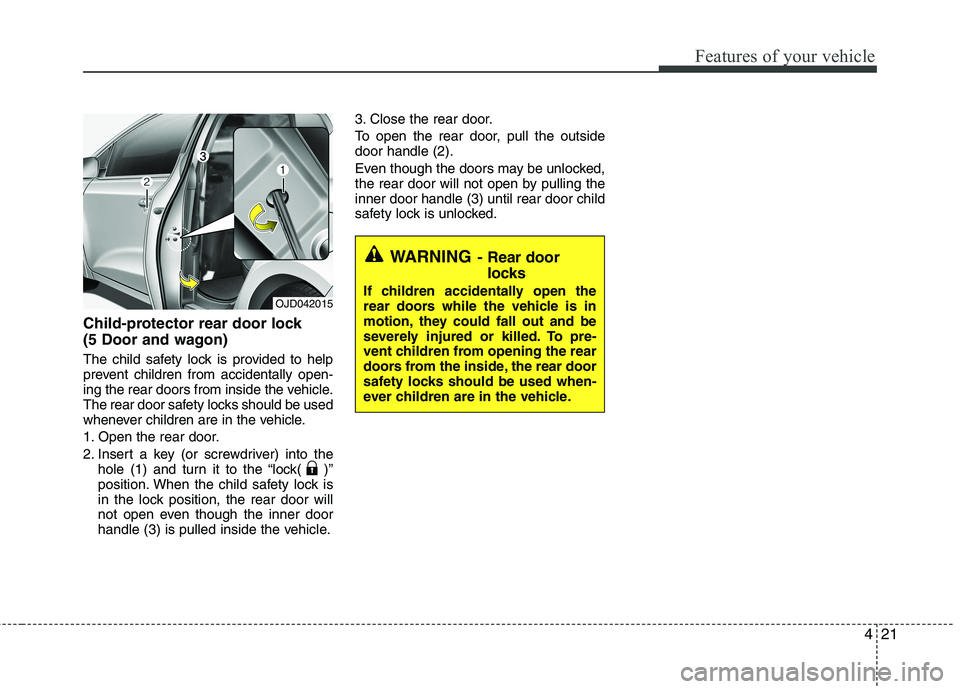
Child-protector rear door lock
(5 Door and wagon)
The child safety lock is provided to help
prevent children from accidentally open-
ing the rear doors from inside the vehicle.
The rear door safety locks should be used
whenever children are in the vehicle.
1. Open the rear door.
2. Insert a key (or screwdriver) into thehole (1) and turn it to the “lock( )”
position. When the child safety lock is
in the lock position, the rear door will
not open even though the inner door
handle (3) is pulled inside the vehicle. 3. Close the rear door.
To open the rear door, pull the outside door handle (2).
Even though the doors may be unlocked,
the rear door will not open by pulling theinner door handle (3) until rear door child
safety lock is unlocked.
WARNING
- Rear door
locks
If children accidentally open the
rear doors while the vehicle is in
motion, they could fall out and be
severely injured or killed. To pre-
vent children from opening the rear
doors from the inside, the rear door
safety locks should be used when-
ever children are in the vehicle.
OJD042015
Page 111 of 653
427
Features of your vehicle
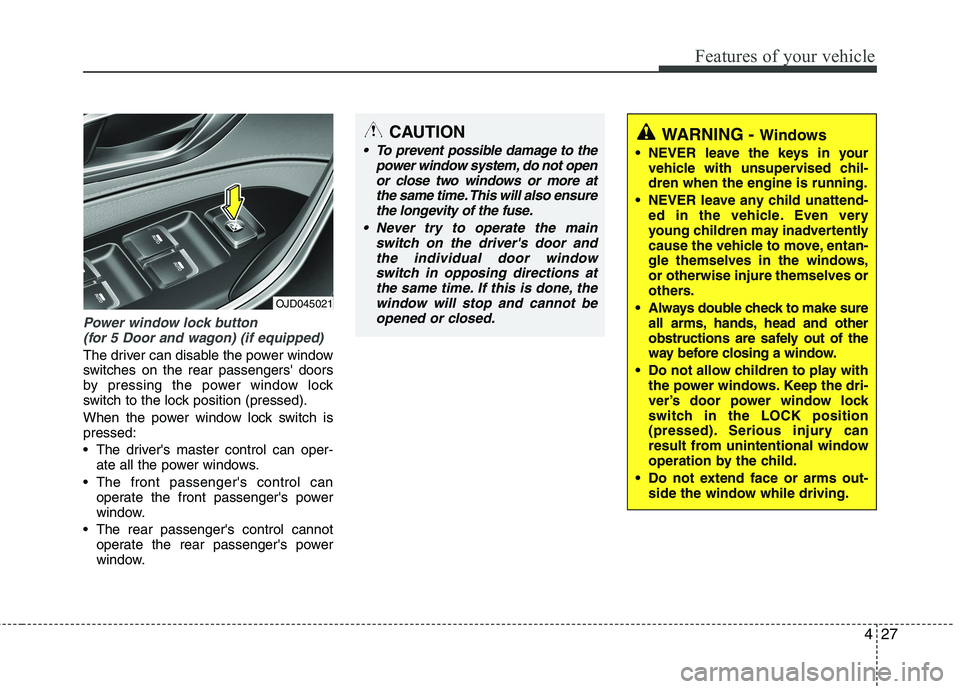
Power window lock button (for 5 Door and wagon) (if equipped)
The driver can disable the power window
switches on the rear passengers' doors
by pressing the power window lock
switch to the lock position (pressed).
When the power window lock switch is pressed:
The driver's master control can oper- ate all the power windows.
The front passenger's control can operate the front passenger's power
window.
The rear passenger's control cannot operate the rear passenger's power
window.
CAUTION
To prevent possible damage to the
power window system, do not open
or close two windows or more atthe same time. This will also ensurethe longevity of the fuse.
Never try to operate the main switch on the driver's door andthe individual door windowswitch in opposing directions atthe same time. If this is done, the
window will stop and cannot beopened or closed.WARNING - Windows
NEVER leave the keys in your vehicle with unsupervised chil- dren when the engine is running.
NEVER leave any child unattend- ed in the vehicle. Even very
young children may inadvertently
cause the vehicle to move, entan-
gle themselves in the windows,or otherwise injure themselves or
others.
Always double check to make sure all arms, hands, head and other
obstructions are safely out of the
way before closing a window.
Do not allow children to play with the power windows. Keep the dri-
ver’s door power window lock
switch in the LOCK position
(pressed). Serious injury can
result from unintentional window
operation by the child.
Do not extend face or arms out- side the window while driving.
OJD045021
Page 382 of 653

Driving your vehicle
4
5
Before entering vehicle
• Be sure that all windows, outside mir-
ror(s), and outside lights are clean.
Check the condition of the tires.
Check under the vehicle for any sign of leaks.
Be sure there are no obstacles behind you if you intend to back up. Necessary inspections
Fluid levels, such as engine oil, engine
coolant, brake fluid, and washer fluid
should be checked on a regular basis,
with the exact interval depending on the
fluid. Further details are provided in
chapter 7, “Maintenance”.
Before starting
Close and lock all doors.
Position the seat so that all controls are
easily reached.
Adjust the inside and outside rearview mirrors.
Be sure that all lights work.
Check all gauges.
Check the operation of warning lights when the ignition switch is turned to the ON position.
Release the parking brake and make sure the brake warning light goes out.
For safe operation, be sure you are famil-
iar with your vehicle and its equipment.
BEFORE DRIVING
WARNING
All passengers must be properly
belted whenever the vehicle is mov-
ing. Refer to “Seat belts” in chapter
3 for more information on their
proper use.
WARNING
Always check the surrounding areas
near your vehicle for people, espe-
cially children, before putting a vehi-
cle into “D (Drive)” or “R (Reverse)”.
WARNING
Driving while distracted can result
in a loss of vehicle control, that
may lead to an accident, severe
personal injury, and death. The dri-
ver’s primary responsibility is in
the safe and legal operation of a
vehicle, and use of any handheld
devices, other equipment, or vehi-
cle systems which take the driver’s
eyes, attention and focus away
from the safe operation of a vehicle
or which are not permissible by law
should never be used during oper-
ation of the vehicle.
Page 401 of 653

523
Driving your vehicle
Automatic transaxle operation
The highly efficient automatic transaxle
has 6 forward speeds and one reverse
speed. The individual speeds are select-
ed automatically, depending on the posi-
tion of the shift lever.
✽✽NOTICE
The first few shifts on a new vehicle, if
the battery has been disconnected, may
be somewhat abrupt. This is a normal
condition, and the shifting sequence will
adjust after shifts are cycled a few times
by the TCM (Transaxle Control Module)
or PCM (Powertrain Control Module).
For smooth operation, depress the brake pedal when shifting from N (Neutral) to aforward or reverse gear.
AUTOMATIC TRANSAXLE (IF EQUIPPED)
OJD052005
+
+++ ((((UUUUPPPP))))
---- ((((DDDDOOOOWWWWNNNN))))
The shift lever can be shifted freely.
Press the lock release button when shifting.
Depress the brake pedal and the lock release button when shifting.
(If the shift lock system is not equipped, it is not necessary to depress the brake pedal.
However, it is recommended to depress the brake pedal to avoid inadvertent movement
of the vehicle.)
WARNING
- Automatic
transaxle
Always check the surrounding areas near your vehicle for peo-
ple, especially children, before
shifting a vehicle into D (Drive) or
R (Reverse).
(Continued)
Page 402 of 653

Driving your vehicle
24
5
Transaxle ranges
The indicator lights in the instrument clus-
ter displays the shift lever position when
the ignition switch is in the ON position.
P (Park)
Always come to a complete stop before
shifting into P (Park). This position locks
the transaxle and prevents the frontwheels from rotating. R (Reverse)
Use this position to drive the vehicle
backward.
N (Neutral)
The wheels and transaxle are not
engaged. The vehicle will roll freely even
on the slightest incline unless the parking
brake or service brakes are applied.(Continued)
Before leaving the driver’s seat,
always make sure the shift lever
is in the P (Park) position; then
set the parking brake fully and
shut the engine off. Unexpected
and sudden vehicle movementcan occur if these precautions
are not followed in the order iden-tified.
Do not use the engine brake (shifting from a high gear to
lower gear) rapidly on slippery
roads. The vehicle may slip caus-ing an accident.
CAUTION
To avoid damage to your
transaxle, do not accelerate theengine in R (Reverse) or any for-ward gear position with thebrakes on.
When stopped on an upgrade, do not hold the vehicle stationarywith engine power. Use the serv-ice brake or the parking brake.
Do not shift from N (Neutral) or P (Park) into D (Drive), or R(Reverse) when the engine isabove idle speed.
WARNING
Shifting into P (Park) while the vehicle is in motion will cause the
drive wheels to lock which will
cause you to lose control of the
vehicle.
Do not use the P (Park) position in place of the parking brake.
Always make sure the shift lever
is latched in the P (Park) position
and set the parking brake fully.
Never leave a child unattended in a vehicle.
CAUTION
The transaxle may be damaged if
you shift into P (Park) while thevehicle is in motion.
CAUTION
Always come to a complete stop before shifting into or out of R(Reverse); you may damage the
transaxle if you shift into R (Reverse)while the vehicle is in motion, except as explained in “Rocking the vehi-cle”, in this manual.
WARNING
Do not drive with the shift lever in N
(Neutral). The engine brake will not
work and lead to an accident.
Page 408 of 653

Driving your vehicle
30
5
DUAL CLUTCH TRANSMISSION (DCT) (IF EQUIPPED)
Dual clutch transmission opera- tion
The dual clutch transmission has 7 (or 6)
forward speeds and one reverse speed. The individual speeds are selected auto-
matically in the D (Drive) position.
OJD052005
+
+++ ((((UUUUPPPP))))
---- ((((DDDDOOOOWWWWNNNN))))
The shift lever can be shifted freely.
Press the lock release button when shifting.
Depress the brake pedal and the lock release button when shifting.
(If the shift lock system is not equipped, it is not necessary to depress the brake pedal.
However, it is recommended to depress the brake pedal to avoid inadvertent movement
of the vehicle.)
WARNING
To reduce the risk of serious injury or death:
ALWAYS check the surrounding areas near your vehicle for peo-
ple, especially children, before
shifting a vehicle into D (Drive) or
R (Reverse).
Before leaving the driver’s seat, always make sure the shift lever
is in the P (Park) position, then
set the parking brake, and place
the ignition switch in the
LOCK/OFF position. Unexpected
and sudden vehicle movementcan occur if these precautions
are not followed.
Do not use engine braking (shift- ing from a high gear to lower
gear) rapidly on slippery roads.
The vehicle may slip causing anaccident.
Page 488 of 653

What to do in an emergency
10
6
Removing and storing the spare tire
Turn the tire hold-down wing bolt (1)
counterclockwise.
Store the tire in the reverse order of
removal.
To prevent the spare tire and tools
from “rattling” while the vehicle is in
motion, store them properly. Changing tires
1. Park on a level surface and apply
the parking brake firmly.
2. Shift the shift lever into R (Reverse) with manual transaxle
or P (Park) with automatic
transaxle.
3. Activate the hazard warning flash- er.
OGD061004
(Continued)
The vehicle can easily roll offthe jack causing serious
injury or death.
Do not get under a vehicle that is supported by a jack.
Do not start or run the engine while the vehicle is on the
jack.
Do not allow anyone to remain in the vehicle while it is on the
jack.
Make sure any children pres- ent are in a secure place away
from the road and from the
vehicle to be raised with the
jack.
OED066033
Page 646 of 653

I3
Index
Brake system..................................................................5-40
Anti-lock brake system (ABS)....................................5-48
Electric parking brake (EPB) ......................................5-44
Electronic stability control (ESC) ..............................5-51
Emergency Stop Signal (ESS) ....................................5-56
Good braking practices ..............................................5-56
Hill-start assist control (HAC) ....................................5-55
Parking brake - Hand type ..........................................5-42
Power brakes ..............................................................5-40
Vehicle stability management (VSM) ........................5-54
Brake/clutch fluid ..........................................................7-32 Checking the brake fluid level ....................................7-32
Bulb wattage ....................................................................8-6
Child restraint system ....................................................3-32 Using a child restraint system ....................................3-34
Clean air ......................................................................4-163
Climate control air filter ................................................7-37 Filter inspection ..........................................................7-37
Filter replacement ......................................................7-37
Cruise Control system ..................................................5-58
Declaration of conformity ............................................8-15 Defroster ......................................................................4-139
Rear window defroster ..............................................4-139
Dimensions ......................................................................8-2
Door locks......................................................................4-17 Child-protector rear door lock ....................................4-21
Deadlocks....................................................................4-20
Door lock/unlock features ..........................................4-20
From inside ................................................................4-18
From outside ..............................................................4-17
Dual Clutch Transmission (DCT)..................................5-30 Dual clutch transmission operation ............................5-30
Good driving practices ................................................5-37
Economical operation ....................................................5-81
Emergency commodity ..................................................6-40 Fire extinguisher ........................................................6-40
First aid kit ..................................................................6-40
Tire pressure gauge ....................................................6-40
Triangle reflector ........................................................6-40
Emergency starting ..........................................................6-5 Jump starting ................................................................6-5
Push-starting ................................................................6-7
Emission control system ..............................................7-107
Engine ..............................................................................8-3
Engine compartment ................................................2-6, 7-3
C
D
E