2017 KIA CARENS RHD tow
[x] Cancel search: towPage 598 of 723
811
Maintenance
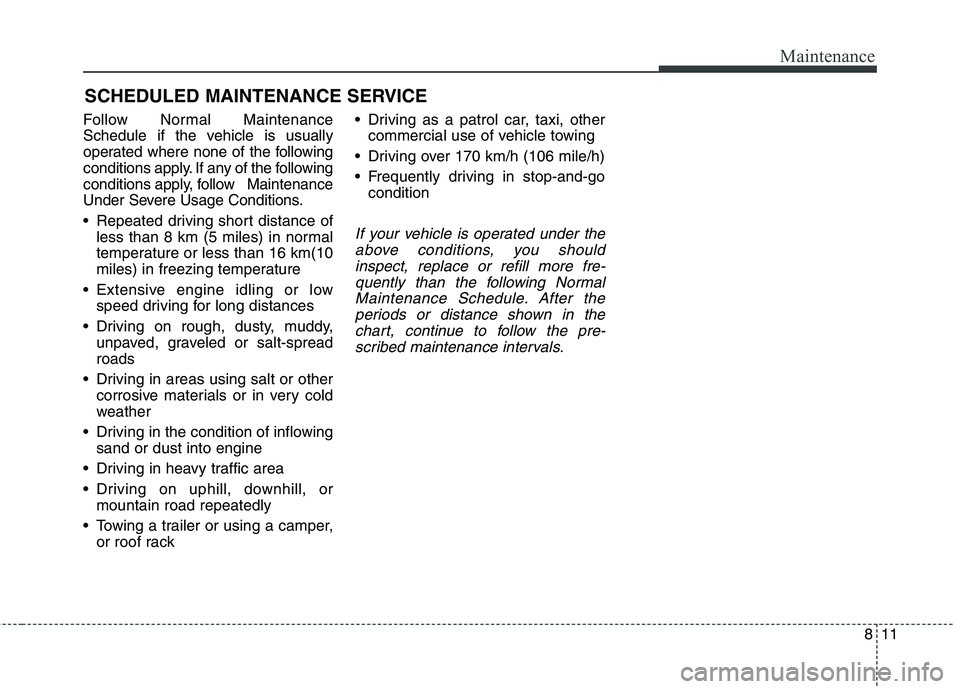
SCHEDULED MAINTENANCE SERVICE
Follow Normal Maintenance
Schedule if the vehicle is usually
operated where none of the following
conditions apply. If any of the following
conditions apply, follow Maintenance
Under Severe Usage Conditions.
Repeated driving short distance of less than 8 km (5 miles) in normal
temperature or less than 16 km(10
miles) in freezing temperature
Extensive engine idling or low speed driving for long distances
Driving on rough, dusty, muddy, unpaved, graveled or salt-spreadroads
Driving in areas using salt or other corrosive materials or in very cold
weather
Driving in the condition of inflowing sand or dust into engine
Driving in heavy traffic area
Driving on uphill, downhill, or mountain road repeatedly
Towing a trailer or using a camper, or roof rack Driving as a patrol car, taxi, other
commercial use of vehicle towing
Driving over 170 km/h (106 mile/h)
Frequently driving in stop-and-go condition
If your vehicle is operated under the
above conditions, you shouldinspect, replace or refill more fre- quently than the following NormalMaintenance Schedule. After theperiods or distance shown in the chart, continue to follow the pre-scribed maintenance intervals.
Page 605 of 723

Maintenance
18
8
Severe driving conditions
A : Repeatedly driving short distance of less than 8 km (5
miles) in normal temperature or less than 16 km (10 miles)
in freezing temperature.
B : Extensive engine idling or low speed driving for long dis- tances.
C : Driving on rough, dusty, muddy, unpaved, graveled or salt- spread roads.
D : Driving in areas using salt or other corrosive materials or in very cold weather. E : Driving in heavy dust condition.
F : Driving in heavy traffic area.
G : Driving on uphill, downhill, or mountain roads repeatedly.
H : Towing a trailer or using a camper on roof rack.
I : Driving for patrol car, taxi, commercial car or vehicle towing.
J : Driving over 170 km/h (106 mile/h).
K : Frequently driving in stop-and-go conditions.
Maintenance itemMaintenance
operationMaintenance intervalsDriving Condition
Front suspension ball jointsIInspect more frequently depending on the conditionC, D, E, F, G
Disc brakes and pads, calipers and rotorsIInspect more frequently depending on the conditionC, D, E, G, H
Parking brake (Hand type)IInspect more frequently depending on the conditionC, D, G, H
Drive shaft and bootsIInspect more frequently depending on the conditionC, D, E, F,
G, H, I, J, K
Climate control air filter RReplace more frequently depending on the conditionC, E, G
Spark plugsRReplace more frequently depending on the conditionB, H, I, K
Page 614 of 723

827
Maintenance
Severe driving conditions
A : Repeatedly driving short distance of less than 8 km (5miles) in normal temperature or less than 16 km (10 miles)
in freezing temperature.
B : Extensive engine idling or low speed driving for long dis- tances.
C : Driving on rough, dusty, muddy, unpaved, graveled or salt- spread roads.
D : Driving in areas using salt or other corrosive materials or in very cold weather. E : Driving in heavy dust condition.
F : Driving in heavy traffic area.
G : Driving on uphill, downhill, or mountain roads repeatedly.
H : Towing a trailer or using a camper on roof rack.
I : Driving for patrol car, taxi, commercial car or vehicle towing.
J : Driving over 170 km/h (106 mile/h).
K : Frequently driving in stop-and-go conditions.
Maintenance itemMaintenance
operationMaintenance intervalsDriving condition
Steering gear rack, linkage and bootsIInspect more frequently
depending on the conditionC, D, E, F, G
Front suspension ball jointsIInspect more frequently
depending on the conditionC, D, E, F, G
Disc brakes and pads, calipers and rotorsIInspect more frequently
depending on the conditionC, D, E, G, H
Parking brake (Hand type)IInspect more frequently
depending on the conditionC, D, G, H
Driveshaft and bootsIInspect more frequently
depending on the conditionC, D, E, F, G, H, I, J
Climate control air filterRReplace more frequently
depending on the conditionC, E, G
Spark plugsRReplace more frequently
depending on the conditionB, H, I, K
Page 621 of 723
Maintenance
34
8
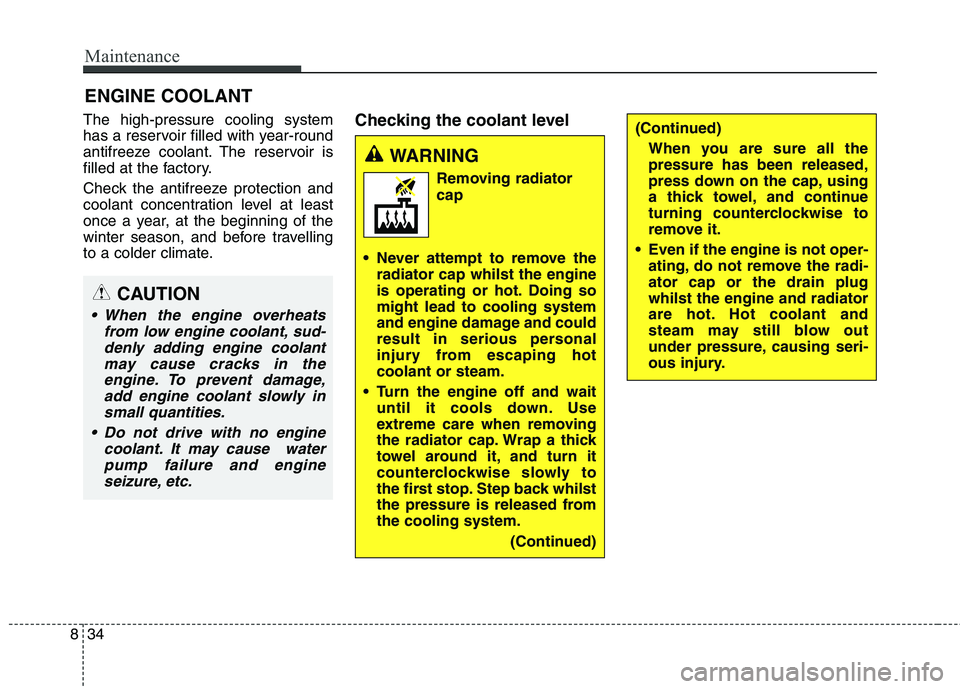
ENGINE COOLANT
The high-pressure cooling system
has a reservoir filled with year-round
antifreeze coolant. The reservoir is
filled at the factory.
Check the antifreeze protection and
coolant concentration level at least
once a year, at the beginning of the
winter season, and before travelling
to a colder climate. Checking the coolant level
(Continued)
When you are sure all the pressure has been released,
press down on the cap, using
a thick towel, and continue
turning counterclockwise to
remove it.
Even if the engine is not oper- ating, do not remove the radi-ator cap or the drain plugwhilst the engine and radiator
are hot. Hot coolant and
steam may still blow out
under pressure, causing seri-
ous injury.
WARNING
Removing radiatorcap
Never attempt to remove the radiator cap whilst the engine
is operating or hot. Doing somight lead to cooling system
and engine damage and could
result in serious personal
injury from escaping hotcoolant or steam.
Turn the engine off and wait until it cools down. Use
extreme care when removing
the radiator cap. Wrap a thick
towel around it, and turn it
counterclockwise slowly to
the first stop. Step back whilst
the pressure is released fromthe cooling system.
(Continued)
CAUTION
When the engine overheatsfrom low engine coolant, sud-denly adding engine coolantmay cause cracks in theengine. To prevent damage, add engine coolant slowly insmall quantities.
Do not drive with no engine coolant. It may cause waterpump failure and engine seizure, etc.
Page 721 of 723
I9
Index
Highway driving ........................................................6-95
Rocking the vehicle ..................................................6-92
Smooth cornering ........................................................6-93
Speed limit control system ............................................6-69 Speed limit control switch ..........................................6-69
To set speed limit ........................................................6-69
To turn off the speed limit control ..............................6-71
Speed Limit Information Function (SLIF) ....................6-72 Display ........................................................................6-74
DRIVER'S ATTENTION............................................6-77
Operation ....................................................................6-73
SLIF activation / Deactivation ....................................6-73
Steering wheel ..............................................................4-48 Electronic power steering (EPS) ................................4-48
FLEX STEER ............................................................4-51
Heated steering wheel ................................................4-49
Horn ............................................................................4-50
Tilt & telescopic steering ..........................................4-49
Storage compartment ..................................................4-168 Centre console storage ..............................................4-168
Cool box....................................................................4-169
Floor under tray ........................................................4-171
Glove box ................................................................4-168
Luggage tray ............................................................4-170
Sunglass holder ........................................................4-170 Tailgate ..........................................................................4-30
Closing the tailgate ....................................................4-31
Emergency tailgate safety release ..............................4-32
Opening the tailgate ....................................................4-30
Theft-alarm system ........................................................4-16 Armed stage ................................................................4-16
Disarmed stage ............................................................4-18
Theft-alarm stage ........................................................4-18
Theft-alarm system (intrusion protection system, UK only) ......................4-19Armed stage ................................................................4-19
Disarmed stage ............................................................4-22
Self-diagnosis..............................................................4-22
Theft-alarm stage ........................................................4-21
Towing ..........................................................................7-32 Emergency towing ......................................................7-34
Removable towing hook ............................................7-33
Towing service ............................................................7-32
Trailer Towing..............................................................6-100
Trip computer ................................................................4-77 Fuel Economy ............................................................4-79
Overview ....................................................................4-77
Trip A/B (for Type A cluster) ....................................4-78
Tyre Pressure Monitoring System (TPMS) ....................7-9 Changing a tyre with TPMS ......................................7-12
Low tyre pressure telltale............................................7-10T