2017 KIA BORREGO check oil
[x] Cancel search: check oilPage 464 of 548

Maintenance
28
8
POWER STEERING FLUID
Checking the power steering
fluid level
With the vehicle on level ground,
check the fluid level in the power
steering reservoir periodically. The
fluid should be between MAX and
MIN marks on the side of the reser-
voir at the normal temperature.
Before adding power steering fluid, thoroughly clean the area around the
reservoir cap to prevent power steer-ing fluid contamination.
If the level is low, add fluid to the
MAX level.
✽✽ NOTICE
Check that the fluid level is in the
"HOT" range on the reservoir. If
the fluid is cold, check that it is in
the "COLD" range.
In the event the power steering sys- tem requires frequent addition of
fluid we recommend that the vehicle
should be inspected by an author-
ized Kia dealer.
Use only the specified power steering fluid. (Refer to "Recommended lubri-cants or capacities" in chapter 9.)
Checking the power steering hose
Check the connections for oil leaks,
damage and twists in the power
steering hose before driving.
CAUTION
To avoid damage to the power steering pump, do not operatethe vehicle for prolonged peri-ods with a low power steeringfluid level.
Never start the engine when the reservoir tank is empty.
When adding fluid, be careful that dirt does not get into thetank.
(Continued)
(Continued) Too little fluid can result in increased steering effortand/or noise from the power steering system.
The use of the non-specified fluid could reduce the effective-ness of the power steering sys-tem and cause damage to it.
OHM078006N
Page 476 of 548

Maintenance
40
8
Battery capacity label ❈ The actual battery label in the vehicle may
differ from the illustration.
1. AGM90L-DIN : The Kia model
name of battery
2. 90Ah(20HR) : The nominal capaci-
ty (in Ampere hours)
3. 170RC : The nominal reserve
capacity (in min.)
4. 12V : The nominal voltage
5. 850CCA (SAE) : The cold-test cur-
rent in amperes
by SAE
6. 680A : The cold-test current in
amperes by EN Battery recharging
Your vehicle has a maintenance-free,
calcium-based battery.
If the battery becomes discharged
in a short time (because, for exam-
ple, the headlights or interior lights
were left on while the vehicle was
not in use), recharge it by slow
charging (trickle) for 10 hours.
If the battery gradually discharges because of high electric load while
the vehicle is being used, recharge
it at 20-30A for two hours.
OUM074113L
■
Example
WARNING - Recharging
battery
When recharging the battery,
observe the following precau-tions:
The battery must be removed from the vehicle and placed in an area with good ventilation.
Do not allow cigarettes, sparks, or flame near the battery.
Watch the battery during charging, and stop or reduce
the charging rate if the batterycells begin gassing (boiling)
violently or if the temperature
of the electrolyte of any cell
exceeds 49°C (120°F).
Wear eye protection when checking the battery during
charging.
(Continued)
Page 489 of 548

853
Maintenance
FUSES
❈ Left side : Normal
Right side : blown
A vehicle’s electrical system is pro-
tected from electrical overload dam-
age by fuses. This vehicle has 5 fuse panels, one
located in the driver’s side panel bol-
ster, the others in the engine com-
partment near the battery.
If any of your vehicle’s lights, acces-
sories, or controls do not work, check
the appropriate circuit fuse. If the fuse
becomes disconnected, the electricalsystem it protected will not function
properly. Therefore, replace the fuse.
If the electrical system does not work,
first check the driver’s side fuse panel.
In order to replace the fuse, turn off
the engine and switch of all electrical
system first. Then, disconnect the
negative battery cable of the fuse and
replace at a level and safe location.
Always replace a blown fuse with
one of the same rating. If
the replace-
ment fuse blows, this indicates an elec-
trical problem. Avoid using the system
involved and we recommend that you
consult an authorized Kia dealer.
Three kinds of fuses are used: blade
type for lower amperage rating, car-tridge type, and fusible link for higheramperage ratings.
WARNING - Fuse replace- ment
Never replace a fuse with any- thing but another fuse of the same rating.
A higher capacity fuse could cause damage and possibly a
fire.
Never install a wire or alu- minum foil instead of the
proper fuse even as a tempo-
rary repair. It may cause
extensive wiring damage and
a possible fire.
Do not arbitrarily modify or add-on electric wiring of the
vehicle.
1VQA4037
Normal
Normal
Blade type
Cartridge type
Fusible link Blown
Blown
Normal Blown
Page 532 of 548

Specifications & Consumer information
8
9
Recommended SAE viscosity
number
Engine oil viscosity (thickness) has
an effect on fuel economy and cold
weather operating (engine start and
engine oil flowability). Lower viscosi-
ty engine oils can provide better fuel
economy and cold weather perform-
ance, however, higher viscosity
engine oils are required for satisfac-
tory lubrication in hot weather. Using
oils of any viscosity other than thoserecommended could result in engine
damage.
CAUTION
Always be sure to clean the area
around any filler plug, drainplug, or dipstick before check- ing or draining any lubricant.This is especially important industy or sandy areas and when the vehicle is used on unpavedroads. Cleaning the plug anddipstick areas will prevent dirt and grit from entering theengine and other mechanismsthat could be damaged.
When choosing an oil, consider the range of temperature your vehicle will be
operated in before the next oil change. Proceed to select the recommended
oil viscosity from the chart.
Temperature Range for SAE Viscosity Numbers
Temperature
Gasoline Engine Oil (Except Middle East* 1
)
Gasoline Engine Oil (For Middle East* 1
)
°C
(°F)-30 -20 -10 0 10 20 30 40 50 -10 0 20 40 60 80 100 120
*1
: Middle East includes India, Libya, Algeria, Morocco, Tunisia, Sudan, Egypt and Iran.
* 2
: For better fuel economy, it is recommended to use the engine oil of a viscosity grade SAE
5W-20(API SM / ILSAC GF-4). However, if the engine oil is not available in your country,
select the proper engine oil using the engine oil viscosity chart.
* 3
: For better fuel economy, it is recommended to use the engine oil of a viscosity grade SAE
5W-30(ACEA A5). However, if the engine oil is not available in your country, select the prop-
er engine oil using the engine oil viscosity chart.
* 4
: It is only for extreme cold area and to be restricted by driving condition and area.
(Especially, not recommended for sustained high loaded and high speed operation.)
20W-50
10W-30
15W-40
5W-20 * 2
, 5W-30
20W-50
10W-30
15W-40
5W-30 * 3
, 5W-40
Diesel Engine Oil5W-30, 5W-40
15W-40
10W-30, 10W-40
0W-30 *4
Page 540 of 548
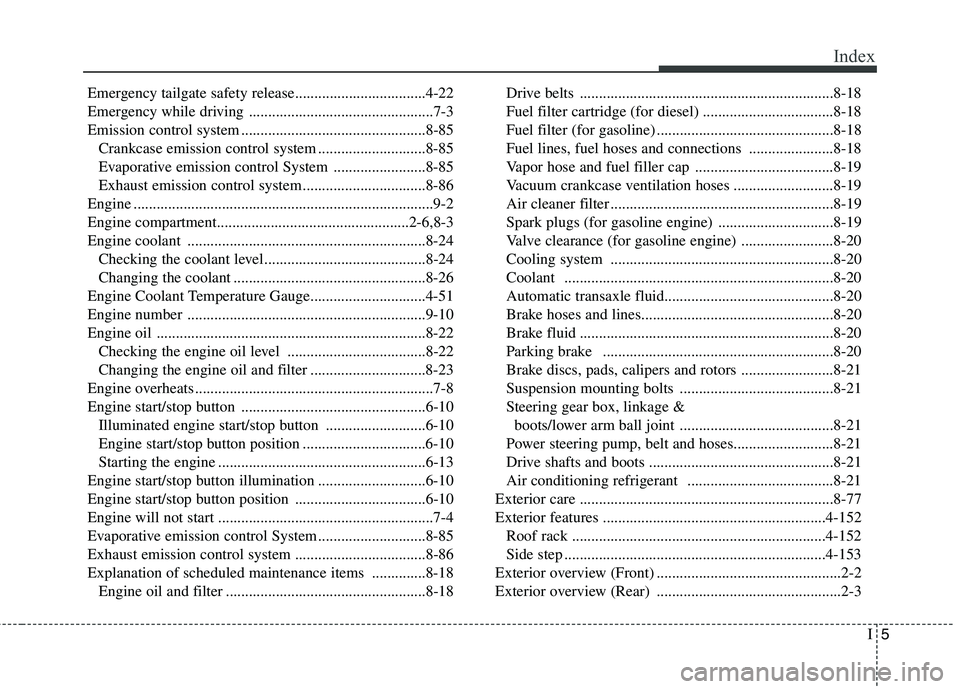
I5
Index
Emergency tailgate safety release..................................4-22
Emergency while driving ................................................7-3
Emission control system ................................................8-85
Crankcase emission control system ............................8-85
Evaporative emission control System ........................8-85
Exhaust emission control system ................................8-86
Engine ..............................................................................9-2
Engine compartment..................................................2-6,8-3
Engine coolant ..............................................................8-24 Checking the coolant level..........................................8-24
Changing the coolant ..................................................8-26
Engine Coolant Temperature Gauge..............................4-51
Engine number ..............................................................9-10
Engine oil ......................................................................8-22 Checking the engine oil level ....................................8-22
Changing the engine oil and filter ..............................8-23
Engine overheats ..............................................................7-8
Engine start/stop button ................................................6-10 Illuminated engine start/stop button ..........................6-10
Engine start/stop button position ................................6-10
Starting the engine ......................................................6-13
Engine start/stop button illumination ............................6-10
Engine start/stop button position ..................................6-10
Engine will not start ........................................................7-4
Evaporative emission control System ............................8-85
Exhaust emission control system ..................................8-86
Explanation of scheduled maintenance items ..............8-18 Engine oil and filter ....................................................8-18 Drive belts ..................................................................8-18
Fuel filter cartridge (for diesel) ..................................8-18
Fuel filter (for gasoline) ..............................................8-18
Fuel lines, fuel hoses and connections ......................8-18
Vapor hose and fuel filler cap ....................................8-19
Vacuum crankcase ventilation hoses ..........................8-19
Air cleaner filter ..........................................................8-19
Spark plugs (for gasoline engine) ..............................8-19
Valve clearance (for gasoline engine) ........................8-20
Cooling system ..........................................................8-20Coolant ......................................................................8-20Automatic transaxle fluid............................................8-20
Brake hoses and lines..................................................8-20
Brake fluid ..................................................................8-20
Parking brake ............................................................8-20
Brake discs, pads, calipers and rotors ........................8-21
Suspension mounting bolts ........................................8-21
Steering gear box, linkage & boots/lower arm ball joint ........................................8-21
Power steering pump, belt and hoses..........................8-21
Drive shafts and boots ................................................8-21
Air conditioning refrigerant ......................................8-21
Exterior care ..................................................................8-77
Exterior features ..........................................................4-152 Roof rack ..................................................................4-152
Side step ....................................................................4-153
Exterior overview (Front) ................................................2-2
Exterior overview (Rear) ................................................2-3
Page 544 of 548

I9
Index
Maintenance
Engine compartment ....................................................8-3
Maintenance services ....................................................8-5
Owner maintenance ......................................................8-8
Scheduled maintenance service ..................................8-10
Explanation of scheduled maintenance items ............8-18
Tire maintenance ........................................................8-47
Maintenance schedule....................................................8-10 Normal Maintenance Schedule ..................................8-11
Maintenance Under Severe Usage Conditions ..........8-16
Maintenance services ......................................................8-5 Owner’s responsibility ..................................................8-5
Owner maintenance precautions ..................................8-5
Engine compartment precautions (Diesel engine) ............................................................8-6
Manual mode - Automatic transaxle ............................6-19
Map lamp ....................................................................4-112
Mirrors ..........................................................................4-42 Inside rearview mirror ................................................4-42
Day/night rearview mirror ..........................................4-42
Electrochromic mirror (ECM) ..................................4-42
Outside rearview mirror ..............................................4-43
Remote control ............................................................4-44
Folding the outside rearview mirror ..........................4-46 Non-inflation conditions(Air bags) ..............................3-68
Odometer ......................................................................4-53
Oil (Engine) ..................................................................8-22
Outside rearview mirror ................................................4-43
Outside Temperature ......................................................4-53
Overheats ........................................................................7-8
Owner maintenance ........................................................8-8
Owner maintenance schedule ......................................8-8
Parking assist system ....................................................4-91 Types of warning indicator and sound........................4-92
Parking brake ................................................................6-36
Parking brake ................................................................8-29 Checking the parking brake ........................................8-29
Parking light position ....................................................4-99
Power brakes ..................................................................6-34
Power outlet ................................................................4-147
Power steering................................................................4-39
Power steering fluid ......................................................8-28 Checking the power steering fluid level ....................8-28
Checking the power steering hose ..............................8-28
M
O
N
P