2017 KIA BORREGO weight
[x] Cancel search: weightPage 402 of 548

Driving your vehicle
78
6
Use high quality ethylene gly- col coolant
Your vehicle is delivered with high
quality ethylene glycol coolant in the
cooling system. It is the only type ofcoolant that should be used because
it helps prevent corrosion in the cool-
ing system, lubricates the water
pump and prevents freezing. Be sure
to replace or replenish your coolantin accordance with the maintenance
schedule in chapter 8. Before winter,
have your coolant tested to assure
that its freezing point is sufficient for
the temperatures anticipated during
the winter.
Check battery and cables
Winter puts additional burdens on
the battery system. Visually inspect
the battery and cables as described
in chapter 8. We recommend that the
level of charge in your battery be
checked by an authorized Kia dealer. Change to "winter weight" oil
if necessary In some climates it is recommended
that a lower viscosity "winter weight"
oil be used during cold weather. See
chapter 9 for recommendations. If
you aren't sure what weight oil you
should use, we recommend that you
consult an authorized Kia dealer.
Check spark plugs and ignition system
Inspect your spark plugs as
described in chapter 8 and replace
them if necessary. Also check all
ignition wiring and components to be
sure they are not cracked, worn or
damaged in any way.
To keep locks from freezing
To keep the locks from freezing,
squirt an approved de-icer fluid or
glycerine into the key opening. If a
lock is covered with ice, squirt it with
an approved de-icing fluid to remove
the ice. If the lock is frozen internally,
you may be able to thaw it out by
using a heated key. Handle the heat-
ed key with care to avoid injury.
Use approved window washer
anti-freeze in system
To keep the water in the window
washer system from freezing, add an
approved window washer anti-freeze
solution in accordance with instruc-
tions on the container. Window wash-
er anti-freeze is available from an
authorized Kia dealer and most auto
parts outlets. Do not use engine
coolant or other types of anti-freeze
as these may damage the paint fin-ish.
Page 404 of 548

Driving your vehicle
80
6
VEHICLE WEIGHT
This section will guide you in the
proper loading of your vehicle and/or
trailer, to keep your loaded vehicle
weight within its design rating capa-
bility, with or without a trailer. Properly
loading your vehicle will provide max-
imum return of the vehicle design
performance. Before loading your
vehicle, familiarize yourself with the
following terms for determining your
vehicle's weight ratings, with or with-
out a trailer, from the vehicle's speci-
fications and the certification label: Base curb weight
This is the weight of the vehicle including a full tank of fuel and all
standard equipment. It does not
include passengers, cargo, or option-al equipment.
Vehicle curb weight
This is the weight of your new vehicle
when you picked it up from your deal-
er plus any aftermarket equipment. Cargo weight
This figure includes all weight added
to the Base Curb Weight, includingcargo and optional equipment.
GAW (Gross axle weight)
This is the total weight placed on each axle (front and rear) - including
vehicle curb weight and all payload.
GAWR
(Gross axle weight rating)
This is the maximum allowable
weight that can be carried by a single
axle (front or rear). These numbers
are shown on the certification label.
The total load on each axle must
never exceed its GAWR.
GVW (Gross vehicle weight)
This is the Base Curb Weight plus
actual Cargo Weight plus passengers.
GVWR
(Gross vehicle weight rating)
This is the maximum allowable
weight of the fully loaded vehicle
(including all options, equipment,
passengers and cargo). The GVWR
is shown on the certification label. Overloading
WARNING
- Vehicle
weight
The gross axle weight rating
(GAWR) and the gross vehicle
weight rating (GVWR) for your
vehicle are on the certification
label attached to the driver's (or
front passenger’s) door.Exceeding these ratings can
cause an accident or vehicle
damage. You can calculate the
weight of your load by weighing
the items (and people) before
putting them in the vehicle. Be
careful not to overload your
vehicle.
Page 478 of 548

Maintenance
42
8
TIRES AND WHEELS
Tire care
For proper maintenance, safety, and
maximum fuel economy, you must
always maintain recommended tire
inflation pressures and stay within
the load limits and weight distribution
recommended for your vehicle. Recommended cold tire infla- tion pressures All tire pressures (including the
spare) should be checked when the
tires are cold. “Cold Tires” means the
vehicle has not been driven for at
least three hours or driven less than1.6 km (one mile).
Recommended pressures must be
maintained for the best ride, top vehi-
cle handling, and minimum tire wear.
For recommended inflation pressure,
refer to “Tire and wheels” in chapter 9. All specifications (sizes and pres-
sures) can be found on a label
attached to the vehicle.
WARNING -
Tire under- inflation
Severe underinflation (70 kPa (10 psi) or more) can lead to
severe heat build-up, causing
blowouts, tread separation andother tire failures that can result
in the loss of vehicle control
leading to severe injury or
death. This risk is much higher
on hot days and when driving
for long periods at high speeds.
OHM088005N
CAUTION
Underinflation also results in excessive wear, poor handlingand reduced fuel economy. Wheel deformation also ispossible. Keep your tire pres-sures at the proper levels. If a tire frequently needs refilling,we recommend that the sys-tem be checked by an author- ized Kia dealer.
Overinflation produces a harsh ride, excessive wear atthe center of the tire tread, anda greater possibility of dam- age from road hazards.
Page 481 of 548

845
Maintenance
Disc brake pads should be inspectedfor wear whenever tires are rotated.
✽✽ NOTICE
Rotate radial tires that have an
asymmetric tread pattern only from
front to rear and not from right to
left.Wheel alignment and tire bal- ance
The wheels on your vehicle were aligned and balanced carefully at the
factory to give you the longest tire life
and best overall performance.
In most cases, you will not need to
have your wheels aligned again.
However, if you notice unusual tire
wear or your vehicle pulling one way
or the other, the alignment may needto be reset.
If you notice your vehicle vibrating
when driving on a smooth road, your
wheels may need to be rebalanced.
WARNING
Do not mix bias ply and radial
ply tires under any circum-
stances. This may cause unusu-
al handling characteristics that
could result in death, severe
injury, or property damage.
S2BLA790A
CBGQ0706
With a full-size spare tire
(Only the vehicle without TPMS system)
Directional tires (if equipped)
Without a spare tire
CBGQ0707A
CAUTION
Improper wheel weights can damage your vehicle's alu-minum wheels. Use onlyapproved wheel weights.
Page 525 of 548
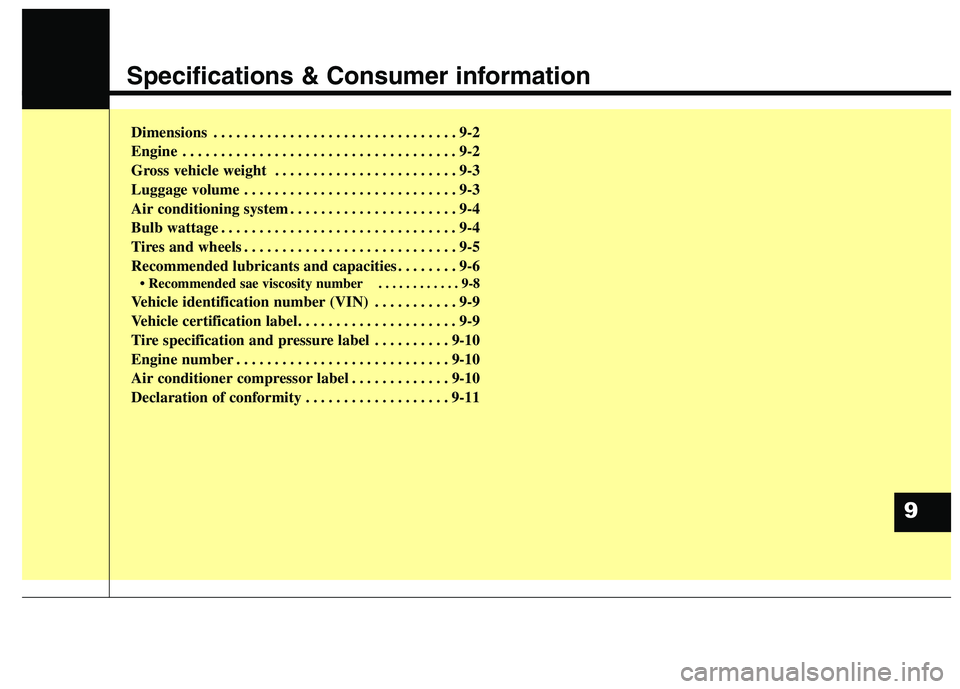
Specifications & Consumer information
Dimensions . . . . . . . . . . . . . . . . . . . . . . . . . . . . . . . . 9-2
Engine . . . . . . . . . . . . . . . . . . . . . . . . . . . . . . . . . . . . 9-2
Gross vehicle weight . . . . . . . . . . . . . . . . . . . . . . . . 9-3
Luggage volume . . . . . . . . . . . . . . . . . . . . . . . . . . . . 9-3
Air conditioning system . . . . . . . . . . . . . . . . . . . . . . 9-4
Bulb wattage . . . . . . . . . . . . . . . . . . . . . . . . . . . . . . . 9-4
Tires and wheels . . . . . . . . . . . . . . . . . . . . . . . . . . . . 9-5
Recommended lubricants and capacities . . . . . . . . 9-6• Recommended sae viscosity number . . . . . . . . . . . . 9-8
Vehicle identification number (VIN) . . . . . . . . . . . 9-9
Vehicle certification label. . . . . . . . . . . . . . . . . . . . . 9-9
Tire specification and pressure label . . . . . . . . . . 9-10
Engine number . . . . . . . . . . . . . . . . . . . . . . . . . . . . 9-10
Air conditioner compressor label . . . . . . . . . . . . . 9-10
Declaration of conformity . . . . . . . . . . . . . . . . . . . 9-11
9
Page 527 of 548

93
Specifications & Consumer information
GROSS VEHICLE WEIGHT
LUGGAGE VOLUME
Item
Gasoline EngineDiesel Engine
3.8 MPI3.0
2WD4WD4WD
GVWkg2,7202,7202,810
Item
Diesel Engine
3.0
4WD
GVWkg 2,820
For except Europe
For Europe
ITEMMinimum Volume
VDA580 l
Page 528 of 548

Specifications & Consumer information
4
9
AIR CONDITIONING SYSTEM
We recommend that you contact an authorized Kia dealer
for more details.
ITEMWeight of
volumeClassification
Refrigerant
GSL
Front A/CON600±25g
R134a
Front +
Rear A/CON750±25g
DSL
Front A/CON750±25g
Front +
Rear A/CON950±25g
Compressor lubricant200g±10gPAG OIL (PAG30)
* : If equipped
BULB WATTAGE
Light BulbWattage
Headlights (Low)55 or 35 (HID)
Daytime running lights* LED
Headlights (High)55
Front turn signal light21
Position lightsWith DRLLED
Without DRL5W
Side repeater lights* LED
Front fog lights* 35W
Rear fog light*21
Stop and tail lightsExcept Middle East21/5 or LED
For Middle East 27/8 or LED
Tail light*5 or LED
Rear turn signal lights 21 or 27
Back-up lights16
High mounted stop light*LED
License plate lights5
Map lamps6
Room lamps10
Luggage lamp*5
Glove box lamp*5
Vanity mirror lamps*5
Door courtesy lamps*5
Page 541 of 548

Index
6
I
Flat tire ..........................................................................7-16
Jack and tools ..............................................................7-16
Removing the spare tire ..............................................7-17
Storing the spare tire ..................................................7-17
Changing tires ............................................................7-18
Compact spare tire ......................................................7-23
Floor mat anchor(s) ....................................................4-149Fluid Brake fluid ..................................................................8-27
Power steering fluid ....................................................8-28
Washer fluid ................................................................8-29
Fog light (front) ..........................................................4-105
Folding the outside rearview mirror ..............................4-46
Four wheel drive (4WD)................................................6-23 Tight corner brake effect ............................................6-24
Part-Time 4WD ..........................................................6-25
Full-Time 4WD Operation..........................................6-27
For safe four wheel drive operation ............................6-29
Reducing the risk of a rollover ..................................6-31
Front fog lamp bulb replacement ..................................8-70
Front position lamp bulb replacement ..........................8-70
Front seat adjustment (manual) ......................................3-6
Front seat adjustment (power) ........................................3-7
Front turn signal lamp replacement ..............................8-70
Fuel filler lid ..................................................................4-31
Fuel filter (for diesel) ....................................................8-30 Draining water from the fuel filter ............................8-30
Fuel filter cartridge replacement ................................8-30
Fuel Gauge ....................................................................4-52
Fuel requirements ............................................................1-3
Fuses ..............................................................................8-53 Inner panel fuse replacement ....................................8-55
Engine compartment fuse replacement ......................8-56
Fuse/relay panel description ......................................8-58
Gauges ..........................................................................4-50
Glove box ....................................................................4-139
Gross vehicle weight........................................................9-3
Hazard warning flasher ....................................................7-2
Hazardous driving conditions ........................................6-71
Headlamp bulb replacement ..........................................8-70
Headlight position........................................................4-100
Headrest (rear) ..............................................................3-22
Headrest(front) ..............................................................3-12
Heated steering wheel....................................................4-40
High - beam operation ................................................4-101
High mounted stop light bulb replacement ..................8-75
Highway driving ............................................................6-74
Hill-start assist control (HAC) ......................................6-45
F
G
H