Page 149 of 516
Electronic Stability Control (ESC) OFF Indicator Light — If Equipped
Yellow TelltaleLight What It Means
Electronic Stability Control (ESC) OFF Indicator Light — If Equipped
This light indicates the Electronic Stability Control (ESC) is off.
Electronic Park Brake Fail Light
Yellow Telltale
Light What It Means
Electronic Park Brake Fail Warning Light
This telltale will turn on to indicate the Electronic Park Brake is not functioning properly and that
service is required. Contact your authorized dealership.
Fuel Level Sensor Failure
Yellow Telltale
Light What It Means
Fuel Level Sensor Failure
This light illuminates when there is a fuel level sensor failure. If this light illuminates, take it to
an authorized dealer and have them inspect it.
4
GETTING TO KNOW YOUR INSTRUMENT PANEL 147
Page 150 of 516
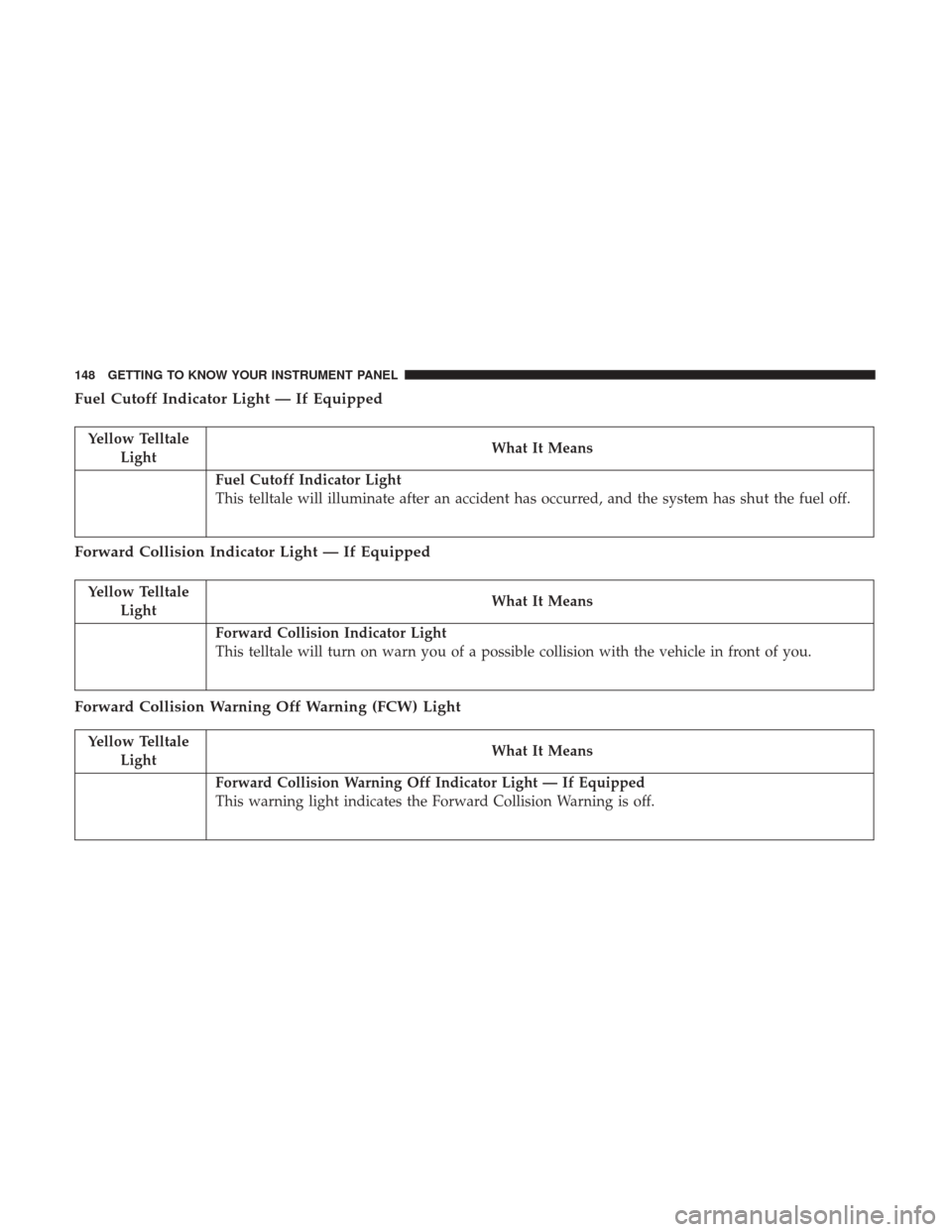
Fuel Cutoff Indicator Light — If Equipped
Yellow TelltaleLight What It Means
Fuel Cutoff Indicator Light
This telltale will illuminate after an accident has occurred, and the system has shut the fuel off.
Forward Collision Indicator Light — If Equipped
Yellow Telltale
Light What It Means
Forward Collision Indicator Light
This telltale will turn on warn you of a possible collision with the vehicle in front of you.
Forward Collision Warning Off Warning (FCW) Light
Yellow Telltale
Light What It Means
Forward Collision Warning Off Indicator Light — If Equipped
This warning light indicates the Forward Collision Warning is off.
148 GETTING TO KNOW YOUR INSTRUMENT PANEL
Page 151 of 516
Icy Road Condition Indicator Light — If Equipped
Yellow TelltaleLight What It Means
Icy Road Condition Indicator Light
This light will illuminate during an icy road condition.
Keyless System Failure
Yellow Telltale
Light What It Means
Keyless System Failure
This light illuminates when there is a keyless system failure. If this light illuminates, take it to an
authorized dealer and have them inspect it.
Low Fuel Warning Light
Yellow Telltale
Light What It Means
Low Fuel Indicator Light
When the fuel level reaches approximately 1.3–1.85 gal (5–7 L) this light will turn on, and remain
on until fuel is added.
4
GETTING TO KNOW YOUR INSTRUMENT PANEL 149
Page 153 of 516

Loose Fuel Filler Cap Indicator Light — If Equipped
Yellow TelltaleLight What It Means
Loose Fuel Filler Cap Indicator Light — If Equipped
This light will illuminate when fuel filler cap is loose. Properly close the filler cap to disengage
the light. If the light does not turn off, please see your authorized dealer.
Engine Malfunction Warning Light
Yellow Telltale
Light What It Means
Vehicle Check/Malfunction Indicator Light (MIL)
The Vehicle Check/Malfunction Indicator Light (MIL) is a part of an Onboard Diagnostic System
called OBD II that monitors emissions control systems. The light will illuminate when the igni-
tion is in the ON position before vehicle start up. If the bulb does not come on when placing the
ignition in the ON/RUN position, have the condition checked promptly.
Certain conditions, such as a loose or missing gas cap, poor quality fuel, etc., may illuminate the
light after vehicle start. The vehicle should be serviced if the light stays on through several typi-
cal driving styles. In most situations, the vehicle will drive normally and will not require towing.
When the vehicle is running, the MIL may flash to alert serious conditions that could lead to im-
mediate loss of power or severe catalytic converter damage. The vehicle should be serviced as
soon as possible if this occurs.
4
GETTING TO KNOW YOUR INSTRUMENT PANEL 151
Page 154 of 516
WARNING!
A malfunctioning catalytic converter, as referenced
above, can reach higher temperatures than in normal
operating conditions. This can cause a fire if you drive
slowly or park over flammable substances such as dry
plants, wood, cardboard, etc. This could result in death
or serious injury to the driver, occupants or others.
CAUTION!
Prolonged driving with the Malfunction Indicator
Light (MIL) on could cause damage to the vehicle
control system. It also could affect fuel economy and
driveability. If the MIL is flashing, severe catalytic
converter damage and power loss will soon occur.
Immediate service is required.
152 GETTING TO KNOW YOUR INSTRUMENT PANEL
Page 155 of 516
Service Stop/Start System Indicator Light — If Equipped
Yellow TelltaleLight What It Means
Service Stop/Start System Indicator Light
This telltale will turn on to indicate the Stop/Start system is not functioning properly and service
is required.
Tire Pressure Monitoring System (TPMS) Warning Light
Yellow Telltale
Light What It Means
Tire Pressure Monitoring System (TPMS) Warning Light
The warning light switches on and a message is displayed to indicate that the tire pressure is
lower than the recommended value and/or that slow pressure loss is occurring. In these cases,
optimal tire duration and fuel consumption may not be guaranteed.
Should one or more tires be in the condition mentioned above, the display will show the indica-
tions corresponding to each tire in sequence.
4
GETTING TO KNOW YOUR INSTRUMENT PANEL 153
Page 156 of 516

CAUTION!
Do not continue driving with one or more flat tires as
handling may be compromised. Stop the vehicle,
avoiding sharp braking and steering. Repair immedi-
ately using the dedicated tire repair kit and contact
your authorized dealer as soon as possible.
Each tire, including the spare (if provided), should be checked
monthly when cold and inflated to the inflation pressure
recommended by the vehicle manufacturer on the vehicle
placard or tire inflation pressure label. (If your vehicle has tires
of a different size than the size indicated on the vehicle placard
or tire inflation pressure label, you should determine the
proper tire inflation pressure for those tires.)
As an added safety feature, your vehicle has been
equipped with a tire pressure monitoring system (TPMS)
that illuminates a low tire pressure telltale when one or
more of your tires is significantly under-inflated. Accord-
ingly, when the low tire pressure telltale illuminates, you
should stop and check your tires as soon as possible, and
inflate them to the proper pressure. Driving on a signifi-
cantly under-inflated tire causes the tire to overheat andcan lead to tire failure. Under-inflation also reduces fuel
efficiency and tire tread life, and may affect the vehicle’s
handling and stopping ability.
Please note that the TPMS is not a substitute for proper tire
maintenance, and it is the driver ’s responsibility to main-
tain correct tire pressure, even if under-inflation has not
reached the level to trigger illumination of the TPMS low
tire pressure telltale.
Your vehicle has also been equipped with a TPMS malfunction
indicator to indicate when the system is not operating prop-
erly. The TPMS malfunction indicator is combined with the
low tire pressure telltale. When the system detects a malfunc-
tion, the telltale will flash for approximately one minute and
then remain continuously illuminated. This sequence will
continue upon subsequent vehicle start-ups as long as the
malfunction exists. When the malfunction indicator is illumi-
nated, the system may not be able to detect or signal low tire
pressure as intended. TPMS malfunctions may occur for a
variety of reasons, including the installation of replacement or
alternate tires or wheels on the vehicle that prevent the TPMS
from functioning properly. Always check the TPMS malfunc-
tion telltale after replacing one or more tires or wheels on your
vehicle to ensure that the replacement or alternate tires and
wheels allow the TPMS to continue to function properly.
154 GETTING TO KNOW YOUR INSTRUMENT PANEL
Page 166 of 516

ONBOARD DIAGNOSTIC SYSTEM (OBD II)
Your vehicle is equipped with a sophisticated onboard
diagnostic system called OBD II. This system monitors the
performance of the emissions, engine, and automatic trans-
mission control systems. When these systems are operating
properly, your vehicle will provide excellent performance
and fuel economy, as well as engine emissions well within
current government regulations.
If any of these systems require service, the OBD II system
will turn on the “Malfunction Indicator Light (MIL).” It
will also store diagnostic codes and other information to
assist your service technician in making repairs. Although
your vehicle will usually be drivable and not need towing,
see your authorized dealer for service as soon as possible.
CAUTION!
•Prolonged driving with the MIL on could cause further
damage to the emission control system. It could also
affect fuel economy and driveability. The vehicle must be
serviced before any emissions tests can be performed.
• If the MIL is flashing, while the engine is running,
severe catalytic converter damage and power loss
will soon occur. Immediate service is required.
Onboard Diagnostic System (OBD II) Cybersecurity
Your vehicle is required to have an Onboard Diagnostic
system (OBD II) and a connection port to allow access to
information related to the performance of your emissions
controls. Authorized service technicians may need to ac-
cess this information to assist with the diagnosis and
service of your vehicle and emissions system.
WARNING!
• ONLY an authorized service technician should con-
nect equipment to the OBD II connection port in
order to diagnose or service your vehicle.
• If unauthorized equipment is connected to the OBD
II connection port, such as a driver-behavior tracking
device, it may:
• Be possible that vehicle systems, including safety
related systems, could be impaired or a loss of
vehicle control could occur that may result in an
accident involving serious injury or death.
• Access, or allow others to access, information
stored in your vehicle systems, including personal
information.
164 GETTING TO KNOW YOUR INSTRUMENT PANEL