2017 JEEP PATRIOT oil
[x] Cancel search: oilPage 300 of 421

Use only manufacturer’s recommended brake fluid. Refer
to “Fluids And Lubricants” in “Technical Specifications”
for further information.
WARNING!
•Use only manufacturer’s recommended brake fluid.
Refer to “Fluids And Lubricants” in “Technical
Specifications” for further information. Using the
wrong type of brake fluid can severely damage your
brake system and/or impair its performance. The
proper type of brake fluid for your vehicle is also
identified on the original factory installed hydraulic
master cylinder reservoir.
• To avoid contamination from foreign matter or mois-
ture, use only new brake fluid or fluid that has been
in a tightly closed container. Keep the master cylin-
der reservoir cap secured at all times. Brake fluid in
a open container absorbs moisture from the air
resulting in a lower boiling point. This may cause it
to boil unexpectedly during hard or prolonged brak-
ing, resulting in sudden brake failure. This could
result in a collision.
(Continued)
WARNING! (Continued)
•Overfilling the brake fluid reservoir can result in
spilling brake fluid on hot engine parts, causing the
brake fluid to catch fire. Brake fluid can also damage
painted and vinyl surfaces, care should be taken to
avoid its contact with these surfaces.
• Do not allow petroleum based fluid to contaminate
the brake fluid. Brake seal components could be
damaged, causing partial or complete brake failure.
This could result in a collision.
CAUTION!
Use of improper brake fluids will affect overall clutch
system performance. Improper brake fluids may dam-
age the clutch system resulting in loss of clutch func-
tion and the ability to shift the transmission.
Manual Transmission — If Equipped
Lubricant Selection
Use only the manufacturers recommended transmission
fluid. Refer to “Fluids And Lubricants” in “Technical
Specifications” for further information.
Please see your authorized dealer for service.
298 SERVICING AND MAINTENANCE
Page 304 of 421

Fluid Level Check
Visually inspect the unit at each oil change for leakage. If
leakage is detected, check the fluid level by removing the
fill plug. The fluid level should be maintained between the
bottom of the fill hole to 1/8 inch (4 mm) below the fill
hole.
Add fluid, if necessary, to maintain the proper level.
Frequency Of Fluid Change
Refer to the “Maintenance Plan” for the proper mainte-
nance intervals.
Power Transfer Unit (PTU) — AWD/4WD Models
Only
Lubricant Selection
Use only the manufacturer’s recommended fluid. Refer to
“Fluids And Lubricants” in “Technical Specifications” for
further information.
Fluid Level Check
Visually inspect the unit at each oil change for leakage. If
leakage is detected, Check the fluid level by removing thefill plug. The fluid level should be maintained between the
bottom of the fill hole to 1/8 inch (4 mm) below the fill
hole.
Add fluid, if necessary, to maintain the proper level.
Frequency Of Fluid Change
Refer to the “Maintenance Plan” for the proper mainte-
nance intervals.
RAISING THE VEHICLE
In the case where it is necessary to raise the vehicle, go to
an authorized dealer or service station.
TIRES
Tire Safety Information
Tire safety information will cover aspects of the following
information: Tire Markings, Tire Identification Numbers,
Tire Terminology and Definitions, Tire Pressures and Tire
Loading.
302 SERVICING AND MAINTENANCE
Page 317 of 421

Keep dismounted tires in a cool, dry place with as little
exposure to light as possible. Protect tires from contact with
oil, grease, and gasoline.
Replacement Tires
The tires on your new vehicle provide a balance of many
characteristics. They should be inspected regularly for
wear and correct cold tire inflation pressures. The manu-
facturer strongly recommends that you use tires equivalent
to the originals in size, quality and performance when
replacement is needed. Refer to the paragraph on “Tread
Wear Indicator”. Refer to the Tire and Loading Information
placard or the Vehicle Certification Label for the size
designation of your tire. The Load Index and Speed
Symbol for your tire will be found on the original equip-
ment tire sidewall. See the Tire Sizing Chart example found
in the “Tire Safety Information” section of this manual for
more information relating to the Load Index and Speed
Symbol of a tire.
It is recommended to replace the two front tires or two rear
tires as a pair. Replacing just one tire can seriously affect
your vehicle’s handling. If you ever replace a wheel, make
sure that the wheel’s specifications match those of the
original wheels.It is recommended you contact your authorized tire dealer
or original equipment dealer with any questions you may
have on tire specifications or capability. Failure to use
equivalent replacement tires may adversely affect the
safety, handling, and ride of your vehicle.
WARNING!
•
Do not use a tire, wheel size, load rating, or speed
rating other than that specified for your vehicle.
Some combinations of unapproved tires and wheels
may change suspension dimensions and perfor-
mance characteristics, resulting in changes to steer-
ing, handling, and braking of your vehicle. This can
cause unpredictable handling and stress to steering
and suspension components. You could lose control
and have a collision resulting in serious injury or
death. Use only the tire and wheel sizes with load
ratings approved for your vehicle.
• Never use a tire with a smaller load index or capacity,
other than what was originally equipped on your
vehicle. Using a tire with a smaller load index could
result in tire overloading and failure. You could lose
control and have a collision.
(Continued)
8
SERVICING AND MAINTENANCE 315
Page 328 of 421

CAUTION!
Damage caused by these type of products may not be
covered by your New Vehicle Limited Warranty.
Cleaning Plastic Instrument Cluster Lenses
The lenses in front of the instruments in this vehicle are
molded in clear plastic. When cleaning the lenses, care
must be taken to avoid scratching the plastic.
1. Clean with a wet soft cloth. A mild soap solution may beused, but do not use high alcohol content or abrasive
cleaners. If soap is used, wipe clean with a clean damp
cloth.
2. Dry with a soft cloth.
Leather Parts
MOPAR Total Clean is specifically recommended for
leather upholstery.
Your leather upholstery can be best preserved by regular
cleaning with a damp soft cloth. Small particles of dirt can
act as an abrasive and damage the leather upholstery and
should be removed promptly with a damp cloth. Stubborn
soils can be removed easily with a soft cloth and MOPAR
Total Clean. Care should be taken to avoid soaking your leather upholstery with any liquid. Please do not use
polishes, oils, cleaning fluids, solvents, detergents, or
ammonia-based cleaners to clean your leather upholstery.
Application of a leather conditioner is not required to
maintain the original condition.
CAUTION!
Do not use Alcohol and Alcohol-based and/or Keton
based cleaning products to clean leather seats, as
damage to the seat may result.
Glass Surfaces
All glass surfaces should be cleaned on a regular basis with
MOPAR Glass Cleaner, or any commercial household-type
glass cleaner. Never use an abrasive type cleaner. Use
caution when cleaning the inside rear window equipped
with electric defrosters or windows equipped with radio
antennas. Do not use scrapers or other sharp instrument
that may scratch the elements.
When cleaning the rear view mirror, spray cleaner on the
towel or cloth that you are using. Do not spray cleaner
directly on the mirror.
326 SERVICING AND MAINTENANCE
Page 331 of 421

BRAKE SYSTEM
Your vehicle is equipped with power assisted brakes as
standard equipment. In the event power assist is lost for
any reason (for example, repeated brake applications with
the engine off), the brakes will still function. However, the
effort required to brake the vehicle will be much greater
than that required with the power system operating.
WARNING!
Riding the brakes can lead to brake failure and possi-
bly a collision. Driving with your foot resting or riding
on the brake pedal can result in abnormally high brake
temperatures, excessive lining wear, and possible
brake damage. You would not have your full braking
capacity in an emergency.
If either of the two hydraulic systems lose normal capabil-
ity, the remaining system will still function with some loss
of overall braking effectiveness. This will be evident by
increased pedal travel during application and greater pedal
force required to slow or stop. In addition, if the malfunc-
tion is caused by an internal leak, as the brake fluid in the
master cylinder drops, the “Brake Warning Light” will
light.
WARNING!
Driving a vehicle with the “Brake Warning Light” on is
dangerous. A significant decrease in braking perfor-
mance or vehicle stability during braking may occur. It
will take you longer to stop the vehicle or will make
your vehicle harder to control. You could have a
collision. Have the vehicle checked immediately.
WHEEL AND TIRE TORQUE SPECIFICATIONS
Proper lug nut/bolt torque is very important to ensure that
the wheel is properly mounted to the vehicle. Any time a
wheel has been removed and reinstalled on the vehicle the
lug nuts/bolts should be torqued using a properly cali-
brated torque wrench.
Torque Specifications
Lug Nut/Bolt Torque **Lug Nut/ Bolt SizeLug Nut/
Bolt
Socket Size
100 Ft-Lbs (135 N·m) M12 x 1.5 19 mm
**Use only your authorized dealer recommended lug nuts/
bolts and clean or remove any dirt or oil before tightening.
9
TECHNICAL SPECIFICATIONS 329
Page 337 of 421

FLUID CAPACITIES
U.S.Metric
Fuel (Approximate) 13.6 Gallons51 Liters
Engine Oil with Filter
2.0L and 2.4L Engine (SAE 5W-20,
API Certified) 4.5 Quarts
4.26 Liters
Cooling System *
2.0L and 2.4L Engine (MOPAR
Antifreeze/Engine Coolant 10 Year/
150,000 Mile Formula or equivalent) 7.2 Quarts
6.8 Liters
* Includes heater and coolant recovery bottle filled to MAX level.
9
TECHNICAL SPECIFICATIONS 335
Page 338 of 421
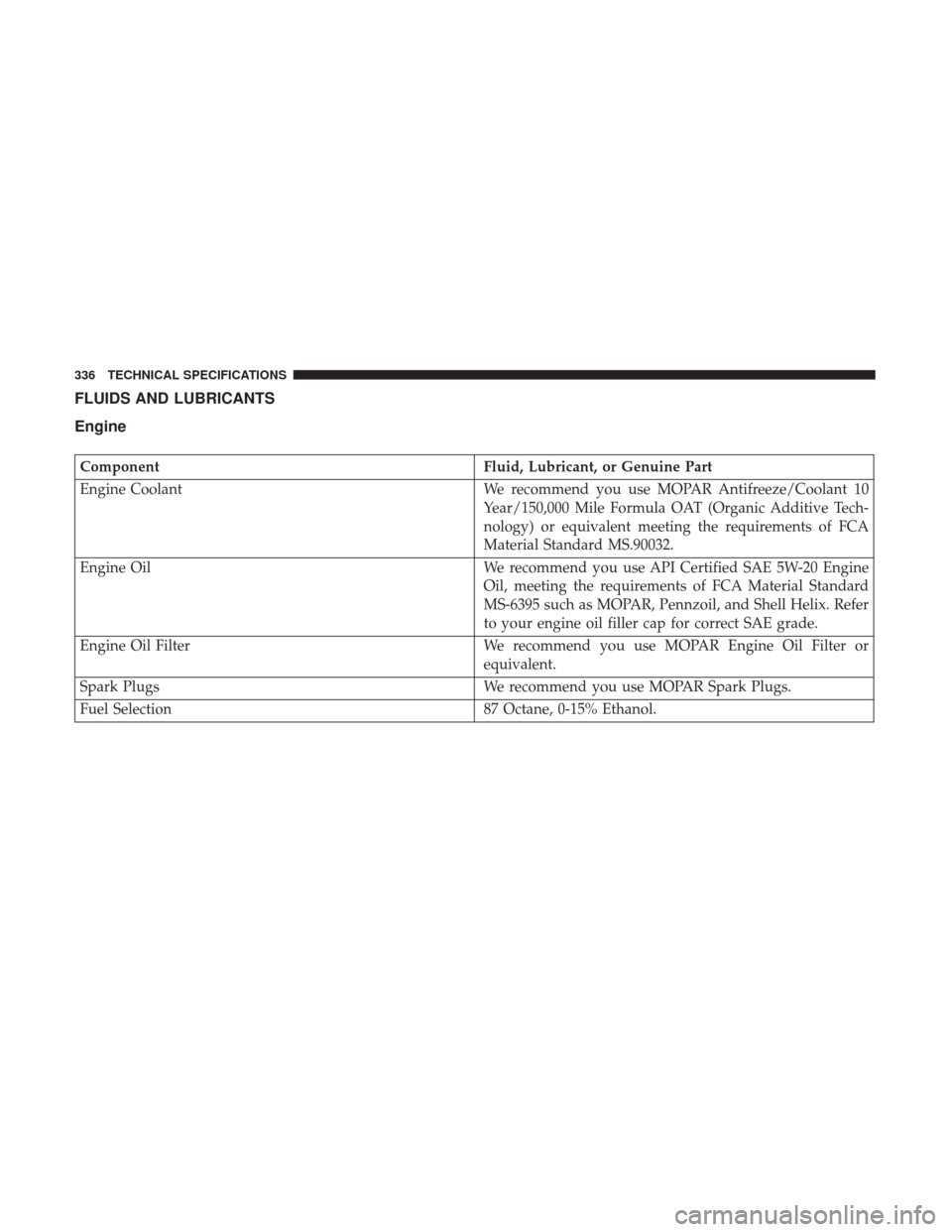
FLUIDS AND LUBRICANTS
Engine
ComponentFluid, Lubricant, or Genuine Part
Engine Coolant We recommend you use MOPAR Antifreeze/Coolant 10
Year/150,000 Mile Formula OAT (Organic Additive Tech-
nology) or equivalent meeting the requirements of FCA
Material Standard MS.90032.
Engine Oil We recommend you use API Certified SAE 5W-20 Engine
Oil, meeting the requirements of FCA Material Standard
MS-6395 such as MOPAR, Pennzoil, and Shell Helix. Refer
to your engine oil filler cap for correct SAE grade.
Engine Oil Filter We recommend you use MOPAR Engine Oil Filter or
equivalent.
Spark Plugs We recommend you use MOPAR Spark Plugs.
Fuel Selection 87 Octane, 0-15% Ethanol.
336 TECHNICAL SPECIFICATIONS
Page 407 of 421

Gear Ranges........................ .204, 209
Special Additives .....................299, 301
Axle Fluid .............................. .338
Battery ................................. .102
Charging System Light ....................102
Belts, Seat ............................... .190
Body Mechanism Lubrication ..................290
B-Pillar Location .......................... .306
Brake Assist System ........................ .132
Brake Fluid .............................. .338
Brake, Parking ............................ .198
Brakes ................................. .329
Brake System ......................... .297, 329
Master Cylinder ........................ .297
Parking .............................. .198
Warning Light .......................... .100
Brake/Transmission Interlock ..................203
Bulb Replacement ......................... .243
Bulbs, Light .......................... .192, 243
Calibration, Compass ....................... .124
Camera, Rear ............................ .217
Capacities, Antifreeze (Engine Coolant) ...........335
Capacities, Fluid .......................... .335Caps, Filler
Fuel ................................. .219
Oil (Engine) ..................... .282, 283, 286
Power Steering ......................... .213
Radiator (Coolant Pressure) .................295
Carbon Monoxide Warning ................189, 334
Cargo Area Cover ...........................74
Cargo Area Features .........................74
Cargo Compartment .........................74
Light ..................................74
Luggage Carrier ..........................91
Cargo Light ...............................74
Cargo Load Floor ...........................75
Cargo Tie-Downs ...........................76
Car Washes .............................. .324
Cellular
Phone........................ .367, 395
Center High Mounted Stop Light ...............245
Certification Label ......................... .220
Chains, Tire ............................. .320
Changing A Flat Tire .....................249, 302
Check Engine Light (Malfunction Indicator Light). . . .127
Checking Your Vehicle For Safety ...............189
Checks, Safety ............................ .189
Child Restraint ........................... .174
12
INDEX 405