Page 216 of 421

WARNING!
Fluid level should be checked on a level surface and
with the engine off to prevent injury from moving
parts and to ensure accurate fluid level reading. Do not
overfill. Use only manufacturer’s recommended power
steering fluid.
If necessary, add fluid to restore to the proper indicated
level. With a clean cloth, wipe any spilled fluid from all
surfaces. Refer to “Fluids And Lubricants” in “Servicing
And Maintenance” for further information.
ELECTRONIC SPEED CONTROL — IF EQUIPPED
When engaged, the Electronic Speed Control takes over
accelerator operations at speeds greater than 25 mph
(40 km/h).
The Electronic Speed Control buttons are located on the
right side of the steering wheel. NOTE:
In order to ensure proper operation, the Electronic
Speed Control System has been designed to shut down if
multiple Speed Control functions are operated at the same
time. If this occurs, the Electronic Speed Control System
can be reactivated by pushing the Electronic Speed Control
ON/OFF button and resetting the desired vehicle set
speed.
Electronic Speed Control Buttons
1 — ON/OFF 3 — SET -
2 — RES + 4 — CANCEL
214 STARTING AND OPERATING
Page 227 of 421

Trailer Hitch Classification Definitions
Class III - Heavy Duty 5,000 lbs (2 267 kg)
Class IV - Extra Heavy Duty 10,000 lbs (4 535 kg)
Refer to the “Trailer Towing Weights (Maximum Trailer Weight Ratings)” chart for the Maximum Gross Trailer Weight
(GTW) towable for your given drivetrain.
All trailer hitches should be professionally installed on your vehicle.
Trailer Towing Weights (Maximum Trailer Weight Ratings)
Engine/Transmission Frontal AreaMaximum GTW (Gross
Trailer Wt.) Maximum Tongue Wt.
(See Note)
2.0L Auto/Man 22 sq ft (2.04 sq m) 1,000 lbs (453 kg) 150 lbs (68 kg)
2.4L Auto/Man 22 sq ft (2.04 sq m) 1,000 lbs (453 kg) 150 lbs (68 kg)
2.4L Auto/Man with Trailer
Tow Prep Package (AHC) 32 sq ft (3.0 sq m)
2,000 lbs (907 kg) 300 lbs (136 kg)
2.4L Auto With Freedom Drive
II Off Road Package (AWL) 32 sq ft (3.0 sq m)
2,000 lbs (907 kg) 300 lbs (136 kg)
Refer to local laws for maximum trailer towing speeds.
NOTE:
The trailer tongue weight must be considered as part
of the combined weight of occupants and cargo, and should
never exceed the weight referenced on the Tire and Loading
Information placard. Refer to “Tire Safety Information” in
“Servicing And Maintenance” for further information.
6
STARTING AND OPERATING 225
Page 229 of 421

WARNING!(Continued)
cause a loss of control, poor performance, or damage
to brakes, axle, engine, transmission, steering, sus-
pension, chassis structure, or tires.
• Safety chains must always be used between your
vehicle and trailer. Always connect the chains to the
frame or hook retainers of the vehicle hitch. Cross
the chains under the trailer tongue and allow enough
slack for turning corners.
• Vehicles with trailers should not be parked on a
grade. When parking, apply the parking brake on the
tow vehicle. Put the tow vehicle transmission in
PARK. Always, block or �chock�the trailer wheels.
• GCWR must not be exceeded.
• Total weight must be distributed between the tow
vehicle and the trailer such that the following four
ratings are not exceeded:
1. GVWR
2. GTW
3. GAWR
4. Tongue weight rating for the trailer hitch utilized.
CAUTION!
• Do not tow a trailer at all during the first 500 miles
(805 km) the new vehicle is driven. The engine, axle
or other parts could be damaged.
• Then, during the first 500 miles (805 km) that a trailer
is towed, do not drive over 50 mph (80 km/h) and do
not make starts at full throttle. This helps the engine
and other parts of the vehicle wear in at the heavier
loads.
Towing Requirements — Tires
• Do not attempt to tow a trailer while using a compact
spare tire.
• Proper tire inflation pressures are essential to the safe
and satisfactory operation of your vehicle. Refer to
“Tires” in “Servicing And Maintenance” for proper tire
inflation procedures.
• Check the trailer tires for proper tire inflation pressures
before trailer usage.
• Check for signs of tire wear or visible tire damage before
towing a trailer. Refer to “Tires” in “Servicing And
Maintenance” for the proper inspection procedure.
6
STARTING AND OPERATING 227
Page 230 of 421

•When replacing tires, refer to “Tires” in “Servicing And
Maintenance” for the proper tire replacement proce-
dures. Replacing tires with a higher load carrying capac-
ity will not increase the vehicle’s GVWR and GAWR
limits.
Towing Requirements — Trailer Brakes
• Do not interconnect the hydraulic brake system or
vacuum system of your vehicle with that of the trailer.
This could cause inadequate braking and possible per-
sonal injury.
• An electronically actuated trailer brake controller is
required when towing a trailer with electronically actu-
ated brakes. When towing a trailer equipped with a
hydraulic surge actuated brake system, an electronic
brake controller is not required.
• Trailer brakes are recommended for trailers over
1,000 lbs (453 kg) and required for trailers in excess of
2,000 lbs (907 kg).
WARNING!
• Do not connect trailer brakes to your vehicle’s hy-
draulic brake lines. It can overload your brake sys-
tem and cause it to fail. You might not have brakes
when you need them and could have a collision.
• Towing any trailer will increase your stopping dis-
tance. When towing you should allow for additional
space between your vehicle and the vehicle in front
of you. Failure to do so could result in a collision.
CAUTION!
If the trailer weighs more than 1,000 lbs (453 kg)
loaded, it should have its own brakes and they should
be of adequate capacity. Failure to do this could lead to
accelerated brake lining wear, higher brake pedal
effort, and longer stopping distances.
228 STARTING AND OPERATING
Page 232 of 421

Towing Tips
Before setting out on a trip, practice turning, stopping, and
backing up the trailer in an area located away from heavy
traffic.
Manual Transmission — If Equipped
If using a manual transmission vehicle for trailer towing,
all starts must be in first gear to avoid excessive clutch
slippage.
Automatic Transmission — If Equipped
The DRIVE range can be selected when towing. However,
if frequent shifting or changes in engine speed occur while
in this range, use the AutoStick shift control (if equipped)
to select a lower gear ratio.
NOTE:
•Using a lower gear ratio while operating the vehicle
under heavy loading conditions, will improve perfor-
mance and extend transmission life by reducing exces-
sive shifting and heat buildup. This action will also
provide better engine braking.
• If you REGULARLY tow a trailer for more than 45
minutes of continuous operation, then change the trans-
mission fluid and filter as specified for �police, taxi, fleet,
or frequent trailer towing�. Refer to the �Maintenance
Plan� for the proper maintenance intervals.
Seven-Pin Connector
1 — Battery 5 — Ground
2 — Backup Lamps 6 — Left Stop/Turn
3 — Right Stop/Turn 7 — Running Lamps
4 — Electric Brakes 230 STARTING AND OPERATING
Page 254 of 421
WARNING!(Continued)
•If working on or near a roadway, be extremely
careful of motor traffic.
• To assure that spare tires, flat or inflated, are securely
stowed, spares must be stowed with the valve stem
facing the ground.
NOTE: Refer to “Tires — General Information” in “Servic-
ing And Maintenance” for further information about the
spare tire, it’s use, and operation. 1. Remove the scissors jack and lug wrench from the spare
wheel as an assembly. Turn the jack screw to the left to
loosen the lug wrench and remove the wrench from the
jack assembly.
NOTE: The jack handle attaches to the side of the jack with
two attachment points. When the jack is partially ex-
panded, the tension between the two attachment points
holds the jack handle in place.
2. Loosen, but do not remove, the wheel nuts by turning them to the left one turn while the wheel is still on the
ground.
Jack Warning Label
Removing Jack Handle From Jack
252 IN CASE OF EMERGENCY
Page 277 of 421
SERVICING AND MAINTENANCE
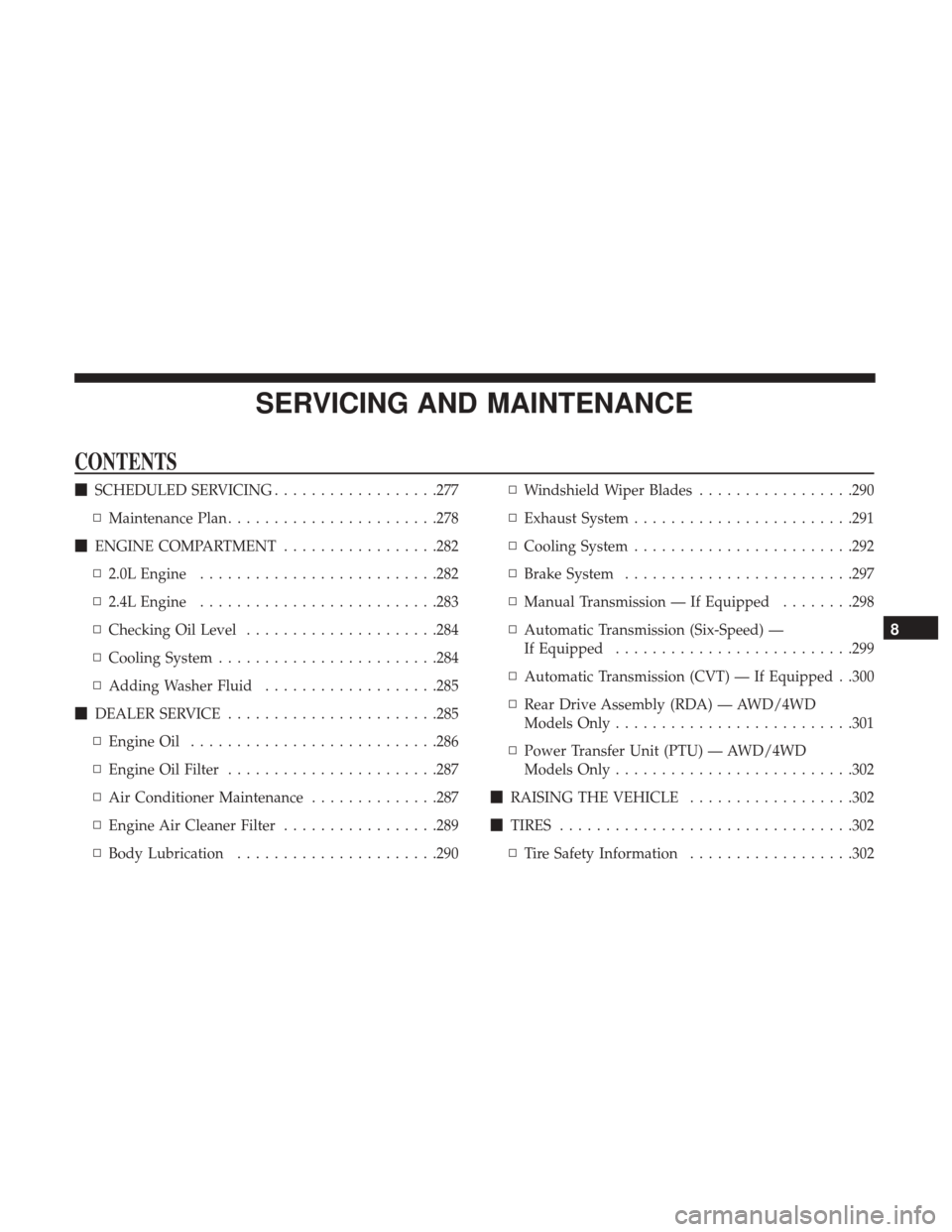
CONTENTS
�SCHEDULED SERVICING ..................277
▫ Maintenance Plan ...................... .278
� ENGINE COMPARTMENT .................282
▫ 2.0L Engine ......................... .282
▫ 2.4L Engine ......................... .283
▫ Checking Oil Level .....................284
▫ Cooling System ....................... .284
▫ Adding Washer Fluid ...................285
� DEALER SERVICE ...................... .285
▫ Engine Oil .......................... .286
▫ Engine Oil Filter ...................... .287
▫ Air Conditioner Maintenance ..............287
▫ Engine Air Cleaner Filter .................289
▫ Body Lubrication ..................... .290▫
Windshield Wiper Blades .................290
▫ Exhaust System ....................... .291
▫ Cooling System ....................... .292
▫ Brake System ........................ .297
▫ Manual Transmission — If Equipped ........298
▫ Automatic Transmission (Six-Speed) —
If Equipped ......................... .299
▫ Automatic Transmission (CVT) — If Equipped . .300
▫ Rear Drive Assembly (RDA) — AWD/4WD
Models Only ......................... .301
▫ Power Transfer Unit (PTU) — AWD/4WD
Models Only ......................... .302
� RAISING THE VEHICLE ..................302
� TIRES ............................... .302
▫ T
ire Safety Information ..................302
8
Page 278 of 421
▫Tires — General Information ..............310
▫ Tire Types ........................... .316
▫ Spare Tires — If Equipped ................317
▫ Wheel And Wheel Trim Care ..............319
▫ Tire Chains (Traction Devices) .............320
▫ Tire Rotation Recommendations ............321
� DEPARTMENT OF TRANSPORTATION UNIFORM
TIRE QUALITY GRADES ..................322
▫ Treadwear ........................... .322
▫ Traction Grades ....................... .322
▫ Temperature Grades .....................322 �
BODYWORK .......................... .323
▫ Protection From Atmospheric Agents ........323
▫ Body And Underbody Maintenance ..........323
▫ Preserving The Bodywork .................324
� INTERIORS ........................... .325
▫ Seats And Fabric Parts ...................325
▫ Plastic And Coated Parts ..................325
▫ Leather Parts ......................... .326
▫ Glass Surfaces ........................ .326
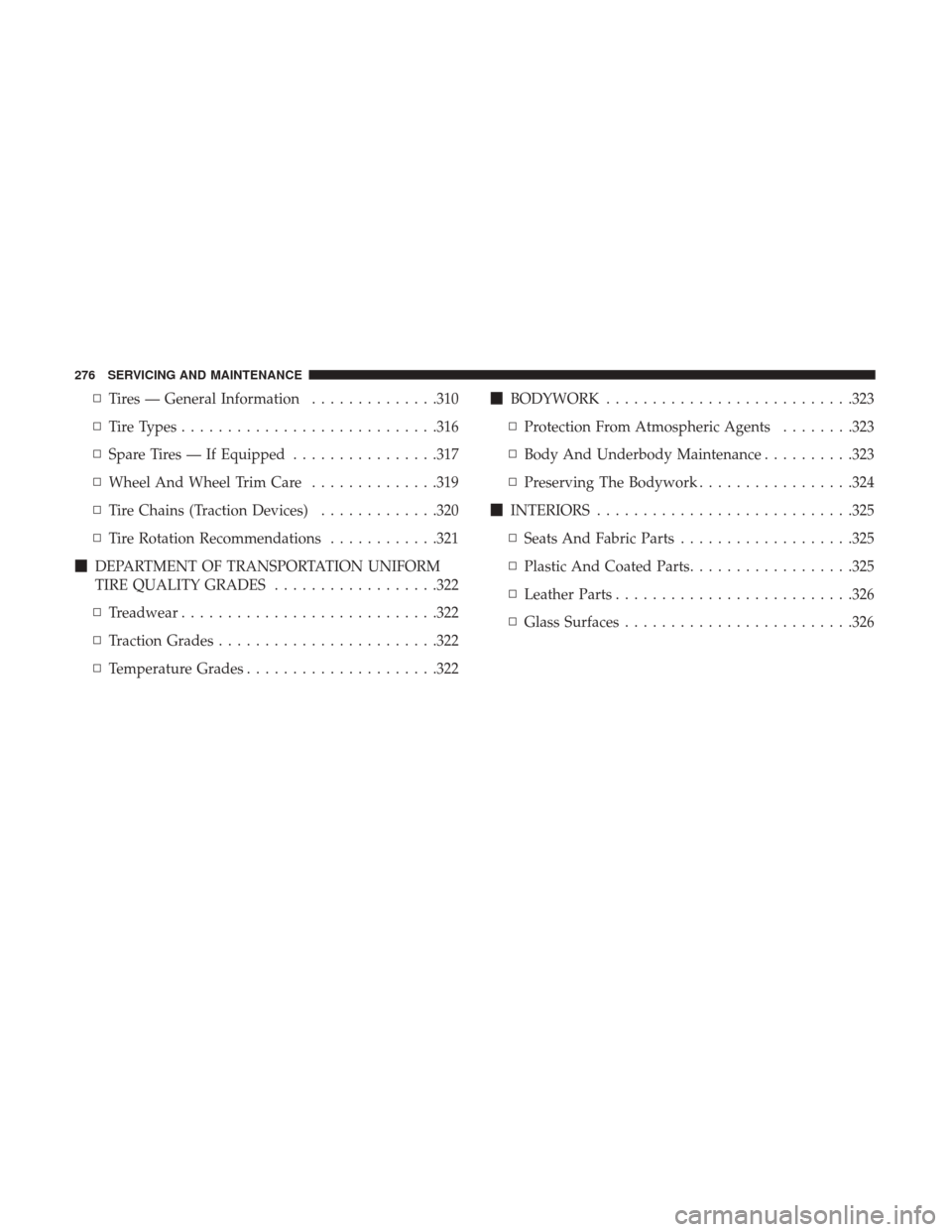
276 SERVICING AND MAINTENANCE