Page 242 of 429

Driving Across An Incline
If at all possible avoid driving across an incline. If it is
necessary, know your vehicle’s abilities. Driving across an
incline places more weight on the down-hill wheels, which
increases the possibilities of a down-hill slide or rollover.
Make sure the surface has good traction with firm and
stable soils. If possible transverse the incline at an angle
heading slightly up or down.
WARNING!
Driving across an incline increases the risk of a roll-
over, which may result in severe injury.
If You Stall Or Begin To Lose Headway
If you stall or begin to lose headway while climbing a steep
hill, allow your vehicle to come to a stop and immediately
apply the brake. Restart the engine and shift to REVERSE.
Back slowly down the hill allowing engine and hill descent
braking to control the descent and apply your brakes if
necessary, but do not allow the tires to lock.
WARNING!
If the engine stalls or you lose headway or cannot
make it to the top of a steep hill or grade, never attempt
to turn around. To do so may result in tipping and
rolling the vehicle, which may result in severe injury.
Always back carefully straight down a hill in RE-
VERSE gear. Never back down a hill in NEUTRAL
using only the vehicle brakes. Never drive diagonally
across a hill, always drive straight up or down.
Driving Through Water
Extreme care should be taken crossing any type of water.
Water crossings should be avoided if possible, and only be
attempted when necessary in a safe responsible manner.
You should only drive through areas which are designated
and approved. You should tread lightly and avoid damage
to the environment. You should know your vehicles abili-
ties and be able to recover it if something goes wrong. You
should never stop or shut a vehicle off when crossing deep
water unless you ingested water into the engine air intake.
If the engine stalls, do not attempt to restart it. Determine
if it has ingested water first. The key to any crossing is low
and slow. You want to use low (L Off-Road [if equipped] )
with the 4WD LOCK engaged and proceed very slowly
240 STARTING AND OPERATING
Page 250 of 429

WARNING!(Continued)
•Before replacing a fuse, make sure that the ignition is
off and that all the other services are switched off
and/or disengaged.
• If the replaced fuse blows again, contact an autho-
rized dealer.
• If a general protection fuse for safety systems (air
bag system, braking system), power unit systems
(engine system, gearbox system) or steering system
blows, contact an authorized dealer.
Integrated Power Module (IPM)
The Integrated Power Module is located in the engine
compartment near the air cleaner assembly. This center
contains cartridge fuses and mini-fuses. A label that iden-
tifies each component may be printed on the inside of the cover. Refer to “Engine Compartment” in “Maintaining
Your Vehicle” for further information.
Cavity
Cartridge Fuse Mini-FuseDescription
1 20 Amp Blue –Trailer Tow – If Equipped
2 – 15 Amp Lt Blue AWD/4WD Control Module –
If Equipped
3 – 10 Amp RedRear Center Brake Light Switch
4 – 10 Amp RedIgnition Switch/Clock Spring
5 – 15 Amp Lt Blue Battery Feed For Power Tech
Integrated Power Module
248 IN CASE OF EMERGENCY
Page 276 of 429
TOWING A DISABLED VEHICLE
This section describes procedures for towing a disabled
vehicle using a commercial towing service.
Towing Condi-tion Wheels OFF
The Ground Manual Trans-
mission 6-Speed Auto-
matic (FWD Only) 6-Speed Auto-
matic 4WD CVT Automatic
Transmission
Flat Tow NONE
•Transmission
in NEUTRAL
• Key in ACC
or ON/RUN
position
If transmission
is operable:
• Transmission
in NEUTRAL
• 25 mph
(40 km/h)
max speed
• 15 miles
(24 km) max
distance
If transmission is operable:
• Transmission
in NEUTRAL
• 25 mph
(40 km/h)
max speed
• 15 miles
(24 km) max
distance
NOT ALLOWED
Wheel Lift or Dolly Tow Rear
NOT AL-
LOWED NOT
ALLOWED NOT ALLOWED
Front FWD Models ONLY OK
NOT
ALLOWED FWD Models
ONLY
Flatbed ALL BEST METHOD BEST METHOD BEST METHOD BEST METHOD
274 IN CASE OF EMERGENCY
Page 277 of 429

With Ignition Key
Automatic Transmission
•Front Wheel Drive (FWD) vehicles can be towed with
the front wheels elevated, or on a flatbed truck (all four
wheels OFFthe ground).
• Four-Wheel Drive (4WD) vehicles can be towed on a
flatbed truck (all four wheels OFFthe ground).
If the transmission is operable, Front Wheel Drive (FWD)
and Four Wheel Drive (4WD) vehicles, with the 6-speed
automatic transmission only ( NOTthe Continuously
Variable automatic transmission [CVT]), may be flat towed
(with all four wheels on the ground) under the following
conditions:
• The transmission must be in NEUTRAL.
• The towing speed must not exceed 25 mph (40 km/h).
• The towing distance must not exceed 15 miles (24 km).
Front Wheel Drive (FWD) models (with 6-speed automatic
only) may also be towed (under the same limitations
shown above) with the rear wheels elevated.
CAUTION!
• DO NOT flat tow any vehicle equipped with a CVT
automatic transmission. Damage to the drivetrain
will result. If these vehicles require towing, make
sure all drive wheels are OFF the ground.
• Towing this vehicle in violation of the above require-
ments can cause severe transmission and/or transfer
case damage. Damage from improper towing is not
covered under the New Vehicle Limited Warranty..
If the vehicle’s battery is discharged, refer to “Gear Selector
Override” in this section for instructions on shifting the
automatic transmission out of PARK for towing.
Manual Transmission
• Front Wheel Drive (FWD) or Four-Wheel Drive (4WD)
vehicles can be flat towed (all four wheels on the
ground) with the transmission in NEUTRAL.
• FWD vehicles can be towed with the front wheels
elevated.
• FWD or 4WD vehicles can be towed on a flatbed truck
(all wheels OFFthe ground).
7
IN CASE OF EMERGENCY 275
Page 279 of 429
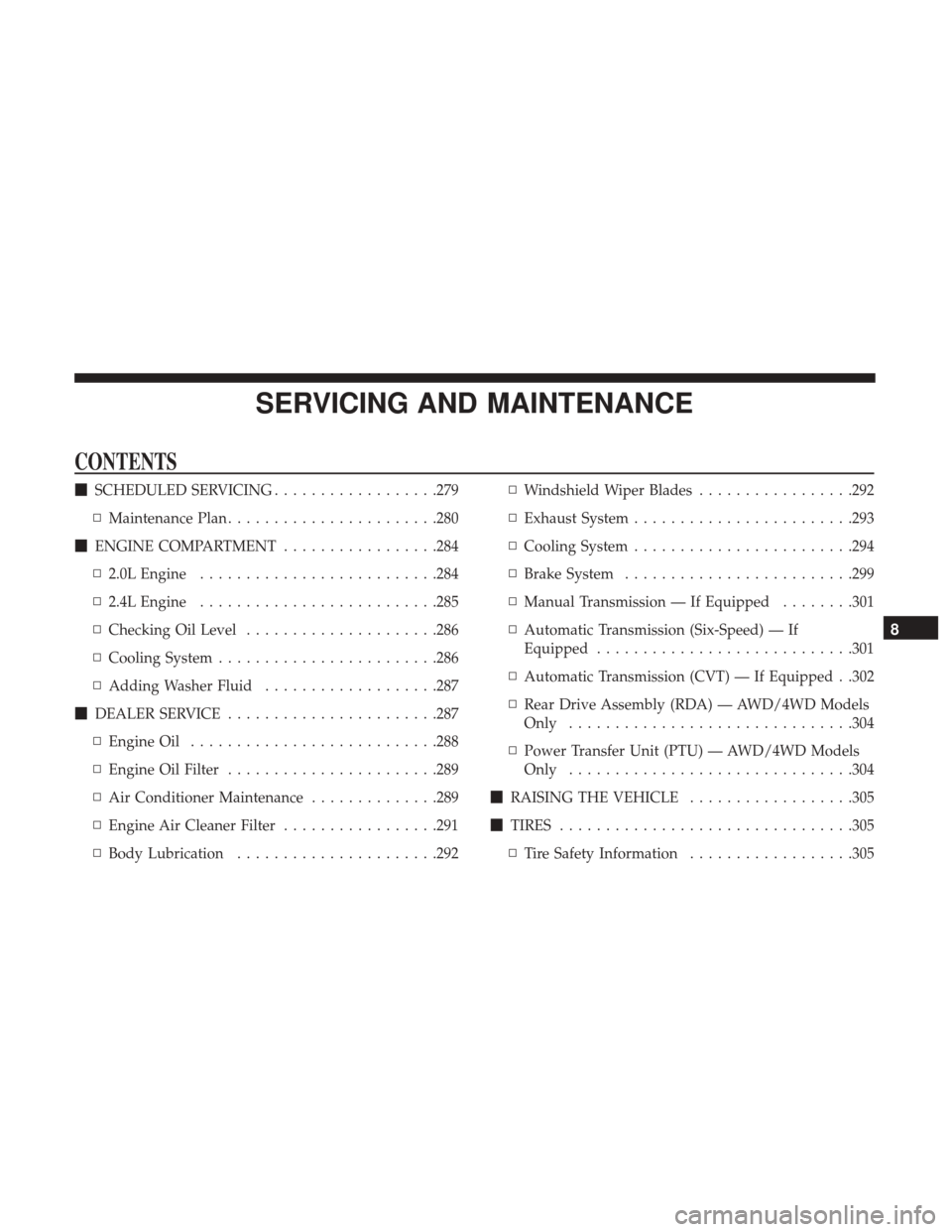
SERVICING AND MAINTENANCE
CONTENTS
�SCHEDULED SERVICING ..................279
▫ Maintenance Plan .......................280
� ENGINE COMPARTMENT .................284
▫ 2.0L Engine ..........................284
▫ 2.4L Engine ..........................285
▫ Checking Oil Level .....................286
▫ Cooling System ........................286
▫ Adding Washer Fluid ...................287
� DEALER SERVICE .......................287
▫ Engine Oil .......................... .288
▫ Engine Oil Filter .......................289
▫ Air Conditioner Maintenance ..............289
▫ Engine Air Cleaner Filter .................291
▫ Body Lubrication ..................... .292▫
Windshield Wiper Blades .................292
▫ Exhaust System ........................293
▫ Cooling System ........................294
▫ Brake System ........................ .299
▫ Manual Transmission — If Equipped ........301
▫ Automatic Transmission (Six-Speed) — If
Equipped ............................301
▫ Automatic Transmission (CVT) — If Equipped . .302
▫ Rear Drive Assembly (RDA) — AWD/4WD Models
Only ...............................304
▫ Power Transfer Unit (PTU) — AWD/4WD Models
Only ...............................304
� RAISING THE VEHICLE ..................305
� TIRES ............................... .305
▫ Tire Safety Information ..................305
8
Page 306 of 429

Rear Drive Assembly (RDA) — AWD/4WD Models
Only
Lubricant Selection
Use only the manufacturer ’s recommended transmission
fluid. Refer to “Fluids And Lubricants” in “Technical
Specifications” for further information.
Fluid Level Check
Visually inspect the unit at each oil change for leakage. If
leakage is detected, check the fluid level by removing the
fill plug. The fluid level should be maintained between the
bottom of the fill hole to 1/8 inch (4 mm) below the fill
hole.
Add fluid, if necessary, to maintain the proper level.
Frequency Of Fluid Change
Refer to the “Maintenance Plan” for the proper mainte-
nance intervals.
Power Transfer Unit (PTU) — AWD/4WD Models
Only
Lubricant Selection
Use only the manufacturer’s recommended fluid. Refer to
“Fluids And Lubricants” in “Technical Specifications” for
further information.
Fluid Level Check
Visually inspect the unit at each oil change for leakage. If
leakage is detected, Check the fluid level by removing the
fill plug. The fluid level should be maintained between the
bottom of the fill hole to 1/8 inch (4 mm) below the fill
hole.
Add fluid, if necessary, to maintain the proper level.
304 SERVICING AND MAINTENANCE
