2017 Hyundai Sonata Plug-in Hybrid trailer
[x] Cancel search: trailerPage 541 of 744
5-94
Driving your vehicle
Certification label
The certification label is located on
the driver's door sill at the center pil-
lar and shows the maximum allow-
able weight of the fully loaded vehi-
cle. This is called the GVWR (Gross
Vehicle Weight Rating). The GVWR
includes the weight of the vehicle, all
occupants, fuel and cargo.
This label also tells you the maxi-
mum weight that can be supported
by the front and rear axles, called
Gross Axle Weight Rating (GAWR).The total weight of the vehicle,
including all occupants, accessories,
cargo, and trailer tongue load must
not exceed the Gross Vehicle Weight
Rating (GVWR) or the Gross Axle
Weight Rating (GAWR). To find out
the actual loads on your front and
rear axles, you need to go to a weigh
station and weigh your vehicle. Be
sure to spread out your load equally
on both sides of the centerline.
OBH059070
Overloading
Never exceed the GVWR for
your vehicle, the GAWR for
either the front or rear axle
and vehicle capacity weight.
Exceeding these ratings can
affect your vehicle's handling
and braking ability, and cause
an accident.
Do not overload your vehicle.
Overloading your vehicle can
cause heat buildup in your
vehicle's tires and possible
tire failure, increased stop-
ping distances and poor vehi-
cle handling-all of which may
result in a crash.
WARNING
Page 542 of 744
5-95
Driving your vehicle
5
Overloading your vehicle may
cause damage. Repairs would not
be covered by your warranty. Do
not overload your vehicle.We do not recommend using this
vehicle for trailer towing.
NOTICE
If you carry items inside your
vehicle (e.g., suitcases, tools,
packages, or anything else),
they are moving as fast as the
vehicle. If you have to stop or
turn quickly, or if there is a
crash, the items will keep going
and can cause an injury if they
strike the driver or a passenger.
Put items in the cargo area of
your vehicle. Try to spread the
weight evenly.
Do not stack items, like suit-
cases, inside the vehicle
above the tops of the seats.
Do not leave an unsecured
child restraint in your vehicle.
When you carry something
inside the vehicle, secure it.
WARNING
T T
R
R A
A I
IL
L E
E R
R
T
T O
O W
W I
IN
N G
G
Page 558 of 744
6-16
It is possible that some tires, espe-
cially with larger punctures or dam-
age to the sidewall, cannot be sealed
completely.
Air pressure loss in the tire may
adversely affect tire performance.
For this reason, you should avoid
abrupt steering or other driving
maneuvers, especially if the vehicle
is heavily loaded or if a trailer is in
use.
The Tire Mobility Kit is not designed
or intended as a permanent tire
repair method and is to be used for
one tire only.
This instruction shows you step by
step how to temporarily seal the
puncture simply and reliably.
Read the section "Notes on the safe
use of the Tire Mobility Kit".Notes on the safe use of theTire Mobility Kit
Park your car at the side of the
road so that you can work with the
Tire Mobility Kit away from moving
traffic.
To be sure your vehicle will not move, even when you're on fairly
level ground, always set your park-
ing brake.
Only use the Tire Mobility Kit for sealing/inflation passenger car
tires. Only punctured areas located
within the tread region of the tire
can be sealed using the tire mobil-
ity kit.
Do not use on motorcycles, bicy- cles or any other type of tires.
When the tire and wheel are dam- aged, do not use Tire Mobility Kit
for your safety.
Use of the Tire Mobility Kit may not be effective for tire damage larger
than approximately 0.24 inch (6
mm).
Please contact the nearest
HYUNDAI dealership if the tire
cannot be made roadworthy with
the Tire Mobility Kit. Do not use the Tire Mobility Kit if a
tire is severely damaged by driving
run flat or with insufficient air pres-
sure.
Do not remove any foreign objects such as nails or screws that have
penetrated the tire.
Provided the car is outdoors, leave the engine running. Otherwise
operating the compressor may
eventually drain the car battery.
Never leave the Tire Mobility Kit unattended while it is being used.
Do not leave the compressor run- ning for more than 10 minutes at a
time or it may overheat.
Do not use the Tire Mobility Kit if the ambient temperature is below
-22°F (-30°C).
What to do in an emergency
Page 591 of 744
7
Maintenance
7-23
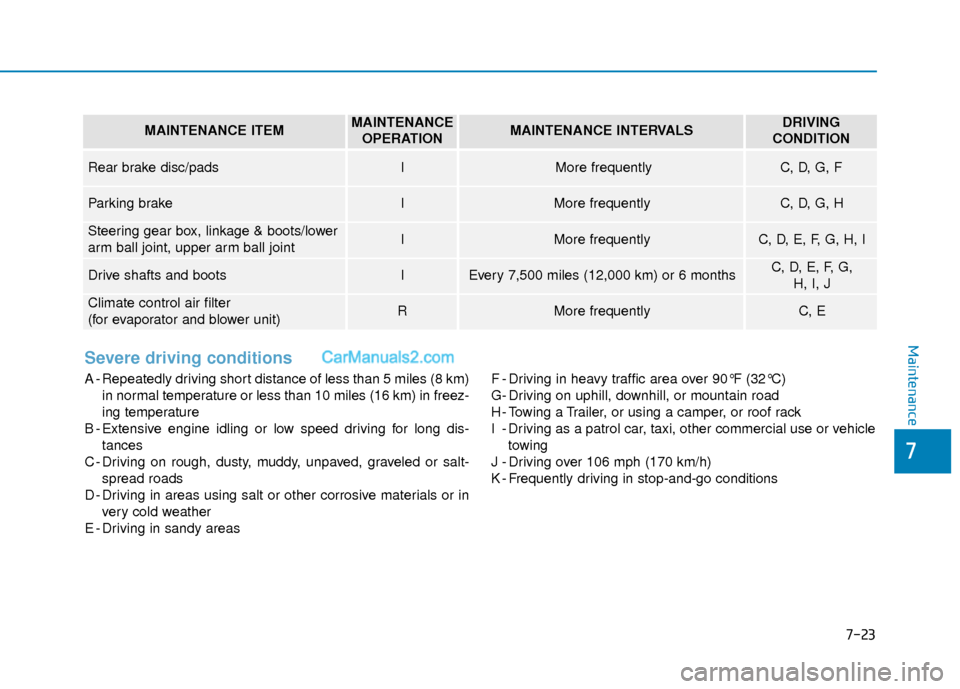
Severe driving conditions
A - Repeatedly driving short distance of less than 5 miles (8 km)in normal temperature or less than 10 miles (16 km) in freez-
ing temperature
B - Extensive engine idling or low speed driving for long dis- tances
C - Driving on rough, dusty, muddy, unpaved, graveled or salt- spread roads
D - Driving in areas using salt or other corrosive materials or in very cold weather
E - Driving in sandy areas F - Driving in heavy traffic area over 90°F (32°C)
G- Driving on uphill, downhill, or mountain road
H - Towing a Trailer, or using a camper, or roof rack
I - Driving as a patrol car, taxi, other commercial use or vehicle
towing
J - Driving over 106 mph (170 km/h)
K - Frequently driving in stop-and-go conditions
MAINTENANCE ITEMMAINTENANCE OPERATIONMAINTENANCE INTERVALSDRIVING
CONDITION
Rear brake disc/padsIMore frequentlyC, D, G, F
Parking brakeIMore frequentlyC, D, G, H
Steering gear box, linkage & boots/lower
arm ball joint, upper arm ball jointIMore frequentlyC, D, E, F, G, H, I
Drive shafts and bootsIEvery 7,500 miles (12,000 km) or 6 monthsC, D, E, F, G,
H, I, J
Climate control air filter
(for evaporator and blower unit)RMore frequentlyC, E
Page 696 of 744

I-11
Steering wheel.................................................................3-16Electric power steering (EPS) ....................................3-16
Heated steering wheel ................................................3-17
Horn ........................................................................\
....3-18
Telescope steering ......................................................3-17
Tilt steering.................................................................3-17
Steering wheel audio control ............................................4-3
Storage compartment ....................................................3-154 Center console storage .............................................3-154
Glove box .................................................................3-154
Multi box ..................................................................3-155
Sunglass holder ........................................................3-155
Sunglass holder .............................................................3-155
Sunroof, see panoramic sunroof .....................................3-42
Sunvisor ........................................................................\
3-158
Telescope steering ...........................................................3-17
Theft-alarm system .........................................................3-13
Tilt steering .....................................................................3-1\
7
Tire chains .......................................................................5\
-86
Tire Mobility kit..............................................................6-15
Tire pressure monitoring system (TPMS) ........................6-9
Tire rotation ....................................................................7-47\
Tire specification and pressure label ................................8-9 Tires and wheels .............................................................7-44
Checking tire inflation pressure .................................7-46
Low aspect ratio tires .................................................7-58
Recommended cold tire inflation pressures ...............7-45
Tire care ......................................................................7-\
44
Tire maintenance ........................................................7-50
Tire replacement .........................................................7-48
Tire rotation ................................................................7-47
Tire sidewall labeling .................................................7-50
Tire traction ................................................................7-49
Wheel alignment and tire balance ..............................7-48
Wheel replacement .....................................................7-48
Towing ........................................................................\
....6-22
Trailer towing..................................................................5-95
Transmission Automatic transmission ..............................................5-12
Shift lock system ........................................................5-16
Shift-lock release ........................................................5-16
Trip A/B ........................................................................\
3-106
Trip computer................................................................3-105 Trip A/B ....................................................................3-10\
6
Fuel Economy ..........................................................3-107
Digital speedometer..................................................3-109
Trunk ........................................................................\
.......3-47 Smart trunk .................................................................3-50
Trunk room lamp ..........................................................3-126
Turn by turn (TBT) mode ...............................................3-97
Turn signals...................................................................3-120\
I
Index
T