2017 Hyundai Santa Fe Sport seat adjustment
[x] Cancel search: seat adjustmentPage 23 of 614

Safety features of your vehicle
Important safety precautions . . . . . . . . . . . . . . . . . 3-2
• Always Wear Your Seat Belt . . . . . . . . . . . . . . . . . . . . 3-2
• Restrain All Children . . . . . . . . . . . . . . . . . . . . . . . . . . 3-2
• Air Bag Hazards . . . . . . . . . . . . . . . . . . . . . . . . . . . . . . 3-2
• Driver Distraction . . . . . . . . . . . . . . . . . . . . . . . . . . . . . 3-2
• Control Your Speed . . . . . . . . . . . . . . . . . . . . . . . . . . . . 3-3
• Keep Your Vehicle in Safe Condition. . . . . . . . . . . . . . 3-3
Seat. . . . . . . . . . . . . . . . . . . . . . . . . . . . . . . . . . . . \
. . . 3-4
• Front seat adjustment - Manual . . . . . . . . . . . . . . . . . 3-7
• Front seat adjustment - Power . . . . . . . . . . . . . . . . . . . 3-8
• Driver position memory system (for power seat) . . . 3-15
• Rear seat adjustment . . . . . . . . . . . . . . . . . . . . . . . . . 3-17
Seat belts . . . . . . . . . . . . . . . . . . . . . . . . . . . . . . . . . 3-26
• Seat belt restraint system . . . . . . . . . . . . . . . . . . . . . . 3-26
• Pre-tensioner seat belt . . . . . . . . . . . . . . . . . . . . . . . . 3-31
• Seat belt precautions . . . . . . . . . . . . . . . . . . . . . . . . . . 3-34
• Care of seat belts . . . . . . . . . . . . . . . . . . . . . . . . . . . . . 3-37
Child restraint system . . . . . . . . . . . . . . . . . . . . . . 3-38
• Using a child restraint system . . . . . . . . . . . . . . . . . . 3-40
• Securing a child restraint seat with
"Tether Anchor" system . . . . . . . . . . . . . . . . . . . . . 3-43
• Securing a child restraint seat with child seat lower anchor system . . . . . . . . . . . . . . . . . . . . . . . . 3-45
Air bag - supplemental restraint system . . . . . . . 3-47
• How does the air bag system operate . . . . . . . . . . . . 3-48
• Air bag warning light . . . . . . . . . . . . . . . . . . . . . . . . . 3-50
• SRS components and functions . . . . . . . . . . . . . . . . . 3-51
• Occupant classification system. . . . . . . . . . . . . . . . . . 3-54
• Main components of occupant classification system. 3-55
• Driver's and passenger's front air bag . . . . . . . . . . . 3-60
• Side air bag . . . . . . . . . . . . . . . . . . . . . . . . . . . . . . . . . 3-65
• Curtain air bag . . . . . . . . . . . . . . . . . . . . . . . . . . . . . . 3-66
• SRS Care . . . . . . . . . . . . . . . . . . . . . . . . . . . . . . . . . . . 3-\
73
• Additional safety precautions. . . . . . . . . . . . . . . . . . . 3-74
• Air bag warning label . . . . . . . . . . . . . . . . . . . . . . . . . 3-75
3
Page 29 of 614

37
Safety features of your vehicle
Front seat adjustment - Manual
(if equipped)
Forward and rearward
To move the seat forward or rearward:
1. Pull the seat slide adjustmentlever up and hold it.
2. Slide the seat to the position you desire.
3. Release the lever and make sure the seat is locked in place.
Adjust the seat before driving, and
make sure the seat is locked secure-
ly by trying to move forward and rear-
ward without using the lever. If the
seat moves, it is not locked properly.
Seatback angle
To recline the seatback:
1. Lean forward slightly and lift up the seatback recline lever.
2. Carefully lean back on the seat and adjust the seatback of the
seat to the position you desire.
3. Release the lever and make sure the seatback is locked in place.
(The lever MUST return to its orig-
inal position for the seatback to
lock.)
Seat cushion height
(for driver's seat, if equipped)
To change the height of the seat
cushion, push the lever upwards or
downwards.
To lower the seat cushion, push the lever down several times.
To raise the seat cushion, pull the lever up several times.OANNSA2007
OANNSA2008
OANNSA2009
Page 30 of 614

Safety features of your vehicle
83
Lumbar support (for driver’s seat)
1. Press the front portion of theswitch to increase support or the
rear portion of the switch to
decrease support.
2. Release the switch once it reach- es the desired position.
Front seat adjustment - Power
(if equipped)
The front seat can be adjusted by
using the control knobs located on
the outside of the seat cushion.
Before driving, adjust the seat to the
proper position so as to easily con-
trol the steering wheel, pedals and
switches on the instrument panel.
OANNSA2010
WARNING
The power seat is operable with
the ignition OFF.
Therefore, children should never
be left unattended in the vehicle.
CAUTION
The power seat is driven by anelectric motor. Stop operatingonce the adjustment is com-pleted. Excessive operationmay damage the electricalequipment.
When in operation, the power seat consumes a large amountof electrical power. To preventunnecessary battery drain,don’t adjust the power seatlonger than necessary whilethe engine is not running.
Do not operate two or more power seat control knobs at thesame time. Doing so may resultin power seat motor or electri-cal component malfunction.
Page 32 of 614

Safety features of your vehicle
10
3
Lumbar support
(for driver’s seat, if equipped)
The lumbar support can be adjusted
by pressing the switch.
1. Press the front portion (1) of the switch to increase support, or the
rear portion (2) of the switch, to
decrease support.
2. Release the switch once it reaches the desired position.
3. Press the upper portion (3) of the switch to move the support position
up, or press the lower portion (4) of
the switch, to move the support
position down.
4. Release the switch once it reaches the desired position.
Headrest
The driver's and front passenger's
seats are equipped with a headrest
for the occupant's safety and comfort.
The headrest not only provides com-
fort for the driver and front passenger,
but also helps to protect the head and
neck in the event of a collision.OANNSA2014OLM039303N
WARNING - Headrest
adjustment
For maximum effectiveness in case of an accident, the head-
rest should be adjusted so the
middle of the headrest is at the
same height as the center of
gravity of an occupant's head.
Generally, the center of gravity
of most people's head is simi-
lar with the height of the top of
their eyes.
Also adjust the headrest as
close to your head as possible.
For this reason, the use of a
cushion that holds the body
away from the seatback is not
recommended.
Do not operate the vehicle with the headrests removed. Severe
injury to an occupant may
occur in the event of an acci-
dent. Headrests may provide
protection against severe neck
injuries when properly adjust-
ed.
Do not adjust the headrest position of the driver's seat
while the vehicle is in motion.
Page 33 of 614
311
Safety features of your vehicle
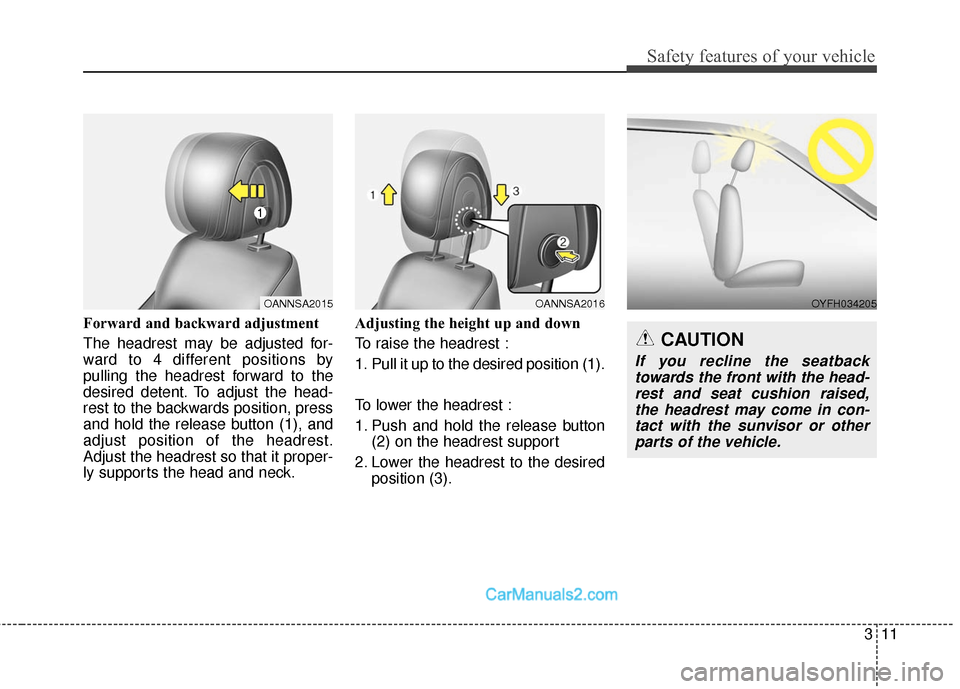
Forward and backward adjustment
The headrest may be adjusted for-
ward to 4 different positions by
pulling the headrest forward to the
desired detent. To adjust the head-
rest to the backwards position, press
and hold the release button (1), and
adjust position of the headrest.
Adjust the headrest so that it proper-
ly supports the head and neck.Adjusting the height up and down
To raise the headrest :
1. Pull it up to the desired position (1).
To lower the headrest :
1. Push and hold the release button
(2) on the headrest support
2. Lower the headrest to the desired position (3).
OANNSA2015OANNSA2016OYFH034205
CAUTION
If you recline the seatbacktowards the front with the head-rest and seat cushion raised,the headrest may come in con-tact with the sunvisor or otherparts of the vehicle.
Page 38 of 614

Safety features of your vehicle
16
3
Storing positions into memory
using the buttons on the door
Storing driver’s seat positions
1. Shift the shift lever into P while the engine start/stop button is ON or
ignition switch ON.
2. Adjust the driver’s seat and side view mirror to a position that is
comfortable for the driver.
3. Press SET button on the control panel. The system will beep once.
4. Press one of the memory buttons (1 or 2) within 5 seconds after
pressing the SET button. The sys-
tem will beep twice when memory
has been successfully stored.
Recalling positions from memory
The position in memory will be
recalled when:
1. The shift lever is in P with one of the condition below:
- The ignition switch in the ON position or engine running.
- The ignition switch in the LOCK/OFF or ACC position
while the driver's door is opened.
2. Press the desired memory button (1 or 2). The system will beep
once, then the driver's seat will
automatically adjust to the stored
position.
Adjusting the control switch for the
driver’s seat while the system is
recalling the stored position will
cause the movement to stop and
move in the direction that the control
switch is moved.WARNING
Use caution when recalling the
adjustment memory while sit-
ting in the vehicle. Push the
seat position control switch to
the desired position immediate-
ly if the seat moves too far in
any direction.
Page 39 of 614
317
Safety features of your vehicle
Easy access function (if equipped)
The system will move the driver's
seat automatically as follows:
Without smart key system
- It will move the driver’s seat rear-ward when the ignition key is
removed.
- It will move the driver’s seat for- ward when the ignition key is
inserted.
With smart key system - It will move the driver’s seat rear-ward when the engine start/stop
button is changed to the OFF
position.
- It will move the driver’s seat for- ward when the engine start/stop
button is changed to the ACC or
START position.
You can activate or deactivate this
feature. Refer to "User settings" in
section 4.
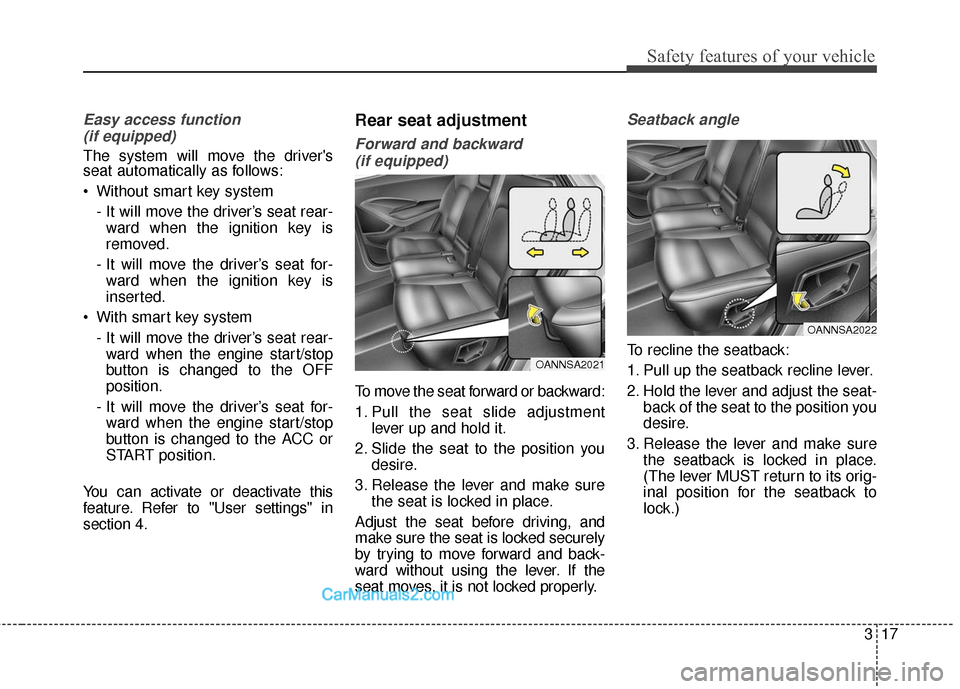
Rear seat adjustment
Forward and backward (if equipped)
To move the seat forward or backward:
1. Pull the seat slide adjustment lever up and hold it.
2. Slide the seat to the position you desire.
3. Release the lever and make sure the seat is locked in place.
Adjust the seat before driving, and
make sure the seat is locked securely
by trying to move forward and back-
ward without using the lever. If the
seat moves, it is not locked properly.
Seatback angle
To recline the seatback:
1. Pull up the seatback recline lever.
2. Hold the lever and adjust the seat- back of the seat to the position you
desire.
3. Release the lever and make sure the seatback is locked in place.
(The lever MUST return to its orig-
inal position for the seatback to
lock.)OANNSA2021
OANNSA2022
Page 40 of 614

Safety features of your vehicle
18
3
Headrest (for rear seat)
The rear seat(s) is equipped with
headrests in all the seating positions
for the occupant's safety and com-
for t.
The headrest not only provides com-
fort for passengers, but also helps to
protect the head and neck in the
event of a collision.
WARNING - Headrest
adjustment
For maximum effectiveness in case of an accident, the head-
rest should be adjusted so the
middle of the headrest is at the
same height as the center of
gravity of an occupant's head.
Generally, the center of gravi-
ty of most people's head is
similar with the height of the
top of their eyes.
Also adjust the headrest as
close to your head as possi-
ble. For this reason, the use of
a cushion that holds the body
away from the seatback is not
recommended.
(Continued)(Continued)
Do not operate the vehiclewith the headrests removed.
Severe injury to an occupant
may occur in the event of an
accident. Headrests may pro-
vide protection against severe
neck injuries when properly
adjusted.
Do not adjust the headrest height while the vehicle is in
motion.
OLM039304N