2017 Hyundai Santa Fe oil pan
[x] Cancel search: oil panPage 7 of 569

1
2
3
4
5
6
7
8I
IntroductionHow to use this manual / Fuel requirements / Vehicle break-in process / Vehicle handling instructions /Vehicle data collection and event data recorders
Your vehicle at a glance
Exterior overview / Interior overview / Instrument panel overview / Engi\
ne compartment
Safety features of your vehicle
Seats / Seat belts / Child restraint system / Air bag
Features of your vehicleKeys / Door locks / Tailgate / Windows / Hood / Fuel filler lid / Panoramic sunroof / Steering wheel / Mirrors
/ Instrument cluster / Lighting / Wipers & Washers / Climate control system / Multimedia system / Etc.
Driving your vehicleBefore driving / Engine start/stop button / Transaxle / All Wheel Drive (AWD) / Brake system / Cruise con-
trol system / Blind Spot Detection System / Active ECO system / Winter driving / Vehicle load limit / Etc.
What to do in an emergencyRoad warning / Emergency while driving / Emergency starting / Engine overheat / TPMS / Flat tire / Towing / Etc.
MaintenanceEngine compartment / Maintenance service / Engine oil / Engine coolant /\
Brake fluid / Washer fluid /
Parking brake / Air cleaner / Wiper blades / Battery / Tire and wheels / Fuses / Light bulbs / Etc.
Specifications, Consumer information and Reporting safety defects
Index
table of contents
Page 52 of 569
331
Safety features of your vehicle
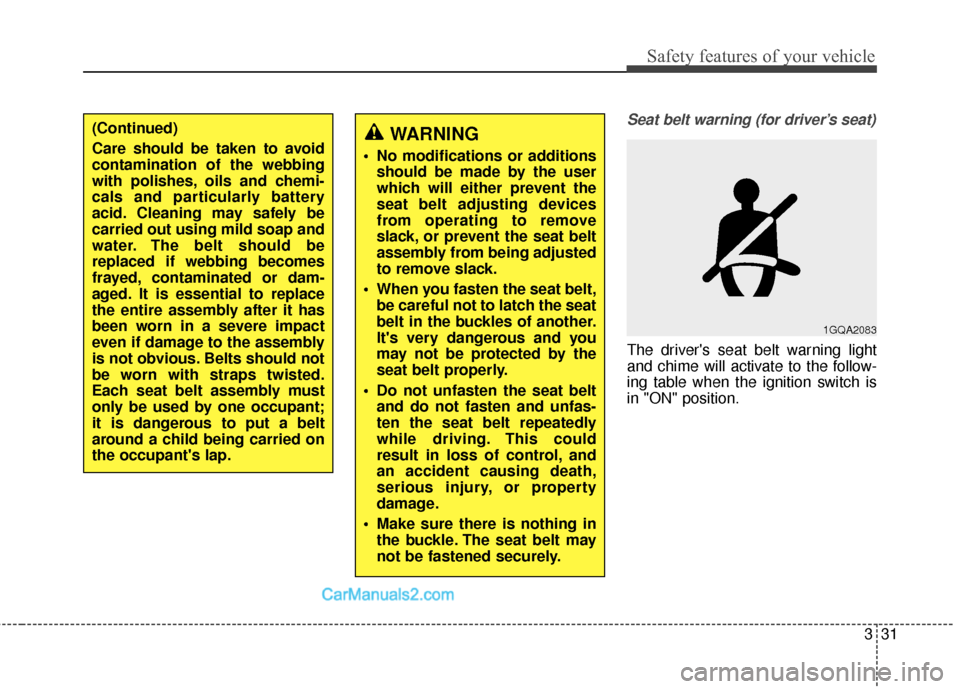
Seat belt warning (for driver’s seat)
The driver's seat belt warning light
and chime will activate to the follow-
ing table when the ignition switch is
in "ON" position.
WARNING
No modifications or additionsshould be made by the user
which will either prevent the
seat belt adjusting devices
from operating to remove
slack, or prevent the seat belt
assembly from being adjusted
to remove slack.
When you fasten the seat belt, be careful not to latch the seat
belt in the buckles of another.
It's very dangerous and you
may not be protected by the
seat belt properly.
Do not unfasten the seat belt and do not fasten and unfas-
ten the seat belt repeatedly
while driving. This could
result in loss of control, and
an accident causing death,
serious injury, or property
damage.
Make sure there is nothing in the buckle. The seat belt may
not be fastened securely.
1GQA2083
(Continued)
Care should be taken to avoid
contamination of the webbing
with polishes, oils and chemi-
cals and particularly battery
acid. Cleaning may safely be
carried out using mild soap and
water. The belt should be
replaced if webbing becomes
frayed, contaminated or dam-
aged. It is essential to replace
the entire assembly after it has
been worn in a severe impact
even if damage to the assembly
is not obvious. Belts should not
be worn with straps twisted.
Each seat belt assembly must
only be used by one occupant;
it is dangerous to put a belt
around a child being carried on
the occupant's lap.
Page 411 of 569
5119
Driving your vehicle
When you are ready to leave after
parking on a hill
1. With the automatic transaxle in P(Park), apply your brakes and hold
the brake pedal down while you:
and
2. Slowly remove your foot from the brake pedal.
3. Drive slowly until the trailer is clear of the chocks.
4. Stop and have someone pick up and store the chocks.
Maintenance when trailer towing
Your vehicle will need service more
often when you regularly pull a trail-
er. Important items to pay particular
attention to include engine oil, auto-
matic transaxle fluid, axle lubricant
and cooling system fluid. Brake con-
dition is another important item to
frequently check. Each item is cov-
ered in this manual, and the Index
will help you find them quickly. If
you’re trailering, it’s a good idea to
review these sections before you
start your trip.
Don’t forget to also maintain your
trailer and hitch. Follow the mainte-
nance schedule that accompanied
your trailer and check it periodically.
Preferably, conduct the check at the
start of each day’s driving. Most
importantly, all hitch nuts and bolts
should be tight.WARNING- Parking
brake
It can be dangerous to get out
of your vehicle if the parking
brake is not firmly set.
If you have left the engine run-
ning, the vehicle can move sud-
denly. You or others could be
seriously or fatally injured.CAUTION
Due to higher load during trailer usage, overheatingmight occur in hot days orduring uphill driving. If thecoolant gauge indicates over-heating, switch off the A/C andstop the vehicle in a safe areato cool down the engine.
When towing check transaxle fluid more frequently.
Page 478 of 569
Maintenance
30
7
ENGINE OIL
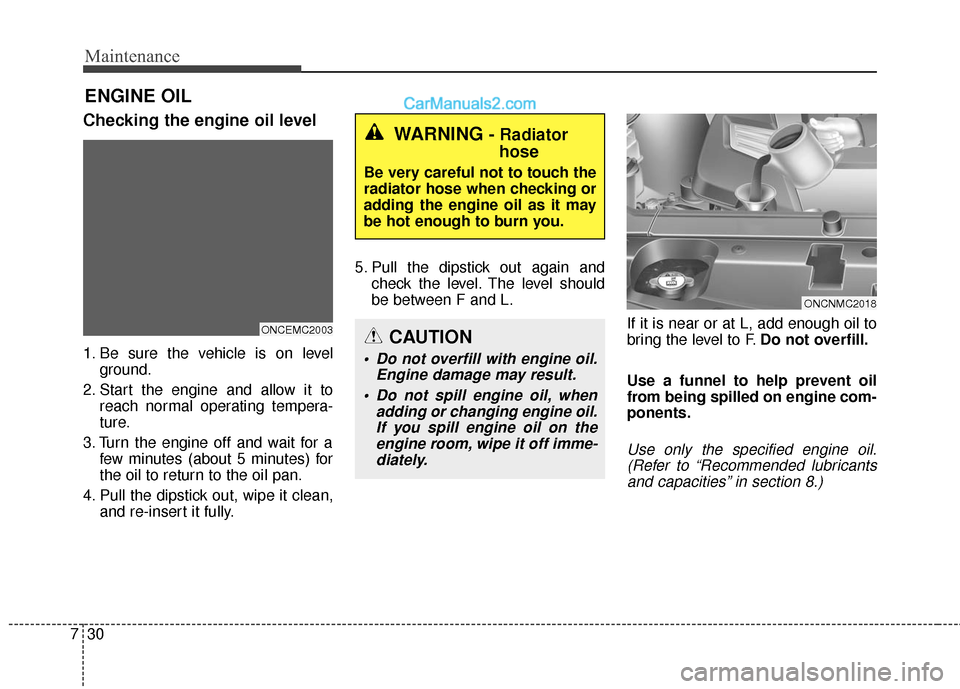
Checking the engine oil level
1. Be sure the vehicle is on level
ground.
2. Start the engine and allow it to reach normal operating tempera-
ture.
3. Turn the engine off and wait for a few minutes (about 5 minutes) for
the oil to return to the oil pan.
4. Pull the dipstick out, wipe it clean, and re-insert it fully. 5. Pull the dipstick out again and
check the level. The level should
be between F and L.
If it is near or at L, add enough oil to
bring the level to F.Do not overfill.
Use a funnel to help prevent oil
from being spilled on engine com-
ponents.
Use only the specified engine oil. (Refer to “Recommended lubricantsand capacities” in section 8.)
WARNING - Radiator hose
Be very careful not to touch the
radiator hose when checking or
adding the engine oil as it may
be hot enough to burn you.
CAUTION
Do not overfill with engine oil.
Engine damage may result.
Do not spill engine oil, when adding or changing engine oil.If you spill engine oil on theengine room, wipe it off imme-diately.
ONCEMC2003
ONCNMC2018
Page 512 of 569
Maintenance
64
7
FUSES
A vehicle’s electrical system is pro-
tected from electrical overload dam-
age by fuses.
This vehicle has 2 fuse panels, one
located in the driver’s side panel bol-
ster, the other in the engine compart-
ment near the battery.
If any of your vehicle’s lights, acces-
sories, or controls do not work, check
the appropriate circuit fuse. If a fuse
has blown, the element inside the
fuse will be melted.
If the electrical system does not
work, first check the driver’s side
fuse panel.
Always replace a blown fuse with
one of the same rating.
Before replacing an open fuse, dis-
connect the negative battery cable.
If the replacement fuse blows, this
indicates an electrical problem. Avoid
using the system involved and imme-
diately consult an authorized
HYUNDAI dealer.
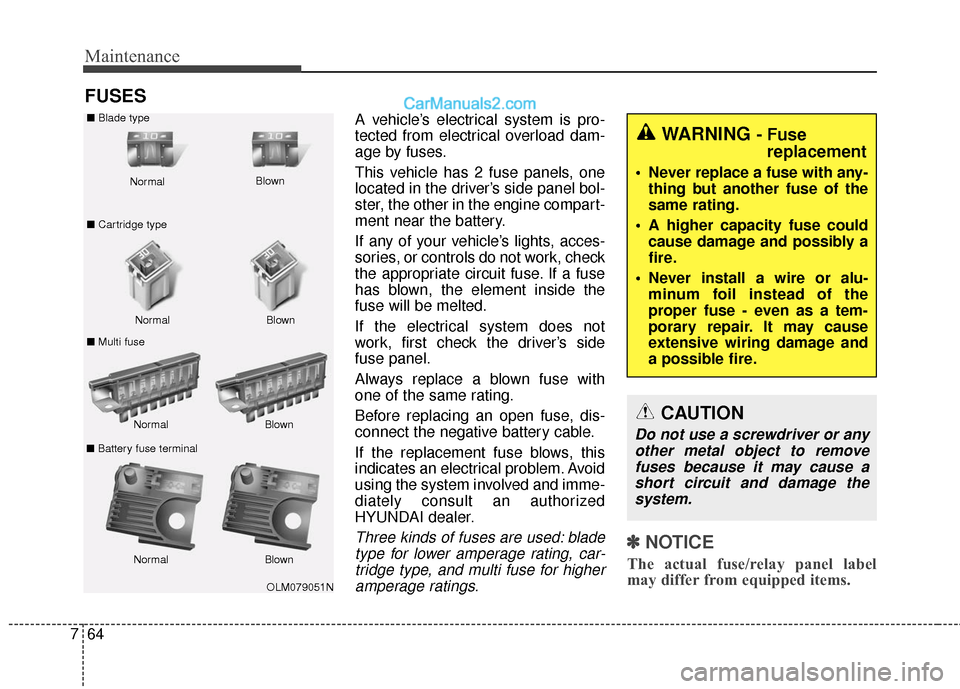
Three kinds of fuses are used: blade
type for lower amperage rating, car-tridge type, and multi fuse for higheramperage ratings.✽ ✽ NOTICE
The actual fuse/relay panel label
may differ from equipped items.
OLM079051N
Normal
Normal
■
Blade type
■ Cartridge type
■ Multi fuse Blown
Blown
Normal Blown
Normal Blown
WARNING - Fuse
replacement
Never replace a fuse with any-
thing but another fuse of the
same rating.
A higher capacity fuse could cause damage and possibly a
fire.
Never install a wire or alu- minum foil instead of the
proper fuse - even as a tem-
porary repair. It may cause
extensive wiring damage and
a possible fire.
CAUTION
Do not use a screwdriver or anyother metal object to removefuses because it may cause ashort circuit and damage thesystem.■ Battery fuse terminal
Page 553 of 569
87
Specifications, Consumer information and Reporting safety defects
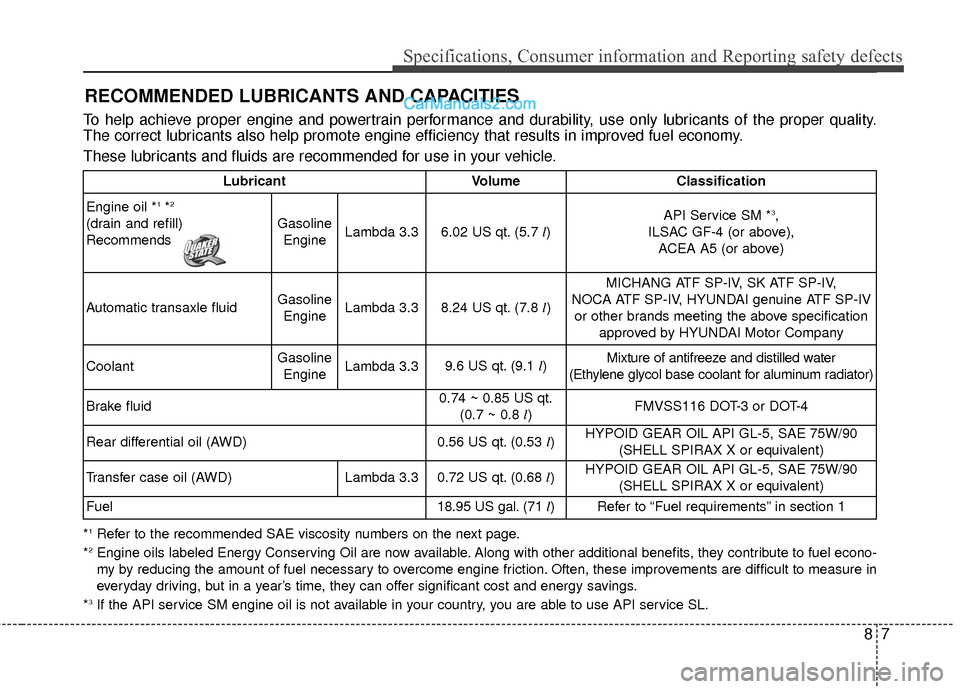
RECOMMENDED LUBRICANTS AND CAPACITIES
*1Refer to the recommended SAE viscosity numbers on the next page.
*2Engine oils labeled Energy Conserving Oil are now available. Along with other additional benefits, they contribute to fuel econo -
my by reducing the amount of fuel necessary to overcome engine friction. Often, these improvements are difficult to measure in
everyday driving, but in a year’s time, they can offer significant cost and energy savings.
*
3If the API service SM engine oil is not available in your country, you are able to use API service SL.
To help achieve proper engine and powertrain performance and durability, use only lubricants of the proper quality.
The correct lubricants also help promote engine efficiency that results in improved fuel economy.
These lubricants and fluids are recommended for use in your vehicle.
Lubricant VolumeClassification
Engine oil *
1*2
(drain and refill)
Recommends Gasoline
Engine Lambda 3.3
6.02 US qt. (5.7
l) API Service SM *3,
ILSAC GF-4 (or above), ACEA A5 (or above)
Automatic transaxle fluid Gasoline
Engine Lambda 3.3
8.24 US qt. (7.8
l)MICHANG ATF SP-IV, SK ATF SP-IV,
NOCA ATF SP-IV, HYUNDAI genuine ATF SP-IV or other brands meeting the above specification approved by HYUNDAI Motor Company
Coolant Gasoline
Engine Lambda 3.3
9.6 US qt. (9.1
l)Mixture of antifreeze and distilled water
(Ethylene glycol base coolant for aluminum radiator)
Brake fluid0.74 ~ 0.85 US qt. (0.7 ~ 0.8 l)FMVSS116 DOT-3 or DOT-4
Rear differential oil (AWD) 0.56 US qt. (0.53 l)HYPOID GEAR OIL API GL-5, SAE 75W/90
(SHELL SPIRAX X or equivalent)
Transfer case oil (AWD) Lambda 3.30.72 US qt. (0.68
l)HYPOID GEAR OIL API GL-5, SAE 75W/90
(SHELL SPIRAX X or equivalent)
Fuel18.95 US gal. (71 l)Refer to “Fuel requirements” in section 1
Page 562 of 569
Index
4I
Rocking the vehicle.................................................5-104
Smooth cornering ....................................................5-105
Economical operation .................................................5-101
Electric power steering (EPS) ......................................4-56
Electronic parking brake (EPB) ...................................5-35
Electronic Stability Control (ESC) ...............................5-46
Emergency starting .........................................................6-5 Jump starting ...............................................................6-5
Jump starting procedure ..............................................6-6
Push-starting ................................................................6-7
Emergency towing ........................................................6-27
Emergency while driving ...............................................6-3 If engine stalls while driving ......................................6-3
If the engine stalls at a crossroad or crossing .............6-3
If you have a flat tire while driving ............................6-3
Emission control system ...............................................7-94
Engine ........................................................................\
.....8-2
Engine compartment ...............................................2-7, 7-3
Engine coolant ..............................................................7-32
Engine number..............................................................8-10
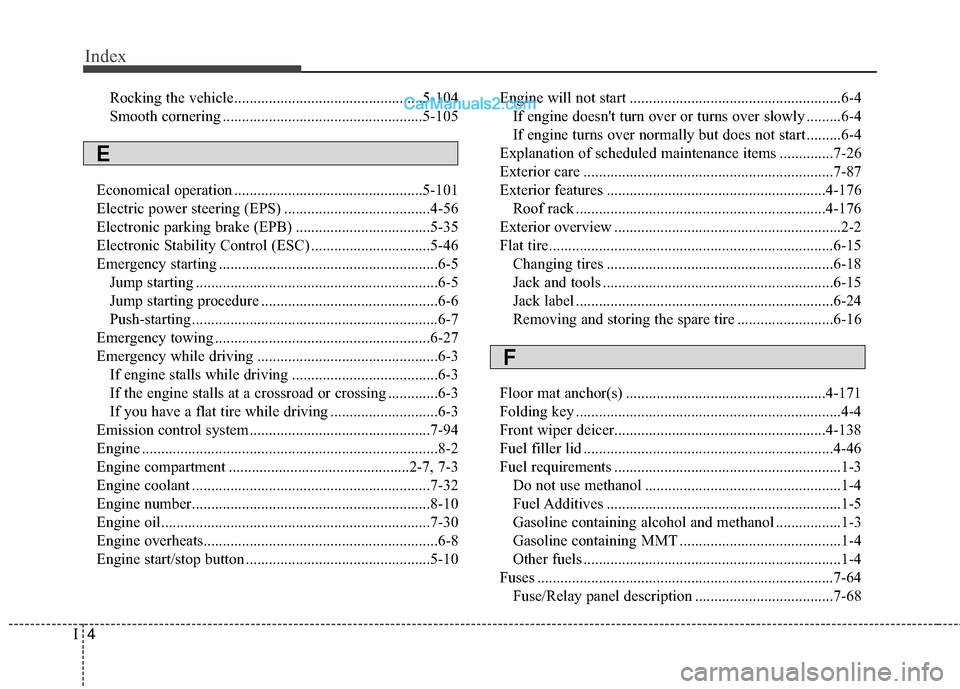
Engine oil......................................................................7-\
30
Engine overheats.............................................................6-8
Engine start/stop button ................................................5-10 Engine will not start .......................................................6-4
If engine doesn't turn over or turns over slowly .........6-4
If engine turns over normally but does not start .........6-4
Explanation of scheduled maintenance items ..............7-26
Exterior care .................................................................7-87
Exterior features .........................................................4-176 Roof rack .................................................................4-176
Exterior overview ...........................................................2-2
Flat tire........................................................................\
..6-15 Changing tires ...........................................................6-18
Jack and tools ............................................................6-15
Jack label ...................................................................6-24
Removing and storing the spare tire .........................6-16
Floor mat anchor(s) ....................................................4-171
Folding key .....................................................................4-4\
Front wiper deicer.......................................................4-138
Fuel filler lid .................................................................4-46
Fuel requirements ...........................................................1-3 Do not use methanol ...................................................1-4
Fuel Additives .............................................................1-5
Gasoline containing alcohol and methanol .................1-3
Gasoline containing MMT ..........................................1-4
Other fuels ...................................................................1-4
Fuses ........................................................................\
.....7-64 Fuse/Relay panel description ....................................7-68
E
F