2017 Hyundai Santa Fe front side car seat
[x] Cancel search: front side car seatPage 64 of 569
343
Safety features of your vehicle
Children riding in the car should sit in
the rear seat and must always be
properly restrained to minimize the
risk of injury in an accident, sudden
stop or sudden maneuver. According
to accident statistics, children are
safer when properly restrained in the
rear seats than in the front seat.
Larger children not in a child restraint
should use one of the seat belts pro-
vided.
You should be aware of the specific
requirements in your state. Child
and/or infant safety seats must be
properly placed and installed in the
rear seat. You must use a commer-
cially available child restraint system
that meets the requirements of the
Federal Motor Vehicle Safety
Standards (FMVSS).
Child restraint systems are designed
to be secured in vehicle seats by lap
belts or the lap belt portion of a
lap/shoulder belt, or by a LATCH sys-
tem (if equipped).Children could be injured or killed in
a crash if their restraints are not
properly secured. For small children
and babies, a child seat or infant seat
must be used. Before buying a par-
ticular child restraint system, make
sure it fits your car seat and seat
belts, and fits your child. Follow all
the instructions provided by the man-
ufacturer when installing the child
restraint system.
CHILD RESTRAINT SYSTEM
WARNING
A child restraint system must
be placed in the rear seat.
Never install a child or infant
seat on the front passenger's
seat. Should an accident
occur and cause the passen-
ger-side air bag to deploy, it
could severely injure or kill an
infant or child seated in an
infant or child seat. Thus only
use a child restraint in the
rear seat of your vehicle.
A seat belt or child restraint system can become very hot
if it is left in a closed vehicle
on a sunny day, even if the
outside temperature does not
feel hot. Be sure to check the
seat cover and buckles before
placing a child there.
(Continued)
Page 65 of 569
Safety features of your vehicle
44
3
WARNING
To reduce the chance of serious
or fatal injuries:
Children of all ages are safer
when restrained in the rear
seat. A child riding in the front
passenger seat can be force-
fully struck by an inflating air
bag resulting in serious or
fatal injuries.
Always follow the child restraint system manufactur-
er’s instructions for installa-
tion and use of the child
restraint.
Always make sure the child seat is secured properly in the
car and your child is securely
restrained in the child seat.
Never hold a child in your arms or lap when riding in a
vehicle. The violent forces cre-
ated during a crash will tear
the child from your arms and
throw the child against the
car’s interior.
(Continued)
(Continued)
Never put a seat belt overyourself and a child. During a
crash, the belt could press
deep into the child causing
serious internal injuries.
Never leave children unat- tended in a vehicle – not even
for a short time. The car can
heat up very quickly, resulting
in serious injuries to children
inside. Even very young chil-
dren may inadvertently cause
the vehicle to move, entangle
themselves in the windows, or
lock themselves or others
inside the vehicle.
Never allow two children, or any two persons, to use the
same seat belt.
Children often squirm and reposition themselves improp-
erly. Never let a child ride with
the shoulder belt under their
arm or behind their back.
Always properly position and
secure children in the rear
seat.
(Continued)(Continued)
When the child restraint sys-tem is not in use, store it in
the luggage area or fasten it
with a seat belt so that it will
not be thrown forward in the
case of a sudden stop or an
accident.
Children may be seriously injured or killed by an inflating
air bag. All children, even
those too large for child
restraints, must ride in the
rear seat.
Page 66 of 569
345
Safety features of your vehicle
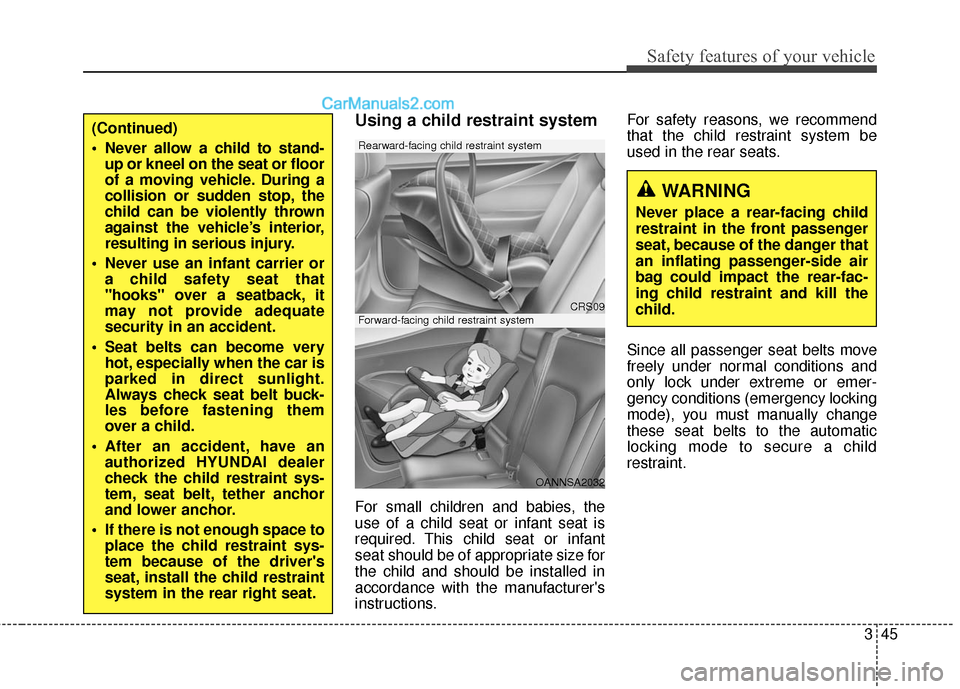
Using a child restraint system
For small children and babies, the
use of a child seat or infant seat is
required. This child seat or infant
seat should be of appropriate size for
the child and should be installed in
accordance with the manufacturer's
instructions.For safety reasons, we recommend
that the child restraint system be
used in the rear seats.
Since all passenger seat belts move
freely under normal conditions and
only lock under extreme or emer-
gency conditions (emergency locking
mode), you must manually change
these seat belts to the automatic
locking mode to secure a child
restraint.
WARNING
Never place a rear-facing child
restraint in the front passenger
seat, because of the danger that
an inflating passenger-side air
bag could impact the rear-fac-
ing child restraint and kill the
child.
CRS09
OANNSA2032
Forward-facing child restraint system
Rearward-facing child restraint system
(Continued)
Never allow a child to stand-
up or kneel on the seat or floor
of a moving vehicle. During a
collision or sudden stop, the
child can be violently thrown
against the vehicle’s interior,
resulting in serious injury.
Never use an infant carrier or a child safety seat that
"hooks" over a seatback, it
may not provide adequate
security in an accident.
Seat belts can become very hot, especially when the car is
parked in direct sunlight.
Always check seat belt buck-
les before fastening them
over a child.
After an accident, have an authorized HYUNDAI dealer
check the child restraint sys-
tem, seat belt, tether anchor
and lower anchor.
If there is not enough space to place the child restraint sys-
tem because of the driver's
seat, install the child restraint
system in the rear right seat.
Page 97 of 569
Safety features of your vehicle
76
3
❈ The actual air bags in the vehicle may dif-
fer from the illustration.
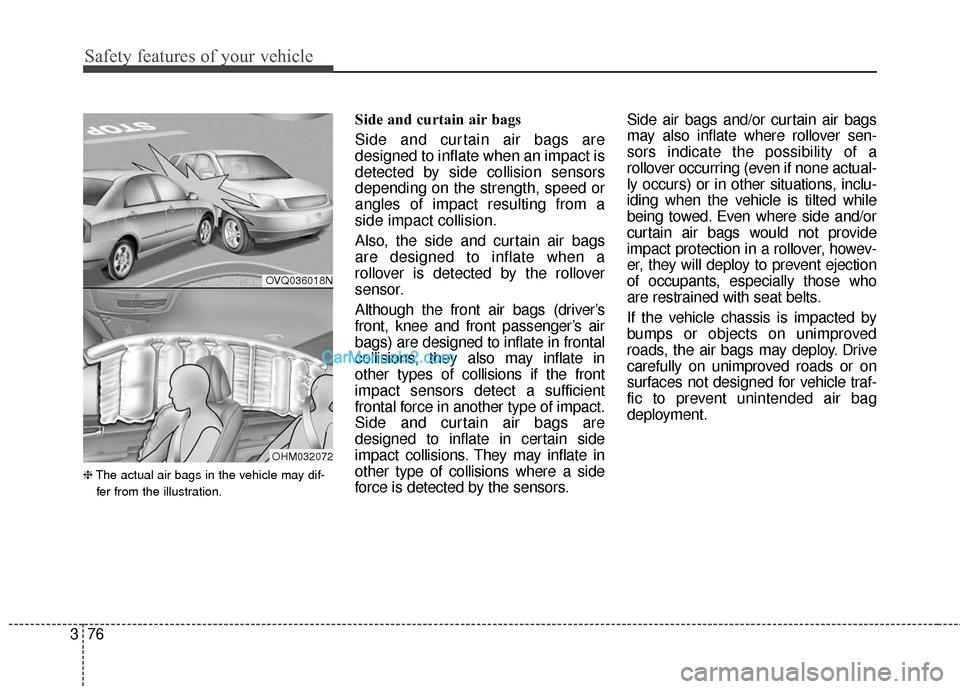
Side and curtain air bags
Side and curtain air bags are
designed to inflate when an impact is
detected by side collision sensors
depending on the strength, speed or
angles of impact resulting from a
side impact collision.
Also, the side and curtain air bags
are designed to inflate when a
rollover is detected by the rollover
sensor.
Although the front air bags (driver’s
front, knee and front passenger’s air
bags) are designed to inflate in frontal
collisions, they also may inflate in
other types of collisions if the front
impact sensors detect a sufficient
frontal force in another type of impact.
Side and curtain air bags are
designed to inflate in certain side
impact collisions. They may inflate in
other type of collisions where a side
force is detected by the sensors. Side air bags and/or curtain air bags
may also inflate where rollover sen-
sors indicate the possibility of a
rollover occurring (even if none actual-
ly occurs) or in other situations, inclu-
iding when the vehicle is tilted while
being towed. Even where side and/or
curtain air bags would not provide
impact protection in a rollover, howev-
er, they will deploy to prevent ejection
of occupants, especially those who
are restrained with seat belts.
If the vehicle chassis is impacted by
bumps or objects on unimproved
roads, the air bags may deploy. Drive
carefully on unimproved roads or on
surfaces not designed for vehicle traf-
fic to prevent unintended air bag
deployment.
OVQ036018N
OHM032072
Page 102 of 569

381
Safety features of your vehicle
Passengers should not place
hard or sharp objects between
themselves and the air bags.
Carrying hard or sharp objects on
your lap or in your mouth can result
in injuries if an air bag inflates.
Keep occupants away from the air
bag covers. All occupants should sit
upright, fully back in their seats with
their seat belts on and their feet on
the floor. If occupants are too close
to the air bag covers, they could be
injured if the air bags inflate.
Do not attach or place objects
on or near the air bag covers.
Any object attached to or placed
on the front or side air bag covers
could interfere with the proper
operation of the air bags.
Do not modify the front seats.
Modification of the front seats could
interfere with the operation of the
supplemental restraint system sens-
ing components or side air bags.
Do not place items under the
front seats. Placing items under
the front seats could interfere with
the operation of the supplemental
restraint system sensing compo-
nents and wiring harnesses.
Never hold an infant or child on
your lap. The infant or child could
be seriously injured or killed in the
event of a crash. All infants and chil-
dren should be properly restrained
in appropriate child safety seats or
seat belts in the rear seat.
WARNING
Sitting improperly or out of position can cause occupants
to be shifted too close to a
deploying air bag, strike the
interior structure or be thrown
from the vehicle resulting in
serious injury or death.
Always sit upright with the seatback in an upright posi-
tion, centered on the seat
cushion with your seat belt
on, legs comfortably extended
and your feet on the floor.
(Continued)
(Continued)
Always have the ignition OFFwhen the vehicle is being
towed or where it may other-
wise be tilted, since the side
and/or curtain air bags may
inflate if the sensors interpret
those tilt angles as a potential
rollover.
Be careful not to cause impact to the doors when the ignition
is ON. The air bags may
inflate.
Page 506 of 569

Maintenance
58
7
Tire terminology and defini-
tions
Air Pressure: The amount of air
inside the tire pressing outward on
the tire. Air pressure is expressed in
pounds per square inch (psi) or kilo-
pascal (kPa).
Accessory Weight: This means the
combined weight of optional acces-
sories. Some examples of optional
accessories are, automatic transaxle
power seats, and air conditioning.
Aspect Ratio: The relationship of a
tire's height to its width.
Belt: A rubber coated layer of cords
that is located between the plies and
the tread. Cords may be made from
steel or other reinforcing materials.
Bead: The tire bead contains steel
wires wrapped by steel cords that
hold the tire onto the rim.
Bias Ply Tire: A pneumatic tire in
which the plies are laid at alternate
angles less than 90 degrees to the
centerline of the tread.
Cold Tire Pressure: The amount of
air pressure in a tire, measured in
pounds per square inch (psi) or kilo-
pascals (kPa) before a tire has built
up heat from driving. Curb Weight:
This means the weight
of a motor vehicle with standard and
optional equipment including the
maximum capacity of fuel, oil and
coolant, but without passengers and
cargo.
DOT Markings: A code molded into
the sidewall of a tire signifying that
the tire is in compliance with the U.S.
Department of Transportation motor
vehicle safety standards. The DOT
code includes the Tire Identification
Number (TIN), an alphanumeric des-
ignator which can also identify the
tire manufacturer, production plant,
brand and date of production.
GVWR: Gross Vehicle Weight Rating
GAWR FRT: Gross Axle Weight
Rating for the Front Axle.
GAWR RR: Gross Axle Weight
Rating for the Rear axle.
Intended Outboard Sidewall: The
side of an asymmetrical tire, that
must always face outward when
mounted on a vehicle.
Kilopascal (kPa): The metric unit for
air pressure.
WARNING - Tire temperature
The temperature grade for this
tire is established for a tire that
is properly inflated and not
overloaded. Excessive speed,
underinflation, or excessive
loading, either separately or in
combination, can cause heat
build-up and possible sudden
tire failure. This can cause loss
of vehicle control and serious
injury or death.
Page 561 of 569
I3
Index
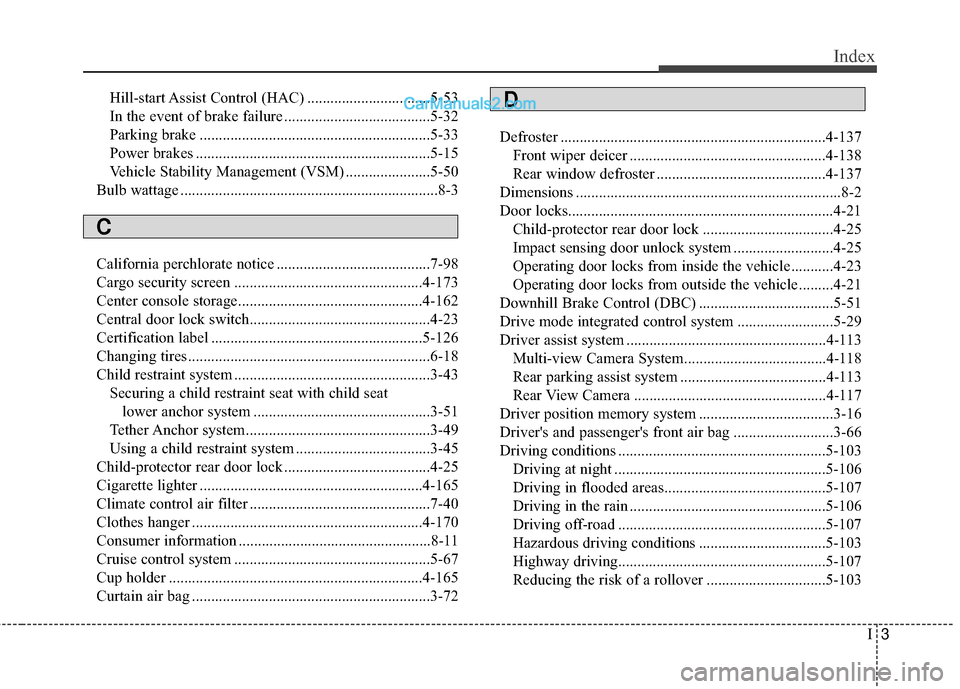
Hill-start Assist Control (HAC) ................................5-53
In the event of brake failure ......................................5-32
Parking brake ............................................................5-33
Power brakes .............................................................5-15
Vehicle Stability Management (VSM) ......................5-50
Bulb wattage ...................................................................8-3
California perchlorate notice ........................................7-98
Cargo security screen .................................................4-173
Center console storage................................................4-162
Central door lock switch...............................................4-23
Certification label .......................................................5-126
Changing tires ...............................................................6-18
Child restraint system ...................................................3-43 Securing a child restraint seat with child seat lower anchor system ..............................................3-51
Tether Anchor system................................................3-49
Using a child restraint system ...................................3-45
Child-protector rear door lock ......................................4-25
Cigarette lighter ..........................................................4-165
Climate control air filter ...............................................7-40
Clothes hanger ............................................................4-170
Consumer information ..................................................8-11
Cruise control system ...................................................5-67
Cup holder ..................................................................4-165
Curtain air bag ..............................................................3-72 Defroster .....................................................................4-1\
37
Front wiper deicer ...................................................4-138
Rear window defroster ............................................4-137
Dimensions .....................................................................8-2\
Door locks..............................................................\
.......4-21 Child-protector rear door lock ..................................4-25
Impact sensing door unlock system ..........................4-25
Operating door locks from inside the vehicle ...........4-23
Operating door locks from outside the vehicle .........4-21
Downhill Brake Control (DBC) ...................................5-51
Drive mode integrated control system .........................5-29
Driver assist system ....................................................4-113 Multi-view Camera System.....................................4-118
Rear parking assist system ......................................4-113
Rear View Camera ..................................................4-117
Driver position memory system ...................................3-16
Driver's and passenger's front air bag ..........................3-66
Driving conditions ......................................................5-103 Driving at night .......................................................5-106
Driving in flooded areas..........................................5-107
Driving in the rain ...................................................5-106
Driving off-road ......................................................5-107
Hazardous driving conditions .................................5-103
Highway driving......................................................5-107
Reducing the risk of a rollover ...............................5-103
C
D
Page 566 of 569
Index
8I
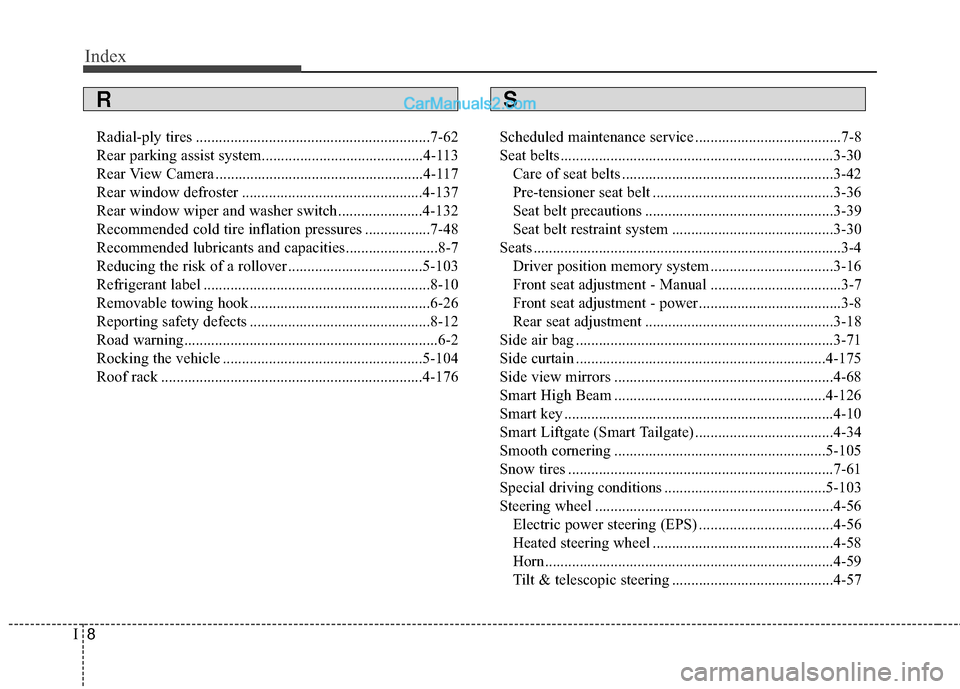
Radial-ply tires .............................................................7-62
Rear parking assist system..........................................4-113
Rear View Camera ......................................................4-117
Rear window defroster ...............................................4-137
Rear window wiper and washer switch......................4-132
Recommended cold tire inflation pressures .................7-48
Recommended lubricants and capacities........................8-7
Reducing the risk of a rollover ...................................5-103
Refrigerant label ...........................................................8-10
Removable towing hook ...............................................6-26
Reporting safety defects ...............................................8-12
Road warning..................................................................6-2
Rocking the vehicle ....................................................5-104
Roof rack ....................................................................4-17\
6Scheduled maintenance service ......................................7-8
Seat belts .......................................................................3\
-30
Care of seat belts .......................................................3-42
Pre-tensioner seat belt ...............................................3-36
Seat belt precautions .................................................3-39
Seat belt restraint system ..........................................3-30
Seats ........................................................................\
........3-4 Driver position memory system ................................3-16
Front seat adjustment - Manual ..................................3-7
Front seat adjustment - power .....................................3-8
Rear seat adjustment .................................................3-18
Side air bag ...................................................................3-71
Side curtain .................................................................4-175
Side view mirrors .........................................................4-68
Smart High Beam .......................................................4-126
Smart key ......................................................................4-\
10
Smart Liftgate (Smart Tailgate) ....................................4-34
Smooth cornering .......................................................5-105
Snow tires .....................................................................7-6\
1
Special driving conditions ..........................................5-103
Steering wheel ..............................................................4-56 Electric power steering (EPS) ...................................4-56
Heated steering wheel ...............................................4-58
Horn........................................................................\
...4-59
Tilt & telescopic steering ..........................................4-57
RS