2017 Hyundai Santa Fe Sensors
[x] Cancel search: SensorsPage 75 of 569
Safety features of your vehicle
54
3
How does the air bag system
operate
Air bags are activated (able to
inflate if necessary) only when the
ignition switch is turned to the ON
or START position.
The appropriate air bags inflate instantly in the event of serious
frontal or side collision in order to
help protect the occupants from
serious physical injury.
There is no single speed at which the air bags will inflate.
Generally, air bags are designed to
inflate by the severity of a collision
and its direction. These two factors
determine whether the sensors
send out an electronic deployment/
inflation signal.
Air bag deployment depends on a number of factors including vehicle
speed, angles of impact and the
density and stiffness of the vehi-
cles or objects which your vehicle
hits in the collision. Though, factors
are not limited to those mentioned
above. The front air bags will completely
inflate and deflate in an instant.
It is virtually impossible for you to
see the air bags inflate during an
accident.
It is much more likely that you will
simply see the deflated air bags
hanging out of their storage com-
partments after the collision.
In addition to inflating in serious side collisions, side and/or curtain
air bags will inflate if the sensing
system detects a rollover.
When a rollover is detected, side and/or curtain air bags will remain
inflated longer to help provide pro-
tection from ejection, especially
when used in conjunction with the
seat belts.
In order to help provide protection, the air bags must inflate rapidly.
The speed of air bag inflation is a
consequence of the extremely
short time in which to inflate the air
bag between the occupant and the
vehicle structures before the occu-
pant impacts those structures. This speed of inflation reduces the
risk of serious or life-threatening
injuries and is thus a necessary
part of air bag design.
However, air bag inflation can also
cause injuries which normally can
include facial abrasions, bruises
and broken bones because the
inflation speed also causes the air
bags to expand with a great deal of
force.
There are even circumstances
under which contact with the air
bag can cause fatal injuries,
especially if the occupant is
positioned excessively close to
the air bag.
Page 78 of 569

357
Safety features of your vehicle
SRS components and functions
The SRS consists of the following
components:
1. Driver's front air bag module
2. Passenger's front air bag module
3. Side air bag modules
4. Curtain air bag modules
5. Retractor pre-tensioner assem-blies
6. Air bag warning light
7. SRS control module (SRSCM)/ Rollover sensor
8. Front impact sensors
9. Pressure type side impact sensors 10. "PASSENGER AIR BAG OFF"
indicator (Front passenger's seat
only)
11. Occupant classification system (Front passenger's seat only)
12. Driver's and front passenger's seat belt buckle sensors
13. Driver's knee air bag module
14. Acceleration type side impact sensors
The SRSCM continually monitors all
SRS components while the ignition
switch is ON to determine if a crash
impact is severe enough to require
air bag deployment or pre-tensioner
seat belt deployment. The SRS air bag warning light " "
on the instrument panel will illumi-
nate for about 6 seconds after the
ignition switch is turned to the ON
position, after which the SRS air bag
warning light " " should go out.
W7-147
ONC037005N
Page 88 of 569

367
Safety features of your vehicle
Your vehicle is equipped with a
Supplemental Restraint (Air Bag)
System and the lap/shoulder belts at
both the driver and passenger seat-
ing positions.
The front air bags are designed to
supplement the three-point seat
belts. For these air bags to provide
protection, the seat belts must be
worn at all times when driving.
The indications of the system's pres-
ence are the letters "SRS AIR BAG"
embossed on the air bag pad cover
in the steering wheel, on the knee
bolster below the steering wheel col-
umn and the passenger's side front
panel pad above the glove box.
The SRS consists of air bags
installed under the pad covers in the
center of the steering wheel , in the
knee bolster below the steering
wheel column and the passenger's
side front panel above the glove box.
The purpose of the SRS is to provide
the vehicle's driver and/or the front
passenger with additional protection
than that offered by the seat belt sys-
tem alone in case of a frontal impact
of sufficient severity.The seat belt buckle sensors deter-
mine if the driver and front passen-
ger's seat belts are fastened. These
sensors provide the ability to control
the SRS deployment based on
whether or not the seat belts are fas-
tened, and how severe the impact is.
The advanced SRS offers the ability
to control the air bag inflation within
two levels. A first stage level is pro-
vided for moderate-severity impacts.
A second stage level is provided for
more severe impacts.
According to the impact severity and
seat belt usage, the SRSCM (SRS
Control Module) controls the air bag
inflation. Failure to properly wear
seat belts can increase the risk or
severity of injury in an accident.
Additionally, your vehicle is equipped
with an occupant classification sys-
tem in the front passenger's seat.
The occupant classification system
detects the presence of a passenger
in the front passenger's seat and will
turn off the front passenger's air bag
under certain conditions. For more
detail, see "Occupant classification
system" in this section.
Page 95 of 569

Safety features of your vehicle
74
3
Why didn’t my air bag go off in a
collision? (Inflation and non-infla-
tion conditions of the air bag)
There are many types of accidents
in which the air bag would not be
expected to provide additional
protection.
These include rear impacts, sec-
ond or third collisions in multiple
impact accidents, as well as low
speed impacts.Air bag collision sensors
(1) SRS control module /
Rollover sensor
(2) Front impact sensor (3)
Pressure type side impact sensor
(4) Acceleration type side impact
sensor
ONC036001/ONC037006N/ONC036002/OANNSA2038/ODM032048
1234
Page 96 of 569

375
Safety features of your vehicle
Problems may arise if the sensorinstallation angles are changed
due to the deformation of the front
bumper, body or C pillars or front
door where side collision sensors
are installed. Have the vehicle
checked and repaired by an
authorized HYUNDAI dealer.
Your vehicle has been designed to absorb impact and deploy the air
bag(s) in certain collisions. Installing
bumper guards or side steppers or
replacing a bumper with non-gen-
uine parts may adversely affect your
vehicle’s collision and air bag
deployment performance.Air bag inflation conditions
Front air bags
Front air bags are designed to inflate
in a frontal collision depending on
the intensity, speed or angles of
impact of the front collision.
WARNING - Air bag
sensors
Do not hit or allow any objects to impact the locations where
air bags or sensors are
installed.
This may cause unexpected
air bag deployment, which
could result in serious per-
sonal injury or death.
If the installation location or angle of the sensors is altered
in any way, the air bags may
deploy when they should not
or they may not deploy when
they should, causing severe
injury or death.
Therefore, do not try to per-
form maintenance on or
around the air bag sensors.
Have the vehicle checked and
repaired by an authorized
HYUNDAI dealer.
1VQA2084
Page 97 of 569
Safety features of your vehicle
76
3
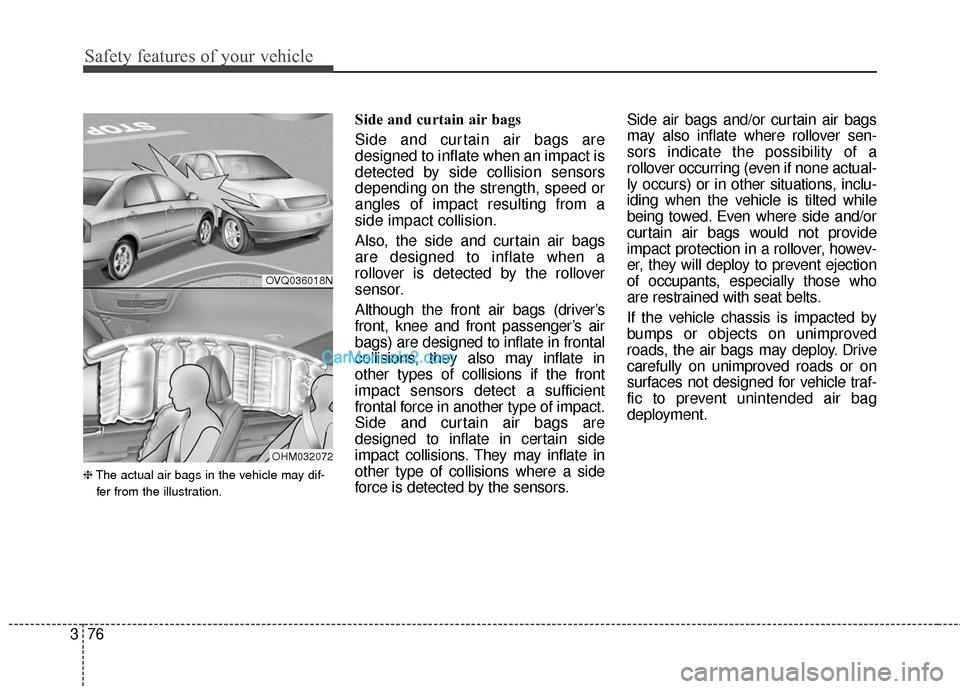
❈ The actual air bags in the vehicle may dif-
fer from the illustration.
Side and curtain air bags
Side and curtain air bags are
designed to inflate when an impact is
detected by side collision sensors
depending on the strength, speed or
angles of impact resulting from a
side impact collision.
Also, the side and curtain air bags
are designed to inflate when a
rollover is detected by the rollover
sensor.
Although the front air bags (driver’s
front, knee and front passenger’s air
bags) are designed to inflate in frontal
collisions, they also may inflate in
other types of collisions if the front
impact sensors detect a sufficient
frontal force in another type of impact.
Side and curtain air bags are
designed to inflate in certain side
impact collisions. They may inflate in
other type of collisions where a side
force is detected by the sensors. Side air bags and/or curtain air bags
may also inflate where rollover sen-
sors indicate the possibility of a
rollover occurring (even if none actual-
ly occurs) or in other situations, inclu-
iding when the vehicle is tilted while
being towed. Even where side and/or
curtain air bags would not provide
impact protection in a rollover, howev-
er, they will deploy to prevent ejection
of occupants, especially those who
are restrained with seat belts.
If the vehicle chassis is impacted by
bumps or objects on unimproved
roads, the air bags may deploy. Drive
carefully on unimproved roads or on
surfaces not designed for vehicle traf-
fic to prevent unintended air bag
deployment.
OVQ036018N
OHM032072
Page 99 of 569

Safety features of your vehicle
78
3
In an angled collision, the force of
impact may direct the occupants in
a direction where the air bags would
not be able to provide any addition-
al benefit, and thus the SRS may
not deploy any air bags. Just before impact, drivers often
brake heavily. Such heavy braking
lowers the front portion of the vehi-
cle causing it to "ride" under a vehi-
cle with a higher ground clearance.
Air bags may not inflate in this
"under-ride" situation because
forces that are detected by sensors
may be reduced by such "under-
ride" collisions. Front air bags may not inflate in
rollover accidents where the
SRSCM indicates that the SRSCM
indicates that the front air bag
deployment would not provide
additional occupant protection.
1VQA20901VQA20891VQA2091
Page 102 of 569

381
Safety features of your vehicle
Passengers should not place
hard or sharp objects between
themselves and the air bags.
Carrying hard or sharp objects on
your lap or in your mouth can result
in injuries if an air bag inflates.
Keep occupants away from the air
bag covers. All occupants should sit
upright, fully back in their seats with
their seat belts on and their feet on
the floor. If occupants are too close
to the air bag covers, they could be
injured if the air bags inflate.
Do not attach or place objects
on or near the air bag covers.
Any object attached to or placed
on the front or side air bag covers
could interfere with the proper
operation of the air bags.
Do not modify the front seats.
Modification of the front seats could
interfere with the operation of the
supplemental restraint system sens-
ing components or side air bags.
Do not place items under the
front seats. Placing items under
the front seats could interfere with
the operation of the supplemental
restraint system sensing compo-
nents and wiring harnesses.
Never hold an infant or child on
your lap. The infant or child could
be seriously injured or killed in the
event of a crash. All infants and chil-
dren should be properly restrained
in appropriate child safety seats or
seat belts in the rear seat.
WARNING
Sitting improperly or out of position can cause occupants
to be shifted too close to a
deploying air bag, strike the
interior structure or be thrown
from the vehicle resulting in
serious injury or death.
Always sit upright with the seatback in an upright posi-
tion, centered on the seat
cushion with your seat belt
on, legs comfortably extended
and your feet on the floor.
(Continued)
(Continued)
Always have the ignition OFFwhen the vehicle is being
towed or where it may other-
wise be tilted, since the side
and/or curtain air bags may
inflate if the sensors interpret
those tilt angles as a potential
rollover.
Be careful not to cause impact to the doors when the ignition
is ON. The air bags may
inflate.