2017 HYUNDAI IX20 park assist
[x] Cancel search: park assistPage 145 of 456

467
Features of your vehicle
✽✽NOTICE
This system can only sense objects with-
in the range and location of the sensors;
it can not detect objects in other areas
where sensors are not installed. Also,
small or slim objects, such as poles or
objects located between sensors may not
be detected by the sensors.
Always visually check behind the vehi-
cle when backing up.
Be sure to inform any drivers of the
vehicle that may be unfamiliar with the
system regarding the systems capabili-
ties and limitations.Self-diagnosis
When you shift the gear to the R
(Reverse) position and if one or more of
the below occurs you may have a mal-
function in the rear parking assist sys-tem.
You don't hear an audible warning sound or if the buzzer sounds intermit-
tently.
If this occurs, we recommend that the
system be checked by an authorized
HYUNDAI dealer.
WARNING
Pay close attention when the vehi-
cle is driven close to objects on the
road, particularly pedestrians, and
especially children. Be aware that
some objects may not be detected
by the sensors, due to the object’s
distance, size or material, all of
which can limit the effectiveness of
the sensor. Always perform a visu-al inspection to make sure the vehi-
cle is clear of all obstructions
before moving the vehicle in anydirection.
WARNING
Your new vehicle warranty does not
cover any accidents or damage to
the vehicle or injuries to its occu-pants due to a rear parking assist
system malfunction. Always drive
safely and cautiously.
(blinks)
is displayed. (if equipped)
procarmanuals.com
Page 259 of 456
Driving your vehicle
28
5
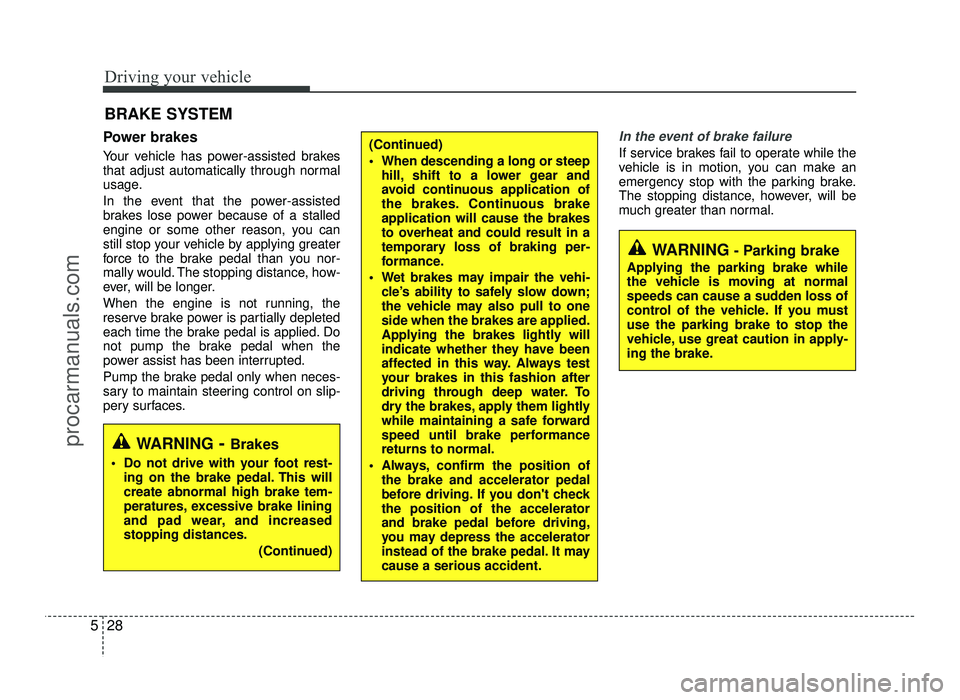
Power brakes
Your vehicle has power-assisted brakes
that adjust automatically through normal
usage.
In the event that the power-assisted
brakes lose power because of a stalled
engine or some other reason, you can
still stop your vehicle by applying greater
force to the brake pedal than you nor-
mally would. The stopping distance, how-
ever, will be longer.
When the engine is not running, the
reserve brake power is partially depleted
each time the brake pedal is applied. Do
not pump the brake pedal when the
power assist has been interrupted.
Pump the brake pedal only when neces-
sary to maintain steering control on slip-
pery surfaces.In the event of brake failure
If service brakes fail to operate while the
vehicle is in motion, you can make an
emergency stop with the parking brake.
The stopping distance, however, will be
much greater than normal.
BRAKE SYSTEM (Continued)
When descending a long or steep
hill, shift to a lower gear and
avoid continuous application of
the brakes. Continuous brakeapplication will cause the brakes
to overheat and could result in a
temporary loss of braking per-
formance.
Wet brakes may impair the vehi- cle’s ability to safely slow down;
the vehicle may also pull to oneside when the brakes are applied.
Applying the brakes lightly will
indicate whether they have been
affected in this way. Always test
your brakes in this fashion after
driving through deep water. To
dry the brakes, apply them lightly
while maintaining a safe forward
speed until brake performancereturns to normal.
Always, confirm the position of the brake and accelerator pedal
before driving. If you don't checkthe position of the accelerator
and brake pedal before driving,
you may depress the accelerator
instead of the brake pedal. It maycause a serious accident.
WARNING - Parking brake
Applying the parking brake while
the vehicle is moving at normal
speeds can cause a sudden loss of
control of the vehicle. If you mustuse the parking brake to stop the
vehicle, use great caution in apply-
ing the brake.
WARNING - Brakes
Do not drive with your foot rest- ing on the brake pedal. This will create abnormal high brake tem-
peratures, excessive brake lining
and pad wear, and increasedstopping distances.
(Continued)
procarmanuals.com
Page 267 of 456
Driving your vehicle
36
5
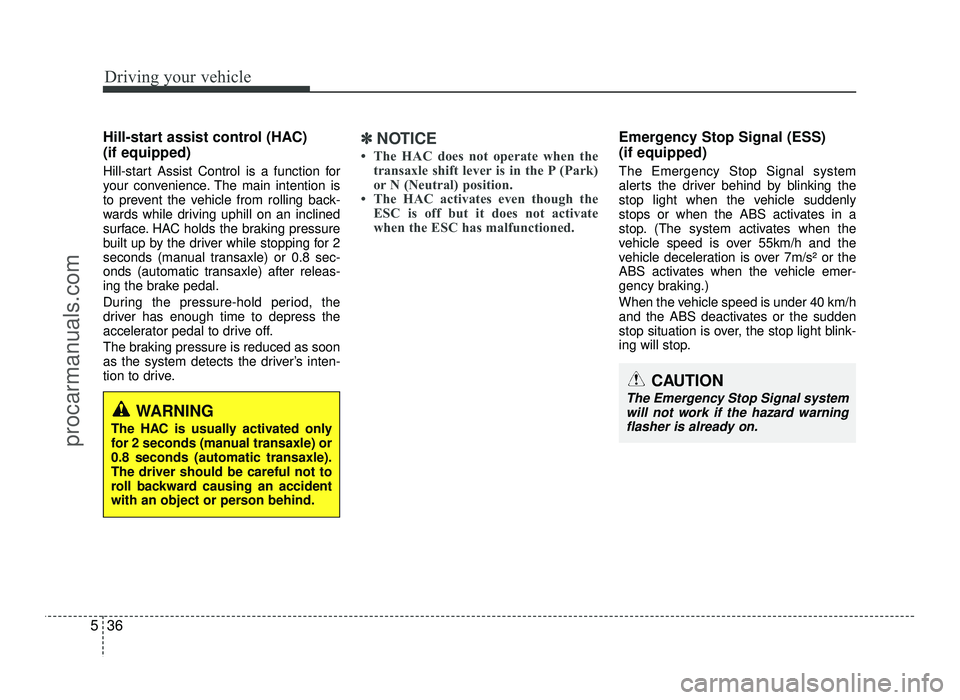
Hill-start assist control (HAC) (if equipped)
Hill-start Assist Control is a function for
your convenience. The main intention is
to prevent the vehicle from rolling back-
wards while driving uphill on an inclined
surface. HAC holds the braking pressure
built up by the driver while stopping for 2
seconds (manual transaxle) or 0.8 sec-
onds (automatic transaxle) after releas-
ing the brake pedal.
During the pressure-hold period, the
driver has enough time to depress the
accelerator pedal to drive off.
The braking pressure is reduced as soon
as the system detects the driver’s inten-
tion to drive.✽✽
NOTICE
The HAC does not operate when the transaxle shift lever is in the P (Park)
or N (Neutral) position.
The HAC activates even though the ESC is off but it does not activate
when the ESC has malfunctioned. Emergency Stop Signal (ESS) (if equipped) The Emergency Stop Signal system
alerts the driver behind by blinking the
stop light when the vehicle suddenly
stops or when the ABS activates in a
stop. (The system activates when the
vehicle speed is over 55km/h and the
vehicle deceleration is over 7m/s² or the
ABS activates when the vehicle emer-
gency braking.)
When the vehicle speed is under 40 km/h
and the ABS deactivates or the sudden
stop situation is over, the stop light blink-
ing will stop.
WARNING
The HAC is usually activated only
for 2 seconds (manual transaxle) or0.8 seconds (automatic transaxle).The driver should be careful not to
roll backward causing an accident
with an object or person behind.
CAUTION
The Emergency Stop Signal system will not work if the hazard warning
flasher is already on.
procarmanuals.com
Page 268 of 456
537
Driving your vehicle
Good braking practices
Check to be sure the parking brake isnot engaged and that the parking
brake indicator light is out before driv-
ing away.
Driving through water may get the brakes wet. They can also get wet
when the vehicle is washed. Wet
brakes can be dangerous! Your vehicle
will not stop as quickly if the brakes are
wet. Wet brakes may cause the vehicle
to pull to one side.
To dry the brakes, apply the brakes
lightly until the braking operation
returns to normal, to keep the vehicle
under control at all times. If the braking
operation does not return to normal,
stop as soon as it is safe to do so and
we recommend that you call an author-
ized HYUNDAI dealer for assistance.
Don't coast down hills with the vehicle out of gear. This is extremely haz-
ardous. Keep the vehicle in gear at all
times, use the brakes to slow down,
then shift to a lower gear so that
engine braking will help you maintain a
safe speed. Don't "ride" the brake pedal. Resting
your foot on the brake pedal while driv-ing can be dangerous because the
brakes might overheat and lose their
effectiveness. It also increases the
wear of the brake components.
If a tire goes flat while you are driving, apply the brakes gently and keep the
vehicle pointed straight ahead while
you slow down. When you are moving
slowly enough for it to be safe to do so,
pull off the road and stop in a safe
place.
If your vehicle is equipped with an automatic transaxle, don't let your vehi-
cle creep forward. To avoid creeping
forward, keep your foot firmly on the
brake pedal when the vehicle isstopped.
Be cautious when parking on a hill. Firmly engage the parking brake and
place the shift lever in P (automatic
transaxle) or in first or reverse gear
(manual transaxle). If your vehicle is
facing downhill, turn the front wheels
toward the curb to help keep the vehi-
cle from rolling. If your vehicle is facing
uphill, turn the front wheels away from
the curb to help keep the vehicle from
rolling. If there is no curb or if it is
required by other conditions to keep
the vehicle from rolling, block the
wheels. Under some conditions your parking
brake can freeze in the engaged posi-
tion. This is most likely to happen when
there is an accumulation of snow or ice
around or near the rear brakes or if the
brakes are wet. If there is a risk that the
parking brake may freeze, apply it only
temporarily while you put the shift lever
in P (automatic transaxle) or in first or
reverse gear (manual transaxle) and
block the rear wheels so the vehicle
cannot roll. Then release the parking
brake.
Do not hold the vehicle on an upgrade with the accelerator pedal. This can
cause the transaxle to overheat.
Always use the brake pedal or parking
brake.
procarmanuals.com
Page 338 of 456
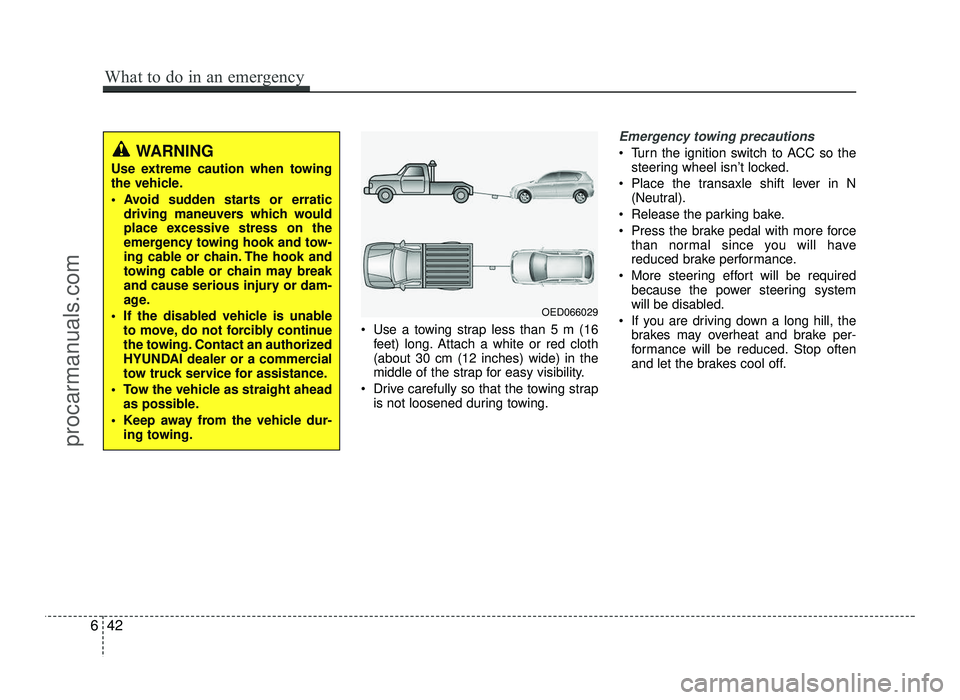
Use a towing strap less than 5 m (16feet) long. Attach a white or red cloth (about 30 cm (12 inches) wide) in the
middle of the strap for easy visibility.
Drive carefully so that the towing strap is not loosened during towing.
Emergency towing precautions
Turn the ignition switch to ACC so thesteering wheel isn’t locked.
Place the transaxle shift lever in N (Neutral).
Release the parking bake.
Press the brake pedal with more force than normal since you will have
reduced brake performance.
More steering effort will be required because the power steering system
will be disabled.
If you are driving down a long hill, the brakes may overheat and brake per-
formance will be reduced. Stop often
and let the brakes cool off.WARNING
Use extreme caution when towing
the vehicle.
driving maneuvers which would
place excessive stress on the
emergency towing hook and tow-
ing cable or chain. The hook and
towing cable or chain may break
and cause serious injury or dam-
age.
If the disabled vehicle is unable to move, do not forcibly continue
the towing. Contact an authorized
HYUNDAI dealer or a commercial
tow truck service for assistance.
Tow the vehicle as straight ahead as possible.
Keep away from the vehicle dur- ing towing.
OED066029
642
What to do in an emergency
procarmanuals.com
Page 447 of 456
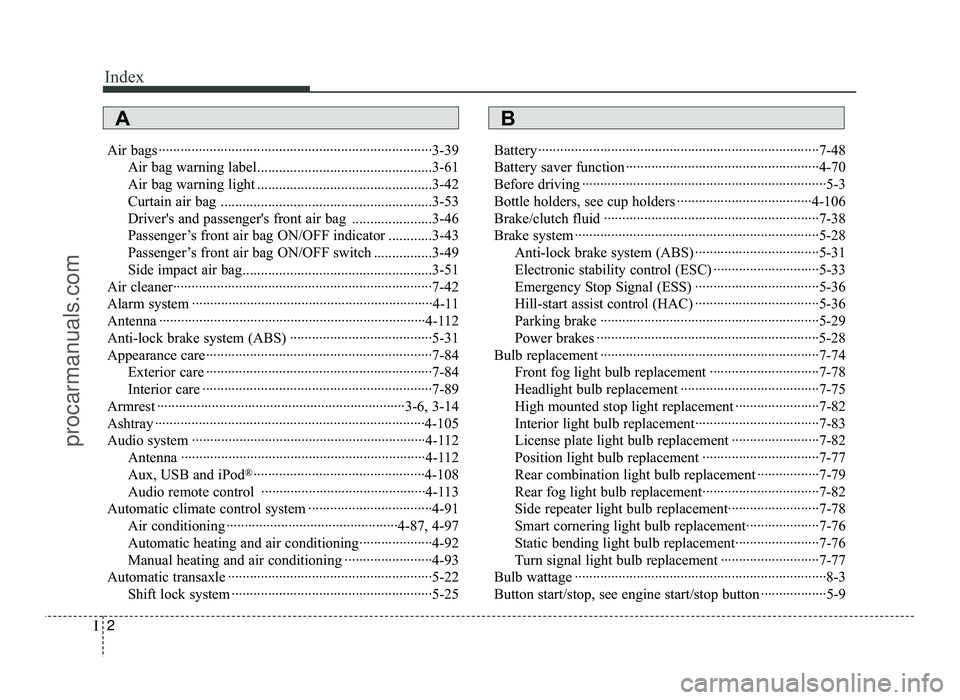
Index
2
I
Air bags ···········································································3-39
Air bag warning label................................................3-61
Air bag warning light ................................................3-42
Curtain air bag ..........................................................3-53
Driver's and passenger's front air bag ......................3-46
Passenger’s front air bag ON/OFF indicator ............3-43
Passenger’s front air bag ON/OFF switch ................3-49
Side impact air bag....................................................3-51
Air cleaner·······································································7-42
Alarm system ··································································4-11
Antenna ·········································································4-112
Anti-lock brake system (ABS) ·······································5-31
Appearance care······························································7-84 Exterior care ······························································7-84
Interior care ·······························································7-89
Armrest ····································································3-6, 3-14
Ashtray ··········································································4-105
Audio system ································································4-112 Antenna ···································································4-112
Aux, USB and iPod ®
···············································4-108
Audio remote control ·············································4-113
Automatic climate control system ··································4-91 Air conditioning ···············································4-87, 4-97
Automatic heating and air conditioning····················4-92
Manual heating and air conditioning ························4-93
Automatic transaxle ························································5-22 Shift lock system ·······················································5-25 Battery ·············································································7-48
Battery saver function ·····················································4-70
Before driving ···································································5-3
Bottle holders, see cup holders ·····································4-106
Brake/clutch fluid ···························································7-38
Brake system ···································································5-28
Anti-lock brake system (ABS) ··································5-31
Electronic stability control (ESC) ·····························5-33
Emergency Stop Signal (ESS) ··································5-36
Hill-start assist control (HAC) ··································5-36
Parking brake ····························································5-29
Power brakes ·····························································5-28
Bulb replacement ····························································7-74 Front fog light bulb replacement ······························7-78
Headlight bulb replacement ······································7-75
High mounted stop light replacement ·······················7-82
Interior light bulb replacement··································7-83
License plate light bulb replacement ························7-82
Position light bulb replacement ································7-77
Rear combination light bulb replacement ·················7-79
Rear fog light bulb replacement································7-82
Side repeater light bulb replacement·························7-78
Smart cornering light bulb replacement····················7-76
Static bending light bulb replacement·······················7-76
Turn signal light bulb replacement ···························7-77
Bulb wattage ·····································································8-3
Button start/stop, see engine start/stop button ··················5-9
AB
procarmanuals.com
Page 453 of 456
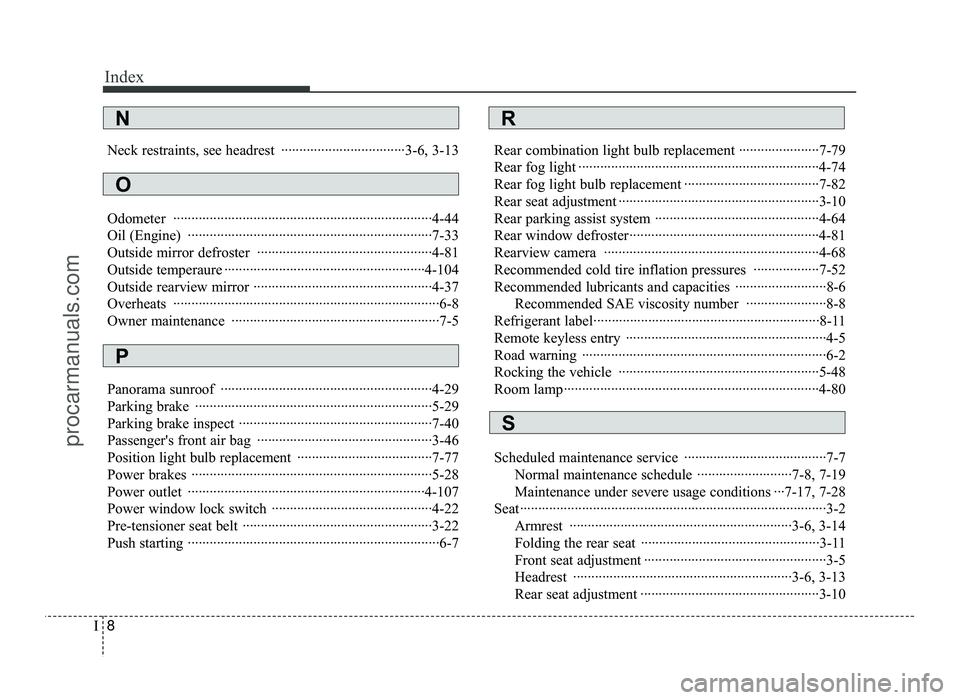
Index
8
I
Neck restraints, see headrest ··································3-6, 3-13
Odometer ·······································································4-44
Oil (Engine) ···································································7-33
Outside mirror defroster ················································4-81
Outside temperaure ·······················································4-104
Outside rearview mirror ·················································4-37
Overheats ·········································································6-8
Owner maintenance ·························································7-5
Panorama sunroof ··························································4-29
Parking brake ·································································5-29
Parking brake inspect ·····················································7-40
Passenger's front air bag ················································3-46
Position light bulb replacement ·····································7-77
Power brakes ··································································5-28
Power outlet ·································································4-107
Power window lock switch ············································4-22
Pre-tensioner seat belt ····················································3-22
Push starting ·····································································6-7 Rear combination light bulb replacement ······················7-79
Rear fog light ··································································4-74
Rear fog light bulb replacement ·····································7-82
Rear seat adjustment ·······················································3-10
Rear parking assist system ·············································4-64
Rear window defroster····················································4-81
Rearview camera ···························································4-68
Recommended cold tire inflation pressures ··················7-52
Recommended lubricants and capacities ·························8-6
Recommended SAE viscosity number ······················8-8
Refrigerant label······························································8-11
Remote keyless entry ·······················································4-5
Road warning ···································································6-2
Rocking the vehicle ·······················································5-48
Room lamp······································································4-80
Scheduled maintenance service ·······································7-7 Normal maintenance schedule ··························7-8, 7-19
Maintenance under severe usage conditions ···7-17, 7-28
Seat····················································································3-2 Armrest ·····························································3-6, 3-14
Folding the rear seat ·················································3-11
Front seat adjustment ··················································3-5
Headrest ····························································3-6, 3-13
Rear seat adjustment ·················································3-10
R
S
O
P
N
procarmanuals.com