2017 Hyundai Ioniq Electric check engine
[x] Cancel search: check enginePage 9 of 582
Trickle Charge (For Europe) ................................H52How to Connect Portable Charger
(ICCB: In-Cable Control Box) ..........................................H52Unlock Charging Door in Emergency ..........................H56
Checking Charging Status ...............................................H56
Charging Status Indicator Lamp for
Portable Charger ...............................................................H58
How to Disconnect Portable Charger
(ICCB: In-Cable Control Box) ..........................................H61 Unlock Charging Connector in Emergency ................H62
Precautions for Portable Charger
(ICCB: In-Cable Control Box) ..........................................H62
How to Start the Vehicle ......................................H63
How to Stop the Vehicle.......................................H64
Virtual Engine Sound System ..............................H64
Distance to Empty .................................................H65 When destination is not set ...........................................H65
When destination is set...................................................H66
Tips for Improving Distance to Empty ...............H66
ECO Guide ...............................................................H67
State of charge (SOC) gauge for high voltage
battery.....................................................................H67
Warning and Indicator Lights
(related to electric vehicle) .................................H68 Ready Indicator ................................................................H68
Service Warning Light .....................................................H68
This warning light illuminates : ......................................H68
Power Down Warning Light ...........................................H69
Charging Indicator Light..................................................H69
High Voltage Battery Level Warning Light .................H69
Regenerative Brake Warning Light ..............................H70 LCD Display Messages ..........................................H70
Shift to P to charge .........................................................H70
Remaining time ..................................................................H70
Charging Door Open ........................................................H71
Charger Error! / Quick Charger Error!........................H71
Stop vehicle and check brakes .....................................H71
Check brakes......................................................................H72
Low Battery........................................................................H72
Charge immediately. Power limited ..............................H72
Low Battery. Charge immediately.................................H73
Low Battery Temp. Power limited.................................H73
Battery Overheated! Stop vehicle ................................H73
Power limited .....................................................................H74
Stop vehicle and check power supply .........................H74
Check Active Air Flap System........................................H75
Check Virtual Engine Sound System............................H75
Check electric vehicle system .......................................H75
Energy flow ...........................................................H76 Vehicle Stop........................................................................H76
EV Propulsion ....................................................................H76
Regeneration ......................................................................H77
Aux. Battery Saver+ .............................................H77 Mode ....................................................................................H77
System Setting...................................................................H78
LCD Message .....................................................................H78
If an Accident Occurs ...........................................H79
Other Precautions for Electric Vehicle ..............H81
Service Plug ...........................................................H81
Page 71 of 582
H64
DDRRIIVV IINN GG EE LLEE CCTT RR IICC VV EEHH IICC LLEE (( CC OO NNTT..))
How to Stop the Vehicle
1. Hold down the brake pedal while
the vehicle is parked.
2. While depressing the brake pedal, shift to P (Park).
3. While depressing the brake pedal, engage the parking brake.
4. While depressing the brake pedal, press the POWER button and turn
off the vehicle.
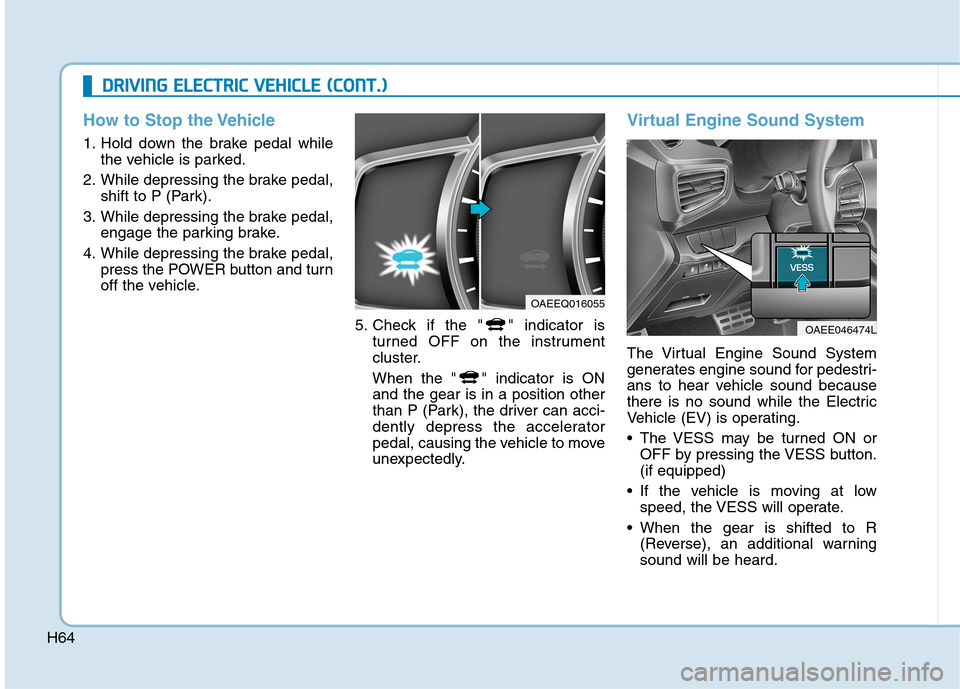
5. Check if the " " indicator isturned OFF on the instrument
cluster.
When the " " indicator is ON and the gear is in a position other
than P (Park), the driver can acci-
dently depress the accelerator
pedal, causing the vehicle to move
unexpectedly.
Virtual Engine Sound System
The Virtual Engine Sound System
generates engine sound for pedestri-
ans to hear vehicle sound because
there is no sound while the Electric
Vehicle (EV) is operating.
The VESS may be turned ON orOFF by pressing the VESS button. (if equipped)
If the vehicle is moving at low speed, the VESS will operate.
When the gear is shifted to R (Reverse), an additional warningsound will be heard.
OAEEQ016055
OAEE046474L
Page 82 of 582
H75
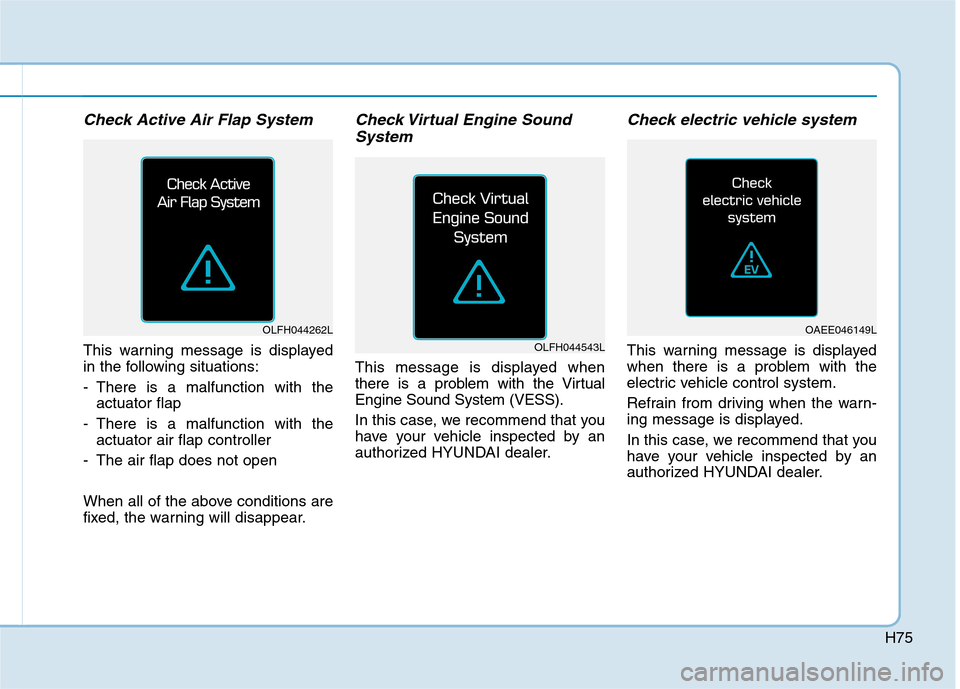
Check Active Air Flap System
This warning message is displayed
in the following situations:
- There is a malfunction with theactuator flap
- There is a malfunction with the actuator air flap controller
- The air flap does not open
When all of the above conditions are
fixed, the warning will disappear.
Check Virtual Engine Sound System
This message is displayed when
there is a problem with the VirtualEngine Sound System (VESS).
In this case, we recommend that you
have your vehicle inspected by an
authorized HYUNDAI dealer.
Check electric vehicle system
This warning message is displayed
when there is a problem with the
electric vehicle control system.
Refrain from driving when the warn-
ing message is displayed.
In this case, we recommend that you
have your vehicle inspected by an
authorized HYUNDAI dealer.
OAEE046149L
OLFH044543L
OLFH044262L
Page 233 of 582
3-64
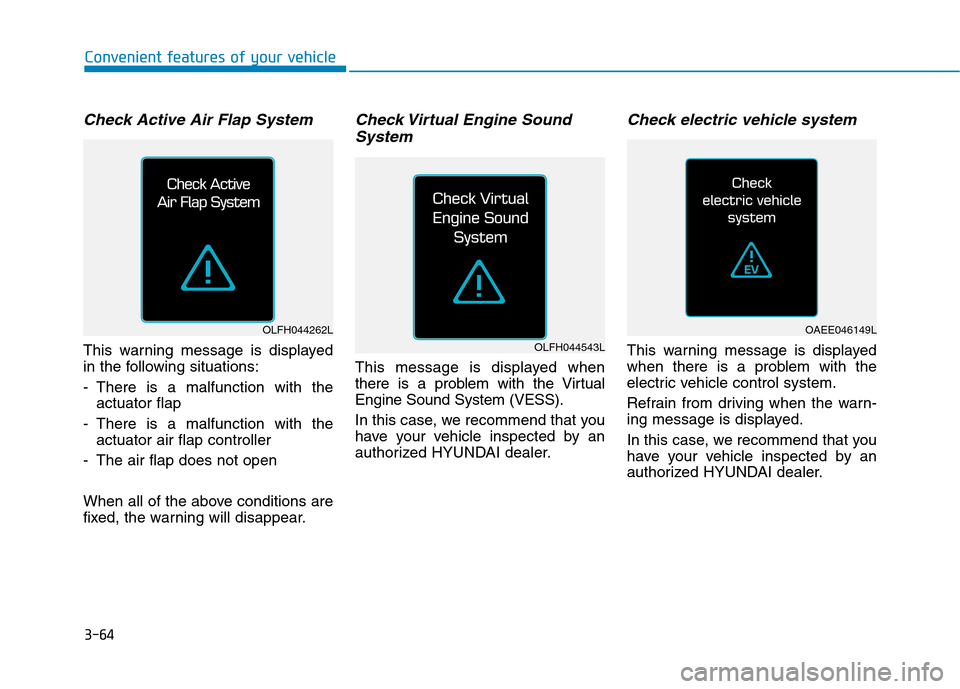
Check Active Air Flap System
This warning message is displayed
in the following situations:
- There is a malfunction with theactuator flap
- There is a malfunction with the actuator air flap controller
- The air flap does not open
When all of the above conditions are
fixed, the warning will disappear.
Check Virtual Engine Sound System
This message is displayed when
there is a problem with the VirtualEngine Sound System (VESS).
In this case, we recommend that you
have your vehicle inspected by an
authorized HYUNDAI dealer.
Check electric vehicle system
This warning message is displayed
when there is a problem with the
electric vehicle control system.
Refrain from driving when the warn-
ing message is displayed.
In this case, we recommend that you
have your vehicle inspected by an
authorized HYUNDAI dealer.
Convenient features of your vehicle
OAEE046149L
OLFH044543L
OLFH044262L
Page 261 of 582
3-92
Convenient features of your vehicle
The indicator may differ from theillustration as objects or sensors
status. If the indicator blinks, we
recommend that you have your
vehicle checked by an author-
ized HYUNDAI dealer.
If the audible warning does not sound or if the buzzer sounds
intermittently when shifting into R
(Reverse) position, this may indi-cate a malfunction with the
Parking Assist System. If this
occurs, we recommend that you
have your vehicle checked by an
authorized HYUNDAI dealer as
soon as possible.
To turn off the Rear Parking
Assist System (if equipped)
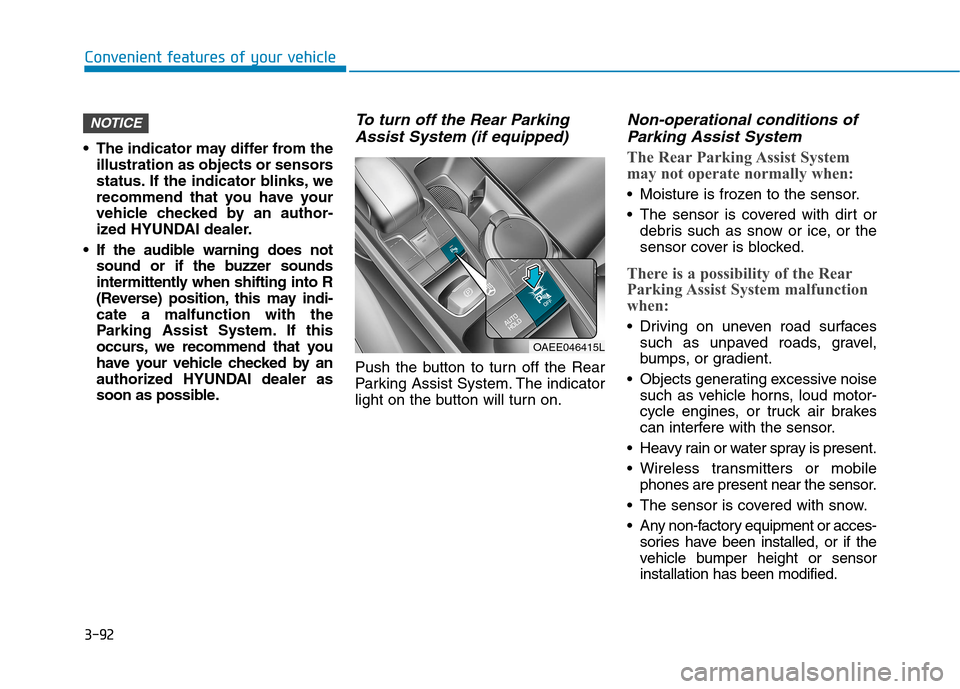
Push the button to turn off the Rear
Parking Assist System. The indicator
light on the button will turn on.
Non-operational conditions ofParking Assist System
The Rear Parking Assist System
may not operate normally when:
Moisture is frozen to the sensor.
The sensor is covered with dirt or debris such as snow or ice, or the
sensor cover is blocked.
There is a possibility of the Rear
Parking Assist System malfunction
when:
Driving on uneven road surfacessuch as unpaved roads, gravel,
bumps, or gradient.
Objects generating excessive noise such as vehicle horns, loud motor-
cycle engines, or truck air brakes
can interfere with the sensor.
Heavy rain or water spray is present.
Wireless transmitters or mobile phones are present near the sensor.
The sensor is covered with snow.
Any non-factory equipment or acces- sories have been installed, or if the
vehicle bumper height or sensorinstallation has been modified.
NOTICE
OAEE046415L
Page 435 of 582
5-96
Driving your vehicle
The severe weather conditions of
winter quickly wear out tires and
cause other problems. To minimize
winter driving problems, you should
take the following suggestions:Information
Information for Snow Tires and Tire
Chains in the national language
(Bulgarian, Hungarian, Icelandic,
Polish) is provided in the Appendix.
Snow or icy conditions
You need to keep sufficient distance
between your vehicle and the vehicle
in front of you.
Apply the brakes gently. Speeding,
rapid acceleration, sudden brake
applications, and sharp turns are
potentially very hazardous practices.
During deceleration, use engine
braking to the fullest extent. Sudden
brake applications on snowy or icy
roads may cause the vehicle to skid.
To drive your vehicle in deep snow, it
may be necessary to use snow tires
or to install tire chains on your tires. Always carry emergency equipment.
Some of the items you may want to
carry include tire chains, tow straps
or chains, a flashlight, emergency
flares, sand, a shovel, jumper cables,
a window scraper, gloves, ground
cloth, coveralls, a blanket, etc.
Snow tires
If you mount snow tires on your vehi-
cle, make sure to use radial tires of
the same size and load range as the
original tires. Mount snow tires on all
four wheels to balance your vehicle’s
handling in all weather conditions.
The traction provided by snow tires
on dry roads may not be as high as
your vehicle's original equipment
tires. Check with the tire dealer for
maximum speed recommendations.
Information
Do not install studded tires without first
checking local and municipal regula-
tions for possible restrictions against
their use.
i
i
WW IINN TTEERR DD RRIIVV IINN GG
Snow tires should be equivalent
in size and type to the vehicle's
standard tires. Otherwise, the
safety and handling of your
vehicle may be adversely affect-ed.
WARNING
Page 447 of 582
6-6
What to do in an emergency
Jump starting procedure
1. Position the vehicles close enoughthat the jumper cables will reach,
but do not allow the vehicles totouch.
2. Avoid fans or any moving parts in the motor compartment at all
times, even when the vehicles are
turned off.
3. Turn off all electrical devices such as radios, lights, air conditioning,
etc. Put the vehicles in P (Park)
and set the parking brakes. Turn
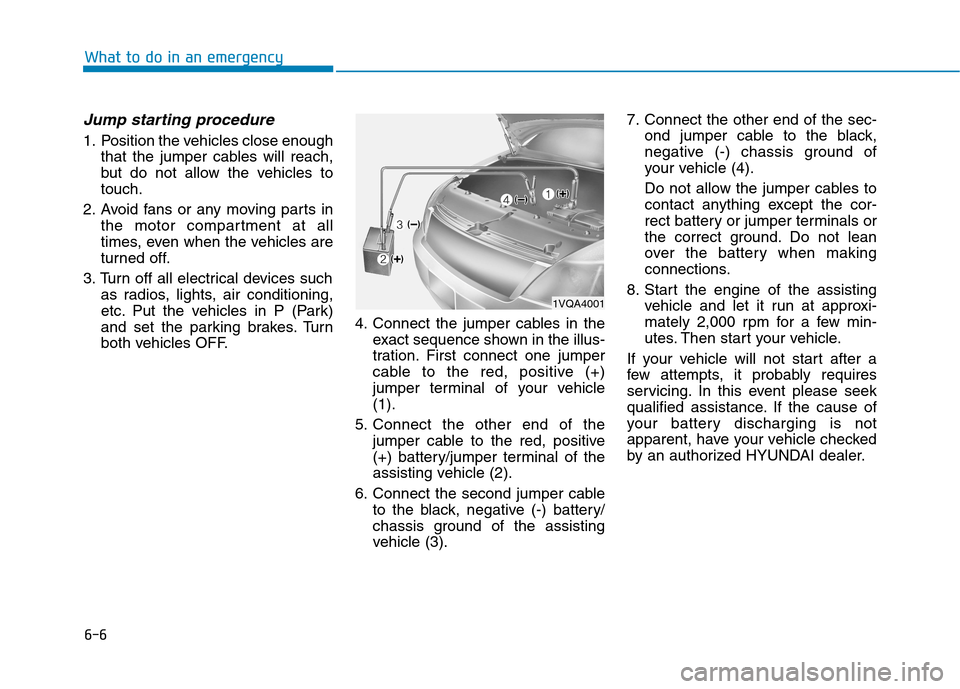
both vehicles OFF. 4. Connect the jumper cables in the
exact sequence shown in the illus-
tration. First connect one jumper
cable to the red, positive (+)
jumper terminal of your vehicle(1).
5. Connect the other end of the jumper cable to the red, positive
(+) battery/jumper terminal of the
assisting vehicle (2).
6. Connect the second jumper cable to the black, negative (-) battery/
chassis ground of the assisting
vehicle (3). 7. Connect the other end of the sec-
ond jumper cable to the black,
negative (-) chassis ground of
your vehicle (4).
Do not allow the jumper cables to
contact anything except the cor-
rect battery or jumper terminals or
the correct ground. Do not lean
over the battery when making
connections.
8. Start the engine of the assisting vehicle and let it run at approxi-
mately 2,000 rpm for a few min-
utes. Then start your vehicle.
If your vehicle will not start after a
few attempts, it probably requires
servicing. In this event please seek
qualified assistance. If the cause of
your battery discharging is not
apparent, have your vehicle checked
by an authorized HYUNDAI dealer.
1VQA4001
Page 487 of 582
7-21
7
Maintenance
BBRRAA KKEE FF LLUU IIDD
Checking the brake fluid level
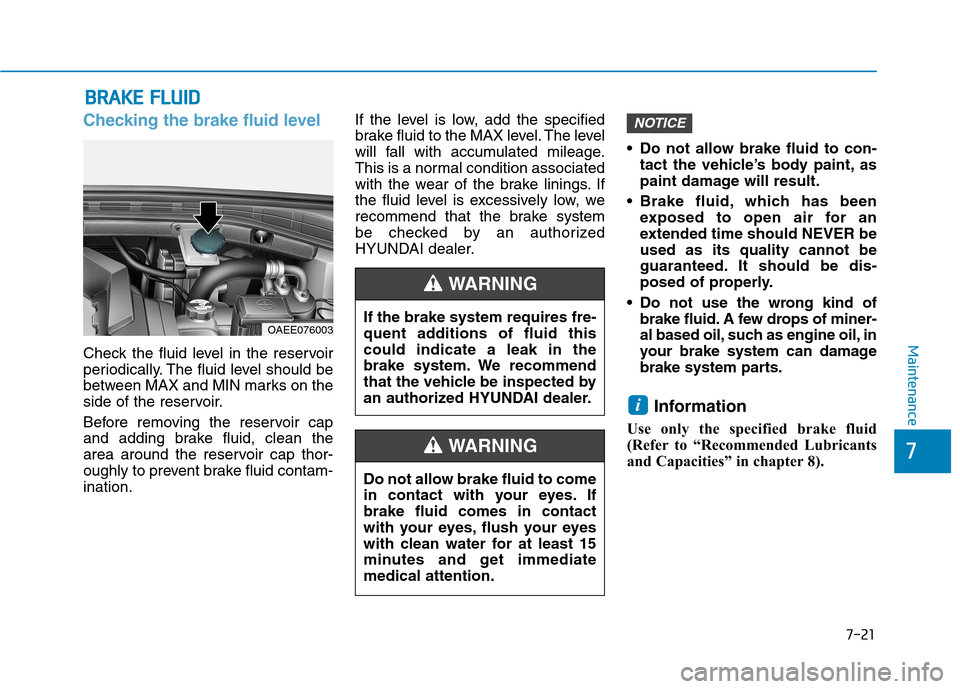
Check the fluid level in the reservoir
periodically. The fluid level should be
between MAX and MIN marks on the
side of the reservoir.
Before removing the reservoir cap
and adding brake fluid, clean the
area around the reservoir cap thor-
oughly to prevent brake fluid contam-ination. If the level is low, add the specified
brake fluid to the MAX level. The level
will fall with accumulated mileage.
This is a normal condition associated
with the wear of the brake linings. If
the fluid level is excessively low, we
recommend that the brake system
be checked by an authorized
HYUNDAI dealer.
Do not allow brake fluid to con-
tact the vehicle’s body paint, as
paint damage will result.
Brake fluid, which has been exposed to open air for an
extended time should NEVER beused as its quality cannot be
guaranteed. It should be dis-
posed of properly.
Do not use the wrong kind of brake fluid. A few drops of miner-
al based oil, such as engine oil, in
your brake system can damage
brake system parts.
Information
Use only the specified brake fluid
(Refer to “Recommended Lubricants
and Capacities” in chapter 8).
i
NOTICE
OAEE076003 If the brake system requires fre-
quent additions of fluid thiscould indicate a leak in the
brake system. We recommend
that the vehicle be inspected by
an authorized HYUNDAI dealer.
WARNING
Do not allow brake fluid to come
in contact with your eyes. Ifbrake fluid comes in contact
with your eyes, flush your eyes
with clean water for at least 15
minutes and get immediatemedical attention.
WARNING