Page 633 of 659

8-5
8
Specifications & Consumer information
When replacing tires, use the same size originally supplied with the vehicle.
Using tires of a different size can damage the related parts or make it work irregularly.
CAUTION
It is permissible to add 20 kPa (3 psi) to the standard tire pressure specification if colder temperatures are expected soon. Tires typically lose 7 kPa (1 psi) for every 7°C (12°F) temperature drop. If extreme tempera-
ture variations are expected, recheck your tire pressure as necessary to keep them properly inflated.
An air pressure generally decreases, as you drive up to a high-altitude area above sea level. Thus, if you plan to drive a high-altitude area, check the tire pressures in advance. If necessary, inflate them to a proper level
(Air inflation per altitude: +10 kPa/1 km (+2.4 psi/1 mile)).
NOTICE
*1LI : LOAD INDEX
*2SS : SPEED SYMBOL
Item Tire Size Wheel Size Load Capacity Speed Capacity
LI *1kg SS *2km/h
Full size tire 195/65 R15 6.0J X 15 91 615 H 210
205/55 R16 6.5J X 16 91 615 H 210
225/45 R177.0J X 1791615W270
L
L O
O A
A D
D
A
A N
N D
D
S
S P
P E
E E
E D
D
C
C A
A P
P A
A C
C I
I T
T Y
Y
T
T I
I R
R E
E S
S
(
( F
F O
O R
R
E
E U
U R
R O
O P
P E
E )
)
Page 634 of 659
8-6
Specifications & Consumer information
A
A I
I R
R
C
C O
O N
N D
D I
I T
T I
I O
O N
N I
I N
N G
G
S
S Y
Y S
S T
T E
E M
M
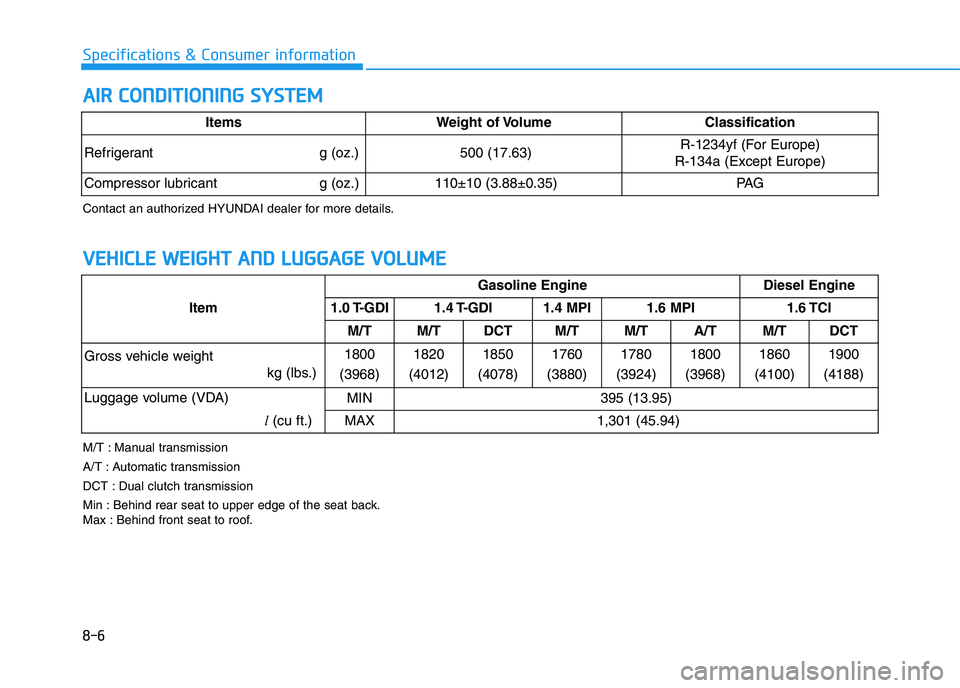
Item Gasoline Engine Diesel Engine
1.0 T-GDI 1.4 T-GDI 1.4 MPI 1.6 MPI 1.6 TCI M/T M/T DCT M/T M/T A/T M/T DCT
Gross vehicle weight kg (lbs.)1800
(3968) 1820
(4012) 1850
(4078) 1760
(3880) 1780
(3924) 1800
(3968) 1860
(4100) 1900
(4188)
Luggage volume (VDA) l(cu ft.) MIN 395 (13.95)
MAX 1,301 (45.94)
V
V E
E H
H I
I C
C L
L E
E
W
W E
E I
I G
G H
H T
T
A
A N
N D
D
L
L U
U G
G G
G A
A G
G E
E
V
V O
O L
L U
U M
M E
E
ItemsWeight of Volume Classification
Refrigerant g (oz.)500 (17.63)R-1234yf (For Europe)
R-134a (Except Europe)
Compressor lubricant g (oz.)110±10 (3.88±0.35)PA G
Contact an authorized HYUNDAI dealer for more details.
M/T : Manual transmission
A/T : Automatic transmission
DCT : Dual clutch transmission
Min : Behind rear seat to upper edge of the seat back.
Max : Behind front seat to roof.
Page 635 of 659
8-7
Specifications & Consumer information
R
R E
E C
C O
O M
M M
M E
E N
N D
D E
E D
D
L
L U
U B
B R
R I
I C
C A
A N
N T
T S
S
A
A N
N D
D
C
C A
A P
P A
A C
C I
I T
T I
I E
E S
S
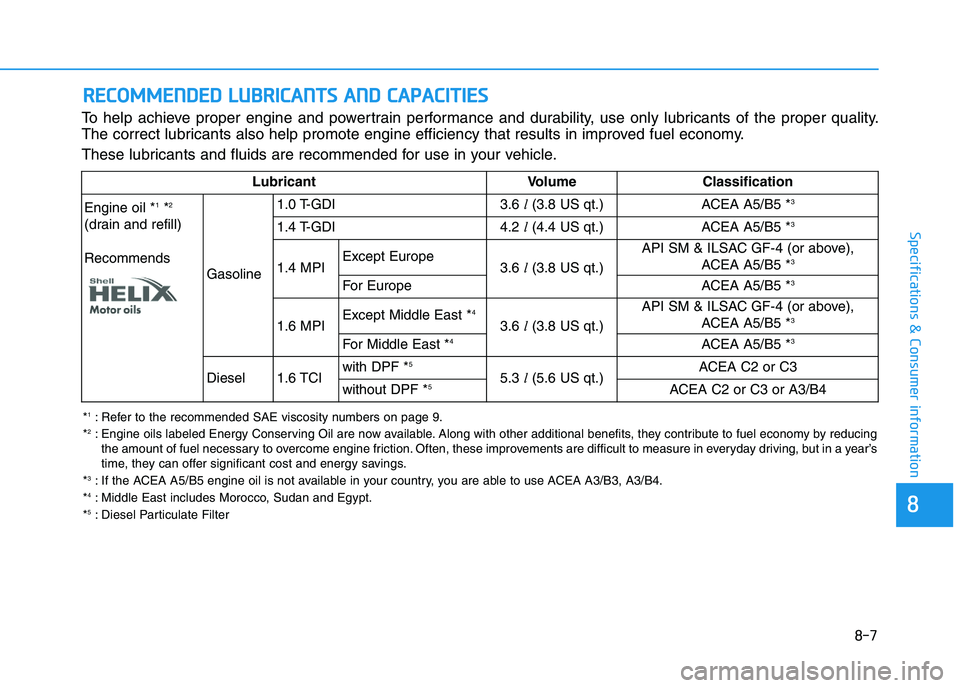
To help achieve proper engine and powertrain performance and durability, use only lubricants of the proper quality.
The correct lubricants also help promote engine efficiency that results in improved fuel economy.
These lubricants and fluids are recommended for use in your vehicle.
Lubricant Volume Classification
Engine oil *
1*2
(drain and refill)
Recommends Gasoline1.0 T-GDI
3.6
l(3.8 US qt.)
ACEA A5/B5 *
3
1.4 T-GDI 4.2
l(4.4 US qt.)
ACEA A5/B5 *3
1.4 MPIExcept Europe
3.6 l(3.8 US qt.) API SM & ILSAC GF-4 (or above),
ACEA A5/B5 *3
For Europe ACEA A5/B5 *3
1.6 MPI Except Middle East *
4
3.6
l(3.8 US qt.) API SM & ILSAC GF-4 (or above),
ACEA A5/B5 *3
For Middle East *4ACEA A5/B5 *3
Diesel 1.6 TCI with DPF *
5
5.3
l(5.6 US qt.) ACEA C2 or C3
without DPF *5ACEA C2 or C3 or A3/B4
8
*1: Refer to the recommended SAE viscosity numbers on page 9.
*2: Engine oils labeled Energy Conserving Oil are now available. Along with other additional benefits, they contribute to fuel econ omy by reducing
the amount of fuel necessary to overcome engine friction. Often, these improvements are difficult to measure in everyday driving , but in a year’s
time, they can offer significant cost and energy savings.
*
3: If the ACEA A5/B5 engine oil is not available in your country, you are able to use ACEA A3/B3, A3/B4.
*4: Middle East includes Morocco, Sudan and Egypt.
*5: Diesel Particulate Filter
Page 636 of 659
8-8
Specifications & Consumer information
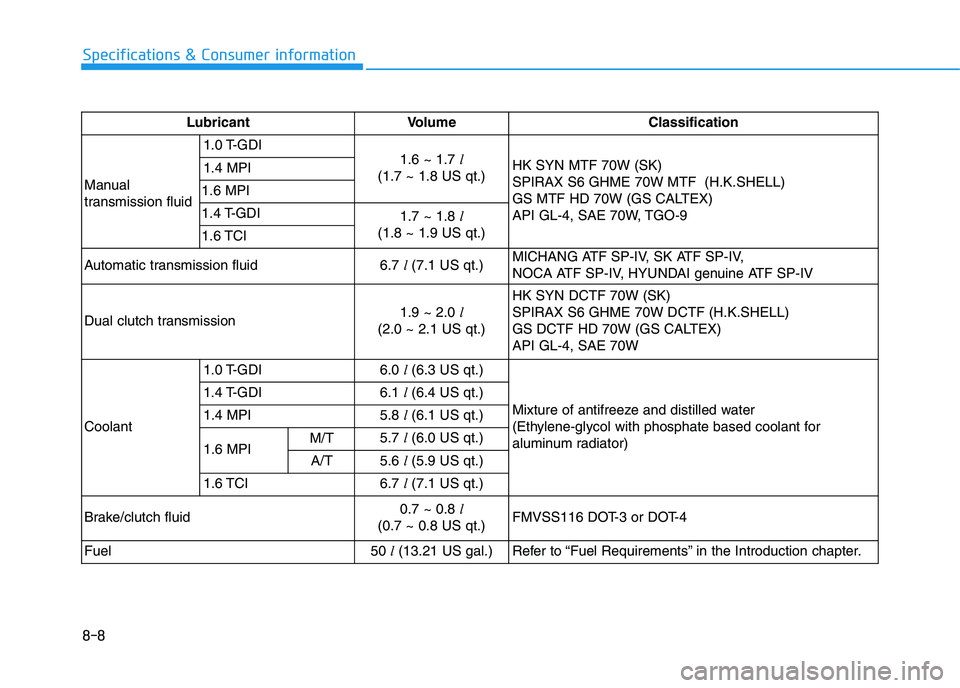
Lubricant Volume Classification
Manual
transmission fluid 1.0 T-GDI
1.6 ~ 1.7 l
(1.7 ~ 1.8 US qt.) HK SYN MTF 70W (SK)
SPIRAX S6 GHME 70W MTF (H.K.SHELL)
GS MTF HD 70W (GS CALTEX)
API GL-4, SAE 70W, TGO-9
1.4 MPI
1.6 MPI
1.4 T-GDI1.7 ~ 1.8
l
(1.8 ~ 1.9 US qt.)
1.6 TCI
Automatic transmission fluid 6.7
l(7.1 US qt.) MICHANG ATF SP-IV, SK ATF SP-IV,
NOCA ATF SP-IV, HYUNDAI genuine ATF SP-IV
Dual clutch transmission 1.9 ~ 2.0
l
(2.0 ~ 2.1 US qt.) HK SYN DCTF 70W (SK)
SPIRAX S6 GHME 70W DCTF (H.K.SHELL)
GS DCTF HD 70W (GS CALTEX)
API GL-4, SAE 70W
Coolant 1.0 T-GDI
6.0
l(6.3 US qt.)
Mixture of antifreeze and distilled water
(Ethylene-glycol with phosphate based coolant for
aluminum radiator)
1.4 T-GDI
6.1
l(6.4 US qt.)
1.4 MPI 5.8
l(6.1 US qt.)
1.6 MPI M/T
5.7
l(6.0 US qt.)
A/T 5.6
l(5.9 US qt.)
1.6 TCI 6.7
l(7.1 US qt.)
Brake/clutch fluid 0.7 ~ 0.8
l
(0.7 ~ 0.8 US qt.) FMVSS116 DOT-3 or DOT-4
Fuel 50
l(13.21 US gal.)
Refer to “Fuel Requirements” in the Introduction chapter.
Page 637 of 659

8-9
8
Specifications & Consumer information
Recommended engine oil (For Europe)
Supplier ProductShell Gasoline Engine
HELIX ULTRA AH-E 5W-30
HELIX ULTRA 5W-40
Diesel Engine HELIX ULTRA AP 5W-30
HELIX ULTRA AP-L 5W-30
Always be sure to clean the area around any filler plug, drain plug, or dipstick before checking or draining
any lubricant. This is especially important in dusty or sandy areas and when the vehicle is used on unpaved
roads. Cleaning the plug and dipstick areas will prevent dirt and grit from entering the engine and other
mechanisms that could be damaged.
CAUTION
Recommended SAE viscosity number
Engine oil viscosity (thickness) has an effect on fuel economy and cold weather operating (engine start and engine oil
flowability). Lower viscosity engine oils can provide better fuel economy and cold weather performance, however, high-
er viscosity engine oils are required for satisfactory lubrication in hot weather. Using oils of any viscosity other than
those recommended could result in engine damage.
Page 640 of 659
8-12
Specifications & Consumer information
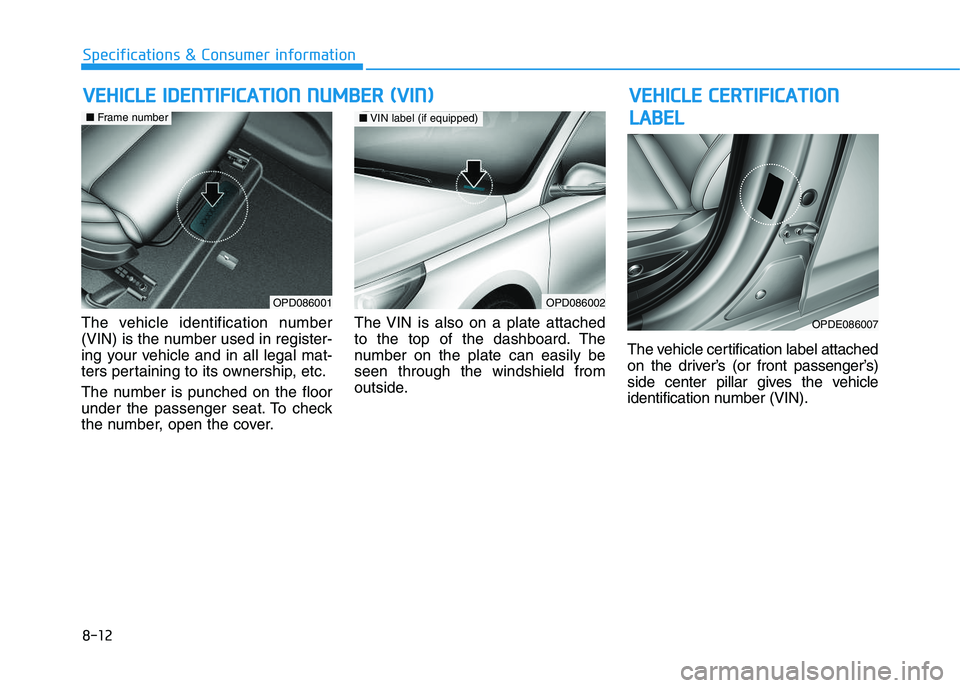
The vehicle identification number
(VIN) is the number used in register-
ing your vehicle and in all legal mat-
ters pertaining to its ownership, etc.
The number is punched on the floor
under the passenger seat. To check
the number, open the cover. The VIN is also on a plate attached
to the top of the dashboard. The
number on the plate can easily be
seen through the windshield from
outside.
The vehicle certification label attached
on the driver’s (or front passenger’s)
side center pillar gives the vehicle
identification number (VIN).
V
V E
E H
H I
I C
C L
L E
E
I
I D
D E
E N
N T
T I
I F
F I
I C
C A
A T
T I
I O
O N
N
N
N U
U M
M B
B E
E R
R
(
( V
V I
I N
N )
) V
V E
E H
H I
I C
C L
L E
E
C
C E
E R
R T
T I
I F
F I
I C
C A
A T
T I
I O
O N
N
L
L A
A B
B E
E L
L
OPD086002
■ VIN label (if equipped)
OPDE086007
OPD086001
■ Frame number
Page 657 of 659
Opony zimowe
Kiedy zakładane są opony zimowe,
należy upewnić się, że są to opony
radialne o takim samym rozmiarze i
zakresie obciążeń co pierwotne
opony pojazdu. Opony zimowe należy
zakładać na wszystkie cztery koła
pojazdu, by we wszystkich
warunkach pogodowych pojazd
pozwalał się prowadzić równomiernie.
Należy pamiętać, że przyczepno\bć
zapewniana przez opony zimowe na
suchej drodze może nie być równie
wysoka jak przyczepno\bć
pierwotnych opon pojazdu. Pojazd
należy prowadzić ostrożnie nawet
wtedy, gdy drogi są oczyszczone. Aby
poznać informacje na temat
zalecanych ograniczeń prędko\bci dla
danych opon, należy skontaktować
się ze sprzedawcą opon.
Opon okolcowanych nie należyzakładać bez uprzedniegosprawdzenia w przepisach lokalnych,stanowych i miejskich, czy na ichużycie nie są nałożone ograniczenia.
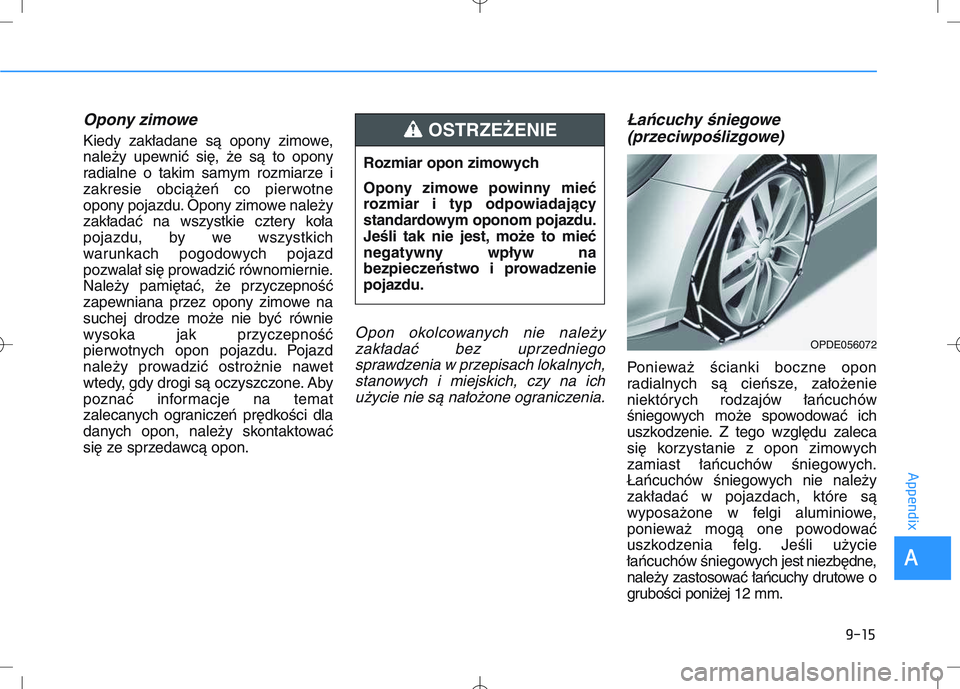
Łańcuchy śniegowe(przeciwpoślizgowe)
Ponieważ \bcianki boczne opon
radialnych są cieńsze, założenie
niektórych rodzajów łańcuchów
\bniegowych może spowodować ich
uszkodzenie. Z tego względu zaleca
się korzystanie z opon zimowych
zamiast łańcuchów \bniegowych.
Łańcuchów \bniegowych nie należy
zakładać w pojazdach, które są
wyposażone w felgi aluminiowe,
ponieważ mogą one powodować
uszkodzenia felg. Je\bli użycie
łańcuchów \bniegowych jest ni ezbędne,
należy zastosować łańcuchy drutowe o
grubo\bci poniżej 12 mm.
9-15
A
Appendix
Rozmiar opon zimowych
Opony zimowe powinny mie\b
rozmiar i typ odpowiadający
standardowym oponom pojazdu.
Jeśli tak nie jest, może to mie\b
negatywny wpływ na
bezpieczeństwo i prowadzenie
pojazdu.
OSTRZEŻENIE
OPDE056072
Page 659 of 659
9-17
A
Appendix
Zakładanie łańcuchów
śniegowych
Aby założy\b łańcuchy śniegowe,
należy zatrzyma\b pojazd na
płaskim podłożu, z dala od ruchu
drogowego. Włączy\b światła
awaryjne pojazdu i umieści\b za
nim trójkąt ostrzegawczy, jeśli
jest on dostępny. Zanim
rozpocznie się instalowanie
łańcuchów śniegowych d\fwignię
zmiany biegów należy zawsze
umieści\b w położeniu P (Postój),
zaciągną\b hamulec postojowy i
wyłączy\b silnik.
OSTRZEŻENIE
Łańcuchy śniegowe
•Użycie łańcuchów śniegowych
może mie\b negatywny wpływ
na prowadzenie pojazdu.
•Pojazdu nie należy prowadzi\b
szybciej niż 30 km/h (20 mil/h)
lub z prędkością większą, niż
zalecana przez producenta,
którakolwiek z tych wartości
okaże się mniejsza.
•Pojazd należy prowadzi\b
ostrożnie i unika\b wybojów,
dziur, ostrych skrętów i innych
zagrożeń drogowych, które
mogą powodowa\b
podskakiwanie pojazdu.
•Należy unika\b ostrych
zakrętów lub hamowania z
zablokowanymi kołami.
OSTRZEŻENIE
•Łańcuchy o niewłaściwym
rozmiarze lub niepoprawnie
założone mogą uszkodzi\b
linki hamulcowe pojazdu,
zawieszenie, nadwozie oraz
koła.
•Za każdym razem, kiedy da się
usłysze\b, że łańcuchy
uderzają w samochód, należy
zatrzyma\b się i zacisną\b je.
OSTROŻNIE