2017 HYUNDAI I30 specifications
[x] Cancel search: specificationsPage 4 of 659
F4
FOREWORD
Congratulations, and thank you for choosing HYUNDAI.We are pleased to welcome you to the growing number of dis-
tinguished people who drive HYUNDAIS.We are very proud of the advanced engineering and high-quality construc-
tion of each HYUNDAI we build.
Your Owner’s Manual will introduce you to the features and operation of your new HYUNDAI. To become familiar with
your new HYUNDAI, so that you can fully enjoy it, read this Owner’s Manual carefully before driving your new vehicle.
This manual contains important safety information and instructions intended to familiarize you with your vehicle’s con-
trols and safety features so you can safely operate your vehicle.
This manual also contains information on maintenance designed to enhance safe operation of the vehicle. It is rec-
ommended that all service and maintenance on your car be performed by an authorized HYUNDAI dealer. HYUNDAI
dealers are prepared to provide high-quality service, maintenance and any other assistance that may be required.
This Owner’s Manual should be considered a permanent part of your vehicle, and should be kept in the vehicle so
you can refer to it at any time. The manual should stay with the vehicle if you sell it to provide the next owner with
important operating, safety and maintenance information.
HYUNDAI MOTOR COMPANY
Copyright 2016 HYUNDAI Motor Company. All rights reserved. No part of this publication may be reproduced, stored
in any retrieval system or transmitted in any form or by any means without the prior written permission of HYUNDAI
Motor Company.Severe engine and transmission damage may result from the use of poor quality fuels and lubricants that
do not meet HYUNDAI specifications. You must always use high quality fuels and lubricants that meet the
specifications listed on Page 8-7 in the Vehicle Specifications section of the Owner's Manual.
CAUTION
Page 9 of 659

Diesel engine
Diesel fuel
Diesel engine must be operated only
on commercially available diesel fuel
that complies with EN 590 or compa-
rable standard. (EN stands for
"European Norm"). Do not use
marine diesel fuel, heating oils, or
non-approved fuel additives, as this
will increase wear and cause dam-
age to the engine and fuel system.
The use of non-approved fuels and /
or fuel additives will result in a limita-
tion of your warranty rights.
Diesel fuel of above cetane 51 is
used in your vehicle. If two types of
diesel fuel are available, use summer
or winter fuel properly according to
the following temperature conditions.
Above -5°C (23°F) ... Summer typediesel fuel.
Below -5°C (23°F) ... Winter type diesel fuel.
Watch the fuel level in the tank very
carefully : If the engine stops through
fuel failure, the circuits must be com-
pletely purged to permit restarting.
Biodiesel
Commercially supplied Diesel blends
of no more than 7% biodiesel, com-
monly known as "B7 Diesel" may be
used in your vehicle if Biodiesel meets
EN 14214 or equivalent specifications.
(EN stands for "European Norm"). The
use of biofuels exceeding 7% made
from rapeseed methyl ester (RME),
fatty acid methyl ester (FAME), veg-
etable oil methyl ester (VME) etc. or
mixing diesel exceeding 7% with
biodiesel will cause increased wear or
damage to the engine and fuel sys-
tem. Repair or replacement of worn or
damaged components due to the use
of non approved fuels will not be cov-
ered by the manufactures warranty.
F9
Introduction
Do not let any gasoline or water
enter the tank. This would make
it necessary to drain it out and
to bleed the lines to avoid jam-
ming the injection pump and
damaging the engine.
CAUTION
It is recommended to use the
regulated automotive diesel
fuel for diesel vehicle equipped
with the DPF system.
If you use diesel fuel including
high sulfur (more than 50 ppm
sulfur) and unspecified addi-
tives, it can cause the DPF sys-
tem to be damaged and white
smoke can be emitted.
CAUTION
Never use any fuel, whether
diesel, B7 biodiesel or other-
wise, that fails to meet the lat-
est petroleum industry speci-
fication.
Never use any fuel additives
or treatments that are not rec-
ommended or approved by
the vehicle manufacturer.
CAUTION
Page 11 of 659
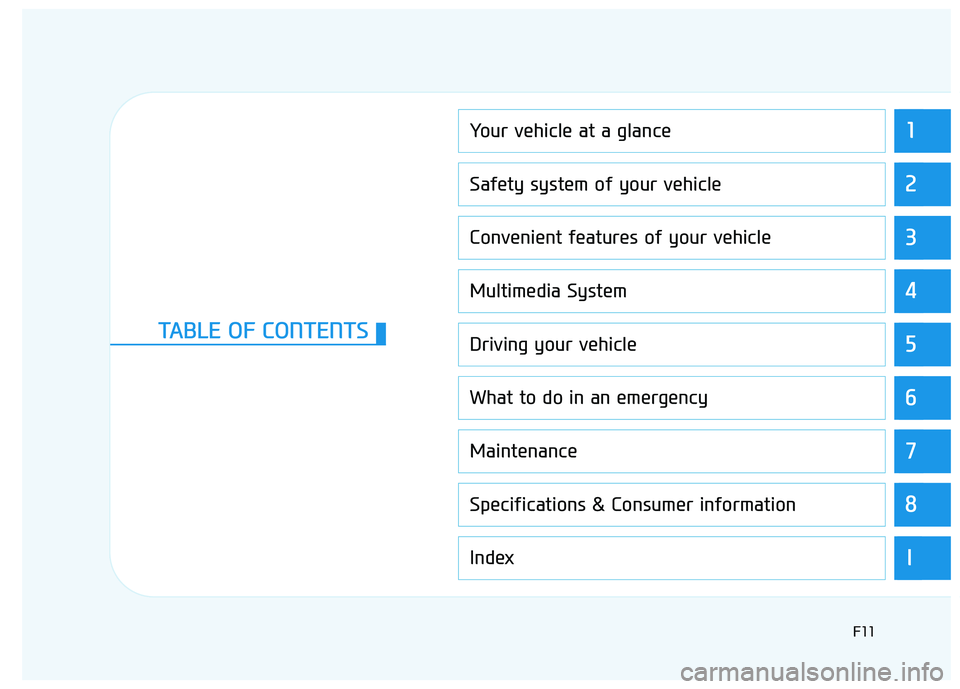
1
2
3
4
5
6
7
8
I
Your vehicle at a glance
Safety system of your vehicle
Convenient features of your vehicle
Multimedia System
Driving your vehicle
What to do in an emergency
Maintenance
Specifications & Consumer information
Index
TABLE OF CONTENTS
F11
Page 491 of 659
6-21
What to do in an emergency
6
Jack label
To prevent damaging the com-
pact spare tire and your vehicle:
Drive slowly enough for the
road conditions to avoid all
hazards, such as a potholes
or debris.
Avoid driving over obstacles.
The compact spare tire diame-
ter is smaller than the diame-
ter of a conventional tire and
reduces the ground clearance
approximately 25 mm (1 inch).
Do not use tire chains on the
compact spare tire. Because
of the smaller size, a tire chain
will not fit properly.
Do not use the compact spare
tire on any other wheels, nor
should standard tires, snow
tires, wheel covers or trim
rings be used with the com-
pact spare wheel.
CAUTION■Example
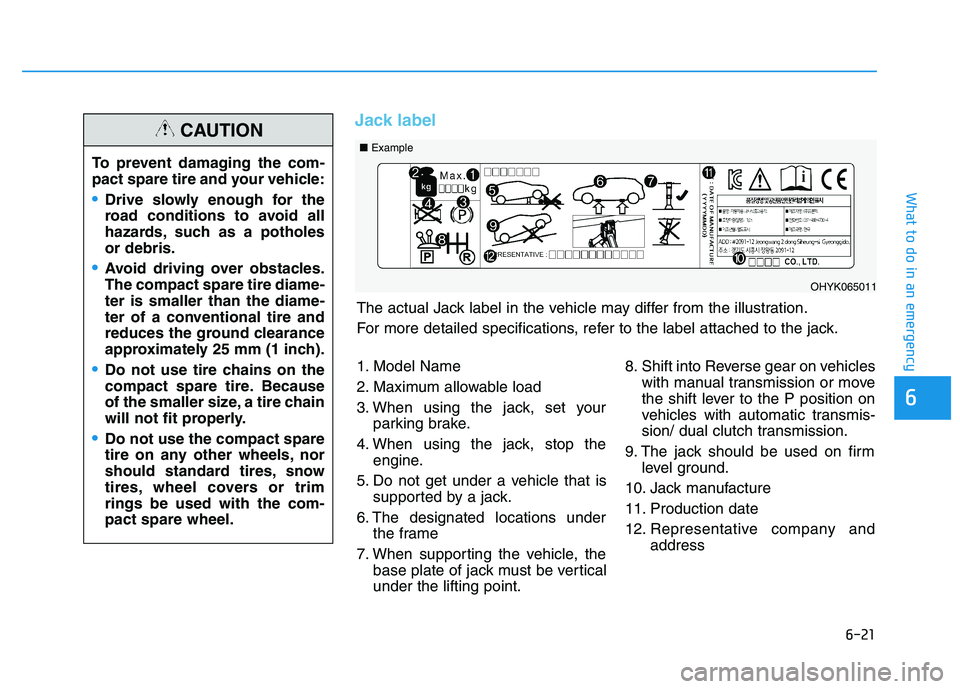
OHYK065011
1. Model Name
2. Maximum allowable load
3. When using the jack, set your
parking brake.
4. When using the jack, stop the engine.
5. Do not get under a vehicle that is supported by a jack.
6. The designated locations under the frame
7. When supporting the vehicle, the base plate of jack must be vertical
under the lifting point. 8. Shift into Reverse gear on vehicles
with manual transmission or move
the shift lever to the P position on
vehicles with automatic transmis-
sion/ dual clutch transmission.
9. The jack should be used on firm level ground.
10. Jack manufacture
11. Production date
12. Representative company and address
The actual Jack label in the vehicle may differ from the illustration.
For more detailed specifications, refer to the label attached to the jack.
Page 535 of 659
Maintenance
7-22
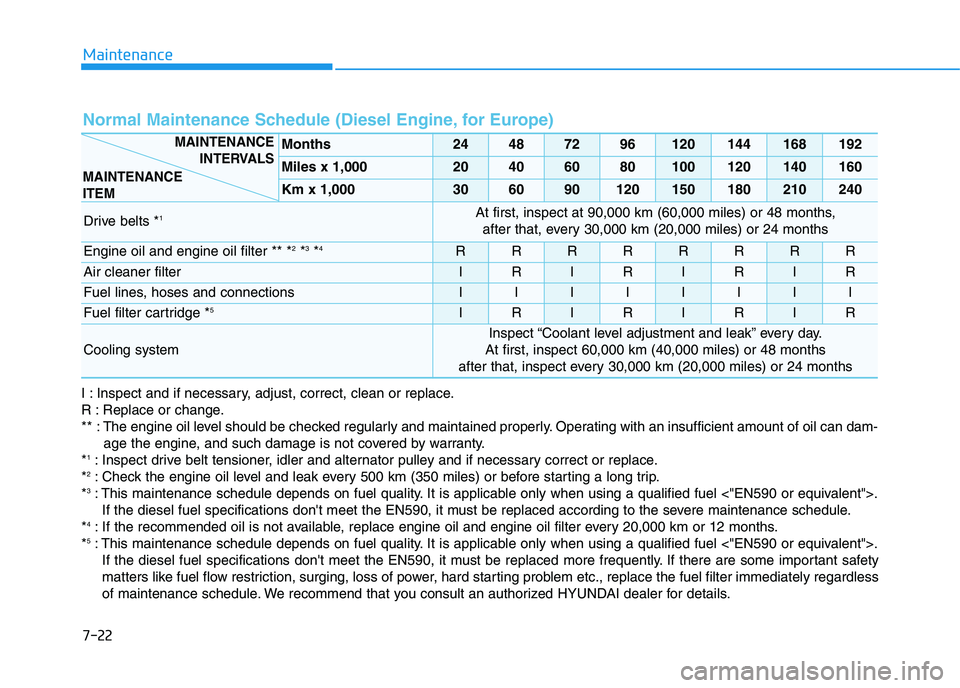
I : Inspect and if necessary, adjust, correct, clean or replace.
R : Replace or change.
** : The engine oil level should be checked regularly and maintained properly. Operating with an insufficient amount of oil can d
am-
age the engine, and such damage is not covered by warranty.
*
1: Inspect drive belt tensioner, idler and alternator pulley and if necessary correct or replace.
*2: Check the engine oil level and leak every 500 km (350 miles) or before starting a long trip.
*3: This maintenance schedule depends on fuel quality. It is applicable only when using a qualified fuel <"EN590 or equivalent">. If the diesel fuel specifications don't meet the EN590, it must be replaced according to the severe maintenance schedule.
*
4: If the recommended oil is not available, replace engine oil and engine oil filter every 20,000 km or 12 months.
*5: This maintenance schedule depends on fuel quality. It is applicable only when using a qualified fuel <"EN590 or equivalent">. If the diesel fuel specifications don't meet the EN590, it must be replaced more frequently. If there are some important safety
matters like fuel flow restriction, surging, loss of power, hard starting problem etc., replace the fuel filter immediately reg ardless
of maintenance schedule. We recommend that you consult an authorized HYUNDAI dealer for details.
Normal Maintenance Schedule (Diesel Engine, for Europe)
Months24487296120144168192
Miles x 1,00020406080100120140160
Km x 1,000306090120150180210240
Drive belts *1At first, inspect at 90,000 km (60,000 miles) or 48 months, after that, every 30,000 km (20,000 miles) or 24 months
Engine oil and engine oil filter ** *2*3*4RRRRRRRR
Air cleaner filterIRIRIRIR
Fuel lines, hoses and connectionsIIIIIIII
Fuel filter cartridge *5IRIRIRIR
Cooling system
Inspect “Coolant level adjustment and leak” every day.
At first, inspect 60,000 km (40,000 miles) or 48 months
after that, inspect every 30,000 km (20,000 miles) or 24 months
MAINTENANCE INTERVALS
MAINTENANCE
ITEM
Page 540 of 659

7-27
7
Maintenance
Normal Maintenance Schedule (Diesel Engine, except Europe)
Months1224364860728496
Miles x 1,0001020304050607080
Km x 1,000153045607590105120
Drive belts *1Except RussiaAt first, inspect at 80,000 km (50,000 miles) or 48 months, after that, every 20,000 km (12,500 miles) or 12 months
For RussiaAt first, inspect at 90,000 km (60,000 miles) or 48 months
after that, inspect every 30,000 km (20,000 miles) or 24 months
Engine oil and
engine oil filter *2 *3Except RussiaReplace every 10,000 km (6,500 miles) or 12 months
For RussiaReplace every 15,000 km (10,000 miles) or 12 months
Air cleaner filter Except Middle EastIIRIIRII
For Middle EastRRRRRRRR
Fuel lines, hoses and connectionsIIII
Fuel filter cartridge *4IRIR
Cooling system
Inspect “Coolant level adjustment and leak” every day.
At first, inspect 60,000 km (40,000 miles) or 48 months
after that, inspect every 30,000 km (20,000 miles) or 24 months
I : Inspect and if necessary, adjust, correct, clean or replace.
R : Replace or change.
*
1: Inspect drive belt tensioner, idler and alternator pulley and if necessary correct or replace.
*2: Check the engine oil level and leak every 500 km (350 miles) or before starting a long trip.
*3 : The engine oil level should be checked regularly and maintained properly. Operating with an insufficient amount of oil can dam- age the engine, and such damage is not covered by warranty.
*
4: This maintenance schedule depends on fuel quality. It is applicable only when using a qualified fuel <"EN590 or equivalent">. If the diesel fuel specifications don't meet the EN590, it must be replaced more frequently. HYUNDAI recommends "every
7,500km inspection, every 15,000km replacement". If there are some important safety matters like fuel flow restriction, surg-
ing, loss of power, hard starting problem etc., replace the fuel filter immediately regardless of maintenance schedule. We rec-
ommend that you consult an authorized HYUNDAI dealer for details.
MAINTENANCE
INTERVALS
MAINTENANCE
ITEM
Page 565 of 659
7-52
Maintenance
T
T I
I R
R E
E S
S
A
A N
N D
D
W
W H
H E
E E
E L
L S
S
Tire care
For proper maintenance, safety, and
maximum fuel economy, you must
always maintain recommended tire
inflation pressures and stay within the
load limits and weight distribution rec-
ommended for your vehicle.
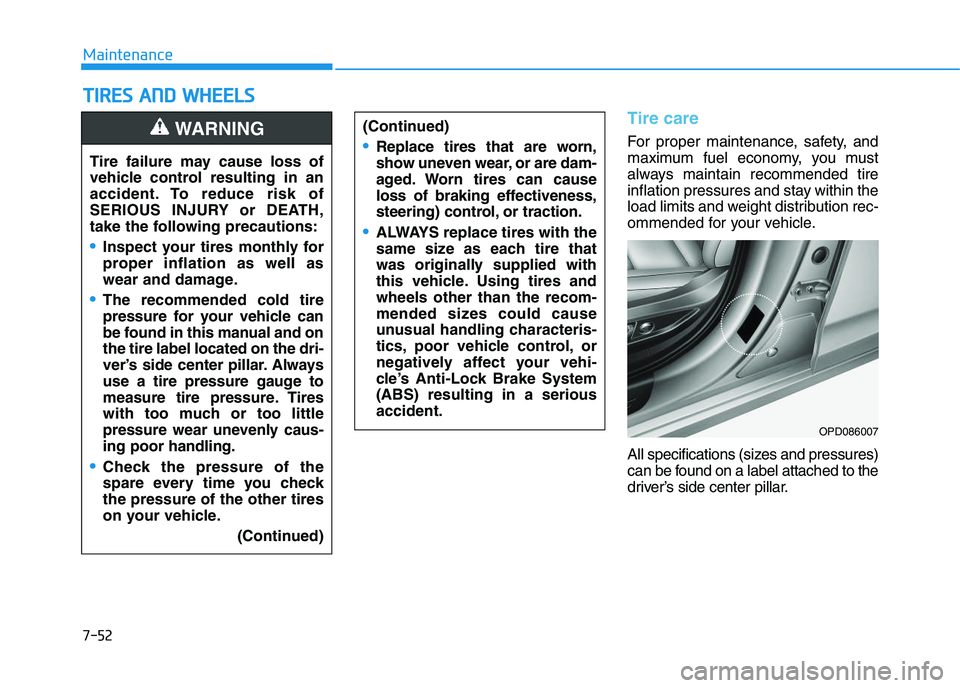
All specifications (sizes and pressures)
can be found on a label attached to the
driver’s side center pillar.
(Continued)Replace tires that are worn,
show uneven wear, or are dam-
aged. Worn tires can cause
loss of braking effectiveness,
steering) control, or traction.
ALWAYS replace tires with the
same size as each tire that
was originally supplied with
this vehicle. Using tires and
wheels other than the recom-
mended sizes could cause
unusual handling characteris-
tics, poor vehicle control, or
negatively affect your vehi-
cle’s Anti-Lock Brake System
(ABS) resulting in a serious
accident.
Tire failure may cause loss of
vehicle control resulting in an
accident. To reduce risk of
SERIOUS INJURY or DEATH,
take the following precautions:
Inspect your tires monthly for
proper inflation as well as
wear and damage.
The recommended cold tire
pressure for your vehicle can
be found in this manual and on
the tire label located on the dri-
ver’s side center pillar. Always
use a tire pressure gauge to
measure tire pressure. Tires
with too much or too little
pressure wear unevenly caus-
ing poor handling.
Check the pressure of the
spare every time you check
the pressure of the other tires
on your vehicle.
(Continued)
WARNING
OPD086007
Page 629 of 659

8
Specifications & Consumer information
8
Specifications & Consumer information
8
Dimensions ..............................................................8-2
Engine ......................................................................8-2
Bulb wattage ...........................................................8-3
Tires and wheels ....................................................8-4
Load and speed capacity tires (for europe)......8-5
Air conditioning system ........................................8-6
Vehicle weight and luggage volume ....................8-6
Recommended lubricants and capacities ...........8-7
Recommended engine oil (For Europe) .......................8-9
Recommended SAE viscosity number ..........................8-9
Vehicle identification number (VIN) ..................8-12
Vehicle certification label ...................................8-12
Tire specification and pressure label ...............8-13
Engine number .....................................................8-13
Air conditioner compressor label ......................8-14
Refrigerant label ..................................................8-14
Declaration of conformity ..................................8-14