2017 Hyundai Elantra refill
[x] Cancel search: refillPage 158 of 637

3-63
Convenient features of your vehicle
3
Washer Fluid Warning
Light (if equipped)
This warning light illuminates:
• When the washer fluid level in the
reservoir is nearly empty.
In this case, you should refill the
washer fluid.
Overspeed Warning
Light (if equipped)
This warning light blinks:
• When you drive the vehicle more
than 120 km/h.
- This is to prevent you from driving
your vehicle with overspeed.
- The overspeed warning chime
also sounds for approximately 5
seconds.
Master Warning Light
(for supervision
cluster)
This indicator light illuminates:
• Once you turn the ignition switch or
Engine Start/Stop button to the ON
position.
- It illuminates for approximately 3
seconds and then goes off.
• When there is a malfunction in
operation in any of the following
systems:
- Low washer fluid (if equipped)
- Exterior lamp malfunction
- Blind Spot Detection (BSD) mal-
function (if equipped)
- Tire Pressure Monitoring System
(TPMS, if equipped)
- Service reminder
To identify the details of the warn-
ing, look at the LCD display.
120km/h
Page 175 of 637
3-80
Convenient features of your vehicle
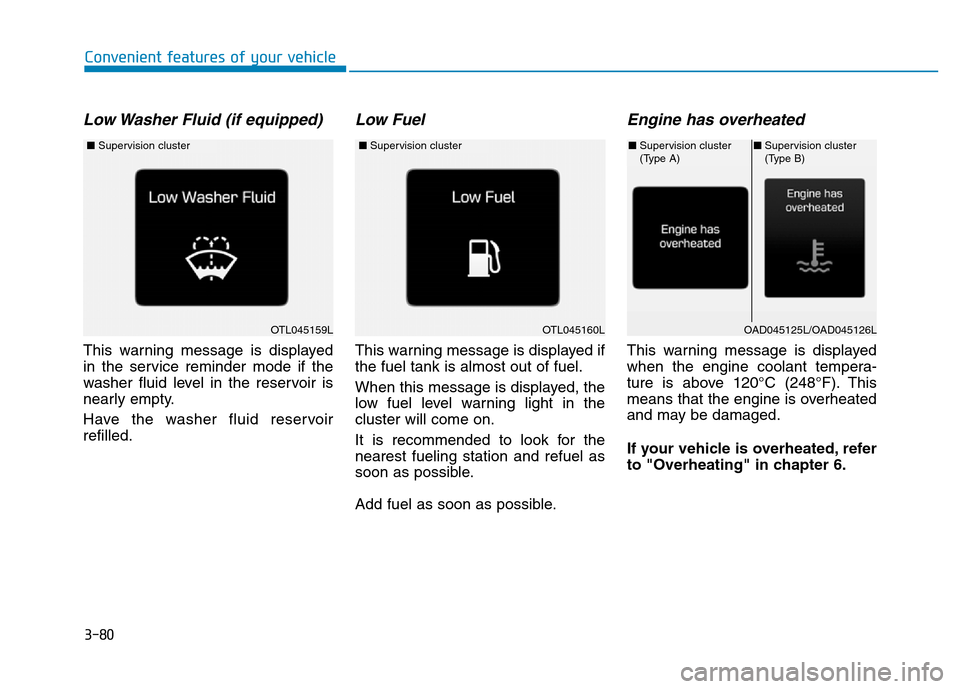
Low Washer Fluid (if equipped)
This warning message is displayed
in the service reminder mode if the
washer fluid level in the reservoir is
nearly empty.
Have the washer fluid reservoir
refilled.
Low Fuel
This warning message is displayed if
the fuel tank is almost out of fuel.
When this message is displayed, the
low fuel level warning light in the
cluster will come on.
It is recommended to look for the
nearest fueling station and refuel as
soon as possible.
Add fuel as soon as possible.
Engine has overheated
This warning message is displayed
when the engine coolant tempera-
ture is above 120°C (248°F). This
means that the engine is overheated
and may be damaged.
If your vehicle is overheated, refer
to "Overheating" in chapter 6.
OTL045160LOTL045159L
■Supervision cluster ■Supervision cluster
OAD045125L/OAD045126L
■Supervision cluster
(Type A)■Supervision cluster
(Type B)
Page 521 of 637
7-10
Maintenance
S
SC
C H
H E
ED
D U
U L
LE
E D
D
M
M A
AI
IN
N T
TE
EN
N A
AN
N C
CE
E
S
S E
E R
R V
V I
IC
C E
E S
S
Follow Normal Maintenance Schedule if the vehicle is usually operated where none of the following conditions apply.
If any of the following conditions apply, you must follow the Maintenance Under Severe Usage Conditions.
Repeated driving short distance of less than 8 km (5 miles) in normal temperature or less than 16 km(10 miles) in
freezing temperature
Extensive engine idling or low speed driving for long distances
Driving on rough, dusty, muddy, unpaved, graveled or salt-spread roads
Driving in areas using salt or other corrosive materials or in very cold weather
Driving in the condition of inflowing sand or dust into engine
Driving in heavy traffic area
Driving on uphill, downhill, or mountain road repeatedly
Towing a trailer or using a camper, or roof rack
Driving as a patrol car, taxi, other commercial use of vehicle towing
Driving over 170 km/h (106 mile/h)
Frequently driving in stop-and-go condition
If your vehicle is operated under the above conditions, you should inspect, replace or refill more frequently than the following Normal Maintenance Schedule. After the periods or distance shown in the chart, continue to follow the pre-scribed maintenance intervals.
Page 548 of 637

7-37
7
Maintenance
•Do not use engine coolant or
antifreeze in the washer fluid
reservoir.
•Engine coolant can severely
obscure visibility when
sprayed on the windshield
and may cause loss of vehicle
control or damage to paint
and body trim.
WARNING
Recommended engine coolant
• When adding coolant, use only
deionized water or soft water for
your vehicle and never mix hard
water in the coolant filled at the fac-
tory. An improper coolant mixture
can result in serious malfunction or
engine damage.
• The engine in your vehicle has alu-
minum engine parts and must be
protected by an phosphate based
ethylene-glycol coolant to prevent
corrosion and freezing.
• DO NOT USE alcohol or methanol
coolant or mix them with the spec-
ified coolant.
• Do not use a solution that contains
more than 60% antifreeze or less
than 35% antifreeze, which would
reduce the effectiveness of the
solution.For mixture percentage, refer to the
following table.
Information
If in doubt about the mix ratio, a 50%
water and 50% antifreeze mix is the
easiest to mix together as it will be the
same quantity of each. It is suitable to
use for most temperature ranges of
-35°C (-31°F) and higher.
Changing the coolant
We recommend that the coolant be
replaced by an authorized HYUNDAI
dealer.
Put a thick cloth or fabric around
the radiator cap before refilling
the coolant in order to prevent the
coolant from overflowing into
engine parts such as generator.
NOTICE
i
Ambient
TemperatureMixture Percentage
(volume)
Antifreeze Water
-15°C (5°F) 35 65
-25°C (-13°F) 40 60
-35°C (-31°F) 50 50
-45°C (-49°F) 60 40
Page 564 of 637

7-53
7
Maintenance
•Underinflation also results in
excessive wear, poor handling
and reduced fuel economy.
Wheel deformation also is
possible. Keep your tire pres-
sures at the proper levels. If a
tire frequently needs refilling,
we recommend that the sys-
tem be checked by an author-
ized HYUNDAI dealer.
•Overinflation produces a
harsh ride, excessive wear at
the center of the tire tread,
and a greater possibility of
damage from road hazards.
CAUTION
•Warm tires normally exceed
recommended cold tire pres-
sures by 28 to 41 kPa (4 to 6
psi). Do not release air from
warm tires to adjust the pres-
sure or the tires will be under-
inflated.
•Be sure to reinstall the tire
inflation valve caps. Without
the valve cap, dirt or moisture
could get into the valve core
and cause air leakage. If a
valve cap is missing, install a
new one as soon as possible.
CAUTION
Tire pressure
Always observe the following:
•Check tire pressure when the
tires are cold. (After vehicle
has been parked for at least
three hours or hasn't been driv-
en more than 1.6 km (1 mile)
since startup.)
•Check the pressure of your
spare tire each time you check
the pressure of other tires.
•Never overload your vehicle.
Be careful not to overload a
vehicle luggage rack if your
vehicle is equipped with one.
•Worn, old tires can cause
accidents. If your tread is
badly worn, or if your tires
have been damaged, replace
them.
CAUTION
Tire inflation
Overinflation or underinflation
can reduce tire life, adversely
affect vehicle handling, and
lead to sudden tire failure. This
could result in loss of vehicle
control and potential injury.
WARNING
Page 632 of 637

8-6
Specifications & Consumer information
R RE
EC
CO
OM
MM
ME
EN
ND
DE
ED
D
L
LU
UB
BR
RI
IC
CA
AN
NT
TS
S
A
AN
ND
D
C
CA
AP
PA
AC
CI
IT
TI
IE
ES
S
To help achieve proper engine and powertrain performance and durability, use only lubricants of the proper quality.
The correct lubricants also help promote engine efficiency that results in improved fuel economy.
These lubricants and fluids are recommended for use in your vehicle.
Lubricant Volume Classification
Engine oil *
1*2
(drain and refill)
RecommendsNu 2.0 MPI4.0l
(4.23 US qt.)Except Middle East,
Morocco, Sudan, EgyptAPI SM*
4& ILSAC GF-4 (or above)
ACEA A5*
3(or above)
For Middle East,
Morocco, Sudan, EgyptACEA A5*
3(or above)
Gamma 1.6
MPI3.6 l
(3.80 US qt.)Except Middle East,
Morocco, Sudan, EgyptAPI SM*
4& ILSAC GF-4 (or above)
ACEA A5*
3(or above)
For Middle East,
Morocco, Sudan, EgyptACEA A5*
3(or above)
U2 1.6 TCI5.3 l
(5.6 US qt.)with DPF ACEA C2 or C3*
5
without DPF ACEA B4*5
Manual transmission fluidNu 2.0 MPI/
U2 1.6 TCI1.7~1.8 l
(1.8~1.9 US qt.)HK MTF 70W (SK)
SPIRAX S6 GHME 70W MTF (H.K.SHELL)
GS MTF HD 70W (GS CALTEX) (API GL-4, SAE 70W) Gamma 1.6
MPI1.6~1.7 l
(1.7~1.8 US qt.)
Automatic transmission
fluidNu 2.0 MPI6.7 l
(7.08 US qt.)
MICHANG ATF SP-IV, SK ATF SP-IV, NOCA ATF SP-IV,
HYUNDAI genuine ATF SP-IV
Gamma 1.6
MPI6.7 l
(7.08 US qt.)