2017 Hyundai Elantra pressure
[x] Cancel search: pressurePage 572 of 637

7-61
7
Maintenance
4. Tire ply composition and
material
The number of layers or plies of rub-
ber-coated fabric are in the tire. Tire
manufacturers also must indicate the
materials in the tire, which include
steel, nylon, polyester, and others.
The letter "R" means radial ply con-
struction; the letter "D" means diago-
nal or bias ply construction; and the
letter "B" means belted-bias ply con-
struction.
5. Maximum permissible infla-
tion pressure
This number is the greatest amount
of air pressure that should be put in
the tire. Do not exceed the maximum
permissible inflation pressure. Refer
to the Tire and Loading Information
label for recommended inflation
pressure.
6. Maximum load rating
This number indicates the maximum
load in kilograms and pounds that
can be carried by the tire. When
replacing the tires on the vehicle,
always use a tire that has the same
load rating as the factory installed
tire.
7. Uniform tire quality grading
Quality grades can be found where
applicable on the tire sidewall
between tread shoulder and maxi-
mum section width.
For example:
TREADWEAR 200
TRACTION AA
TEMPERATURE A
Tread wear
The tread wear grade is a compara-
tive rating based on the wear rate of
the tire when tested under controlled
conditions on a specified govern-
ment test course. For example, a tire
graded 150 would wear one-and-a-
half times (1½) as well on the gov-
ernment course as a tire graded 100.
The relative performance of tires
depends upon the actual conditions
of their use, however, and may
depart significantly from the norm
because of variations in driving
habits, service practices and differ-
ences in road characteristics and cli-
mate.
These grades are molded on the
side-walls of passenger vehicle tires.
The tires available as standard or
optional equipment on your vehicles
may vary with respect to grade.
Page 593 of 637

Maintenance
7-82
Engine compartment main fuse panel - PCB Block (UII 1.6 TCI)
Fuse NameSymbolFuse ratingCircuit Protected
SNSR210AElectronic Vgt Actuator, Egr Cooling Bypass Solenoid Valve,
Stop Lamp Switch, Pm (Particulate Matter) Sensor, Fuel Pressure Regulating Valve,
Rail Pressure Regulating Valve, E/R Junction Block (RLY.2, RLY.9, RLY.5B, RLY,11B)
ECU215A-
ECU110AECM
INJ.15A-
SNSR115ALambda Sensor #1, Lambda Sensor #2
IGN.15A-
SNSR320AFuel Pump Relay, Air Flow Sensor, Camshaft Position Sensor, Oil Control Valve
HORN10AHorn Relay
ECU510AECM
SNSR420AFuel Filter Warning Sensor, Glow Relay Unit
ABS315AABS/ESC Control Module, Multipurpose Check Connector
TCU215ATCM, Transmission Range Switch
Page 603 of 637

7-92
Maintenance
Headlamp and front fog lamp
aiming (For Europe)
Headlamp aiming
1. Inflate the tires to the specified
pressure and remove any loads
from the vehicle except the driver,
spare tire, and tools.
2. The vehicle should be placed on a
flat floor.
3. Draw vertical lines (Vertical lines
passing through respective head
lamp centers) and a horizontal line
(Horizontal line passing through
center of head lamps) on the
screen.
4. With the headlamp and battery in
normal condition, aim the head-
lamps so the brightest portion falls
on the horizontal and vertical
lines.
5. To aim the low beam left or right,
turn the driver clockwise or coun-
terclockwise. To aim the low beam
up or down, turn the driver clock-
wise or counterclockwise.
To aim the high beam up or down,
turn the driver clockwise or coun-
terclockwise.Front fog lamp aiming
The front fog lamp can be aimed as
the same manner of the headlamps
aiming.
With the front fog lamps and battery
in normal condition, aim the front fog
lamps.
To aim the front fog lamp up or down,
turn the driver clockwise or counter-
clockwise.
OAD075066L
OAD075067L
■without Headlight leveling device
■Equipped with Headlight leveling device
Page 614 of 637

7-103
7
Maintenance
APPEARANCE CARE
Exterior care
Exterior general caution
It is very important to follow the label
directions when using any chemical
cleaner or polish. Read all warning
and caution statements that appear
on the label.
High-pressure washing
• When using high-pressure wash-
ers, make sure to maintain suffi-
cient distance from the vehicle.
Insufficient clearance or excessive
pressure can lead to component
damage or water penetration.
• Do not spray the camera, sensors
or its surrounding area directly with
a high pressure washer. Shock
applied from high pressure water
may cause the device to not oper-
ate normally.
• Do not bring the nozzle tip close to
boots (rubber or plastic covers) or
connectors as they may be dam-
aged if they come into contact with
high pressure water.
Finish maintenance
Washing
To help protect your vehicle’s finish
from rust and deterioration, wash it
thoroughly and frequently at least
once a month with lukewarm or cold
water.
If you use your vehicle for off-road
driving, you should wash it after each
off-road trip. Pay special attention to
the removal of any accumulation of
salt, dirt, mud, and other foreign
materials. Make sure the drain holes
in the lower edges of the doors and
rocker panels are kept clear and
clean.
Insects, tar, tree sap, bird droppings,
industrial pollution and similar
deposits can damage your vehicle’s
finish if not removed immediately.
Even prompt washing with plain
water may not completely remove all
these deposits.
A mild soap, safe for use on painted
surfaces, may be used.
After washing, rinse the vehicle thor-
oughly with lukewarm or cold water.
Do not allow soap to dry on the finish.• Do not use strong soap, chemi-
cal detergents or hot water, and
do not wash the vehicle in direct
sunlight or when the body of the
vehicle is warm.
• Be careful when washing the
side windows of your vehicle.
Especially, with high-pressure
water, water may leak through
the windows and wet the interi-
or.
• To prevent damage to the plastic
parts and lamps, do not clean
with chemical solvents or strong
detergents.
NOTICE
Page 615 of 637
7-104
Maintenance
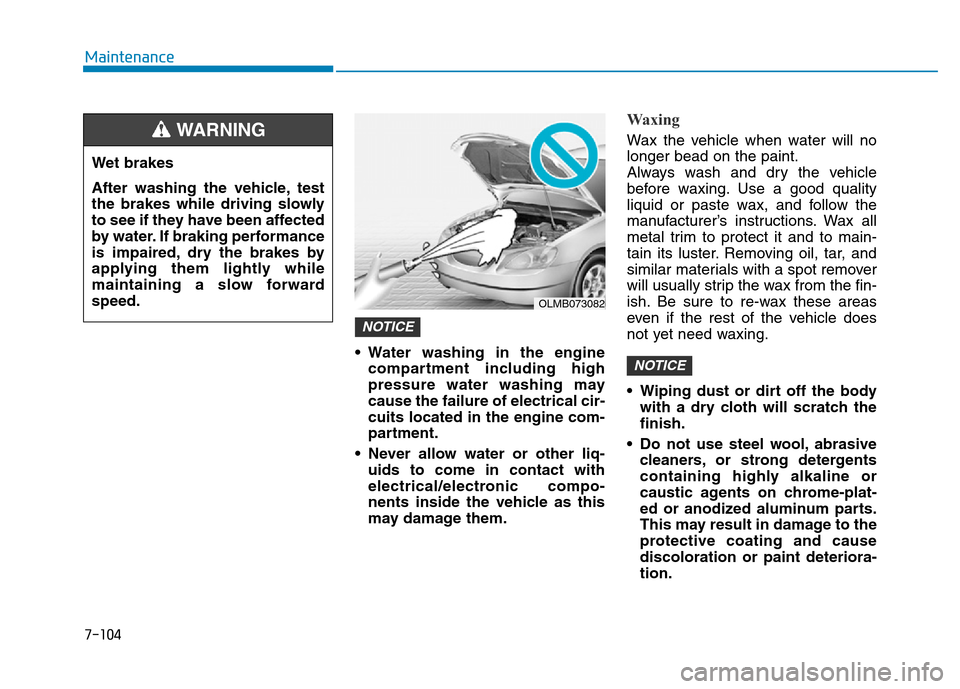
• Water washing in the engine
compartment including high
pressure water washing may
cause the failure of electrical cir-
cuits located in the engine com-
partment.
• Never allow water or other liq-
uids to come in contact with
electrical/electronic compo-
nents inside the vehicle as this
may damage them.
Waxing
Wax the vehicle when water will no
longer bead on the paint.
Always wash and dry the vehicle
before waxing. Use a good quality
liquid or paste wax, and follow the
manufacturer’s instructions. Wax all
metal trim to protect it and to main-
tain its luster. Removing oil, tar, and
similar materials with a spot remover
will usually strip the wax from the fin-
ish. Be sure to re-wax these areas
even if the rest of the vehicle does
not yet need waxing.
• Wiping dust or dirt off the body
with a dry cloth will scratch the
finish.
• Do not use steel wool, abrasive
cleaners, or strong detergents
containing highly alkaline or
caustic agents on chrome-plat-
ed or anodized aluminum parts.
This may result in damage to the
protective coating and cause
discoloration or paint deteriora-
tion.
NOTICE
NOTICE
Wet brakes
After washing the vehicle, test
the brakes while driving slowly
to see if they have been affected
by water. If braking performance
is impaired, dry the brakes by
applying them lightly while
maintaining a slow forward
speed.
WARNING
OLMB073082
Page 618 of 637
7-107
7
Maintenance
High-corrosion areas
If you live in an area where your car
is regularly exposed to corrosive
materials, corrosion protection is
particularly important. Some of the
common causes of accelerated cor-
rosion are road salts, dust control
chemicals, ocean air and industrial
pollution.
Moisture breeds corrosion
Moisture creates the conditions in
which corrosion is most likely to
occur. For example, corrosion is
accelerated by high humidity, partic-
ularly when temperatures are just
above freezing. In such conditions,
the corrosive material is kept in con-
tact with the car surfaces by moisture
that is slow to evaporate.
Mud is particularly corrosive
because it is slow to dry and holds
moisture in contact with the vehicle.
Although the mud appears to be dry,
it can still retain the moisture and
promote corrosion.High temperatures can also acceler-
ate corrosion of parts that are not
properly ventilated so the moisture
can be dispersed. For all these rea-
sons, it is particularly important to
keep your car clean and free of mud
or accumulations of other materials.
This applies not only to the visible
surfaces but particularly to the
underside of the car.To help prevent corrosion
You can help prevent corrosion from
getting started by observing the fol-
lowing:Keep your car clean
The best way to prevent corrosion is
to keep your car clean and free of
corrosive materials. Attention to the
underside of the car is particularly
important.
• If you live in a high-corrosion area
— where road salts are used, near
the ocean, areas with industrial
pollution, acid rain, etc.—, you
should take extra care to prevent
corrosion. In winter, hose off the
underside of your car at least once
a month and be sure to clean the
underside thoroughly when winter
is over.
• When cleaning underneath the car,
give particular attention to the
components under the fenders and
other areas that are hidden from
view. Do a thorough job; just damp-
ening the accumulated mud rather
than washing it away will acceler-
ate corrosion rather than prevent
it. Water under high pressure and
steam are particularly effective in
removing accumulated mud and
corrosive materials.
Page 627 of 637

8
Specifications & Consumer information
8
Specifications & Consumer information
8
Dimensions ..............................................................8-2
Engine ......................................................................8-2
Bulb wattage ...........................................................8-3
Tires and wheels ....................................................8-4
Air conditioning system ........................................8-4
Tire load and speed capacity ..............................8-5
Volume and weight ................................................8-5
Recommended lubricants and capacities ...........8-6
Recommended SAE viscosity number ..........................8-8
Vehicle identification number (VIN) ....................8-9
Vehicle certification label .....................................8-9
Tire specification and pressure label ...............8-10
Engine number .....................................................8-10
Air conditioner compressor label ......................8-11
Declaration of conformity ..................................8-11
Page 630 of 637

8-4
Specifications & Consumer information
T TI
IR
RE
ES
S
A
AN
ND
D
W
WH
HE
EE
EL
LS
S
Item Tire sizeWheel
sizeInflation pressure, bar (kPa, psi)
Wheel lug nut
torque
kgf·m (lbf·ft, N Normal load *1Maximum load
Front Rear Front Rear
Full size tire195/65 R15 6.0J X 15
2.3 (230, 33) 2.3 (230, 33) 2.3 (230, 33) 2.3 (230, 33)
11~13
(79~94, 107~127) 205/55 R16 6.5J X 16
225/45 R17 7.0J X 17
Compact spare tire
(if equipped)T125/80 D154.0T X 154.2 (420, 60)4.2 (420, 60)4.2 (420, 60)4.2 (420, 60)T125/80 D164.0T X 16
When replacing tires, use the same size originally supplied with the vehicle.
Using tires of a different size can damage the related parts or not work properly.
CAUTION
*1 : Normal load : Up to 3 persons
A AI
IR
R
C
CO
ON
ND
DI
IT
TI
IO
ON
NI
IN
NG
G
S
SY
YS
ST
TE
EM
M
ItemsWeight of Volume Classification
Refrigerant
g (oz.)
500±25 (17.6±0.88)R-1234yf (For Europe)
R-134a (Except Europe)
Compressor lubricant
g (oz.) 110±10 (3.88±0.35)PAG (FD46XG)
Contact an authorized HYUNDAI dealer for more details.