Page 589 of 637
Maintenance
7-78
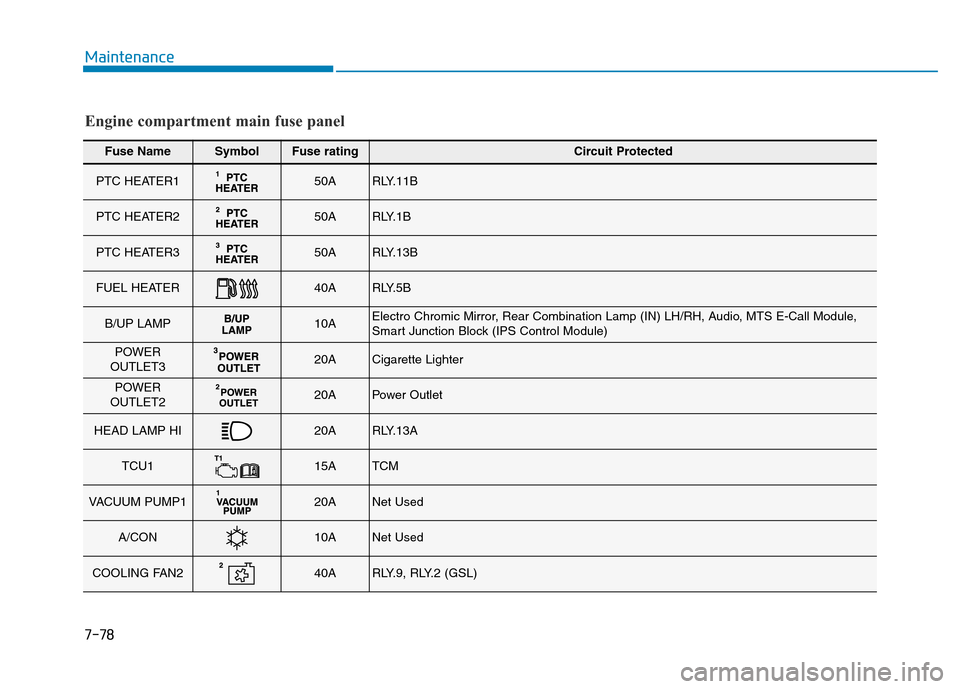
Fuse NameSymbolFuse ratingCircuit Protected
PTC HEATER150ARLY.11B
PTC HEATER250ARLY.1B
PTC HEATER350ARLY.13B
FUEL HEATER40ARLY.5B
B/UP LAMP10AElectro Chromic Mirror, Rear Combination Lamp (IN) LH/RH, Audio, MTS E-Call Module,
Smart Junction Block (IPS Control Module)
POWER
OUTLET320ACigarette Lighter
POWER
OUTLET220APower Outlet
HEAD LAMP HI20ARLY.13A
TCU115ATCM
VACUUM PUMP120ANet Used
A/CON10ANet Used
COOLING FAN240ARLY.9, RLY.2 (GSL)
Engine compartment main fuse panel
Page 590 of 637
7-79
7
Maintenance
Fuse NameSymbolFuse ratingCircuit Protected
BATT140ASmart Junction Block (LEAK CURRENT AUTOCUT DEVICE,
Fuse : F10, F12, F21, F29, F38)
DCT140ATCM
DCT240ATCM
B/ALARM HORN10AR LY. 7
S/FUEL PUMP15AR LY. 5
ABS140AABS Control Module, ESC Control Module, Multipurpose Check Connector
ABS230AABS Control Module, ESC Control Module, Multipurpose Check Connector
POWER40ARLY.14
Engine compartment main fuse panel
Page 591 of 637
Maintenance
7-80
Engine compartment main fuse panel - PCB Block (Gamma 1.6 MPI)
Fuse NameSymbolFuse ratingCircuit Protected
SNSR210APurge Control Solenoid Valve, Variable Intake Solenoid Valve,
E/R Junction Block (RLY.2, RLY.9)
ECU215A-
ECU110AECM/PCM
INJ.15AINJECTOR #1~#4
SNSR115AOxygen Sensor (Up), Oxygen Sensor (Down)
IGN.15AIgnition Coil #1~#4, Condenser
SNSR320AFuel Pump Relay, Oil Control Valve #1, Oil Control Valve #2
HORN10AHorn Relay
ECU510AECM/PCM
SNSR420A-
ABS315AABS/ESC Control Module, Multipurpose Check Connector
TCU215AVehicle Speed Sensor, Transmission Range Switch, E/R Junction Block (Fuse : F17)
ECU420AECM/PCM
ECU310AECM/PCM
F/PUMP20AFuel Pump Relay
Page 592 of 637
7-81
7
Maintenance
Engine compartment main fuse panel - PCB Block (Nu 2.0 MPI)
Fuse NameSymbolFuse ratingCircuit Protected
SNSR210APurge Control Solenoid Valve, Variable Intake Solenoid Valve,
E/R Junction Block (RLY.2, RLY.9), Cold Start Solenoid Valve
ECU215APCM
ECU110A-
INJ.15AINJECTOR #1~#4
SNSR115AOxygen Sensor (Up), Oxygen Sensor (Down)
IGN.15AIgnition Coil #1~#4, Condenser
SNSR320AFuel Pump Relay, Oil Control Valve #1, Oil Control Valve #2
HORN10AHorn Relay
ECU510APCM
SNSR420A-
ABS315AABS/ESC Control Module, Multipurpose Check Connector
TCU215AVehicle Speed Sensor, Transmission Range Switch, E/R Junction Block (Fuse : F17)
ECU420APCM
ECU310APCM
F/PUMP20AFuel Pump Relay
Page 593 of 637
Maintenance
7-82
Engine compartment main fuse panel - PCB Block (UII 1.6 TCI)
Fuse NameSymbolFuse ratingCircuit Protected
SNSR210AElectronic Vgt Actuator, Egr Cooling Bypass Solenoid Valve,
Stop Lamp Switch, Pm (Particulate Matter) Sensor, Fuel Pressure Regulating Valve,
Rail Pressure Regulating Valve, E/R Junction Block (RLY.2, RLY.9, RLY.5B, RLY,11B)
ECU215A-
ECU110AECM
INJ.15A-
SNSR115ALambda Sensor #1, Lambda Sensor #2
IGN.15A-
SNSR320AFuel Pump Relay, Air Flow Sensor, Camshaft Position Sensor, Oil Control Valve
HORN10AHorn Relay
ECU510AECM
SNSR420AFuel Filter Warning Sensor, Glow Relay Unit
ABS315AABS/ESC Control Module, Multipurpose Check Connector
TCU215ATCM, Transmission Range Switch
Page 594 of 637
7-83
7
Maintenance
Engine compartment main fuse panel - PCB Block (UII 1.6 TCI)
Fuse NameSymbolFuse ratingCircuit Protected
ECU420A-
ECU310AECM
F/PUMP20AFuel Pump Relay
Page 615 of 637
7-104
Maintenance
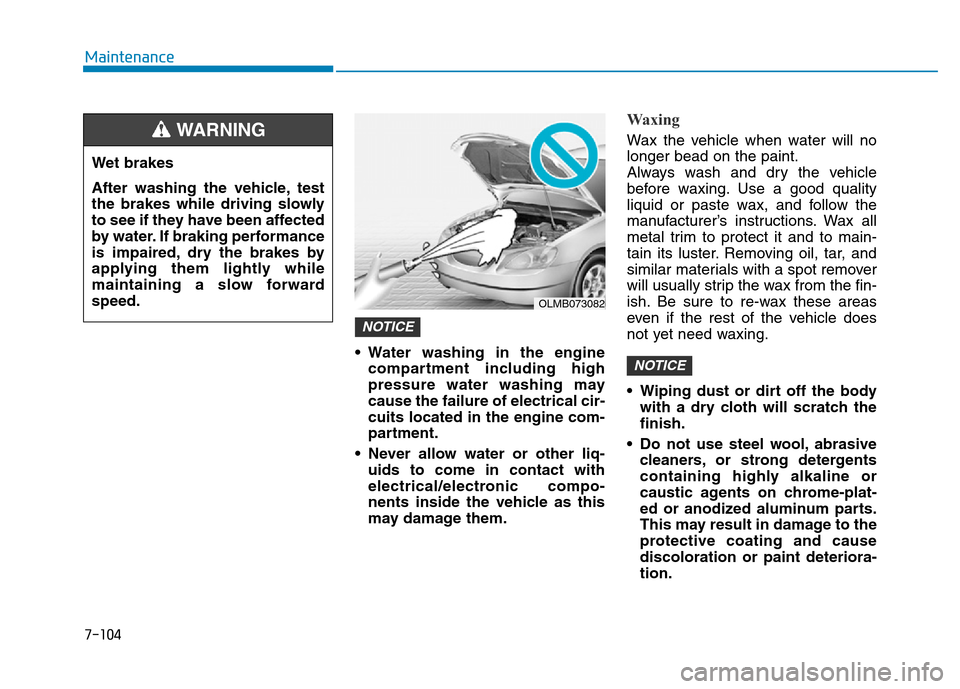
• Water washing in the engine
compartment including high
pressure water washing may
cause the failure of electrical cir-
cuits located in the engine com-
partment.
• Never allow water or other liq-
uids to come in contact with
electrical/electronic compo-
nents inside the vehicle as this
may damage them.
Waxing
Wax the vehicle when water will no
longer bead on the paint.
Always wash and dry the vehicle
before waxing. Use a good quality
liquid or paste wax, and follow the
manufacturer’s instructions. Wax all
metal trim to protect it and to main-
tain its luster. Removing oil, tar, and
similar materials with a spot remover
will usually strip the wax from the fin-
ish. Be sure to re-wax these areas
even if the rest of the vehicle does
not yet need waxing.
• Wiping dust or dirt off the body
with a dry cloth will scratch the
finish.
• Do not use steel wool, abrasive
cleaners, or strong detergents
containing highly alkaline or
caustic agents on chrome-plat-
ed or anodized aluminum parts.
This may result in damage to the
protective coating and cause
discoloration or paint deteriora-
tion.
NOTICE
NOTICE
Wet brakes
After washing the vehicle, test
the brakes while driving slowly
to see if they have been affected
by water. If braking performance
is impaired, dry the brakes by
applying them lightly while
maintaining a slow forward
speed.
WARNING
OLMB073082
Page 623 of 637

7-112
Maintenance
Canister
Fuel vapors generated inside the fuel
tank are absorbed and stored in the
onboard canister. When the engine is
running, the fuel vapors absorbed in
the canister are drawn into the surge
tank through the purge control sole-
noid valve.
Purge Control Solenoid Valve
(PCSV)
The purge control solenoid valve is
controlled by the Engine Control
Module (ECM); when the engine
coolant temperature is low during
idling, the PCSV closes so that evap-
orated fuel is not taken into the
engine. After the engine warms-up
during ordinary driving, the PCSV
opens to introduce evaporated fuel to
the engine.
3. Exhaust emission control
system
The Exhaust Emission Control
System is a highly effective system
which controls exhaust emissions
while maintaining good vehicle per-
formance.
Vehicle modifications
This vehicle should not be modified.
Modification of your vehicle could
affect its performance, safety or
durability and may even violate gov-
ernmental safety and emissions reg-
ulations.
In addition, damage or performance
problems resulting from any modifi-
cation may not be covered under
warranty.
• If you use unauthorized electronic
devices, it may cause the vehicle to
operate abnormally, wire damage,
battery discharge and fire. For your
safety, do not use unauthorized
electronic devices.
Engine exhaust gas precautions
(carbon monoxide)
• Carbon monoxide can be present
with other exhaust fumes.
Therefore, if you smell exhaust
fumes of any kind inside your vehi-
cle, have it inspected and repaired
immediately. If you ever suspect
exhaust fumes are coming into
your vehicle, drive it only with all
the windows fully open. Have your
vehicle checked and repaired
immediately.