Page 3 of 606

Contents
This owner’s manual should be considered a permanent part of the
vehicle and should remain with the vehicle when it is sold.
This owner’s manual covers all models of your vehicle. You may find
descriptions of equipment and features that are not on your
particular model.
Images throughout this owner’s manual (including the front cover)
represent features and equipment that are available on some, but
not all, models. Your particular mo del may not have some of these
features.
This owner’s manual is for vehicles sold in the United States and
Canada.
The information and specifications in cluded in this publication were
in effect at the time of approval for printing. Honda Motor Co., Ltd.
reserves the right, however, to discontinue or change specifications
or design at any time without notice and without incurring any
obligation.2 Safe Driving P. 27
For Safe Driving P. 28 Seat Belts P. 33 Airbags P. 40
2Instrument Panel P. 71
Indicators P. 72 Gauges and Multi-Information Display P. 101
2Controls P. 107
Clock P. 108 Locking and Unlocking the Doors P. 109
Security System P. 131 Opening and Closing the Windows P. 134
Adjusting the Mirrors P. 159 Adjusting the Seats P. 161
Heating and Cooling System
* P. 193
2 Features P. 197
Audio System P. 198
General Information on the Audio System P. 296
HomeLink ® Universal Transceiver
* P. 334 Bluetooth ® HandsFreeLink ® P. 337, 362
2 Driving P. 395
Before Driving P. 396 Towing a Trailer P. 404
Parking Your Vehicle P. 487Multi-View Rear Camera P. 496
2Maintenance P. 503
Before Performing Maintenance P. 504 Maintenance MinderTM P. 507
Checking and Maintaining Wiper Blades P. 529
Heating and Cooling System
*/Climate Control System* Maintenance P. 542
2 Handling the Unexpected P. 551
Tools P. 552 If a Tire Goes Flat P. 553
Overheating P. 569 Indicator, Coming On/Blinking P. 571
When You Cannot Unlock the Fuel Fill Door P. 581
2 Information P. 585
Specifications P. 586 Identification Numbers P. 588
Emissions Testing P. 591 Warranty Coverages P. 593
Page 4 of 606

Contents
Child Safety P. 53Exhaust Gas Hazard P. 68Safety Labels P. 69
Opening and Closing the Tailgate P. 126 Opening and Closing the Trunk P. 128
Opening and Closing the Moonroof* P. 138 Operating the Switches Around the Steering Wheel P. 140
Interior Lights/Convenience It ems P. 169Climate Control System* P. 186
Audio System Basic Operation P. 204, 222 Audio Error Messages P. 292
Customized Features P. 303
Off-Highway Driving Guidelines P. 416 When Driving P. 418 Braking P. 474
Refueling P. 498 Fuel Economy and CO
2 Emissions P. 501
Maintenance Under the Hood P. 511 Replacing Light Bulbs P. 523
Checking and Maintaining Tires P. 531 Battery P. 540 Remote Transmitter Care P. 541
Cleaning P. 543 Accessories and Modifications P. 549
Engine Does Not Start P. 562Jump Starting P. 565 Shift Lever Does Not Move P. 568
Fuses P. 575 Emergency Towing P. 580
Refueling P. 582
Devices that Emit Radio Waves P. 589 Reporting Safety Defects P. 590
Authorized Manuals P. 595 Customer Service Information P. 596
Quick Reference GuideP. 4
Safe DrivingP. 27
Instrument PanelP. 71
ControlsP. 107
FeaturesP. 197
DrivingP. 395
MaintenanceP. 503
Handling the UnexpectedP. 551
InformationP. 585
IndexP. 597
Page 11 of 606
10
Quick Reference Guide
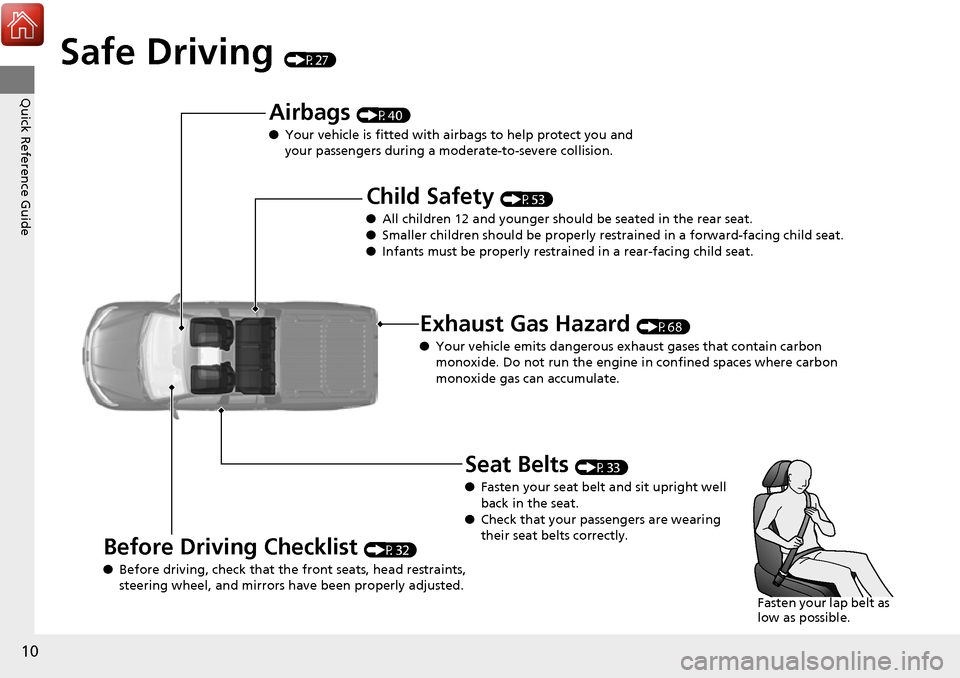
Safe Driving (P27)
Airbags (P40)
● Your vehicle is fitted with airbags to help protect you and
your passengers during a moderate-to-severe collision.
Child Safety (P53)
● All children 12 and younger should be seated in the rear seat.
● Smaller children should be properly restra ined in a forward-facing child seat.
● Infants must be properly restraine d in a rear-facing child seat.
Exhaust Gas Hazard (P68)
● Your vehicle emits dangerous exhaust gases that contain carbon
monoxide. Do not run the engine in confined spaces where carbon
monoxide gas can accumulate.
Before Driving Checklist (P32)
● Before driving, check that the front seats, head restraints,
steering wheel, and mirrors have been properly adjusted.
Seat Belts (P33)
● Fasten your seat belt and sit upright well
back in the seat.
● Check that your passengers are wearing
their seat belts correctly.
Fasten your lap belt as
low as possible.
Page 23 of 606
22
Quick Reference Guide
Maintenance (P503)
Under the Hood (P511)
● Check engine oil, engine coolant, and windshield washer
fluid. Add when necessary.
● Check brake fluid.
● Check the battery condition monthly.
aPull the hood release handle under the corner of the
dashboard.
bLocate the hood latch lever, pull the lever up, and lift up
the hood.
cWhen finished, close the hood and make sure it is firmly
locked in place.
Lights (P523)
● Inspect all lights regularly.
Wiper Blades (P529)
● Replace blades if they leave streaks
across the windshield.
Tires (P531)
● Inspect tires and wheels regularly.
● Check tire pressures regularly.
● Install snow tires for winter
driving.
Page 24 of 606
Quick Reference Guide
23
Handling the Unexpected (P551)
Flat Tire (P553)
● Park in a safe location and replace the
flat tire with the compact spare tire
located in the trunk.
Indicators Come On (P571)
● Identify the indica tor and consult the
owner’s manual.
Engine Won’t Start (P562)
● If the battery is dead, jump start using a
booster battery.
Blown Fuse (P575)
● Check for a blown fuse if an electrical
device does not operate.
Overheating (P569)
● Park in a safe location. If you do not see
steam under the hood, open the hood,
and let the engine cool down.
Emergency Towing (P580)
● Call a professional towing service if you
need to tow your vehicle.
Page 26 of 606
25
Quick Reference Guide
The rear door cannot be
opened from inside the
vehicle. Why?Check if the childproof lock is in
the lock position. If so, open the
rear door with the outside door
handle.
To cancel this function, push the
lever to the unlock position.
Why do the doors lock
after I unlocked the doors?If you do not open the doors within 30 seconds, the doors are
relocked automatically for security.
Why does the beeper
sound when I open the
driver’s door?The beeper sounds when:
●The exterior lights are left on.
●The power mode is in ACCESSORY.
Why does the beeper
sound when I start driving?The beeper sounds when:
●Driver and/or front passenger are not wearing their seat belts.
●The parking brake pedal is not fully released.
Why do I hear a screeching
sound when I apply the
brake pedal?The brake pads may need to be replaced. Have your vehicle
inspected by a dealer.
Page 28 of 606
27
Safe Driving
You can find many safety recommendations throughout this chapter, and throughout this manual.
For Safe Driving
Important Safety Precautions.............. 28
Important Handling Information ......... 30
Your Vehicle’s Safety Features ............ 31
Safety Checklist ................................. 32
Seat Belts About Your Seat Belts ........................ 33
Fastening a Seat Belt .......................... 36
Seat Belt Inspection ............................ 39 Airbags
Airbag System Components ............... 40
Types of Airbags ................................ 43
Front Airbags (SRS) ............................ 43
Side Airbags....................................... 47
Side Curtain Airbags .......................... 49
Airbag System Indicators .................... 50
Airbag Care ....................................... 52 Child Safety
Protecting Child Passengers ............... 53
Safety of Infants and Small Children .... 55
Safety of Larger Children ................... 66
Exhaust Gas Hazard Carbon Monoxide Gas ....................... 68
Safety Labels Label Locations .................................. 69
Page 30 of 606
29
uuFor Safe Driving uImportant Safety Precautions
Safe Driving
■Pay appropriate attention to the task of driving safely
Engaging in cell phone conversation or other activities that keep you from paying
close attention to the road, other vehicles , and pedestrians could lead to a crash.
Remember, situations can change quickly, and only you can decide when it is safe to
divert some attention away from driving.
■Control your speed
Excessive speed is a major factor in crash injuries and deaths. Generally, the higher
the speed, the greater the risk, but serious injuries can also occur at lower speeds.
Never drive faster than is safe for curr ent conditions, regardless of the maximum
speed posted.
■Keep your vehicle in safe condition
Having a tire blowout or a mechanical failure can be extremely hazardous.
To reduce the possibility of such problems, check your tire pressures and condition
frequently, and perform all regularly scheduled maintenance.
■Never let passengers ride in the pickup bed or inside a truck cap (shell).
They could be killed or injured in a crash, or become ill or even die from carbon
monoxide poisoning if engine exhaust enters the cap.