Page 652 of 673
651
Information
This chapter includes your vehicle’s specifications, locations of identification numbers, and other
information required by regulation.
Specifications.................................... 652
Identification Numbers Vehicle Identification Number (VIN), Engine Number, and Transmission
Number ......................................... 654
Devices that Emit Radio Waves ....... 655
Reporting Safety Defects ................. 656Emissions Testing
Testing of Readiness Codes.............. 657
Warranty Coverages ........................ 659
Authorized Manuals ......................... 661
Customer Service Information ......... 662
17 PILOT-31TG76100.book 651 ページ 2016年9月20日 火曜日 午後4時9分
Page 653 of 673

652
Information
Specifications
■Vehicle Specifications
*1: ELITE grade and TRY grade of Canadian models
*2: 2WD models
*3: AWD models
■Air Conditioning
ModelHonda Pilot
No. of Passengers:
Front 2
Rear 2nd Row 3 (2
*1)
3rd Row 3
Total 8 (7
*1)Weights:Gross Vehicle
Weight Rating5,545 lbs (2,515 kg)*2
5,842 lbs (2,650 kg)*3
Gross Axle Weight
Rating (Front)2,734 lbs (1,240 kg)*2
2,855 lbs (1,295kg)*3
Gross Axle Weight
Rating (Rear)2,921 lbs (1,325 kg)*2
3,097 lbs (1,405 kg)*3
Gross Combined Weight
Rating8,025 lbs (3,640 kg)*2
9,755 lbs (4,425 kg)*3
Refrigerant TypeHFO-1234yf (R-1234yf)
Charge Quantity 23.8 – 25.6 oz (675 – 725 g)
Lubricant TypeRL85HM (POE)
Quantity 7.5 – 8.72 cu-in (123 – 143 cm3)
■ Engine Specifications
■ Fuel
■ Washer Fluid
Displacement211.8 cu-in (3,471 cm3)
Spark Plugs NGK DILZKR7B11G
TypeUnleaded gasoline, Pump octane number
of 87 or higher
Fuel Tank Capacity 19.5 US gal (73.8 L)
Tank CapacityU.S.: 4 US qt (3.8 L)
Canada: 5.6 US qt (5.3 L)
■ Light Bulbs
Headlights (Low Beam)LED*
55 W* (H11)
Headlights (High Beam) 60W (HB3)
Fog Lights*35 W (H8)
Parking lights*LEDFront Turn Signal/Parking Lights*28/8 W
Front Side Marker Lights LED
Daytime Running Lights60 W*
LED*
Side Turn Signal Lights (on Door Mirrors)*LEDBrake LightsLED
Rear Side Marker Lights LED
TaillightsLED
Back-Up Lights 21 W
Rear Turn Signal Lights21 W
High-Mount Brake Light LED
Rear License Plate LightLEDInterior Lights
Map LightsLED*
5 W*
Ceiling Lights5 WFront and Rear Ambient LightsLEDVanity Mirror Lights 1.4 WDoor Courtesy Lights3.8 WDoor Inner Handle LightsLEDDoor Pocket LightsLEDConsole Compartment Light1.4 WGlove Box Light1.4 WCargo Area Lights8 W
* Not available on all models
17 PILOT-31TG76100.book 652 ページ 2016年9月20日 火曜日 午後4時9分
Page 654 of 673

653
uuSpecifications u
Information
■Brake Fluid
■ Automatic Transmission Fluid
■ Automatic Transmission Fluid
■ Rear Differential Fluid
*
■Transfer Assembly Fluid*
SpecifiedHonda Heavy Duty Brake Fluid DOT 3
SpecifiedHonda Automatic Transmission ATF DW-1
Capacity Change 3.3 US qt (3.1 L)
SpecifiedHonda Automatic Transmission Fluid ATF-TYPE
3.1 or higher
Capacity Change 3.5 US qt (3.3 L)
SpecifiedHonda DPSF-II
Capacity Change 1.92 US qt (1.82 L)
Specified·Honda Hypoid Gear Oil HGO-1
·Hypoid gear oil SAE 75W-85 or SAE 90 (API
grade GL4 or GL5)
Capacity Change 0.45 US qt (0.43 L)
Automatic transmission models with shift lever
Automatic transmission models with electronic
gear selector
■ Engine Oil
■ Engine Coolant
*1: Automatic transmission models with shift lever
*2: Automatic transmission models with electronic gear selector
Recommended·Genuine Honda Motor Oil 0W-20
·API Premium-grade 0W-20 detergent oil
Capacity Change 5.4 US qt (5.1 L)
Change
including
filter5.7 US qt (5.4 L)
SpecifiedHonda Long Life Antifreeze/Coolant Type 2
Ratio 50/50 with distilled water
Capacity
1.88 US gal (7.13 L)*1
1.93 US gal (7.3 L)*2
(change including the remaining 0.19 US gal
(0.72 L) in the reserve tank)
■ Tire
*1: Model with 18 inch wheel
*2: Model with 20 inch wheel
RegularSize245/60R18 105H*1
245/50R20 102H*2
Pressure
psi (kPa [kgf/cm2])32 (220 [2.2])*1
35 (240 [2.4])*2
Compact
SpareSizeT165/80D17 104MPressure
psi (kPa [kgf/cm2])60 (420 [4.2])
Wheel SizeRegular18 x 8J*1
20 x 8J*2
Compact Spare17 x 4T
* Not available on all models
17 PILOT-31TG76100.book 653 ページ 2016年9月20日 火曜日 午後4時9分
Page 655 of 673
654
Information
Identification Numbers
Vehicle Identification Number (VIN), Engine Number,
and Transmission Number
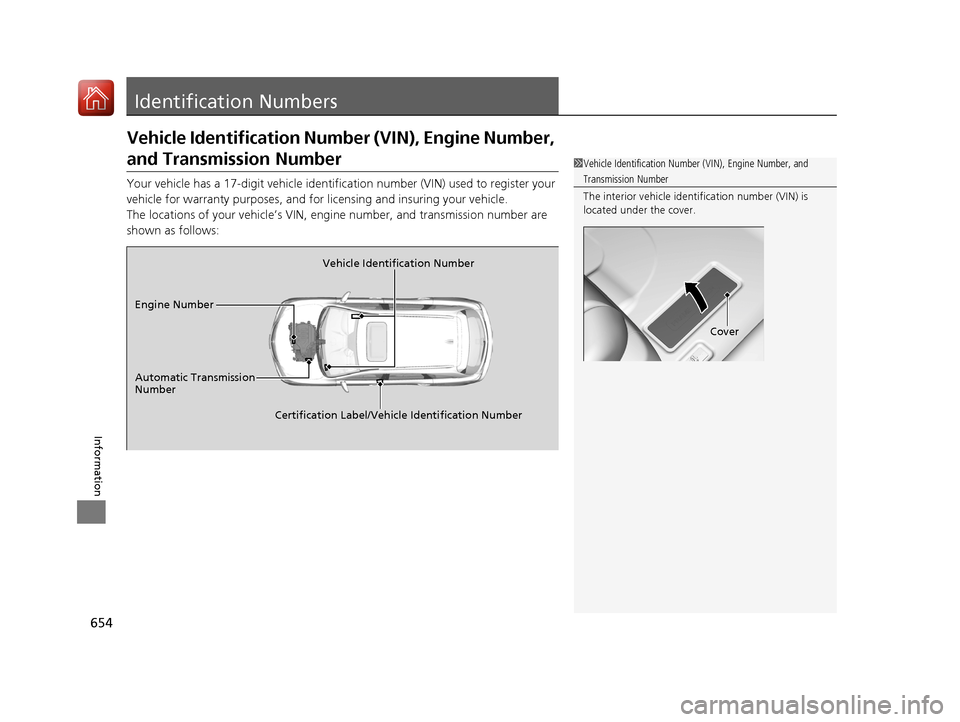
Your vehicle has a 17-digit vehicle identification number (V IN) used to register your
vehicle for warranty purposes, and for licensing and insuring your vehicle.
The locations of your vehicle’s VIN, en gine number, and transmission number are
shown as follows:
1 Vehicle Identification Number (VIN), Engine Number, and
Transmission Number
The interior vehicle identification number (VIN) is
located under the cover.
Cover
Vehicle Identification Number
Engine Number
Certification Label/Vehicle Identification Number
Automatic Transmission
Number
17 PILOT-31TG76100.book 654 ページ 2016年9月20日 火曜日 午後4時9分
Page 656 of 673

655
Information
Devices that Emit Radio Waves
The following products and systems on your vehicle emit radio waves when in operation.
Each of the above complies with the appropriate requirements or the required standards of FCC (Federal Communications Commissio n)
and Industry Canada Standard, described below:
As required by the FCC:
This device complies with Part 15 of the FCC rules. Operation is subject to the following two conditions: (1)
This device may not cause harmful interference, and (2) this device must accept any interference received,
including interference that may cause undesired operation.
Changes or modifications not expres sly approved by the party responsible for compliance could void the
user’s authority to operate the equipment.
This device complies with indus try Canada licence-exempt RSS standard(s). Operation is subject to the following two conditions: (1) this
device may not cause interference, and (2) this device must ac cept any interference, including interference that may cause unde sired
operation of the device.
HondaLink
Audio System
Blind spot information System*
Bluetooth ® Audio
Bluetooth® HandsFreeLink ®
HomeLink® Universal Transceiver*
Collision Mitigati on Braking SystemTM *
Immobilizer System
Remote Transmitter
Smart Entry System*
Tire Pressure Monitoring System (TPMS)
Remote Engine Start System*
* Not available on all models
17 PILOT-31TG76100.book 655 ページ 2016年9月20日 火曜日 午後4時9分
Page 658 of 673

657Continued
Information
Emissions Testing
Testing of Readiness Codes
Your vehicle has readiness code as part of the onboard self diagnostic system.
Some States use these codes for testing to verify whether your vehicle’s emissions
components are working properly.
The codes may not be read properly if testing is performed just after the battery has
gone dead or been disconnected.
To check if they are set, set the power mo de to ON, without starting the engine. The
malfunction indicator lamp will come on for several seconds. If it then goes off, the
readiness codes are set. If it blinks fi ve times, the readiness codes are not set.
If you are required to have your vehicle te sted before the readiness codes are ready,
prepare the vehicle for retest ing by doing the following:
1. Fill the gas tank to approximately 3/4 full.
2. Park the vehicle and leave the engine off for 6 hours or more.
3. Make sure the ambient temperature is between 40°F and 95°F (4°C and 35°C).
4. Start the engine without touching the ac celerator pedal, and let it idle for 20
seconds.
5. Keep the vehicle in
(P. Increase the engine speed to 2,000 rpm, and hold it there
for about 3 minutes.
6. Let the engine idle with your foot off the accelerator for 20 seconds.
1Testing of Readiness Codes
The readiness codes are erased when the battery is
disconnected, and set again only after several days of
driving under a variety of conditions.
If a testing facility determines that the readiness
codes are not set, you may be requested to return at
a later date to complete the test.
If the testing facility determines the readiness codes
are still not set, see a dealer.
17 PILOT-31TG76100.book 657 ページ 2016年9月20日 火曜日 午後4時9分
Page 659 of 673
658
uuEmissions Testing uTesting of Readiness Codes
Information
7. Select a nearby, lightly traveled major hi ghway where you can maintain a speed
of 50 to 60 mph (80 to 97 km/h) for at least 20 minutes. Drive on the highway in
(D. Do not use cruise control. When tra ffic allows, drive for 90 seconds without
moving the accelerator pedal. (Vehicle spee d may vary slightly; this is okay.) If you
cannot do this for a continuous 90 seconds because of traffic conditions, drive for
at least 30 seconds, then repeat it two mo re times (for a total of 90 seconds).
8. Drive in city or suburban traffic for at le ast 10 minutes. When traffic conditions
allow, let the vehicle coast for several se conds without using the accelerator pedal
or the brake pedal.
9. Park the vehicle and leave the engine off for 30 minutes.
17 PILOT-31TG76100.book 658 ページ 2016年9月20日 火曜日 午後4時9分
Page 663 of 673
662
Information
Customer Service Information
Honda dealership personnel are trained professionals.
They should be able to answer all your questions. If you encounter a problem that
your dealership does not solve to your satisfaction, please discuss it with the
dealership’s service manager or general manager. If you are dissatisfied with the
decision made by the dealership’s mana gement, contact Honda Customer Services.
U.S. Owners
American Honda Motor Co., Inc.
Honda Automobile Customer Services
Mail Stop 500-2N-7A
1919 Torrance Blvd.
Torrance, CA 90501-2746
Tel: 1 (800) 999-1009 Canadian Owners
Canadian Owners:
Honda Canada Inc.
Customer Relations
180 Honda Boulevard
Markham, ON
L6C 0H9
Tel: 1-888-9-HONDA-9
Fax: 1-877-939-0909
E-mail: [email protected]
In Puerto Rico and the U.S. Virgin
Islands
Bella International
P.O. Box 190816
San Juan, PR 00919-0816
Tel: 1 (787) 620-75461 Customer Service Information
When you call or write, pl ease give us the following
information:
•Vehicle Identification Number
2Vehicle Identification Number (VIN),
Engine Number, and Transmission
Number P. 654
•Date of purchase•Odometer reading of your vehicle
•Your name, address, and telephone number
•A detailed description of the problem•Name of the dealer who sold the vehicle to you
17 PILOT-31TG76100.book 662 ページ 2016年9月20日 火曜日 午後4時9分