Page 20 of 565

19
Quick Reference Guide
VSA® OFF Button (P427)
● The vehicle stability assist (VSA® ) system
helps stabilize the vehicle during
cornering, and helps maintain traction
while accelerating on loose or slippery
road surfaces.
● VSA ® comes on automatically every time
you start the engine.
● To turn VSA ® on or off, press and hold
the button until you hear a beep.
Cruise Control (P415)
● Cruise control allows you to maintain a
set speed without keeping your foot on
the accelerator pedal.
● To use cruise control, press the CRUISE
button, then press once you
have achieved the desired speed (above
25 mph or 40 km/h).
Tire Pressure Monitoring
System (TPMS)
(P428)
● TPMS monitors tire pressure.
● TPMS is turned on automatically every
time you start the engine.
DECEL/SET
Refueling (P446)
Fuel recommendation: Unleaded gasoline with a pump octane number 87 or
higher required
Fuel tank capacity: 21 US gal (79.5 L)
aPull the fuel fill door
release handle.
bTurn the fuel fill cap
slowly to remove the
cap.
cPlace the cap in the
holder on the fuel fill
door.
dAfter refueling, screw
the cap back on until it
clicks at least once.
17 US ODYSSEY (KA KC)-31TK86600.book 19 ページ 2016年10月24日 月曜日 午後4時2分
Page 21 of 565
20
Quick Reference Guide
Maintenance (P451)
Under the Hood (P463)
● Check engine oil, engine coolant, and window washer fluid.
Add when necessary.
● Check brake fluid.
● Check the battery condition monthly.
aPull the hood release handle under the corner of the
dashboard.
bLocate the hood latch lever, pull it up, and then raise the
hood. Once you have raised the hood slightly, you can
release the lever.
cWhen finished, close the hood and make sure it is firmly
locked in place.
Lights (P475)
● Inspect all lights regularly.
Wiper Blades (P486)
● Replace blades if they leave streaks
across the windshield.
Tires (P490)
● Inspect tires and wheels regularly.
● Check tire pressures regularly.
● Install snow tires for winter driving.
17 US ODYSSEY (KA KC)-31TK86600.book 20 ページ 2016年10月24日 月曜日 午後4時2分
Page 23 of 565
22
Quick Reference Guide
What to Do If
*1:Models with the smart entry system have an ENGINE START/STOP button instead of an ignition switch.
The ignition switch does
not turn from
(0 to (q*1.
Why?
●The steering wheel may be locked.
●Try to turn the steering wheel left and
right while turning the ignition key
*.
●Move the steering wheel left and right
while pressing the ENGINE START/STOP
button
* at the same time.
The ignition switch does
not turn from
(q to (0*1
and I cannot remove the
key. Why?
The shift lever should be moved to (P.
Why does the brake pedal
pulsate slightly when
applying the brakes?This can occur when the ABS activates, and does not indicate a
problem. Apply firm, steady pressure on the brake pedal. Never
pump the brake pedal.
2 Anti-lock Brake System (ABS) (P438)
17 US ODYSSEY (KA KC)-31TK86600.book 22 ページ 2016年10月24日 月曜日 午後4時2分
Page 25 of 565
24
Quick Reference Guide
Why does the beeper
sound when I start driving?The beeper sounds when:●Driver and/or front passenger are not wearing their seat belts.●The parking brake is not fully released.
Why do I hear a screeching
sound when I apply the
brake pedal?The brake pads may need to be replaced. Have your vehicle
inspected by a dealer.
I’m seeing an amber
indicator of a tire with an
exclamation point. What is
that?The Tire Pressure Monitoring System (TPMS) needs attention.
Check tire pressure.
2 Tire Pressure Monitoring System (P531, 532)
17 US ODYSSEY (KA KC)-31TK86600.book 24 ページ 2016年10月24日 月曜日 午後4時2分
Page 26 of 565
25
Safe Driving
You can find many safety recommendations throughout this chapter, and throughout this manual.
For Safe Driving
Important Safety Precautions ............. 26
Your Vehicle's Safety Features............ 28
Seat Belts About Your Seat Belts ........................ 30
Fastening a Seat Belt .......................... 33
Seat Belt Inspection............................ 38
Airbags Airbag System Components ............... 39
Types of Airbags ................................ 42
Front Airbags (SRS) ............................ 42
Side Airbags....................................... 46 Side Curtain Airbags .......................... 48
Airbag System Indicators.................... 49
Airbag Care ....................................... 51
Child Safety Protecting Child Passengers ............... 52
Safety of Infants and Small Children ....... 54
Safety of Larger Children ................... 64
Exhaust Gas Hazard Carbon Monoxide Gas ....................... 66
Safety Labels Label Locations .................................. 67
17 US ODYSSEY (KA KC)-31TK86600.book 25 ページ 2016年10月24日 月曜日 午後4時2分
Page 27 of 565
26
Safe Driving
For Safe Driving
The following pages explain your vehicle's safety features and how to use them
properly. The safety precautions below are ones that we consider to be among the
most important.
Important Safety Precautions
■Always wear your seat belt
A seat belt is your best protection in all types of collisions. Airbags are designed to
supplement seat belts, not replace them. So even though your vehicle is equipped
with airbags, make sure you and your passengers always wear your seat belts, and
wear them properly.
■Restrain all children
Children ages 12 and under should ride prop erly restrained in a back seat, not the
front seat. Infants and small children should be restrained in a child seat. Larger
children should use a booster seat and a lap/shoulder seat belt until they can use the
belt properly without a booster seat.
■Be aware of airbag hazards
While airbags can save lives, they can cause serious or fatal injuries to occupants
who sit too close to them, or are not prop erly restrained. Infants, young children,
and short adults are at the greatest risk. Be sure to follow all instructions and
warnings in this manual.
■Don't drink and drive
Alcohol and driving don't mix. Even one dr ink can reduce your ability to respond to
changing conditions, and your reaction time gets worse with every additional drink.
So don't drink and drive, and don't let your friends drink and drive, either.
1Important Safety Precautions
Some states, provinces and territories prohibit the use
of cell phones other than hands-free devices by the
driver while driving.
17 US ODYSSEY (KA KC)-31TK86600.book 26 ページ 2016年10月24日 月曜日 午後4時2分
Page 28 of 565
27
uuFor Safe Driving uImportant Safety Precautions
Safe Driving
■Pay appropriate attention to the task of driving safely
Engaging in cell phone conversation or other activities that keep you from paying
close attention to the road, other vehicles , and pedestrians could lead to a crash.
Remember, situations can change quickly, and only you can decide when it is safe to
divert some attention away from driving.
■Control your speed
Excessive speed is a major factor in crash injuries and deaths. Generally, the higher
the speed, the greater the risk, but serious injuries can also occur at lower speeds.
Never drive faster than is safe for current conditions, regardless of the maximum
speed posted.
■Keep your vehicle in safe condition
Having a tire blowout or a mechanical failure can be extremely hazardous.
To reduce the possibility of such problems, check your tire pressures and condition
frequently, and perform all re gularly scheduled maintenance.
17 US ODYSSEY (KA KC)-31TK86600.book 27 ページ 2016年10月24日 月曜日 午後4時2分
Page 29 of 565
28
uuFor Safe Driving uYour Vehicle's Safety Features
Safe Driving
Your Vehicle's Safety Features
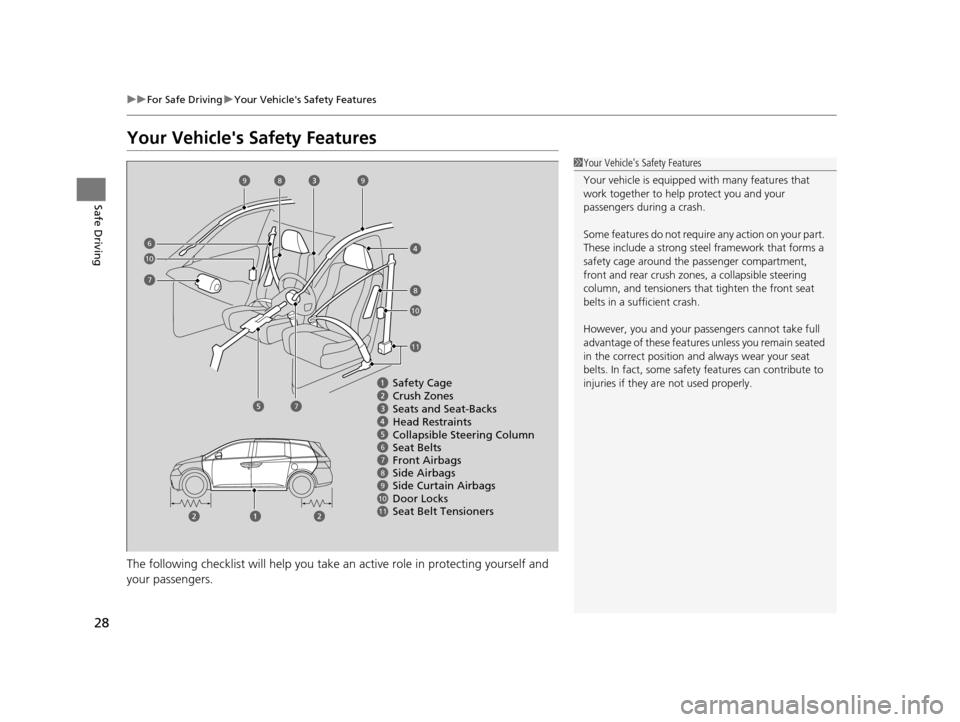
The following checklist will help you take an active role in protecting yourself and
your passengers.
1 Your Vehicle's Safety Features
Your vehicle is equipped wi th many features that
work together to help protect you and your
passengers during a crash.
Some features do not require any action on your part.
These include a strong steel framework that forms a
safety cage around the passenger compartment,
front and rear crush zones, a collapsi ble steering
column, and tensioners that tighten the front seat
belts in a sufficient crash.
However, you and your passe ngers cannot take full
advantage of these features unless you remain seated
in the correct position and always wear your seat
belts. In fact, some safety features can contribute to
injuries if they are not used properly.
67891011
Safety Cage
Crush Zones
Seats and Seat-Backs
Head Restraints
Collapsible Steering Column
Seat Belts
Front Airbags
Side Curtain Airbags
Seat Belt Tensioners Side Airbags
Door Locks
6
7
89
10
11
9
8
10
7
17 US ODYSSEY (KA KC)-31TK86600.book 28 ページ 2016年10月24日 月曜日 午後4時2分


