2017 HONDA HR-V engine
[x] Cancel search: enginePage 25 of 489

24
Quick Reference Guide
Handling the Unexpected (P431)
Flat Tire (P434)
● Park in a safe location and replace the
flat tire with the compact spare tire in the
cargo area.
Indicators Come On
(P451)
●Identify the indicator and consult the
owner’s manual.
Engine Won’t Start (P443)
● If the battery is dead, jump start using a
booster battery.
Blown Fuse (P456)
● Check for a blown fuse if an electrical
device does not operate.
Overheating (P449)
● Park in a safe location. If you do not see
steam under the hood, open the hood,
and let the engine cool down.
Emergency Towing (P461)
● Call a professional towing service if you
need to tow your vehicle.
17 HR-V HDMC-31T7A6100.book 24 ページ 2016年7月20日 水曜日 午前9時50分
Page 26 of 489

25
Quick Reference Guide
What to Do If
*1 : Models with the smart entry system have an ENGINE START/STOP button instead of an ignition switch.
The ignition switch does
not turn from
(0 to (q*1.
Why?
●The steering wheel may be locked.
●Try to turn the steering wheel left and
right while turning the ignition key.
●Move the steering wheel left and right
after pressing the ENGINE START/STOP button at the same
time.
The ignition switch does
not turn from
(q to (0 and
I cannot remove the key.
Why?
The power mode does not
change from ACCESSORY
to VEHICLE OFF (LOCK).
Why?
The shift lever should be moved to (P.
Why does the brake pedal
pulsate slightly when
applying the brakes?This can occur when the ABS activates, and does not indicate a
problem. Apply firm, steady pressure on the brake pedal. Never
pump the brake pedal.
U.S. models with manual transmission
U.S. models without smart entry system
Canadian modelsModels without smart entry system
Models with smart entry system
Models without smart entry system
Models with smart entry system
17 HR-V HDMC-31T7A6100.book 25 ページ 2016年7月20日 水曜日 午前9時50分
Page 37 of 489
uuSeat Belts uAbout Your Seat Belts
36
Safe Driving
■Proper use of seat belts
Follow these guidelines for proper use:
• All occupants should sit upright, well back in the seat, and remain in that position
for the duration of the trip. Slouching and leaning reduc e the effectiveness of the
belt and can increase the chance of serious injury in a crash.
• Never place the shoulder part of a lap/shoulder seat belt under your arm or
behind your back. This could cause very serious injuries in a crash.
• Two people should never use the same seat belt. If they do, they could be very
seriously injured in a crash.
• Do not put any accessories on the seat be lts. Devices intended to improve comfort
or reposition the shoulder part of a seat be lt can reduce the protective capability
and increase the chance of serious injury in a crash.
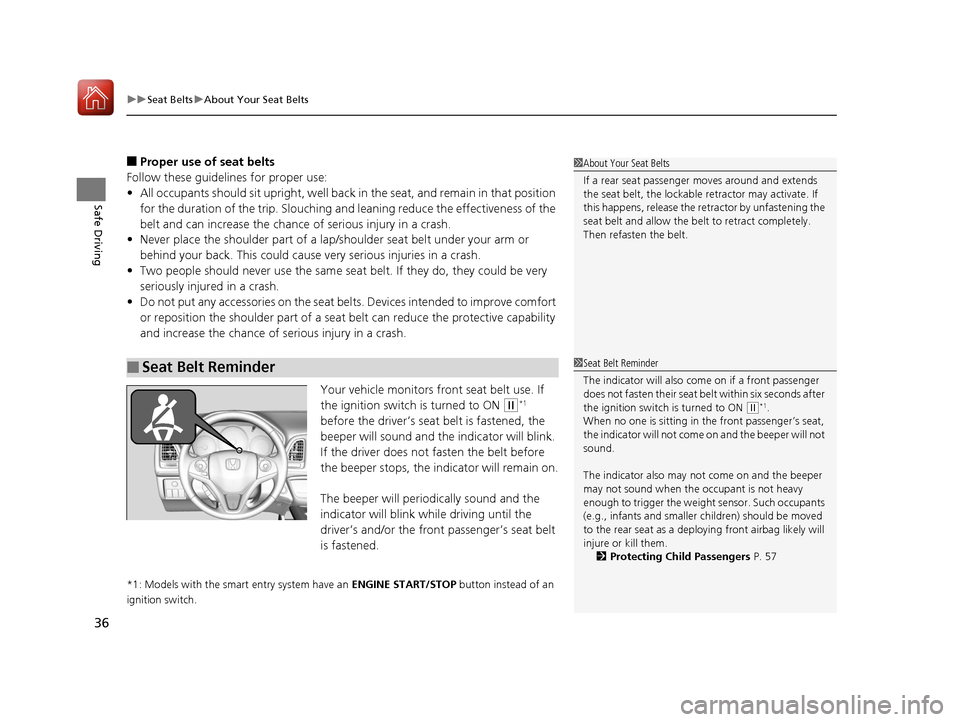
Your vehicle monitors front seat belt use. If
the ignition switch is turned to ON
(w*1
before the driver’s seat belt is fastened, the
beeper will sound and the indicator will blink.
If the driver does not fasten the belt before
the beeper stops, the indicator will remain on.
The beeper will periodically sound and the
indicator will blink while driving until the
driver’s and/or the front passenger’s seat belt
is fastened.
*1: Models with the smart entry system have an ENGINE START/STOP button instead of an
ignition switch.
■Seat Belt Reminder
1 About Your Seat Belts
If a rear seat passenger moves around and extends
the seat belt, the lockable retractor may activate. If
this happens, release the retractor by unfastening the
seat belt and allow the belt to retract completely.
Then refasten the belt.
1 Seat Belt Reminder
The indicator will also come on if a front passenger
does not fasten their seat belt within six seconds after
the ignition switch is turned to ON
(w*1.
When no one is sitting in th e front passenger’s seat,
the indicator will not come on and the beeper will not
sound.
The indicator also may no t come on and the beeper
may not sound when the occupant is not heavy
enough to trigger the weight sensor. Such occupants
(e.g., infants and smaller children) should be moved
to the rear seat as a deploying front airbag likely will
injure or kill them. 2 Protecting Child Passengers P. 57
17 HR-V HDMC-31T7A6100.book 36 ページ 2016年7月20日 水曜日 午前9時50分
Page 48 of 489

47
uuAirbags uTypes of Airbags
Continued
Safe Driving
Types of Airbags
Your vehicle is equipped wi th three types of airbags:
• Front airbags: Airbags in front of the driver’s and front passenger’s seats.
• Side airbags: Airbags in the driver’s and front passenger’s seat-backs.
• Side curtain airbags: Airbags above the side windows.
Each is discussed in the following pages.
Front Airbags (SRS)
The front SRS airbags inflate in a moderate-to-severe frontal collision to help protect
the head and chest of the driver and/or front passenger.
SRS (Supplemental Restraint System) indica tes that the airbags are designed to
supplement seat belts, not replace them . Seat belts are the occupant’s primary
restraint system.
The front airbags are housed in the center of the steering wheel for the driver, and
in the dashboard for the front pass enger. Both airbags are marked SRS AIRBAG.
*1: Models with the smart entry system have an ENGINE START/STOP button instead of an
ignition switch.
■Housing Locations
1 Types of Airbags
The airbags can inflate whenever the ignition switch
is in ON
(w*1.
After an airbag inflates in a crash, you may see a
small amount of smoke. This is from the combustion
process of the infl ator material and is not harmful.
People with respiratory pr oblems may experience
some temporary discomfort. If this occurs, get out of
the vehicle as soon as it is safe to do so.
1 Front Airbags (SRS)
Dual-Stage, Multiple-Threshold Front Airbags
(SRS)
Your vehicle is equipped wi th dual-stage, multiple-
threshold front airbags (SRS).
During a frontal crash severe enough to cause one or
both front airbags to deploy, the airbags can inflate
at different rates, dependi ng on the severity of the
crash, whether or not the se at belts are latched, and/
or other factors. Frontal airbags are designed to
supplement the seat belts to help reduce the
likelihood of head and chest injuries in frontal
crashes.
17 HR-V HDMC-31T7A6100.book 47 ページ 2016年7月20日 水曜日 午前9時50分
Page 55 of 489

uuAirbags uAirbag System Indicators
54
Safe Driving
■When side curtain airbags deploy in a frontal collision
One or both side curtain airbags may also inflate in a moderate-to-severe angled
frontal collision.
Airbag System Indicators
If a problem occurs in the airbag sy stem, the SRS indicator will come on.
■When the ignition switch is turned to
ON
(w*1
The indicator comes on for a few seconds,
then goes off. This tells you the system is
working properly.
If the indicator comes on at any other time, or does not come on at all, have the
system checked by a dealer as soon as po ssible. If you don’t, your airbags and seat
belt tensioners may not work properly when they are needed.
*1: Models with the smart entry system have an ENGINE START/STOP button instead of an
ignition switch.
■Supplemental Restraint System (SRS) Indicator1 Supplemental Restraint System (SRS) Indicator
3WARNING
Ignoring the SRS indi cator can result in
serious injury or death if the airbag systems
or tensioners do not work properly.
Have your vehicle checked by a dealer as
soon as possible if the SRS indicator alerts
you to a possible problem.
17 HR-V HDMC-31T7A6100.book 54 ページ 2016年7月20日 水曜日 午前9時50分
Page 70 of 489

69
Safe Driving
Exhaust Gas Hazard
Carbon Monoxide Gas
The engine exhaust from this vehicle contains carbon monoxide, a colorless,
odorless, and highly toxic gas. As long as you properly maintain your vehicle, carbon
monoxide gas will not get into the interior.
■Have the exhaust system in spected for leaks whenever
• The exhaust system is making an unusual noise.
• The exhaust system may have been damaged.
• The vehicle is raised for an oil change.
When you operate a vehicle with the tailga te open, airflow can pull exhaust gas into
the interior and create a hazardous conditio n. If you must drive with the tailgate
open, open all the windows and set the heating and cooling system
*/climate control
system* as shown below.
1. Select the fresh air mode.
2. Select the mode.
3. Set the fan speed to high.
4. Set the temperature control to a comfortable setting.
Adjust the heating and cooling system
*/climate control system* in the same manner
if you sit in your parked vehicle with the engine running.
1 Carbon Monoxide Gas
An enclosed area such as a garage can quickly fill up
with carbon monoxide gas.
Do not run the engine with the garage door closed.
Even when the garage door is open, drive out of the
garage immediat ely after starting the engine.
3WARNING
Carbon monoxide gas is toxic.
Breathing it can cause unconsciousness and
even kill you.
Avoid any enclosed areas or activities that
expose you to carbon monoxide.
* Not available on all models
17 HR-V HDMC-31T7A6100.book 69 ページ 2016年7月20日 水曜日 午前9時50分
Page 73 of 489

72
Instrument Panel
Indicators
*1:Models with the smart entry system have an ENGINE START/STOP button instead of an ignition switch.
IndicatorNameOn/BlinkingExplanation
Brake System
Indicator
(Red)
●Comes on for a few seconds when you
turn the ignition switch to ON
(w*1, then
goes off.
●Comes on when the brake fluid level is
low.
●Comes on if there is a problem with the
brake system.
●Comes on while driving - Check the brake fluid
level.
2 What to do when the indicator comes on while
driving P. 453
●Comes on along with the ABS indicator - Have
your vehicle checked by a dealer.
2 If the Brake System Indicator (Red) Comes On
P. 453
Brake System
Indicator
(Amber)
●Comes on for a few seconds when you
turn the ignition switch to ON
(w*1, then
goes off.
●Comes on if there is a problem with a
system related to braking other than the
conventional brake system.
●Comes on if there is a problem with an
automatic brake hold system.
●Stays on constantly - Have your vehicle checked
by a dealer.
U.S.
Canada
(Red)
U.S.
Canada
(Amber)
17 HR-V HDMC-31T7A6100.book 72 ページ 2016年7月20日 水曜日 午前9時50分
Page 74 of 489

73
uuIndicators u
Continued
Instrument Panel
*1:Models with the smart entry system have an ENGINE START/STOP button instead of an ignition switch.
IndicatorNameOn/BlinkingExplanation
Electric Parking
Brake Indicator
●Comes on for a few seconds when you
turn the ignition switch to ON
(w*1, then
goes off if the parking brake has been
released.
●Comes on when the parking brake is
applied, and goes off when it is released.
●Comes on for about 15 seconds when
you pull the electric parking brake switch
while the ignition switch is in LOCK
(0*1.●Stays on for about 15 seconds when you
turn the ignition switch to LOCK
(0*1
while the electric parking brake is set.
●Blinks and the electric parking brake system
indicator comes on at the same time - There is a
problem with the electric parking brake system. The
parking brake may not be set.
Electric Parking
Brake System
Indicator
●Comes on for a few seconds when you
turn the ignition switch to ON
(w*1, then
goes off.
●Comes on if there is a problem with the
electric parking brake system.
●Comes on while driving - Avoid using the parking
brake and have your vehicl e checked by a dealer
immediately.
2 If the Electric Parking Brake System Indicator
Comes On P. 454
Automatic Brake
Hold System
Indicator
●Comes on for a few seconds when you
turn the ignition switch to ON
(w*1, then
goes off.
●Comes on when the automatic brake
hold system is on.
2 Automatic Brake Hold P. 366
U.S.
Canada
17 HR-V HDMC-31T7A6100.book 73 ページ 2016年7月20日 水曜日 午前9時50分