2017 GMC SIERRA 1500 tow
[x] Cancel search: towPage 315 of 494
GMC Sierra/Sierra Denali Owner Manual (GMNA-Localizing-U.S./Canada/
Mexico-9955992) - 2017 - crc - 5/3/16
314 Driving and Operating
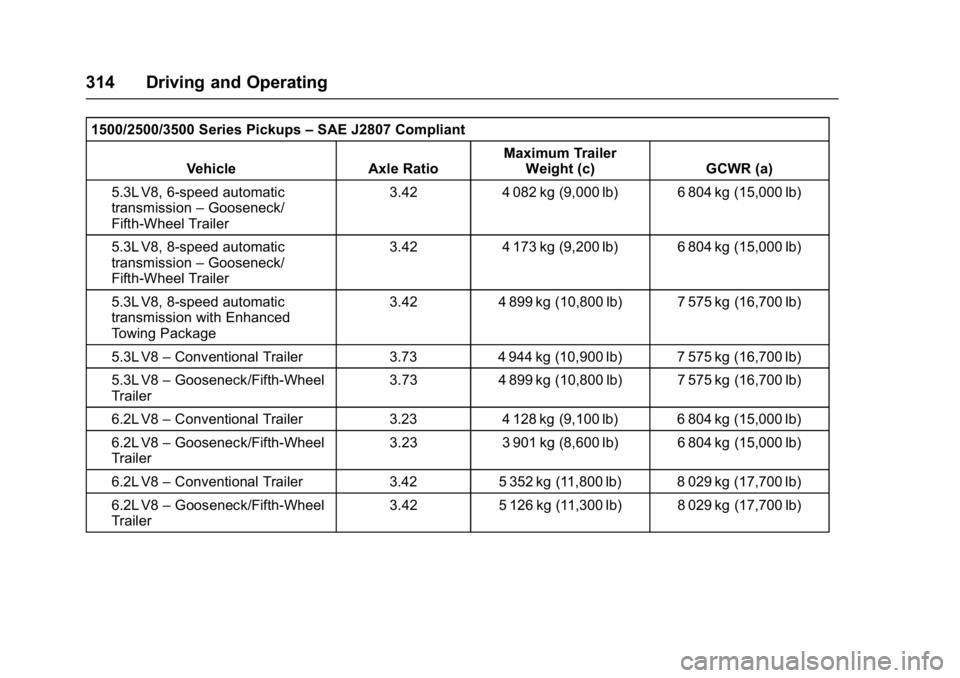
1500/2500/3500 Series Pickups–SAE J2807 Compliant
Vehicle Axle Ratio Maximum Trailer
Weight (c) GCWR (a)
5.3L V8, 6-speed automatic
transmission –Gooseneck/
Fifth-Wheel Trailer 3.42 4 082 kg (9,000 lb) 6 804 kg (15,000 lb)
5.3L V8, 8-speed automatic
transmission –Gooseneck/
Fifth-Wheel Trailer 3.42 4 173 kg (9,200 lb) 6 804 kg (15,000 lb)
5.3L V8, 8-speed automatic
transmission with Enhanced
Towing Package 3.42 4 899 kg (10,800 lb) 7 575 kg (16,700 lb)
5.3L V8 –Conventional Trailer 3.734 944 kg (10,900 lb) 7 575 kg (16,700 lb)
5.3L V8 –Gooseneck/Fifth-Wheel
Trailer 3.73
4 899 kg (10,800 lb) 7 575 kg (16,700 lb)
6.2L V8 –Conventional Trailer 3.234 128 kg (9,100 lb) 6 804 kg (15,000 lb)
6.2L V8 –Gooseneck/Fifth-Wheel
Trailer 3.23
3 901 kg (8,600 lb) 6 804 kg (15,000 lb)
6.2L V8 –Conventional Trailer 3.425 352 kg (11,800 lb) 8 029 kg (17,700 lb)
6.2L V8 –Gooseneck/Fifth-Wheel
Trailer 3.42
5 126 kg (11,300 lb) 8 029 kg (17,700 lb)
Page 316 of 494
GMC Sierra/Sierra Denali Owner Manual (GMNA-Localizing-U.S./Canada/
Mexico-9955992) - 2017 - crc - 5/3/16
Driving and Operating 315
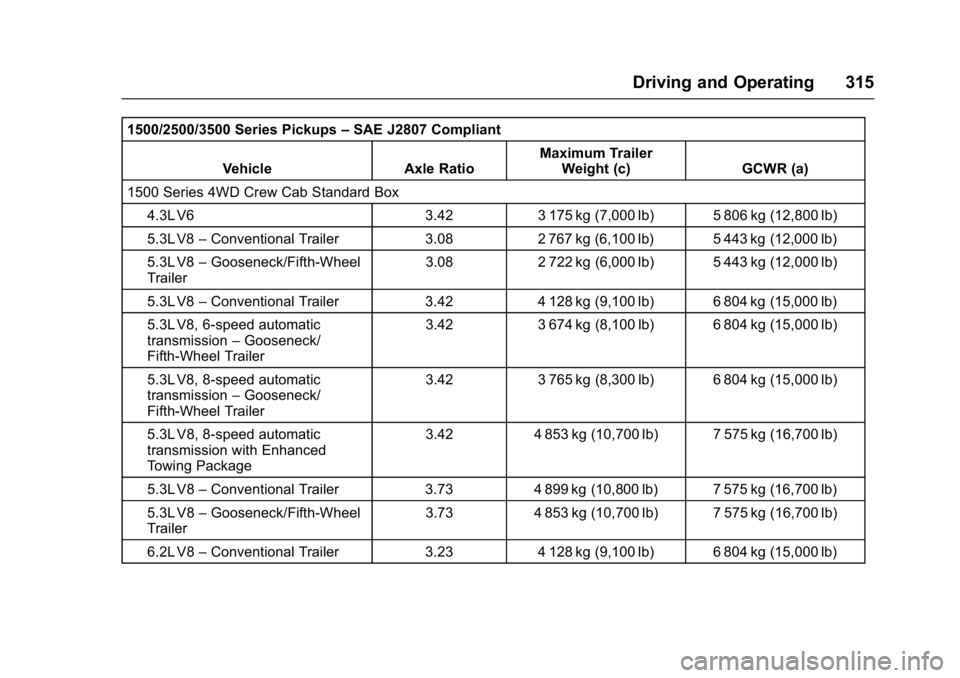
1500/2500/3500 Series Pickups–SAE J2807 Compliant
Vehicle Axle Ratio Maximum Trailer
Weight (c) GCWR (a)
1500 Series 4WD Crew Cab Standard Box 4.3L V6 3.42 3 175 kg (7,000 lb) 5 806 kg (12,800 lb)
5.3L V8 –Conventional Trailer 3.08 2 767 kg (6,100 lb) 5 443 kg (12,000 lb)
5.3L V8 –Gooseneck/Fifth-Wheel
Trailer 3.08 2 722 kg (6,000 lb) 5 443 kg (12,000 lb)
5.3L V8 –Conventional Trailer 3.424 128 kg (9,100 lb) 6 804 kg (15,000 lb)
5.3L V8, 6-speed automatic
transmission –Gooseneck/
Fifth-Wheel Trailer 3.42
3 674 kg (8,100 lb) 6 804 kg (15,000 lb)
5.3L V8, 8-speed automatic
transmission –Gooseneck/
Fifth-Wheel Trailer 3.42
3 765 kg (8,300 lb) 6 804 kg (15,000 lb)
5.3L V8, 8-speed automatic
transmission with Enhanced
Towing Package 3.42
4 853 kg (10,700 lb) 7 575 kg (16,700 lb)
5.3L V8 –Conventional Trailer 3.734 899 kg (10,800 lb) 7 575 kg (16,700 lb)
5.3L V8 –Gooseneck/Fifth-Wheel
Trailer 3.73
4 853 kg (10,700 lb) 7 575 kg (16,700 lb)
6.2L V8 –Conventional Trailer 3.234 128 kg (9,100 lb) 6 804 kg (15,000 lb)
Page 317 of 494
GMC Sierra/Sierra Denali Owner Manual (GMNA-Localizing-U.S./Canada/
Mexico-9955992) - 2017 - crc - 5/3/16
316 Driving and Operating
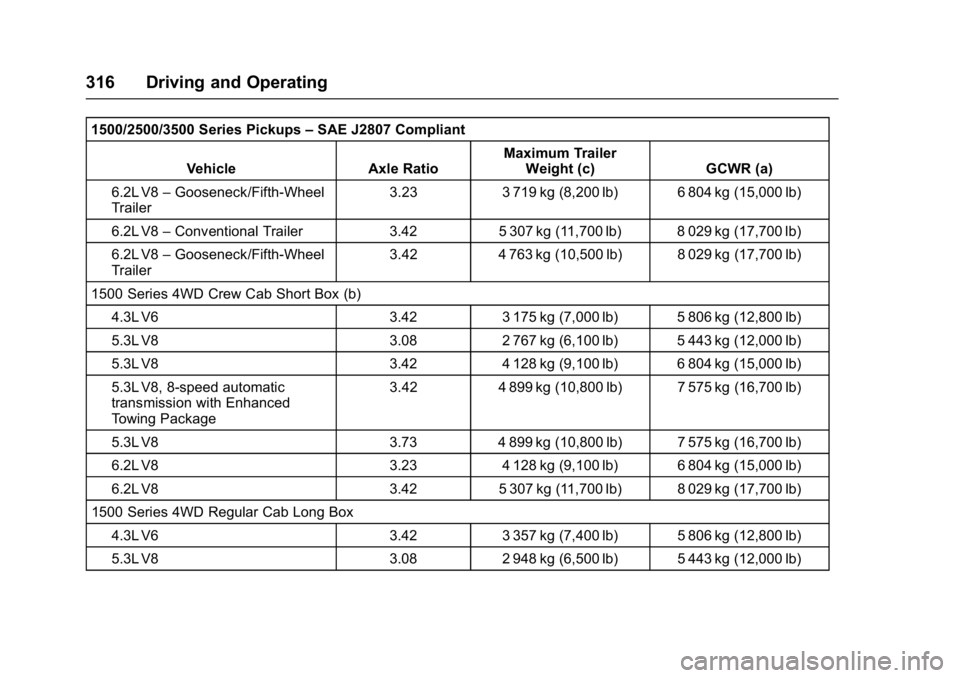
1500/2500/3500 Series Pickups–SAE J2807 Compliant
Vehicle Axle Ratio Maximum Trailer
Weight (c) GCWR (a)
6.2L V8 –Gooseneck/Fifth-Wheel
Trailer 3.23 3 719 kg (8,200 lb) 6 804 kg (15,000 lb)
6.2L V8 –Conventional Trailer 3.425 307 kg (11,700 lb) 8 029 kg (17,700 lb)
6.2L V8 –Gooseneck/Fifth-Wheel
Trailer 3.42
4 763 kg (10,500 lb) 8 029 kg (17,700 lb)
1500 Series 4WD Crew Cab Short Box (b) 4.3L V6 3.423 175 kg (7,000 lb) 5 806 kg (12,800 lb)
5.3L V8 3.082 767 kg (6,100 lb) 5 443 kg (12,000 lb)
5.3L V8 3.424 128 kg (9,100 lb) 6 804 kg (15,000 lb)
5.3L V8, 8-speed automatic
transmission with Enhanced
Towing Package 3.42
4 899 kg (10,800 lb) 7 575 kg (16,700 lb)
5.3L V8 3.734 899 kg (10,800 lb) 7 575 kg (16,700 lb)
6.2L V8 3.234 128 kg (9,100 lb) 6 804 kg (15,000 lb)
6.2L V8 3.425 307 kg (11,700 lb) 8 029 kg (17,700 lb)
1500 Series 4WD Regular Cab Long Box 4.3L V6 3.423 357 kg (7,400 lb) 5 806 kg (12,800 lb)
5.3L V8 3.082 948 kg (6,500 lb) 5 443 kg (12,000 lb)
Page 323 of 494
GMC Sierra/Sierra Denali Owner Manual (GMNA-Localizing-U.S./Canada/
Mexico-9955992) - 2017 - crc - 5/3/16
322 Driving and Operating
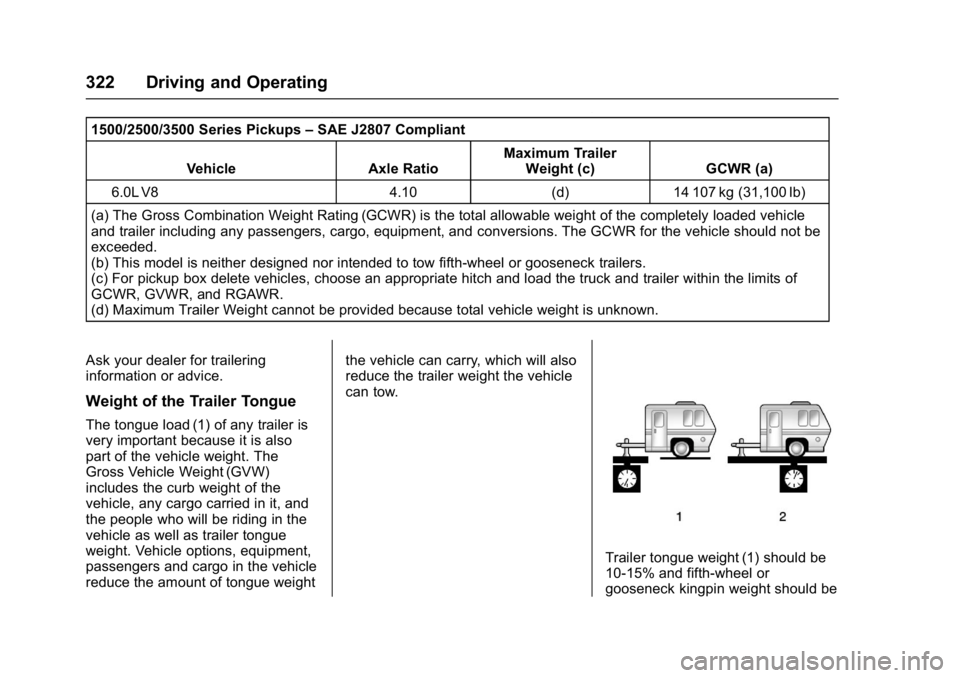
1500/2500/3500 Series Pickups–SAE J2807 Compliant
Vehicle Axle Ratio Maximum Trailer
Weight (c) GCWR (a)
6.0L V8 4.10 (d) 14 107 kg (31,100 lb)
(a) The Gross Combination Weight Rating (GCWR) is the total allowable weight of the completely loaded vehicle
and trailer including any passengers, cargo, equipment, and conversions. The GCWR for the vehicle should not be
exceeded.
(b) This model is neither designed nor intended to tow fifth-wheel or gooseneck trailers.
(c) For pickup box delete vehicles, choose an appropriate hitch and load the truck and trailer within the limits of
GCWR, GVWR, and RGAWR.
(d) Maximum Trailer Weight cannot be provided because total vehicle weight is unknown.
Ask your dealer for trailering
information or advice.
Weight of the Trailer Tongue
The tongue load (1) of any trailer is
very important because it is also
part of the vehicle weight. The
Gross Vehicle Weight (GVW)
includes the curb weight of the
vehicle, any cargo carried in it, and
the people who will be riding in the
vehicle as well as trailer tongue
weight. Vehicle options, equipment,
passengers and cargo in the vehicle
reduce the amount of tongue weight the vehicle can carry, which will also
reduce the trailer weight the vehicle
can tow.
Trailer tongue weight (1) should be
10-15% and fifth-wheel or
gooseneck kingpin weight should be
Page 325 of 494
GMC Sierra/Sierra Denali Owner Manual (GMNA-Localizing-U.S./Canada/
Mexico-9955992) - 2017 - crc - 5/3/16
324 Driving and Operating
If a cargo carrier is used in the
trailer hitch receiver, choose a
carrier that positions the load as
close to the vehicle as possible.
Make sure the total weight,
including the carrier, is no more than
half of the maximum allowable
tongue weight for the vehicle or
227 kg (500 lb), whichever is less.
Total Weight on the Vehicle's
Tires
Be sure the vehicle's tires are
inflated to the inflation pressures
found on the Certification/Tire label
on the center pillar or seeVehicle
Load Limits 0250. Make sure not to
exceed the GVWR limit for the
vehicle, or the RGAWR, with the tow
vehicle and trailer fully loaded for
the trip including the weight of the
trailer tongue. If using a
weight-distributing hitch, make sure
not to exceed the RGAWR before
applying the weight distribution
spring bars.
Weight of the Trailering
Combination
It is important that the combination
of the tow vehicle and trailer does
not exceed any of its weight ratings
— GCWR, GVWR, RGAWR, Trailer
Weight Rating, or Tongue Weight.
The only way to be sure it is not
exceeding any of these ratings is to
weigh the tow vehicle and trailer
combination, fully loaded for the trip,
getting individual weights for each of
these items.
Towing Equipment
Hitches
The correct hitch equipment helps
maintain combination control. Many
trailers can be towed with a
weight-carrying hitch which simply
features a coupler latched to the
hitch ball, or a tow eye latched to a
pintle hook. Other trailers may
require a weight-distributing hitch
that uses spring bars to distribute
the trailer tongue weight among the
tow vehicle and trailer axles.
Fifth-wheel and gooseneck hitches
may also be used. See “Weight ofthe Trailer Tongue”
underTrailer
Towing 0307 for rating limits with
various hitch types.
If a step-bumper hitch will be used,
the bumper could be damaged in
sharp turns. Make sure there
is ample room when turning to avoid
contact between the trailer and the
bumper.
Consider using sway controls with
any trailer. Ask a trailering
professional about sway controls or
refer to the trailer manufacturer's
recommendations and instructions.
Weight-Distributing Hitch and
Adjustment
A weight-distributing hitch may be
useful with some trailers. Use the
following guidelines to determine if a
weight-distributing hitch should
be used.
Page 326 of 494
GMC Sierra/Sierra Denali Owner Manual (GMNA-Localizing-U.S./Canada/
Mexico-9955992) - 2017 - crc - 5/3/16
Driving and Operating 325
Vehicle SeriesTrailer WeightWeight-Distributing Hitch
Usage Hitch Distribution
1500 Up to 3 175 kg (7,000 lb) OptionalRefer to trailer
manufacturer ’s
recommendation
1500 Over 3 175 kg (7,000 lb) Required50%
2500/3500 Up to 9 080 kg (20,000 lb) OptionalRefer to trailer
manufacturer ’s
recommendation
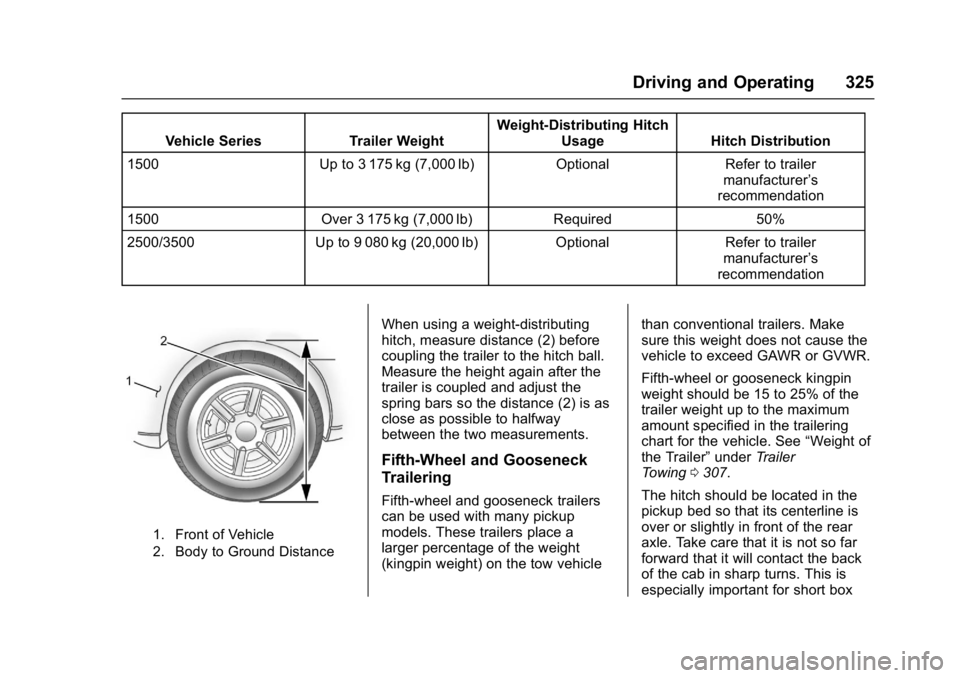
1. Front of Vehicle
2. Body to Ground Distance
When using a weight-distributing
hitch, measure distance (2) before
coupling the trailer to the hitch ball.
Measure the height again after the
trailer is coupled and adjust the
spring bars so the distance (2) is as
close as possible to halfway
between the two measurements.
Fifth-Wheel and Gooseneck
Trailering
Fifth-wheel and gooseneck trailers
can be used with many pickup
models. These trailers place a
larger percentage of the weight
(kingpin weight) on the tow vehicle than conventional trailers. Make
sure this weight does not cause the
vehicle to exceed GAWR or GVWR.
Fifth-wheel or gooseneck kingpin
weight should be 15 to 25% of the
trailer weight up to the maximum
amount specified in the trailering
chart for the vehicle. See
“Weight of
the Trailer” underTrailer
Towing 0307.
The hitch should be located in the
pickup bed so that its centerline is
over or slightly in front of the rear
axle. Take care that it is not so far
forward that it will contact the back
of the cab in sharp turns. This is
especially important for short box
Page 327 of 494
GMC Sierra/Sierra Denali Owner Manual (GMNA-Localizing-U.S./Canada/
Mexico-9955992) - 2017 - crc - 5/6/16
326 Driving and Operating
pickups. Trailer pin box extensions
and sliding fifth-wheel hitch
assemblies can help this condition.
There should be at least 15 cm (6 in)
of clearance between the top of the
pickup box and the bottom of the
trailer shelf that extends over
the box.
Safety Chains
Always attach chains between the
vehicle and the trailer. Cross the
safety chains under the tongue of
the trailer to help prevent the tongue
from contacting the road if it
becomes separated from the hitch.
Instructions about safety chains
may be provided by the hitch
manufacturer or by the trailer
manufacturer. If the trailer being
towed weighs up to 2 271 kg
(5,000 lb) with a factory-installed
step bumper, safety chains may be
attached to the attaching points on
the bumper; otherwise, safety
chains should be attached to holes
on the trailer hitch platform. Always
leave just enough slack so the
combination can turn. Never allow
safety chains to drag on the ground.
Trailer Brakes
A loaded trailer that weighs more
than 900 kg (2,000 lb) must be
equipped with its own brake system,
with brakes working on all axles.
Trailer braking equipment
conforming to Canadian Standards
Association (CSA) requirement
CAN3-D313, or its equivalent, is
recommended.
State and local regulations may also
require the trailer to have its own
braking system if loaded above a
certain threshold.
Be sure to read and follow the
instructions for the trailer brakes so
they are installed, adjusted, and
maintained properly.
Do not tap into the vehicle's
hydraulic brake system.
Auxiliary Battery
The auxiliary battery provision can
be used to supply electrical power
to additional equipment that may be
added, such as a slide-in camper.
If equipped, this relay will be on the
driver side of the vehicle, next to the
underhood electrical center.Be sure to follow the proper
installation instructions included with
any electrical equipment that is
installed.
Caution
Leaving electrical equipment on
for extended periods will drain the
battery. Always turn off electrical
equipment when not in use and
do not use equipment that
exceeds the maximum amperage
rating of 30 amps for the auxiliary
battery provision.
Trailer Wiring Harness
The vehicle is equipped with one of
the following wiring harnesses for
towing a trailer or hauling a slide-in
camper.
Basic Trailer Wiring
All regular, double cab, and crew
cab pickups have a seven-wire
trailer towing harness.
Page 328 of 494
GMC Sierra/Sierra Denali Owner Manual (GMNA-Localizing-U.S./Canada/
Mexico-9955992) - 2017 - crc - 5/6/16
Driving and Operating 327
Use only a round, seven-wire
connector with flat blade terminals
meeting SAE J2863 specifications
for proper electrical connectivity.
For vehicles not equipped with
heavy-duty trailering, the harness is
secured to the vehicle's frame
behind the spare tire mount. The
harness requires the installation of a
trailer connector, which is available
through your dealer.
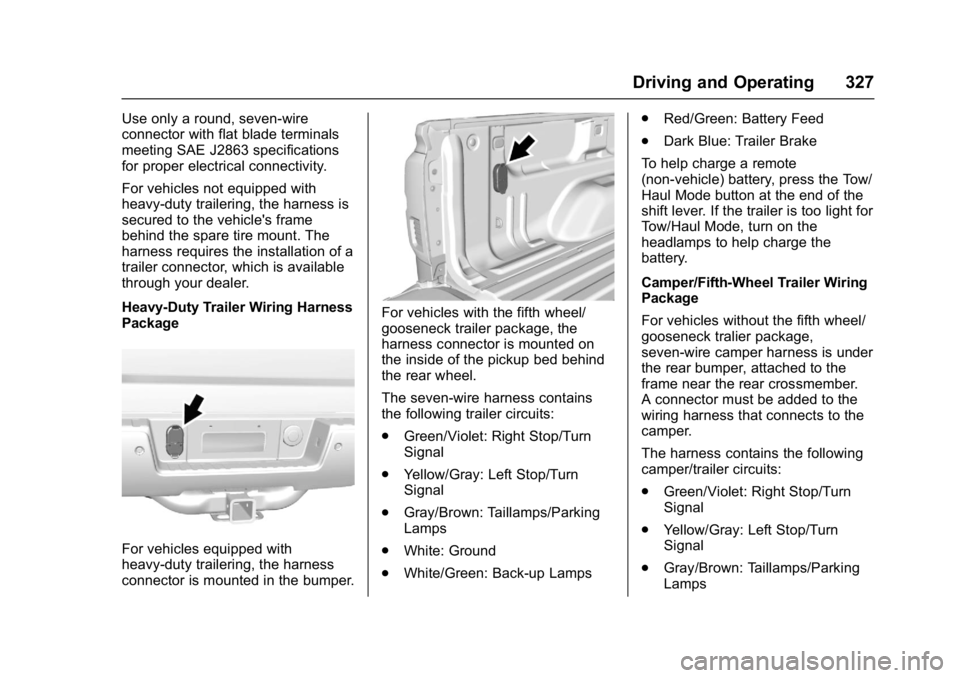
Heavy-Duty Trailer Wiring Harness
Package
For vehicles equipped with
heavy-duty trailering, the harness
connector is mounted in the bumper.
For vehicles with the fifth wheel/
gooseneck trailer package, the
harness connector is mounted on
the inside of the pickup bed behind
the rear wheel.
The seven-wire harness contains
the following trailer circuits:
.Green/Violet: Right Stop/Turn
Signal
. Yellow/Gray: Left Stop/Turn
Signal
. Gray/Brown: Taillamps/Parking
Lamps
. White: Ground
. White/Green: Back-up Lamps .
Red/Green: Battery Feed
. Dark Blue: Trailer Brake
To help charge a remote
(non-vehicle) battery, press the Tow/
Haul Mode button at the end of the
shift lever. If the trailer is too light for
Tow/Haul Mode, turn on the
headlamps to help charge the
battery.
Camper/Fifth-Wheel Trailer Wiring
Package
For vehicles without the fifth wheel/
gooseneck tralier package,
seven-wire camper harness is under
the rear bumper, attached to the
frame near the rear crossmember.
A connector must be added to the
wiring harness that connects to the
camper.
The harness contains the following
camper/trailer circuits:
. Green/Violet: Right Stop/Turn
Signal
. Yellow/Gray: Left Stop/Turn
Signal
. Gray/Brown: Taillamps/Parking
Lamps