2017 FORD POLICE INTERCEPTOR UTILITY child restraint
[x] Cancel search: child restraintPage 41 of 360

DRIVER AND PASSENGER
AIRBAGS
WARNINGS
Never place your arm or any objects
over an airbag module. Placing your
arm over a deploying airbag can
result in serious arm fractures or other
injuries. Objects placed on or over the
airbag inflation area may cause those
objects to be propelled by the airbag into
your face and torso causing serious injury. Airbags can kill or injure a child in a
child seat. Never place a rear-facing
child seat in front of an active airbag.
If you must use a forward-facing child seat
in the front seat, move the seat upon which
the child seat is installed all the way back. The driver and front passenger airbags will
deploy during significant frontal and near
frontal crashes.
The driver and passenger front airbag
system consists of:
•
Driver and passenger airbag modules.
• Front passenger sensing system. · Crash sensors and monitoring
system with readiness indicator.
See Crash Sensors and Airbag
Indicator (page 43). Proper Driver and Front Passenger
Seating Adjustment WARNING
National Highway Traffic Safety
Administration (NHTSA)
recommends a minimum distance
of at least 10 inches (25 centimeters)
between an occupant’ s chest and the
driver airbag module. To properly position yourself away from
the airbag:
•
Move your seat to the rear as far as you
can while still reaching the pedals
comfortably.
• Recline the seat slightly (one or two
degrees) from the upright position.
After all occupants have adjusted their
seats and put on safety belts, it is very
important that they continue to sit
properly. A properly seated occupant sits
upright, leaning against the seat back, and
centered on the seat cushion, with their
feet comfortably extended on the floor.
Sitting improperly can increase the chance
of injury in a crash event. For example, if
an occupant slouches, lies down, turns
sideways, sits forward, leans forward or
sideways, or puts one or both feet up, the
chance of injury during a crash is greatly
increased.
Children and Airbags WARNING
Airbags can kill or injure a child in a
child seat. Never place a rear-facing
child seat in front of an active airbag.
If you must use a forward-facing child seat
in the front seat, move the seat upon which
the child seat is installed all the way back. 38
Police Interceptor (TUB) Canada/United States of America, Police, enUSA, First Printing Supplementary Restraints SystemE151127
Page 42 of 360

Children must always be properly
restrained. Accident statistics suggest that
children are safer when properly restrained
in the rear seating positions than in the
front seating position. Failure to follow
these instructions may increase the risk of
injury in a crash.
FRONT PASSENGER SENSING
SYSTEM
WARNINGS
Even with Advanced Restraints
Systems, children 12 and under
should be properly restrained in a
rear seating position. Failure to follow this
could seriously increase the risk of injury or
death. Sitting improperly out of position or
with the seatback reclined too far
can take off weight from the seat
cushion and affect the decision of the front
passenger sensing system, resulting in
serious injury or death in a crash. Always
sit upright against your seatback, with your
feet on the floor. Any alteration or modification to the
front passenger seat may affect the
performance of the front passenger
sensing system which could seriously
increase the risk of injury or death. This system works with sensors that are
part of the front passenger seat and safety
belt to detect the presence of a
properly-seated occupant and determine
if the front passenger frontal airbag should
be enabled (may inflate) or not.
The front passenger sensing system uses
a passenger airbag status indicator that
will illuminate indicating that the front
passenger frontal airbag is either ON
(enabled) or OFF (disabled).
The indicator lamp is located in the center
stack of the instrument panel.
Note:
The passenger airbag status indicator
OFF and ON indicator lamps will illuminate
for a short period of time when the ignition
is first turned on to confirm it is functional.
The front passenger sensing system is
designed to disable (will not inflate) the
front passenger's frontal airbag when the
front passenger seat is unoccupied, or a
rear facing infant seat, a forward-facing
child restraint, or a booster seat is
detected. Even with this technology,
parents are strongly encouraged to
always properly restrain children in the rear
seat. The sensor also turns off the
passenger front airbag and seat-mounted
side airbag when the passenger seat is
empty.
39
Police Interceptor (TUB) Canada/United States of America, Police, enUSA, First Printing Supplementary Restraints SystemE142846 E181984
Page 43 of 360

•
When the front passenger sensing
system disables (will not inflate) the
front passenger frontal airbag, the
passenger airbag status indicator will
illuminate the OFF lamp and stay lit to
remind you that the front passenger
frontal airbag is disabled.
• If the child restraint has been installed
and the passenger airbag status
indicator illuminates the ON lamp, then
turn the vehicle off, remove the child
restraint from the vehicle and reinstall
the restraint following the child
restraint manufacturer's instructions.
The front passenger sensing system is
designed to enable (may inflate) the front
passenger's frontal airbag anytime the
system senses that a person of adult size
is sitting properly in the front passenger
seat. •
When the front passenger sensing
system enables the front passenger
frontal airbag (may inflate), the
passenger airbag status indicator will
illuminate the ON lamp and remain
illuminated.
If a person of adult size is sitting in the front
passenger seat, but the airbag OFF
indicator lamp is lit, it is possible that the
person is not sitting properly in the seat. If
this happens:
• Turn the vehicle off and ask the person
to place the seatback in the full upright
position.
• Have the person sit upright in the seat,
centered on the seat cushion, with the
person ’s legs comfortably extended.
• Restart the vehicle and have the person
remain in this position for about two
minutes. This will allow the system to
detect that person and enable the
passenger ’s frontal airbag.
• If the indicator OFF lamp remains lit
even after this, the person should be
advised to ride in the rear seat. Passenger airbag
Passenger airbag status
indicator
Occupant
Disabled
OFF: Lit
Empty
ON: Unlit Disabled
OFF: Lit
Child
ON: Unlit Enabled
OFF: Unlit
Adult
ON: Lit
Note: When the passenger airbag status
indicator OFF light is illuminated, the
passenger (seat mounted) side airbag may
be disabled to avoid the risk of airbag
deployment injuries. After all occupants have adjusted their
seats and put on safety belts, it is very
important that they continue to sit
properly. A properly seated occupant sits
upright, leaning against the seatback, and
centered on the seat cushion, with their
40
Police Interceptor (TUB) Canada/United States of America, Police, enUSA, First Printing Supplementary Restraints System
Page 46 of 360
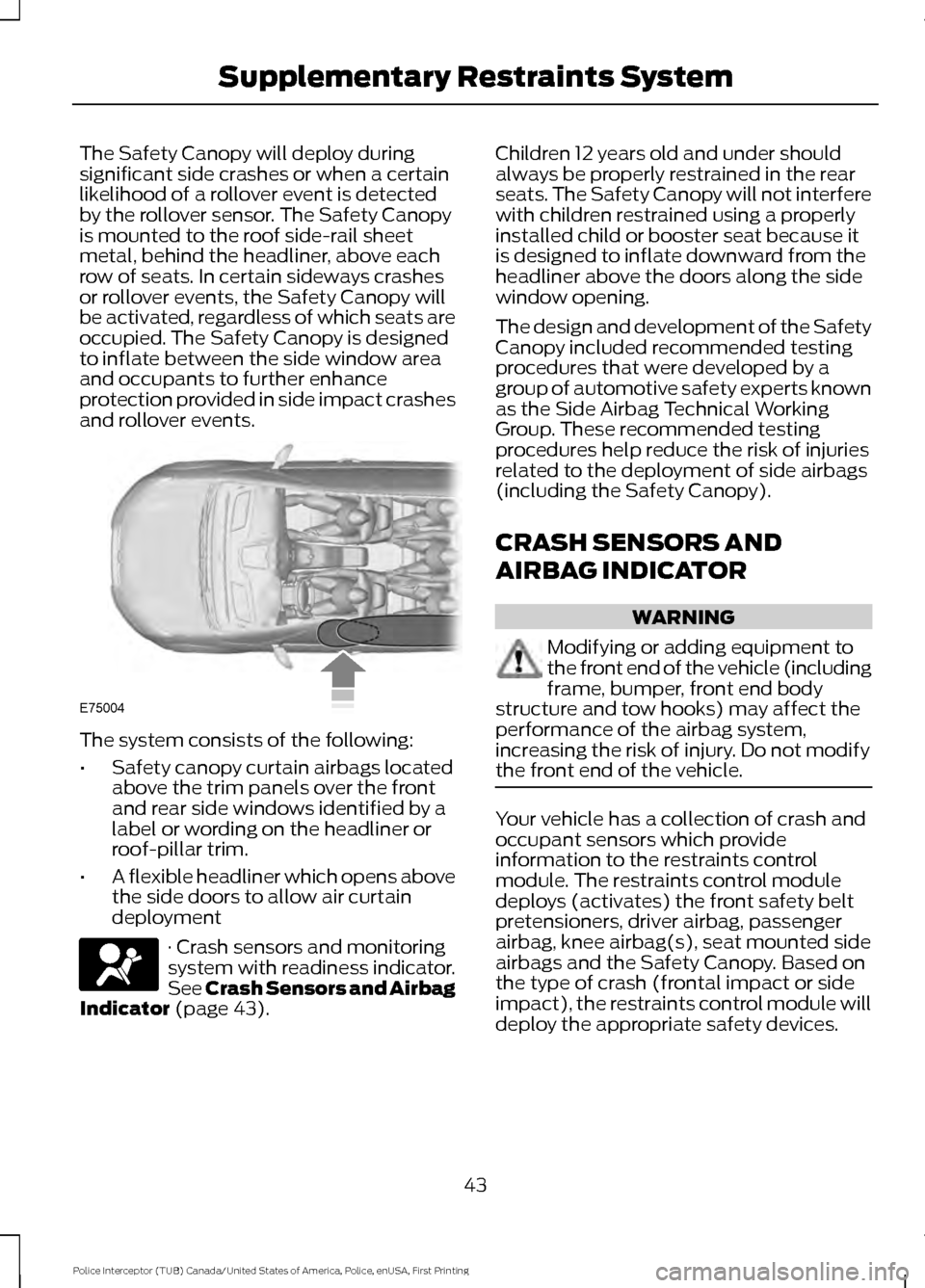
The Safety Canopy will deploy during
significant side crashes or when a certain
likelihood of a rollover event is detected
by the rollover sensor. The Safety Canopy
is mounted to the roof side-rail sheet
metal, behind the headliner, above each
row of seats. In certain sideways crashes
or rollover events, the Safety Canopy will
be activated, regardless of which seats are
occupied. The Safety Canopy is designed
to inflate between the side window area
and occupants to further enhance
protection provided in side impact crashes
and rollover events.
The system consists of the following:
•
Safety canopy curtain airbags located
above the trim panels over the front
and rear side windows identified by a
label or wording on the headliner or
roof-pillar trim.
• A flexible headliner which opens above
the side doors to allow air curtain
deployment · Crash sensors and monitoring
system with readiness indicator.
See Crash Sensors and Airbag
Indicator (page 43). Children 12 years old and under should
always be properly restrained in the rear
seats. The Safety Canopy will not interfere
with children restrained using a properly
installed child or booster seat because it
is designed to inflate downward from the
headliner above the doors along the side
window opening.
The design and development of the Safety
Canopy included recommended testing
procedures that were developed by a
group of automotive safety experts known
as the Side Airbag Technical Working
Group. These recommended testing
procedures help reduce the risk of injuries
related to the deployment of side airbags
(including the Safety Canopy).
CRASH SENSORS AND
AIRBAG INDICATOR
WARNING
Modifying or adding equipment to
the front end of the vehicle (including
frame, bumper, front end body
structure and tow hooks) may affect the
performance of the airbag system,
increasing the risk of injury. Do not modify
the front end of the vehicle. Your vehicle has a collection of crash and
occupant sensors which provide
information to the restraints control
module. The restraints control module
deploys (activates) the front safety belt
pretensioners, driver airbag, passenger
airbag, knee airbag(s), seat mounted side
airbags and the Safety Canopy. Based on
the type of crash (frontal impact or side
impact), the restraints control module will
deploy the appropriate safety devices.
43
Police Interceptor (TUB) Canada/United States of America, Police, enUSA, First Printing Supplementary Restraints SystemE75004
Page 215 of 360

GENERAL INFORMATION
Use only approved wheel and tire sizes,
using other sizes could damage your
vehicle. If you change the diameter of the
tires from that fitted at the factory, the
speedometer may not display the correct
speed. Take your vehicle to an authorized
Ford dealer to have the system
reprogrammed. If you intend to change the
size of the wheels from that fitted by the
manufacturer, you can check the suitability
with an authorized dealer.
Additional information related to the
functionality and maintenance of your tires
can be found later in this chapter. See Tire
Care (page 214).
The Ford recommended tire inflation
pressures can be found on the Tire Label,
which is located on the B-pillar or the edge
of the driver's door. This information can
also be found on the Safety Compliance
Certification Label (affixed to either the
door hinge pillar, door-latch post, or the
door edge that meets the door last post;
next to the driver ’s seating position).
Ford strongly recommends maintaining
these tire pressures at all times. Failure to
follow the tire pressure recommendations
can cause uneven treadwear patterns,
reduced fuel economy, and adversely
affect the way your vehicle handles.
Note: Check and set the tire pressure at the
ambient temperature in which you are
intending to drive your vehicle and when the
tires are cold.
Note: Check your tire pressures at least
once per month.
Set the pressure for your spare tire to the
highest value given for your vehicle and tire
size combination (if equipped). Notice to utility vehicle and truck
owners WARNINGS
Utility vehicles have a significantly
higher rollover rate than other types
of vehicles. To reduce the risk of
serious injury or death from a rollover or
other crash you must avoid sharp turns and
abrupt maneuvers, drive at safe speeds for
the conditions, keep tires inflated to Ford
recommended pressures, never overload
or improperly load your vehicle, and make
sure every passenger is properly restrained. In a rollover crash, an unbelted
person is significantly more likely to
die than a person wearing a seat belt.
All occupants must wear seat belts and
children/infants must use appropriate
restraints to minimize the risk of injury or
ejection. Do not become overconfident in the
ability of four-wheel drive vehicles.
Although a four-wheel drive vehicle
may accelerate better than a two-wheel
drive vehicle in low traction situations, it
won't stop any faster than two-wheel drive
vehicles. Always drive at a safe speed. 212
Police Interceptor (TUB) Canada/United States of America, Police, enUSA, First Printing Wheels and TiresE145298
Page 353 of 360

Car Wash
See: Cleaning the Exterior.............................. 205
Center Console...............................................99
Center Console..................................................... 99
Console Mounting Plates.................................. 99
Universal Top Tray............................................... 99
Changing a Bulb............................................197 Front Direction Indicator.................................. 198
Front Fog Lamp.................................................. 199
Headlamp............................................................. 198
Headlamp High Beam...................................... 198
LED Lamps.......................................................... 200
License Plate Lamp.......................................... 200
Rear Direction Indicator and Reversing Lamp.................................................................. 199
Changing a Fuse............................................179 Fuses........................................................................\
179
Changing a Road Wheel............................233 Dissimilar Spare Wheel and Tire Assembly
Information...................................................... 233
Tire Change Procedure.................................... 234
Changing the 12V Battery..........................193
Changing the Engine Air Filter................203
Changing the Wiper Blades
......................195
Front Wiper Blades............................................ 195
Rear Window Wiper Blade.............................. 195
Checking the Wiper Blades......................195
Child Restraint and Seatbelt Maintenance.................................................34
Child Restraint Positioning.........................25
Child Safety.......................................................16 General Information............................................. 16
Child Safety Locks..........................................27 Left-Hand Side..................................................... 28
Right-Hand Side................................................... 28
Cleaning Leather Seats.............................208
Cleaning Products
.......................................204
Cleaning the Alloy Wheels.......................209
Cleaning the Engine
...................................206
Cleaning the Exterior..................................205
Exterior Chrome Parts..................................... 205
Exterior Plastic Parts........................................ 205
Stripes or Graphics........................................... 205
Underbody........................................................... 206
Under Hood......................................................... 206
Cleaning the Instrument Panel and Instrument Cluster Lens........................208
Cleaning the Interior...................................207 Cleaning the Windows and Wiper
Blades...........................................................207
Climate Control
..............................................90
Coolant Check See: Engine Coolant Check............................ 186
Crash Sensors and Airbag Indicator........43 Airbags and Police Equipment....................... 44
Cross Traffic Alert
..........................................137
False Alerts........................................................... 140
Switching the System Off and On...............140
System Errors....................................................... 140
System Lights, Messages and Audible Alerts.................................................................. 139
System Limitations............................................ 140
Using the System................................................ 137
Cruise Control
..................................................58
Principle of Operation....................................... 133
Cruise control See: Using Cruise Control................................ 133
Customer Assistance
..................................164
D
Data Recording
..................................................9
Event Data Recording.......................................... 10
Service Data Recording........................................ 9
Daytime Running Lamps
............................64
Decommissioning Requirements...........321
Police Engine Idle feature................................ 321
Decommissioning the Vehicle
.................321
Digital Radio..................................................256
HD Radio Reception and Station
Troubleshooting............................................. 257
Direction Indicators
.......................................65
Doors and Locks.............................................52
Driver and Passenger Airbags...................38 Children and Airbags.......................................... 38
Proper Driver and Front Passenger Seating Adjustment........................................................ 38
Driving Aids
.....................................................135
Driving Hints...................................................155
Driving Through Water................................156
DRL See: Daytime Running Lamps......................... 64
E
Economical Driving......................................155
350
Police Interceptor (TUB) Canada/United States of America, Police, enUSA, First Printing Index
Page 355 of 360

Getting Assistance Outside the U.S. and
Canada..........................................................167
Getting the Services You Need...............164 Away From Home.............................................. 164
H
Handbrake See: Parking Brake.............................................. 124
Hazard Warning Flashers..........................159
Headlamp Adjusting See: Adjusting the Headlamps..................... 196
Headlamp Removal See: Removing a Headlamp........................... 197
Head Restraints
..............................................93
Adjusting the Head Restraint.......................... 94
Tilting Head Restraints ..................................... 94
Heated Windows and Mirrors....................92 Heated Exterior Mirror........................................ 92
Heated Rear Window.......................................... 92
Heating See: Climate Control.......................................... 90
Hints on Controlling the Interior Climate.............................................................91
Cooling the Interior Quickly............................... 91
General Hints.......................................................... 91
Heating the Interior Quickly............................... 91
Maximum Cooling Performance in Instrument Panel or Instrument Panel
and Footwell Positions................................. 92
Recommended Settings for Cooling ............91
Recommended Settings for Heating.............91
Side Window Defogging in Cold Weather.............................................................. 92
Vehicle Stationary for Extended Periods During Extreme High Ambient
Temperatures.................................................... 91
Hints on Driving With Anti-Lock Brakes.............................................................123
Hood Lock See: Opening and Closing the Hood............181
I
Ignition Switch
..............................................100
In California (U.S. Only).............................165
Information Display Control......................58 Information Displays
......................................77
General Information............................................. 77
Information Messages.................................80 AdvanceTrac ™....................................................... 81
Alarm........................................................................\
. 81
AWD........................................................................\
... 81
Battery and Charging System......................... 82
Blind Spot Information and Cross Traffic Alert System...................................................... 82
Brake System......................................................... 83
Doors and Locks................................................... 83
Engine....................................................................... 84
Fuel........................................................................\
.... 84
Keys and Intelligent Access............................. 84
Lane Keeping System......................................... 85
Maintenance.......................................................... 86
Park Aid................................................................... 86
Park Brake............................................................... 87
Police Engine Idle feature.................................. 87
Power Steering...................................................... 87
Seats........................................................................\
. 87
Starting System.................................................... 88
Tire Pressure Monitoring System................... 88
Traction Control................................................... 88
Transmission......................................................... 89
Installing Child Restraints.............................17 Child Seats............................................................... 17
Using Lap and Shoulder Belts.......................... 18
Using Lower Anchors and Tethers for CHildren (LATCH)........................................... 20
Using Tether Straps............................................. 22
Instrument Cluster..........................................71
Instrument Lighting Dimmer.....................64
Interior Lamps.................................................65 Dome Lamp........................................................... 65
Dome Task Lamp................................................. 66
Front Map Lamps................................................. 65
Rear Interior Lamp............................................... 66
Interior Mirror
...................................................69
Auto-Dimming Mirror......................................... 69
Introduction.........................................................7
J
Jump Starting the Vehicle
.........................160
Connecting the Jumper Cables.................... 160
Jump Starting........................................................ 161
Preparing Your Vehicle..................................... 160
352
Police Interceptor (TUB) Canada/United States of America, Police, enUSA, First Printing Index