2017 FORD F150 tires
[x] Cancel search: tiresPage 381 of 599
the best of your ability, to the point
where the ratchet or slip occurs, if
possible. The spare tire carrier will not
allow you to overtighten. If the spare
tire carrier ratchets or slips with little
effort, contact your authorized dealer.
4. Check that the tire lies flat against the frame and is properly tightened. Try to
push or pull, then turn the tire to be
sure it will not move. Loosen and
retighten, if necessary. Failure to
properly stow the spare tire may result
in failure of the winch cable and loss
of the tire.
5. Repeat this tightness check procedure
when servicing the spare tire pressure
(every six months, as per your
scheduled maintenance information),
or at any time that the spare tire is
disturbed through service of other
components.
6. If removed, install the spare tire lock into the bumper drive tube with the
spare tire lock key and jack handle.
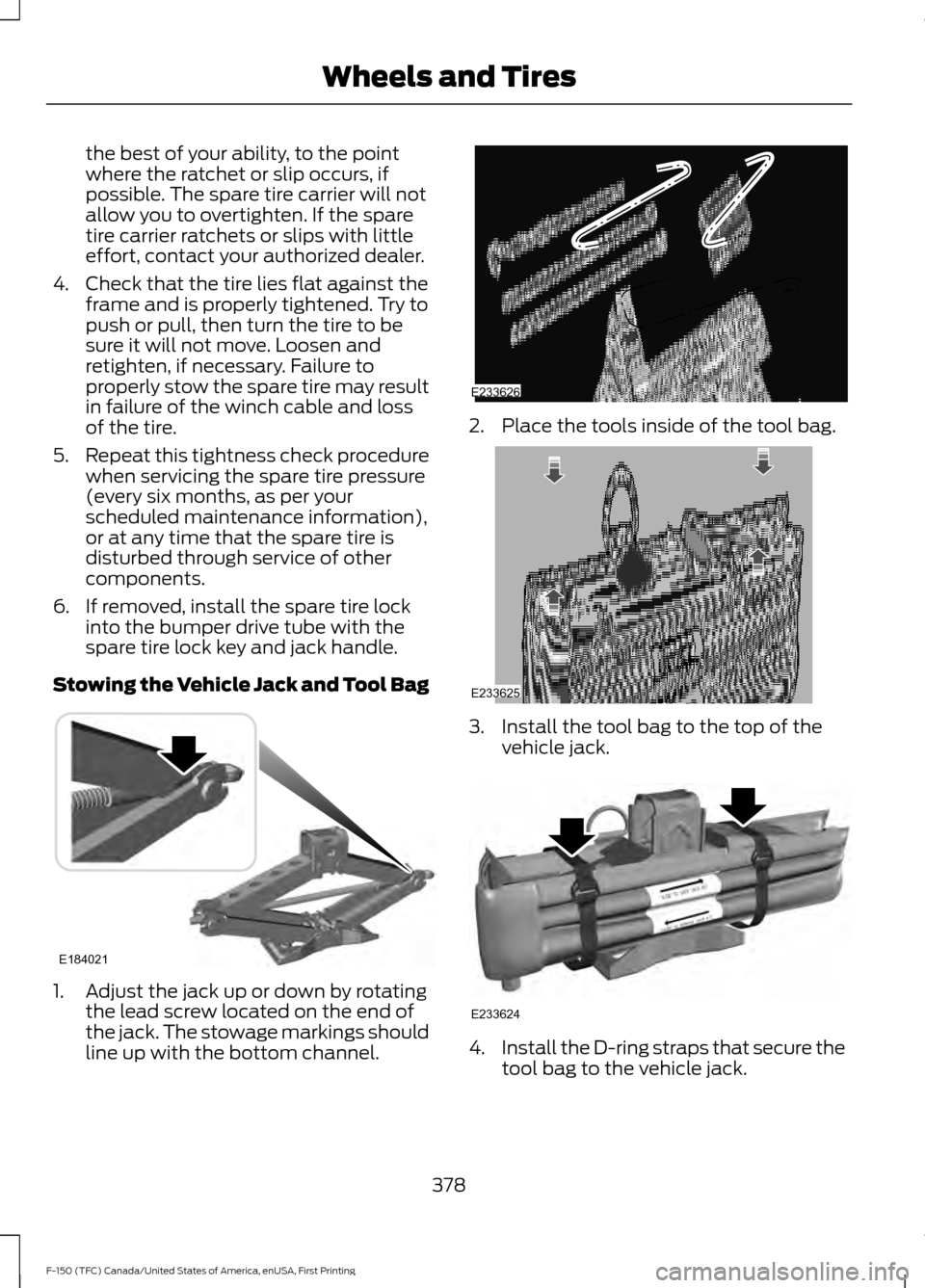
Stowing the Vehicle Jack and Tool Bag 1. Adjust the jack up or down by rotating
the lead screw located on the end of
the jack. The stowage markings should
line up with the bottom channel. 2. Place the tools inside of the tool bag.
3. Install the tool bag to the top of the
vehicle jack. 4.
Install the D-ring straps that secure the
tool bag to the vehicle jack.
378
F-150 (TFC) Canada/United States of America, enUSA, First Printing Wheels and TiresE184021 E233626 E233625 E233624
Page 382 of 599
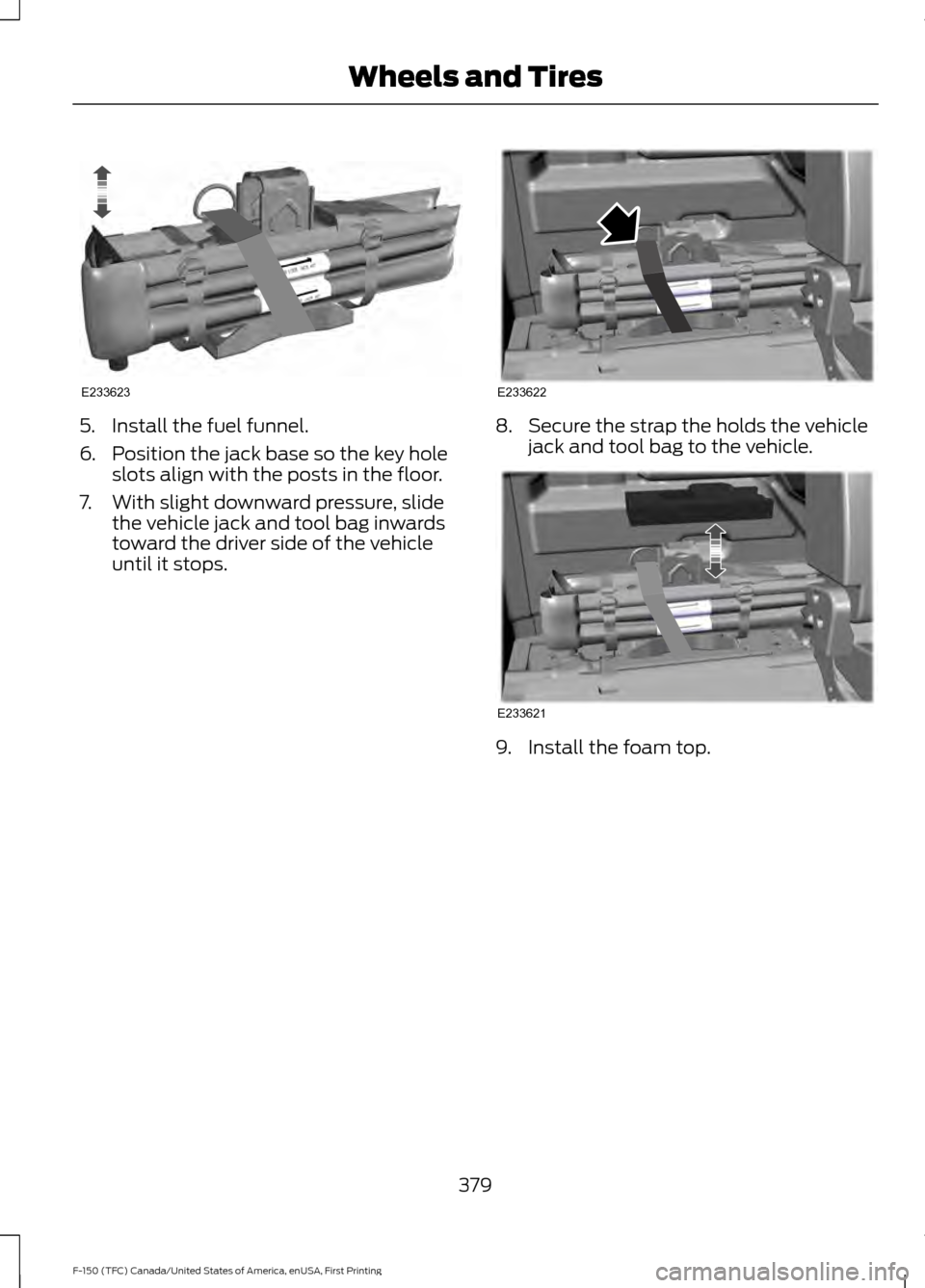
5. Install the fuel funnel.
6. Position the jack base so the key hole
slots align with the posts in the floor.
7. With slight downward pressure, slide the vehicle jack and tool bag inwards
toward the driver side of the vehicle
until it stops. 8. Secure the strap the holds the vehicle
jack and tool bag to the vehicle. 9. Install the foam top.
379
F-150 (TFC) Canada/United States of America, enUSA, First Printing Wheels and TiresE233623 E233622 E233621
Page 383 of 599

TECHNICAL SPECIFICATIONS
Wheel Lug Nut Torque Specifications
WARNING
When you install a wheel, always remove any corrosion, dirt or foreign materials
present on the mounting surfaces of the wheel or the surface of the wheel hub,
brake drum or brake disc that contacts the wheel. Make sure to secure any fasteners
that attach the rotor to the hub so they do not interfere with the mounting surfaces of
the wheel. Installing wheels without correct metal-to-metal contact at the wheel mounting
surfaces can cause the wheel nuts to loosen and the wheel to come off while your vehicle
is in motion, resulting in loss of vehicle control, personal injury or death. lb.ft (Nm)
Bolt size
150 lb.ft (204 Nm)
M14 x 1.5
* Torque specifications are for nut and bolt threads free of dirt and rust. Use only Ford
recommended replacement fasteners.
Retighten the lug nuts to the specified torque within 100 miles (160 kilometers) after any
wheel disturbance (such as tire rotation, changing a flat tire, wheel removal). Wheel pilot bore
A
Inspect the wheel pilot hole and
mounting surface prior to installation.
Remove any visible corrosion or loose
particles.
380
F-150 (TFC) Canada/United States of America, enUSA, First Printing Wheels and TiresE145950
Page 544 of 599

Check every month
Engine oil level.
Function of all interior and exterior lights.
Tires (including spare) for wear and proper pressure. Windshield washer fluid level. Check every six months
Battery connections. Clean if necessary.
Body and door drain holes for obstructions. Clean if necessary. Cooling system fluid level and coolant strength.
Door weatherstrips for wear. Lubricate if necessary.
Hinges, latches and outside locks for proper operation. Lubricate if necessary. Parking brake for proper operation.
Safety belts and seat latches for wear and function.
Safety warning lamps (brake, ABS, airbag and safety belt) for operation.
Washer spray and wiper operation. Clean or replace blades as necessary.
Multi-Point Inspection
In order to keep your vehicle running right,
it is important to have the systems on your
vehicle checked regularly. This can help
identify potential issues and prevent major
problems. We recommend having the
following multi-point inspection performed
at every scheduled maintenance interval
to help make sure your vehicle keeps
running great.
541
F-150 (TFC) Canada/United States of America, enUSA, First Printing Scheduled Maintenance
Page 545 of 599
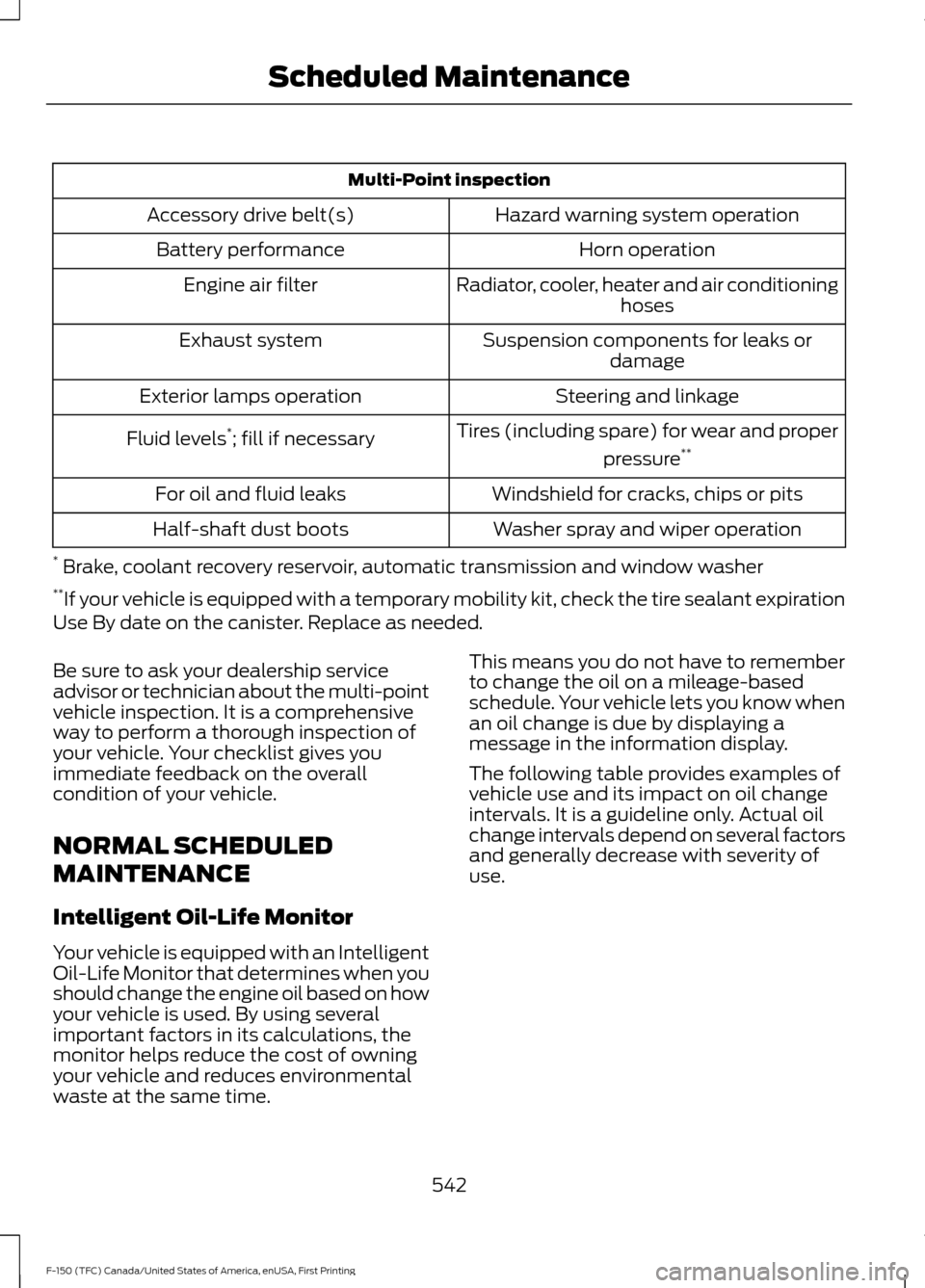
Multi-Point inspection
Hazard warning system operation
Accessory drive belt(s)
Horn operation
Battery performance
Radiator, cooler, heater and air conditioninghoses
Engine air filter
Suspension components for leaks ordamage
Exhaust system
Steering and linkage
Exterior lamps operation
Tires (including spare) for wear and properpressure**
Fluid levels *
; fill if necessary
Windshield for cracks, chips or pits
For oil and fluid leaks
Washer spray and wiper operation
Half-shaft dust boots
* Brake, coolant recovery reservoir, automatic transmission and window washer
** If your vehicle is equipped with a temporary mobility kit, check the tire sealant expiration
Use By date on the canister. Replace as needed.
Be sure to ask your dealership service
advisor or technician about the multi-point
vehicle inspection. It is a comprehensive
way to perform a thorough inspection of
your vehicle. Your checklist gives you
immediate feedback on the overall
condition of your vehicle.
NORMAL SCHEDULED
MAINTENANCE
Intelligent Oil-Life Monitor
Your vehicle is equipped with an Intelligent
Oil-Life Monitor that determines when you
should change the engine oil based on how
your vehicle is used. By using several
important factors in its calculations, the
monitor helps reduce the cost of owning
your vehicle and reduces environmental
waste at the same time. This means you do not have to remember
to change the oil on a mileage-based
schedule. Your vehicle lets you know when
an oil change is due by displaying a
message in the information display.
The following table provides examples of
vehicle use and its impact on oil change
intervals. It is a guideline only. Actual oil
change intervals depend on several factors
and generally decrease with severity of
use.
542
F-150 (TFC) Canada/United States of America, enUSA, First Printing Scheduled Maintenance
Page 546 of 599
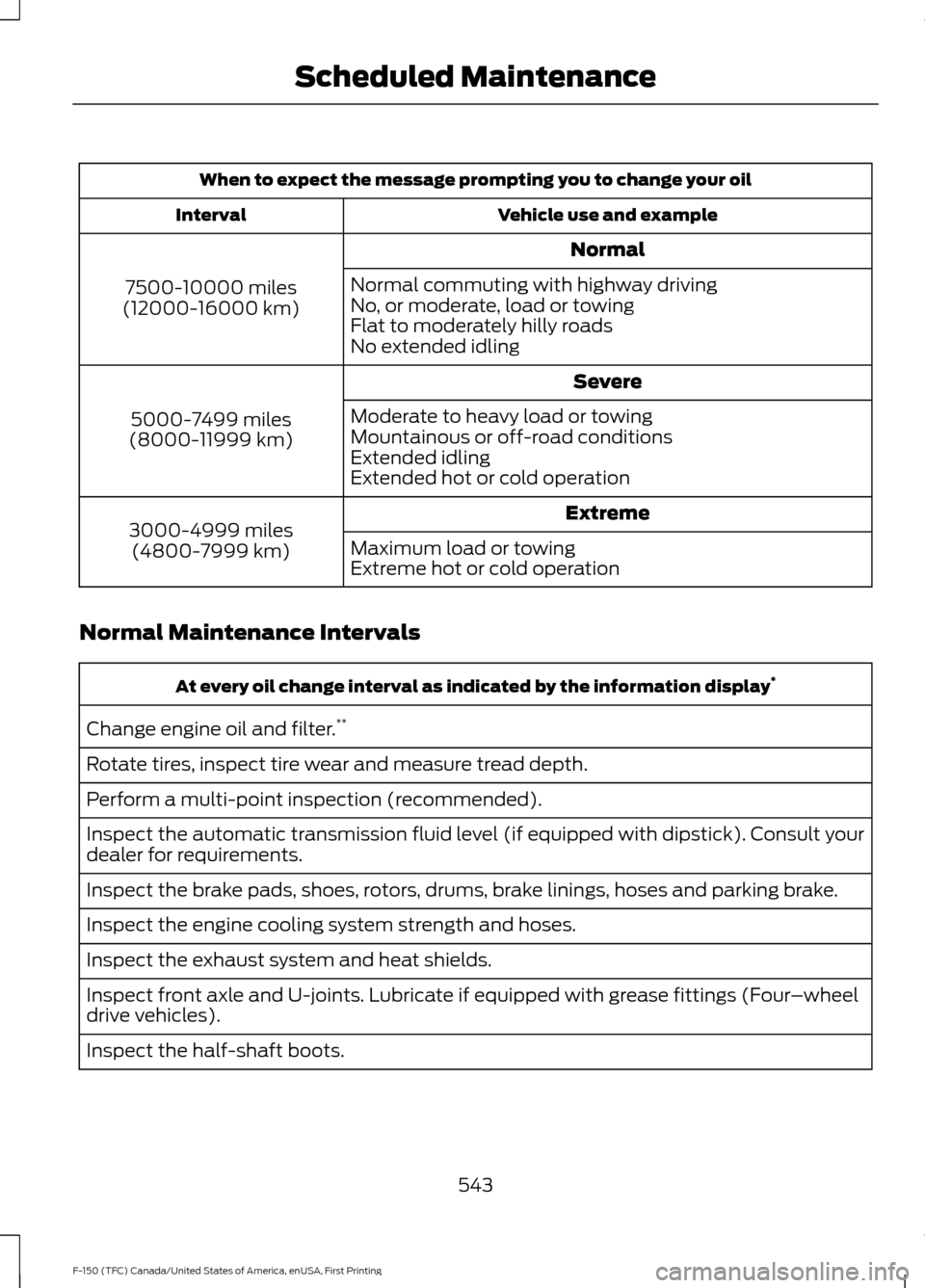
When to expect the message prompting you to change your oil
Vehicle use and example
Interval
Normal
7500-10000 miles
(12000-16000 km) Normal commuting with highway driving
No, or moderate, load or towing
Flat to moderately hilly roads
No extended idling
Severe
5000-7499 miles
(8000-11999 km) Moderate to heavy load or towing
Mountainous or off-road conditions
Extended idling
Extended hot or cold operation
Extreme
3000-4999 miles
(4800-7999 km) Maximum load or towing
Extreme hot or cold operation
Normal Maintenance Intervals At every oil change interval as indicated by the information display
*
Change engine oil and filter. **
Rotate tires, inspect tire wear and measure tread depth.
Perform a multi-point inspection (recommended).
Inspect the automatic transmission fluid level (if equipped with dipstick). Consult your
dealer for requirements.
Inspect the brake pads, shoes, rotors, drums, brake linings, hoses and parking brake.
Inspect the engine cooling system strength and hoses.
Inspect the exhaust system and heat shields.
Inspect front axle and U-joints. Lubricate if equipped with grease fittings (Four –wheel
drive vehicles).
Inspect the half-shaft boots.
543
F-150 (TFC) Canada/United States of America, enUSA, First Printing Scheduled Maintenance
Page 549 of 599
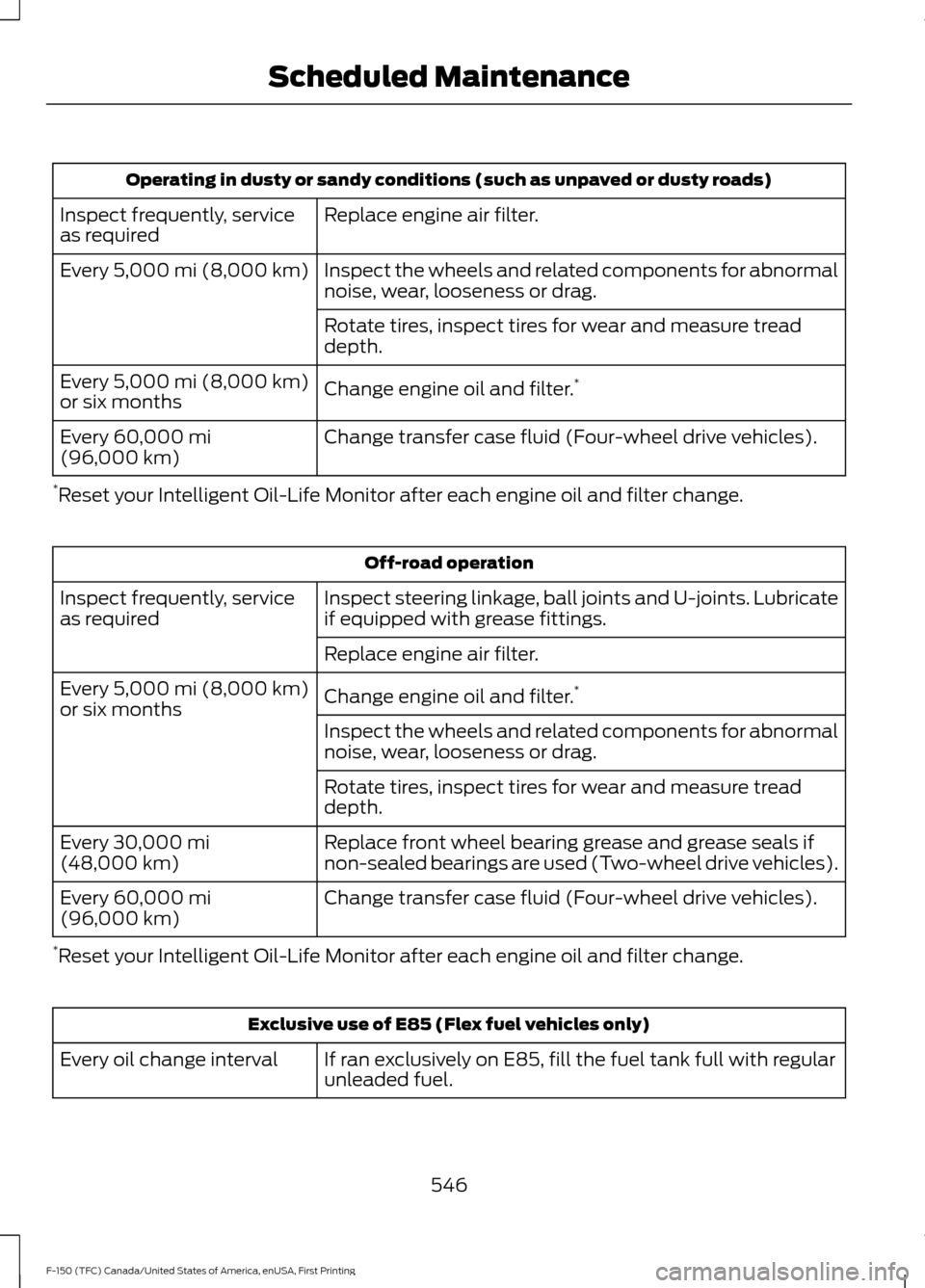
Operating in dusty or sandy conditions (such as unpaved or dusty roads)
Replace engine air filter.
Inspect frequently, service
as required
Inspect the wheels and related components for abnormal
noise, wear, looseness or drag.
Every 5,000 mi (8,000 km)
Rotate tires, inspect tires for wear and measure tread
depth.
Change engine oil and filter. *
Every
5,000 mi (8,000 km)
or six months
Change transfer case fluid (Four-wheel drive vehicles).
Every
60,000 mi
(96,000 km)
* Reset your Intelligent Oil-Life Monitor after each engine oil and filter change. Off-road operation
Inspect steering linkage, ball joints and U-joints. Lubricate
if equipped with grease fittings.
Inspect frequently, service
as required
Replace engine air filter.
Change engine oil and filter.*
Every
5,000 mi (8,000 km)
or six months
Inspect the wheels and related components for abnormal
noise, wear, looseness or drag.
Rotate tires, inspect tires for wear and measure tread
depth.
Replace front wheel bearing grease and grease seals if
non-sealed bearings are used (Two-wheel drive vehicles).
Every
30,000 mi
(48,000 km)
Change transfer case fluid (Four-wheel drive vehicles).
Every
60,000 mi
(96,000 km)
* Reset your Intelligent Oil-Life Monitor after each engine oil and filter change. Exclusive use of E85 (Flex fuel vehicles only)
If ran exclusively on E85, fill the fuel tank full with regular
unleaded fuel.
Every oil change interval
546
F-150 (TFC) Canada/United States of America, enUSA, First Printing Scheduled Maintenance
Page 597 of 599

Steering...........................................................243
Electric Power Steering................................... 243
Steering Wheel Lock...................................169
Steering Wheel...............................................80
Storage Compartments............................166
Sunroof See: Moonroof..................................................... 100
Sun Visors
.......................................................100
Illuminated Vanity Mirror................................. 100
Supplementary Restraints System.........45 Principle of Operation........................................ 45
Symbols Glossary
.............................................7
SYNC™ 3.........................................................461 General Information.......................................... 461
SYNC™ 3 Troubleshooting.......................521
SYNC™ Applications and Services........................................................439
911 Assist............................................................... 439
SYNC Mobile Apps............................................. 441
SYNC™............................................................423 General Information......................................... 423
SYNC™ Troubleshooting.........................453
T
Tailgate Lock
....................................................69
Tailgate Step.....................................................71
Closing the Step..................................................... 71
Opening the Step................................................... 71
Tailgate..............................................................69
Technical Specifications See: Capacities and Specifications.............381
The Better Business Bureau (BBB) Auto Line Program (U.S. Only).......................302
Tire Care
...........................................................351
Glossary of Tire Terminology......................... 352
Information About Uniform Tire Quality Grading.............................................................. 351
Information Contained on the Tire Sidewall............................................................ 353
Temperature A B C............................................ 352
Traction AA A B C................................................ 351
Treadwear.............................................................. 351
Tire Pressure Monitoring System...........367 Changing Tires With a Tire Pressure
Monitoring System....................................... 368
Understanding Your Tire Pressure Monitoring System ...................................... 368Tires
See: Wheels and Tires..................................... 349
Towing a Trailer
............................................256
Load Placement................................................. 257
Towing Points
...............................................298
Towing the Vehicle on Four Wheels..........................................................285
Emergency Towing............................................ 285
Recreational Towing......................................... 285
Towing.............................................................256
Traction Control
...........................................208
Principle of Operation..................................... 208
Trailer Reversing Aids..................................257 Principle of Operation...................................... 258
Pro Trailer Backup Assist™............................ 257
Setting Up Pro Trailer Backup Assist.........258
Troubleshooting................................................. 262
Using Pro Trailer Backup Assist..................... 261
Trailer Sway Control....................................267
Transfer Case Fluid Check........................328
Transmission Code Designation............387
Transmission..................................................186
Transmission See: Transmission.............................................. 186
Transporting the Vehicle...........................297
Type Approvals
............................................582
RF Certification Logos for Tire Pressure
Monitoring Sensor(s).................................. 582
U
Under Hood Overview - 2.7L EcoBoost™..................................................318
2.7L EcoBoost...................................................... 318
Under Hood Overview - 3.5L Ecoboost™.................................................320
Under Hood Overview - 3.5L....................319
Under Hood Overview - 5.0L....................321
Unique Driving Characteristics.................174
Universal Garage Door Opener...............160 HomeLink Wireless Control System...........160
USB Port
..........................................................422
Using Adaptive Cruise Control................225 Blocked Sensor.................................................. 230
Changing the Set Speed................................. 228
Detection Issues................................................. 229
Disengaging the System................................. 228
Following a Vehicle........................................... 226
594
F-150 (TFC) Canada/United States of America, enUSA, First Printing Index