2017 FORD EDGE chain
[x] Cancel search: chainPage 8 of 544

Cleaning the Exterior.................................290
Waxing..............................................................291
Cleaning the Engine....................................292
Cleaning the Windows and Wiper Blades..........................................................292
Cleaning the Interior...................................293
Cleaning the Instrument Panel and Instrument Cluster Lens.......................293
Cleaning Leather Seats.............................294
Repairing Minor Paint Damage
..............294
Cleaning the Wheels..................................294
Vehicle Storage............................................295
Body Styling Kits
..........................................297
Wheels and Tires
General Information...................................298
Tire Sealant and Inflator Kit....................300
Tire Care
.........................................................306
Using Summer Tires
...................................322
Using Snow Chains.....................................323
Tire Pressure Monitoring System...........324
Changing a Road Wheel............................327
Technical Specifications
...........................332
Capacities and Specific- ations
Engine Specifications - 2.0L EcoBoost™................................................333
Engine Specifications - 2.7L EcoBoost™................................................333
Engine Specifications - 3.5L....................334
Motorcraft Parts - 2.0L EcoBoost™
......335
Motorcraft Parts - 2.7L EcoBoost™
......336
Motorcraft Parts - 3.5L...............................337
Vehicle Identification Number................338
Vehicle Certification Label.......................339
Transmission Code Designation............339
Capacities and Specifications - 2.0L EcoBoost™...............................................340
Capacities and Specifications - 2.7L EcoBoost™...............................................344 Capacities and Specifications - 3.5L....348
Audio System
General Information
...................................353
Audio Unit - Vehicles With: Sony AM/FM/ CD..................................................................354
Audio Unit - Vehicles With: AM/FM/CD/ SYNC............................................................358
Audio Unit - Vehicles With: Premium AM/ FM/CD.........................................................360
Digital Radio
..................................................362
Satellite Radio..............................................364
USB Port
..........................................................367
Media Hub......................................................367
SYNC™
General Information...................................368
Using Voice Recognition...........................370
Using SYNC™ With Your Phone.............372
SYNC™ Applications and Services
......384
Using SYNC™ With Your Media Player...........................................................389
SYNC™ Troubleshooting
.........................398
SYNC™ 3
General Information
..................................406
Home Screen.................................................419
Using Voice Recognition
...........................420
Entertainment...............................................427
Climate............................................................437
Phone................................................................441
Navigation......................................................446
Apps.................................................................454
Settings...........................................................457
SYNC™ 3 Troubleshooting.....................469
Accessories
Accessories
....................................................482
5
Edge (CDQ) Canada/United States of America, enUSA, Edition date: 201608, First Printing Table of Contents
Page 78 of 544

PASSIVE ANTI-THEFT
SYSTEM
Note:
The system is not compatible with
non-Ford aftermarket remote start systems.
Use of these systems may result in engine
starting problems and a loss of security
protection.
Note: Metallic objects, electronic devices
or a second coded key on the same key
chain may result in vehicle starting
problems, especially if they are too close to
the key when starting your vehicle. Prevent
these objects from touching the coded key
when starting your vehicle. Switch the
ignition off, move all objects on the key
chain away from the coded key and restart
your vehicle if a problem occurs.
Note: Do not leave a duplicate coded key
in your vehicle. Always take your keys and
lock all doors when leaving your vehicle.
SecuriLock®
The system helps prevent the engine from
starting unless you use a coded key
programmed to your vehicle. Using the
wrong key may prevent your vehicle from
starting. A message may appear in the
information display.
If you are unable to start your vehicle with
a coded key, it is not operating correctly. A
message may appear in the information
display.
Automatic Arming
The system arms when you switch the
ignition off.
Automatic Disarming
The system disarms when you switch the
ignition on with a coded key. Replacement Keys
The intelligent access key functions as a
programmed key that operates the driver
door lock and activates the intelligent
access with push button start system, as
well as a remote control.
If your coded keys are lost or stolen and
you do not have an extra coded key, you
need to erase the key codes from your
vehicle and program new coded keys.
Contact an authorized dealer.
Store an extra programmed key away from
your vehicle in a safe place. You can
purchase replacement keys or remote
controls from an authorized dealer.
Programming a Spare Intelligent
Access Key
Note:
You can program a maximum of four
intelligent access keys to your vehicle.
You must have two previously
programmed intelligent access keys inside
your vehicle and the new unprogrammed
intelligent access keys readily accessible.
If two previously programmed coded keys
are not available, contact an authorized
dealer.
Make sure that the ignition is switched off
before beginning this procedure. Make sure
that you close all the doors before
beginning and that they remain closed
throughout the procedure. Carry out all
steps within 30 seconds of starting the
sequence. Stop and wait for at least one
minute before starting again if you carry
out any steps out of sequence.
Read and understand the entire procedure
before you begin.
75
Edge (CDQ) Canada/United States of America, enUSA, Edition date: 201608, First Printing Security
Page 181 of 544
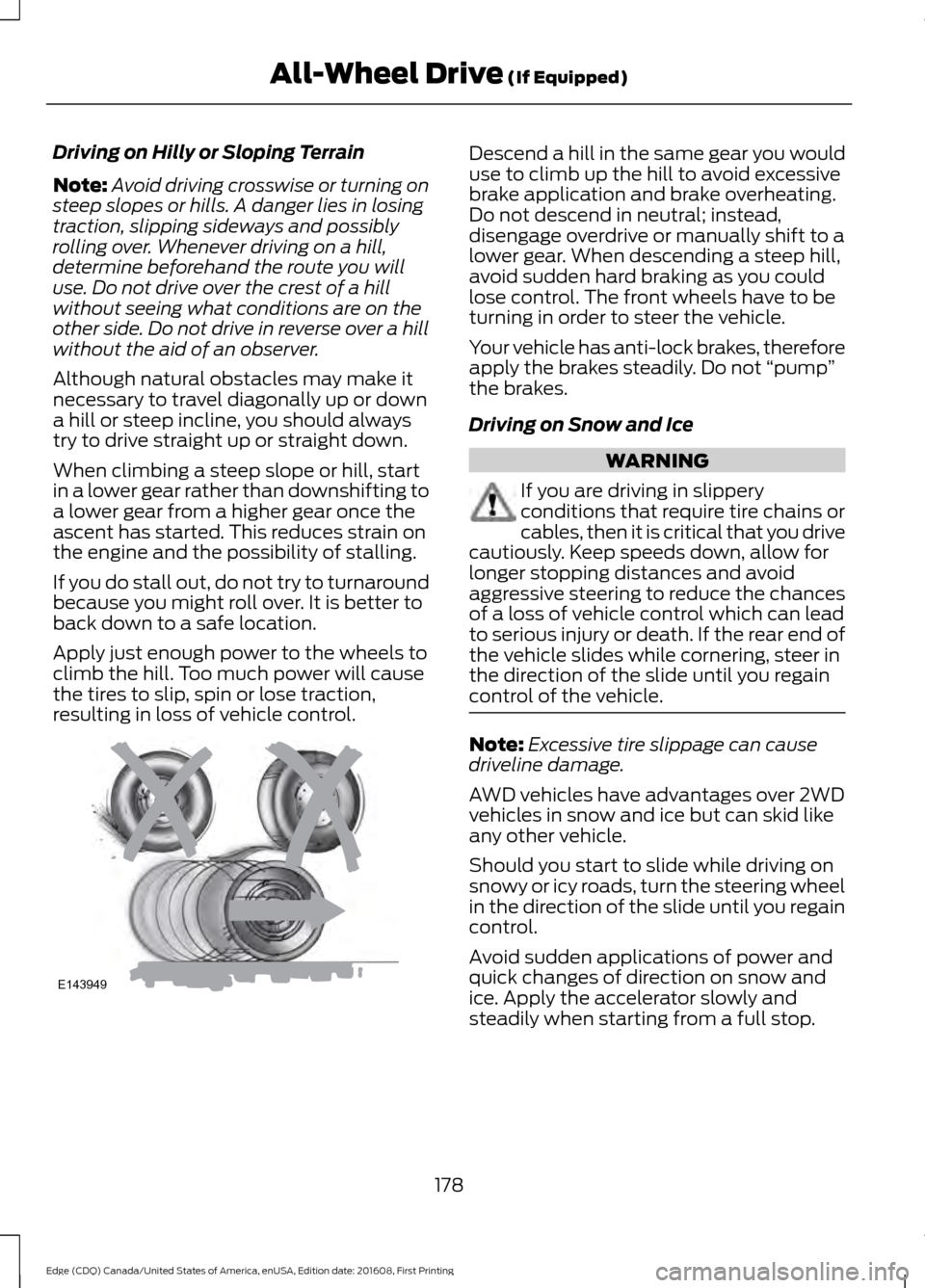
Driving on Hilly or Sloping Terrain
Note:
Avoid driving crosswise or turning on
steep slopes or hills. A danger lies in losing
traction, slipping sideways and possibly
rolling over. Whenever driving on a hill,
determine beforehand the route you will
use. Do not drive over the crest of a hill
without seeing what conditions are on the
other side. Do not drive in reverse over a hill
without the aid of an observer.
Although natural obstacles may make it
necessary to travel diagonally up or down
a hill or steep incline, you should always
try to drive straight up or straight down.
When climbing a steep slope or hill, start
in a lower gear rather than downshifting to
a lower gear from a higher gear once the
ascent has started. This reduces strain on
the engine and the possibility of stalling.
If you do stall out, do not try to turnaround
because you might roll over. It is better to
back down to a safe location.
Apply just enough power to the wheels to
climb the hill. Too much power will cause
the tires to slip, spin or lose traction,
resulting in loss of vehicle control. Descend a hill in the same gear you would
use to climb up the hill to avoid excessive
brake application and brake overheating.
Do not descend in neutral; instead,
disengage overdrive or manually shift to a
lower gear. When descending a steep hill,
avoid sudden hard braking as you could
lose control. The front wheels have to be
turning in order to steer the vehicle.
Your vehicle has anti-lock brakes, therefore
apply the brakes steadily. Do not
“pump”
the brakes.
Driving on Snow and Ice WARNING
If you are driving in slippery
conditions that require tire chains or
cables, then it is critical that you drive
cautiously. Keep speeds down, allow for
longer stopping distances and avoid
aggressive steering to reduce the chances
of a loss of vehicle control which can lead
to serious injury or death. If the rear end of
the vehicle slides while cornering, steer in
the direction of the slide until you regain
control of the vehicle. Note:
Excessive tire slippage can cause
driveline damage.
AWD vehicles have advantages over 2WD
vehicles in snow and ice but can skid like
any other vehicle.
Should you start to slide while driving on
snowy or icy roads, turn the steering wheel
in the direction of the slide until you regain
control.
Avoid sudden applications of power and
quick changes of direction on snow and
ice. Apply the accelerator slowly and
steadily when starting from a full stop.
178
Edge (CDQ) Canada/United States of America, enUSA, Edition date: 201608, First Printing All-Wheel Drive (If Equipped)E143949
Page 236 of 544

ESSENTIAL TOWING CHECKS
Follow these guidelines for safe towing:
•
Do not tow a trailer until you drive your
vehicle at least 1000 miles (1600
kilometers).
• Consult your local motor vehicle laws
for towing a trailer.
• See the instructions included with
towing accessories for the proper
installation and adjustment
specifications.
• Service your vehicle more frequently if
you tow a trailer. See your scheduled
maintenance information.
• If you use a rental trailer, follow the
instructions the rental agency gives
you.
You can find information on load
specification terms found on the tire label
and Safety Compliance label as well as
instructions on calculating your vehicle's
load in the Load Carrying chapter. See
Load Limit (page 225).
Remember to account for the trailer
tongue weight as part of your vehicle load
when calculating the total vehicle weight.
Hitches
Do not use a hitch that either clamps onto
the bumper or attaches to the axle.
Distribute the trailer load so 10-15% of the
total trailer weight is on the tongue.
Safety Chains
Note: Never attach safety chains to the
bumper.
Always connect the safety chains to the
hook retainers of your vehicle hitch.
To connect the safety chains, cross them
under the trailer tongue and allow enough
slack for turning tight corners. Do not allow
the chains to drag on the ground. Trailer Brakes WARNING
Do not connect a trailer's hydraulic
brake system directly to your
vehicle's brake system. Your vehicle
may not have enough braking power and
your chances of having a collision greatly
increase. Electric brakes and manual, automatic or
surge-type trailer brakes are safe if you
install them properly and adjust them to
the manufacturer's specifications. The
trailer brakes must meet local and federal
regulations.
The rating for the tow vehicle's braking
system operation is at the gross vehicle
weight rating, not the gross combined
weight rating.
Separate functioning brake systems
are required for safe control of towed
vehicles and trailers weighing more
than 1500 pounds (680 kilograms)
when load.
Trailer Lamps
WARNING
Never connect any trailer lamp wiring
to the vehicle's tail lamp wiring; this
may damage the electrical system
resulting in fire. Contact your authorized
dealer as soon as possible for assistance
in proper trailer tow wiring installation.
Additional electrical equipment may be
required. Trailer lamps are required on most towed
vehicles. Make sure all running lights, brake
lights, turn signals and hazard lights are
working.
233
Edge (CDQ) Canada/United States of America, enUSA, Edition date: 201608, First Printing Towing
Page 310 of 544

These low-profile
high-performance tires are
designed to optimize the driving
dynamics you expect in a sport
vehicle in both dry and wet
conditions. These tires are not
optimized for off-road or winter
(snow or cold weather)
performance; and their ride, noise,
and wear characteristics are
different than non-performance
tires. With low-profile tires, you
may notice an increase in road
noise and faster wear, depending
on road conditions and driving
habits. Also, because of their
lower profile, the tires are more
susceptible to road damage from
potholes, rough or unpaved roads,
car wash rails, and curb contact
than standard tires and wheels.
Note:
Your vehicle ’s warranty does
not cover these types of damages.
Extra caution should be taken
when operating on rough roads to
avoid impacts that could cause
wheel and tire damage.
The optional 265/40R21 tires were
designed for track use and may
exhibit significantly reduced tread
life and increased tire noise
compared to the standard
equipment tires under normal
driving conditions. Increasing the
front camber settings beyond the
factory settings may further
accelerate tread wear and induce
tire noise. Note:
Do not use tire chains on
your vehicle ’s optional 265/40R21
tires and wheels. The use of any
type of tire chain on these tires may
damage your vehicle. See Using
Snow Chains (page 323).
Notice to Crossover Vehicle
Owners Crossover vehicles handle
differently than passenger cars in
the various driving conditions that
are encountered on streets,
highways and off-road. Crossover
vehicles are not designed for
cornering at speeds as high as
passenger cars any more than
low-slung sports cars are
designed to perform satisfactorily
under off-road conditions.
307
Edge (CDQ) Canada/United States of America, enUSA, Edition date: 201608, First Printing Wheels and TiresE200792
Page 326 of 544

ice conditions. Like any tire, summer tire
performance is affected by tire wear and
environmental conditions. If you must drive
in those conditions, we recommend using
Mud and Snow (M+S, M/S), All-season or
Snow tires.
Always store your summer tires indoors at
temperatures above 19°F (-7°C). The
rubber compounds used in these tires lose
flexibility and may develop surface cracks
in the tread area at temperatures below
19°F (-7°C)
. If the tires have been
subjected to 19°F (-7°C) or less, warm
them in a heated space to at least 41°F
(5°C) for at least 24 hours before installing
them on a vehicle, or moving the vehicle
with the tires installed, or checking tire
inflation. Do not place tires near heaters
or heating devices used to warm the room
where the tires are stored. Do not apply
heat or blow heated air directly on the tires.
Always inspect the tires after storage
periods and before use.
USING SNOW CHAINS WARNING
Snow tires must be the same size,
load index, speed rating as those
originally provided by Ford. Use of
any tire or wheel not recommended by
Ford can affect the safety and
performance of your vehicle, which could
result in an increased risk of loss of vehicle
control, vehicle rollover, personal injury and
death. Additionally, the use of
non-recommended tires and wheels could
cause steering, suspension, axle, transfer
case or power transfer unit failure. The tires on your vehicle may have
all-weather treads to provide traction in
rain and snow. However, in some climates,
you may need to use snow tires and cables.
Your vehicle may not be compatible with
snow chain or cable usage with the
factory-fitted wheels and tires.
Follow these guidelines when using snow
tires and traction device:
•
If possible, avoid fully loading your
vehicle.
• Purchase chains or cables from a
manufacturer that clearly labels body
to tire dimension restrictions.
• Use no larger than 10 mm cables or
chains ONLY on the front axle with
235/60R18 tires. Do not use chains or
cables on any other size tires.
• The snow chains or cables must be
mounted in pairs on the front axle.
• When driving with tire cables, do not
exceed
30 mph (48 km/h) or the
maximum speed recommended by the
chain manufacturer, whichever is less.
• Drive cautiously. If you hear the cables
rub or bang against the vehicle, stop
and re-tighten them. If this does not
work, remove the cables to prevent
vehicle damage.
• Remove the cables when you no longer
need them. Do not use cables on dry
roads.
• If a temporary spare tire is mounted on
your vehicle, do not use snow chains
on the axle with the temporary spare
tire.
If you have any questions regarding snow
chains or cables, please contact an
authorized dealer.
323
Edge (CDQ) Canada/United States of America, enUSA, Edition date: 201608, First Printing Wheels and Tires
Page 331 of 544

If you have a dissimilar spare wheel and
tire, then it is intended for temporary use
only. This means that if you need to use it,
you should replace it as soon as possible
with a road wheel and tire assembly that
is the same size and type as the road tires
and wheels that were originally provided
by Ford. If the dissimilar spare tire or wheel
is damaged, it should be replaced rather
than repaired.
A dissimilar spare wheel and tire assembly
is defined as a spare wheel and tire
assembly that is different in brand, size or
appearance from the road tires and wheels
and can be one of three types:
1.
T-type mini-spare: This spare tire
begins with the letter T for tire size and
may have Temporary Use Only molded in
the sidewall.
2. Full-size dissimilar spare with label
on wheel:
This spare tire has a label on
the wheel that states: THIS WHEEL AND
TIRE ASSEMBLY FOR TEMPORARY USE
ONLY.
When driving with one of the dissimilar
spare tires listed above, do not:
• Exceed
50 mph (80 km/h).
• Load the vehicle beyond maximum
vehicle load rating listed on the Safety
Compliance Label.
• Tow a trailer.
• Use snow chains on the end of the
vehicle with the dissimilar spare tire.
• Use more than one dissimilar spare tire
at a time.
• Use commercial car washing
equipment.
• Try to repair the dissimilar spare tire. Use of one of the dissimilar spare tires
listed above at any one wheel location can
lead to impairment of the following:
•
Handling, stability and braking
performance.
• Comfort and noise.
• Ground clearance and parking at curbs.
• Winter weather driving capability.
• Wet weather driving capability.
• All-wheel driving capability (if
applicable).
3. Full-size dissimilar spare without
label on wheel
When driving with the full-size dissimilar
spare wheel and tire assembly, do not:
• Exceed
70 mph (113 km/h).
• Use more than one dissimilar spare
wheel and tire assembly at a time.
• Use commercial car washing
equipment.
• Use snow chains on the end of the
vehicle with the dissimilar spare wheel
and tire assembly.
The usage of a full-size dissimilar spare
wheel and tire assembly can lead to
impairment of the following:
• Handling, stability and braking
performance.
• Comfort and noise.
• Ground clearance and parking at curbs.
• Winter weather driving capability.
• Wet weather driving capability.
• All-wheel driving capability.
328
Edge (CDQ) Canada/United States of America, enUSA, Edition date: 201608, First Printing Wheels and Tires
Page 537 of 544

Engine Coolant Check................................273
Adding Coolant................................................... 274
Coolant Change.................................................. 275
Engine Coolant Temperature Management.................................................. 276
Fail-Safe Cooling................................................ 275
Recycled Coolant............................................... 275
Severe Climates.................................................. 275
Engine Immobilizer See: Passive Anti-Theft System.....................75
Engine Oil Check............................................271 Adding Engine Oil............................................... 272
Engine Oil Dipstick - 2.0L EcoBoost™ ...................................................271
Engine Oil Dipstick - 2.7L EcoBoost™ ...................................................
271
Engine Oil Dipstick - 3.5L...........................271
Engine Specifications - 2.0L EcoBoost™.................................................333
Drivebelt Routing............................................... 333
Engine Specifications - 2.7L EcoBoost™.................................................333
Drivebelt Routing............................................... 334
Engine Specifications - 3.5L....................334 Drivebelt Routing............................................... 334
Entertainment...............................................427 AM/FM Radio...................................................... 428
Apps....................................................................... 436
Bluetooth Stereo or USB................................ 435
CD (If equipped)................................................ 434
HD Radio ™ Information (If
Available).......................................................... 431
SIRIUS® Satellite Radio (If Activated)........................................................ 429
Sources.................................................................. 427
Supported Media Players, Formats and Metadata Information................................ 436
USB Ports............................................................. 436
Environment
......................................................15
EPB See: Electric Parking Brake.............................. 181
Essential Towing Checks..........................233 Before Towing a Trailer.................................... 234
Hitches................................................................... 233
Launching or Retrieving a Boat or Personal Watercraft (PWC)........................................ 234
Safety Chains...................................................... 233
Trailer Brakes....................................................... 233Trailer Lamps.......................................................
233
When Towing a Trailer..................................... 234
Event Data Recording See: Data Recording.............................................. 9
Export Unique Options..................................13
Exterior Mirrors
................................................93
Auto-dimming Feature...................................... 94
Blind Spot Information System......................94
Direction Indicator Mirrors ............................... 94
Fold-Away Exterior Mirrors............................... 93
Heated Exterior Mirrors ..................................... 93
Integrated Blind Spot Mirror............................ 94
Memory Mirrors .................................................... 93
Power Exterior Mirrors........................................ 93
Puddle Lamps....................................................... 94
F
Fastening the Seatbelts...............................33 Rear Inflatable Seatbelt..................................... 35
Seatbelt Locking Modes.................................... 34
Using Seatbelts During Pregnancy................34
Using the Sliding Clip.......................................... 33
Flat Tire Inflation See: Tire Sealant and Inflator Kit................300
Floor Mats.......................................................239
Ford Credit
..........................................................11
US Only...................................................................... 11
Ford Protect..................................................484 Ford Protect Extended Service Plan
(CANADA ONLY).......................................... 485
Ford Protect Extended Service Plans (U.S. Only)................................................................. 484
Front Parking Aid..........................................189 Obstacle Distance Indicator.......................... 189
Front Passenger Sensing System............44
Fuel and Refueling
.......................................162
Fuel Consumption........................................167 Calculating Fuel Economy............................... 167
Filling the Fuel Tank........................................... 167
Fuel Filler Funnel Location
........................163
Fuel Filter........................................................280
Fuel Quality.....................................................163 Choosing the Right Fuel................................... 163
Fuel Shutoff
...................................................242
Fuses................................................................254
534
Edge (CDQ) Canada/United States of America, enUSA, Edition date: 201608, First Printing Index