2017 FORD E SERIES oil
[x] Cancel search: oilPage 80 of 318

Do not use any fuel other than those
recommended because they could lead to
engine damage that may not be covered
by the vehicle Warranty.
Note:
Use of any fuel other than those
recommended can impair the emission
control system and cause a loss of vehicle
performance.
Do not use:
• Diesel fuel.
• Fuels containing kerosene or paraffin.
• Fuels containing more than 85%
ethanol or E100 fuel.
• Fuels containing methanol.
• Fuels containing metallic-based
additives, including manganese-based
compounds.
• Fuels containing the octane booster
additive, methylcyclopentadienyl
manganese tricarbonyl (MMT).
• Leaded fuel (using leaded fuel is
prohibited by law).
The use of fuels with metallic compounds
such as methylcyclopentadienyl
manganese tricarbonyl (commonly known
as MMT), which is a manganese-based
fuel additive, will impair engine
performance and affect the emission
control system.
Do not be concerned if the engine
sometimes knocks lightly. However, if the
engine knocks heavily while using fuel with
the recommended octane rating, contact
an authorized dealer to prevent any engine
damage. Switching Between E85 and
Gasoline
We do not recommend repeatedly
alternating between E85 and gasoline. If
you switch from using E85 to gasoline, or
from gasoline to E85, add as much fuel as
possible, at least half a tank. Drive your
vehicle immediately for a minimum of 5 mi
(8 km) to allow it to adapt to the change
in ethanol concentration. If you use E85
exclusively, we recommend that you fill
the fuel tank with regular unleaded
gasoline at each scheduled oil change.
RUNNING OUT OF FUEL
Avoid running out of fuel. Running out of
fuel can cause damage not covered by the
vehicle Warranty.
If your vehicle runs out of fuel:
• Normally, adding
1.3 gal (5 L) of fuel is
enough to restart the engine. If your
vehicle is on a steep grade, more fuel
may be required.
• You may need to cycle the ignition from
off to on several times after refueling
to allow the fuel system to pump the
fuel from the tank to the engine. On
restarting, cranking time will take a few
seconds longer than normal.
Filling a Portable Fuel Container
Use the following guidelines to avoid
electrostatic charge build-up when filling
an ungrounded fuel container:
• Only use an approved fuel container to
transfer fuel to your vehicle. Place the
container on the ground when filling.
• Do not fill a fuel container while it is
inside your vehicle (including the cargo
area).
77
E-Series (TE4) Canada/United States of America, enUSA, First Printing Fuel and Refueling
Page 113 of 318

BREAKING-IN
You need to break in new tires for
approximately 300 miles (480
kilometers). During this time, your vehicle
may exhibit some unusual driving
characteristics.
Avoid driving too fast during the first 1000
miles (1600 kilometers). Vary your speed
frequently and change up through the
gears early. Do not labor the engine.
Do not tow during the first 1000 miles
(1600 kilometers).
REDUCED ENGINE
PERFORMANCE
WARNING
Continued operation will increase the
engine temperature and cause the
engine to shut down completely.
If the engine coolant temperature gauge
needle moves to the upper limit position,
the engine is overheating. See Gauges
(page 49).
You must only drive your vehicle for a short
distance if the engine overheats. The
distance you can travel depends on
ambient temperature, vehicle load and
terrain. The engine will continue to operate
with limited power for a short time.
If the engine temperature continues to rise,
the fuel supply to the engine will reduce.
The air conditioning will switch off and the
engine cooling fan will operate continually.
1. Reduce your speed gradually and stop
your vehicle as soon as it is safe to do
so.
2. Switch the engine off immediately to prevent severe engine damage.
3. Wait for the engine to cool down. 4. Check the coolant level. See
Engine
Coolant Check (page 137).
5. Have your vehicle checked by an authorized dealer as soon as possible.
ECONOMICAL DRIVING
Fuel economy is affected by several things
such as how you drive, the conditions you
drive under and how you maintain your
vehicle.
There are some things to keep in mind that
may improve your fuel economy:
• Accelerate and slow down in a smooth,
moderate fashion.
• Drive at steady speeds.
• Anticipate stops; slowing down may
eliminate the need to stop.
• Combine errands and minimize
stop-and-go driving (When running
errands, go to the furthest destination
first and then work your way back
home).
• Close the windows for high-speed
driving.
• Drive at reasonable speeds.
• Keep the tires properly inflated and use
only the recommended size.
• Use the recommended engine oil.
• Perform all regularly scheduled
maintenance.
There are also some things you may want
to avoid doing because they reduce your
fuel economy:
• Avoid sudden or hard accelerations.
• Avoid revving the engine before turning
off the car.
• Avoid long idle periods.
• Do not warm up your vehicle on cold
mornings.
• Reduce the use of air conditioning and
heat.
110
E-Series (TE4) Canada/United States of America, enUSA, First Printing Driving Hints
Page 130 of 318

Protected components
Fuse amp rating
Fuse or relay number
Cluster battery (stripped chassis).
10A*
31
Blower motor.
50A**
32
Anti-lock brake system pump.
40A**
33
Stripped chassis horn.
20A**
34
Powertrain control module relay.
40A**
35
Ignition switch (stripped chassis).
20A**
36
Trailer tow left-hand side stop lamp and
direction indicator lamp relay.
—
37
Trailer tow right-hand side stop lamp and
direction indicator lamp relay.
—
38
Back-up lamp relay.
—
39
Blower motor relay.
—
40
Not used.
—
41
Diagnostic connector (stripped chassis).
15A*
42
Fuel pump.
20A*
43
Auxiliary switch #3.
10A*
44
Auxiliary switch #4.
15A*
45
Powertrain control module keep alive
memory power.
10A*
46
Canister vent control valve.
Powertrain control module relay coil.
Anti-lock brake system relay coil.
40A**
47
Trailer tow stop lamp and direction indic-
ator lamps.
20A**
48
Wiper motor.
30A**
49
Not used.
—
50
Cutaway.
20A**
51
Modified vehicle and stripped chassis run/
start relay coil.
10A*
52
Anti-lock brake system run/start feed.
10A*
53
127
E-Series (TE4) Canada/United States of America, enUSA, First Printing Fuses
Page 131 of 318

Protected components
Fuse amp rating
Fuse or relay number
Fuel pump relay coil.
10A*
54
Not used.
—
55
Not used.
—
56
Trailer tow park lamp.
20A*
57
Trailer tow back-up lamp.
15A*
58
Not used.
—
59
One-touch integrated start diode.
—
60
Not used.
—
61
Auxiliary switch #2 relay.
—
62
Trailer tow battery charge.
30A**
63
Not used.
—
64
Power point 2 (glove box).
20A**
65
Power point 3 (cutaway B+).
20A**
66
Power point 1 (instrument panel).
20A**
67
Modified vehicle.
50A**
68
Not used.
—
69
Stripped chassis.
30A**
70
Not used.
—
71
Cigarette lighter/power point.
20A**
72
Not used.
—
73
Power seat.
30A**
74
Vehicle power 1.
20A*
75
Powertrain control module power.
Vehicle power 2.
20A*
76
Powertrain control module emissions
related components.
Vehicle power 3.
10A*
77
Powertrain control module general
components.
128
E-Series (TE4) Canada/United States of America, enUSA, First Printing Fuses
Page 132 of 318

Protected components
Fuse amp rating
Fuse or relay number
Vehicle power 4.
15A*
78
Engine ignition coil relay coil.
Vehicle power 5.
10A*
79
Transmission.
Cluster run/start (stripped chassis).
10A*
80
Not used.
—
81
Not used.
—
82
Fuel pump diode.
—
83
Not used.
—
84
Auxiliary switch #1 relay.
—
85
*Mini fuses.
**A1S fuses.
***Cartridge fuses.
Passenger Compartment Fuse
Panel WARNING
Always disconnect the battery before
servicing high current fuses. Note:
If your vehicle is equipped with dual
batteries, disconnecting the primary
under-hood battery does not remove power
from all circuits.
The fuse panel is located to the left of the
brake pedal and mounted onto the lower
left cowl panel. Remove the fuse panel
cover to access the fuses.
To remove a fuse, use the fuse puller tool
provided on the inside of the fuse panel
cover.
129
E-Series (TE4) Canada/United States of America, enUSA, First Printing Fuses
Page 138 of 318
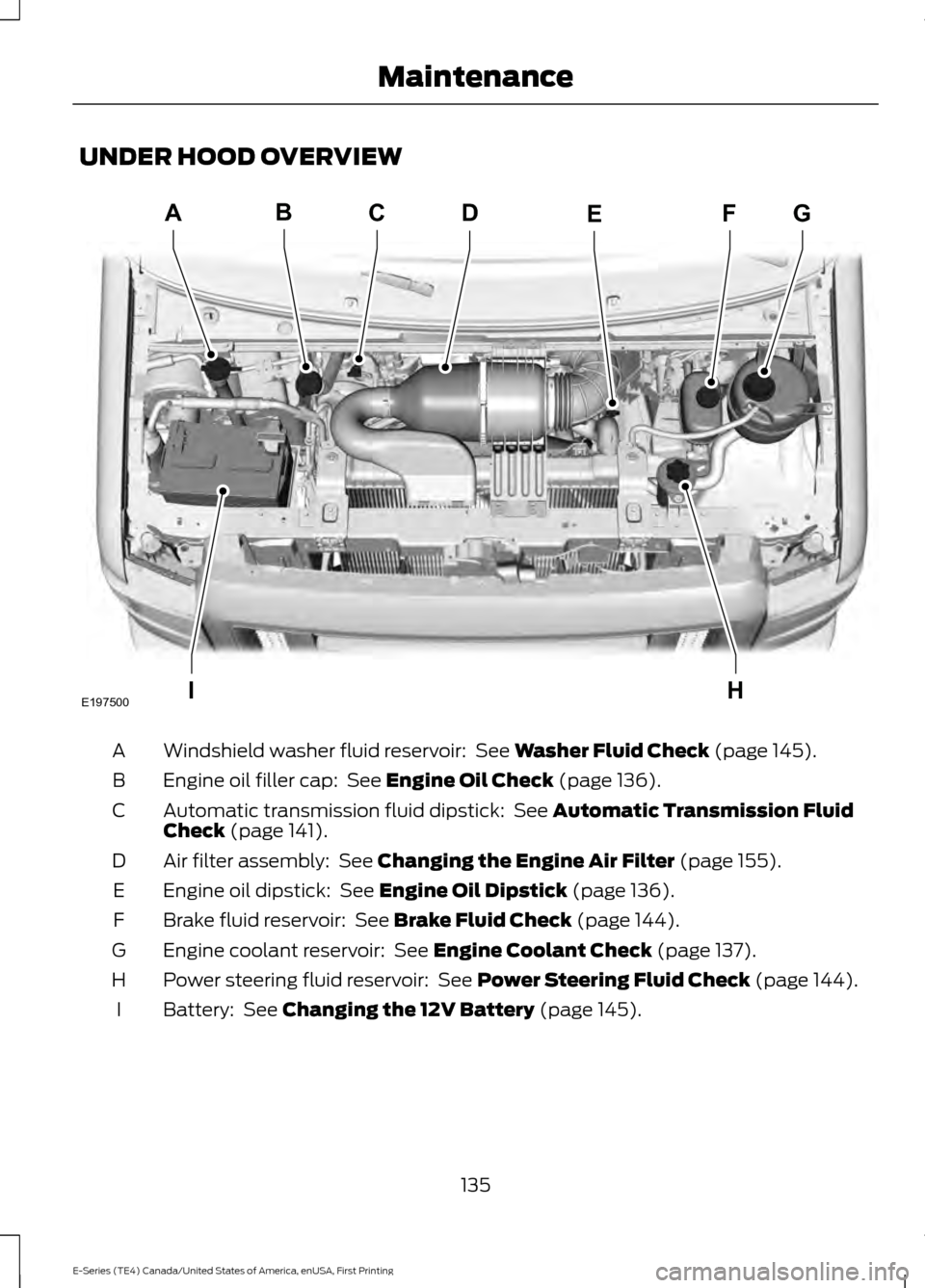
UNDER HOOD OVERVIEW
Windshield washer fluid reservoir: See Washer Fluid Check (page 145).
A
Engine oil filler cap:
See Engine Oil Check (page 136).
B
Automatic transmission fluid dipstick:
See Automatic Transmission Fluid
Check (page 141).
C
Air filter assembly:
See Changing the Engine Air Filter (page 155).
D
Engine oil dipstick:
See Engine Oil Dipstick (page 136).
E
Brake fluid reservoir:
See Brake Fluid Check (page 144).
F
Engine coolant reservoir:
See Engine Coolant Check (page 137).
G
Power steering fluid reservoir:
See Power Steering Fluid Check (page 144).
H
Battery:
See Changing the 12V Battery (page 145).
I
135
E-Series (TE4) Canada/United States of America, enUSA, First Printing MaintenanceIH
DABCEFG
E197500
Page 139 of 318

ENGINE OIL DIPSTICK
MINA
MAX
B
ENGINE OIL CHECK
Note: Check the level before starting the
engine.
Note: Make sure that the level is between
the MIN and the MAX marks.
1. Make sure that your vehicle is on level ground.
2. Turn the engine off and wait 10 minutes
for the oil to drain into the oil pan.
3. Remove the dipstick and wipe it with a clean, lint-free cloth. Replace the
dipstick and remove it again to check
the oil level.
If the level is at the MIN mark, add oil
immediately.
Adding Engine Oil
Note: Do not remove the filler cap when
the engine is running.
Note: Do not add oil further than the MAX
mark. Oil levels above the MAX mark may
cause engine damage. Only use oils certified for gasoline engines
by the American Petroleum Institute (API).
An oil with this trademark symbol
conforms to the current engine and
emission system protection standards and
fuel economy requirements of the
International Lubricants Specification
Advisory Council (ILSAC), comprised of
U.S. and Japanese automobile
manufacturers.
1. Remove the filler cap.
2. Add engine oil that meets the Ford
specifications. See Capacities and
Specifications (page 192).
3. Wipe off any spilled oil.
4. Replace the filler cap. Turn it until you feel a strong resistance.
OIL CHANGE INDICATOR
RESET
Resetting the Oil Life Monitoring
System
Only reset the oil life monitoring system
after changing the engine oil and oil filter.
136
E-Series (TE4) Canada/United States of America, enUSA, First Printing MaintenanceE161560
AB E142732
Page 140 of 318

To reset the oil life monitoring system do
the following:
1.
Switch the ignition on. Do not start the
engine.
2. Fully press the accelerator and brake pedals at the same time.
3. Keep the accelerator and brake pedals
fully pressed.
4. After three seconds, a message displays confirming the reset procedure
is in progress.
5. After 25 seconds, a message displays confirming the reset procedure is
complete.
6. Release the accelerator and brake pedals.
7. Switch the ignition off.
ENGINE COOLANT CHECK WARNINGS
Do not add engine coolant when the
engine is hot. Steam and scalding
liquids released from a hot cooling
system can burn you badly. Also, spilling
coolant on hot engine parts can burn you. Do not put engine coolant in the
windshield washer fluid container. If
sprayed on the windshield, engine
coolant could make it difficult to see
through the windshield. To reduce the risk of personal injury,
make sure the engine is cool before
unscrewing the coolant pressure
relief cap. The cooling system is under
pressure. Steam and hot liquid can come
out forcefully when you loosen the cap
slightly. Do not add coolant further than the
MAX mark. When the engine is cold, check the
concentration and level of the coolant at
the intervals listed in the scheduled
maintenance information. See Scheduled
Maintenance
(page 268).
Note: Make sure that the coolant level is
between the
MIN and MAX marks on the
coolant reservoir.
Note: Coolant expands when it is hot. The
level may extend beyond the
MAX mark.
Maintain coolant concentration within
48% to 50%, which equates to a freeze
point between -30°F (-34°C) and -34°F
(-37°C). Coolant concentration should be
checked using a refractometer. We do not
recommend the use of hydrometers or
coolant test strips for measuring coolant
concentration.
Adding Coolant WARNING
Never remove the coolant reservoir
cap while the engine is running or hot.
Note:
Automotive fluids are not
interchangeable. Do not use coolant or
windshield washer fluid outside of its
specified function and vehicle location.
Note: Do not use stop leak pellets, cooling
system sealants, or non-specified additives
as they can cause damage to the engine
cooling or heating systems. Resulting
component damage may not be covered by
the vehicle Warranty.
137
E-Series (TE4) Canada/United States of America, enUSA, First Printing Maintenance