2017 FIAT TIPO 4DOORS Windows
[x] Cancel search: WindowsPage 9 of 240
KNOWING YOUR CAR
In-depth knowledge of your new vehicle
starts here.
The booklet that you are reading simply
and directly explains how it is made and
how it works.
That’s why we advise you to read it
seated comfortably on board, so that
you can see immediately what is
described here for yourself.INSTRUMENT PANEL...........8
THE KEYS.................10
IGNITION DEVICE............11
FIAT CODE.................12
DOORS...................12
SEATS....................14
HEADRESTS................17
STEERING WHEEL............18
REAR VIEW MIRRORS.........19
EXTERNAL LIGHTS...........20
INTERIOR LIGHTS............23
WINDSCREEN WASHER / WIPER . .24
CLIMATE CONTROL SYSTEM.....26
ELECTRIC WINDOWS..........31
BONNET..................32
DUALDRIVE ELECTRIC POWER
STEERING.................33
BOOT....................34
VERSION WITH LPG SYSTEM....36
7
Page 28 of 240
CLIMATE CONTROL
SYSTEM
1)
PASSENGER
COMPARTMENT AIR
DIFFUSERS
Adjustable air diffusers
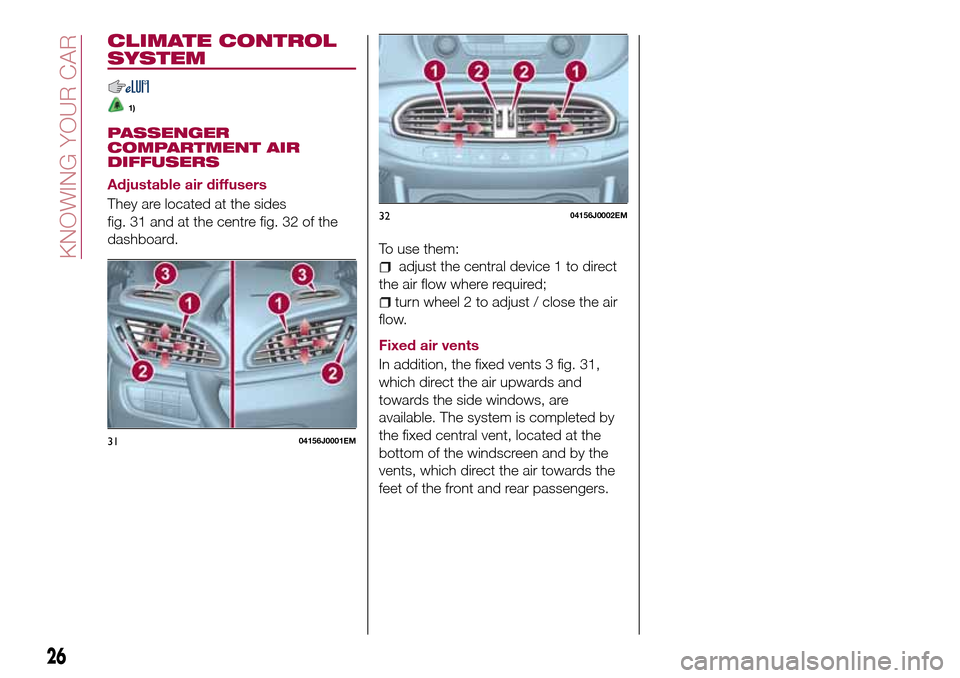
They are located at the sides
fig. 31 and at the centre fig. 32 of the
dashboard.
To use them:
adjust the central device 1 to direct
the air flow where required;
turn wheel 2 to adjust / close the air
flow.
Fixed air vents
In addition, the fixed vents 3 fig. 31,
which direct the air upwards and
towards the side windows, are
available. The system is completed by
the fixed central vent, located at the
bottom of the windscreen and by the
vents, which direct the air towards the
feet of the front and rear passengers.
3104156J0001EM
3204156J0002EM
26
KNOWING YOUR CAR
Page 30 of 240
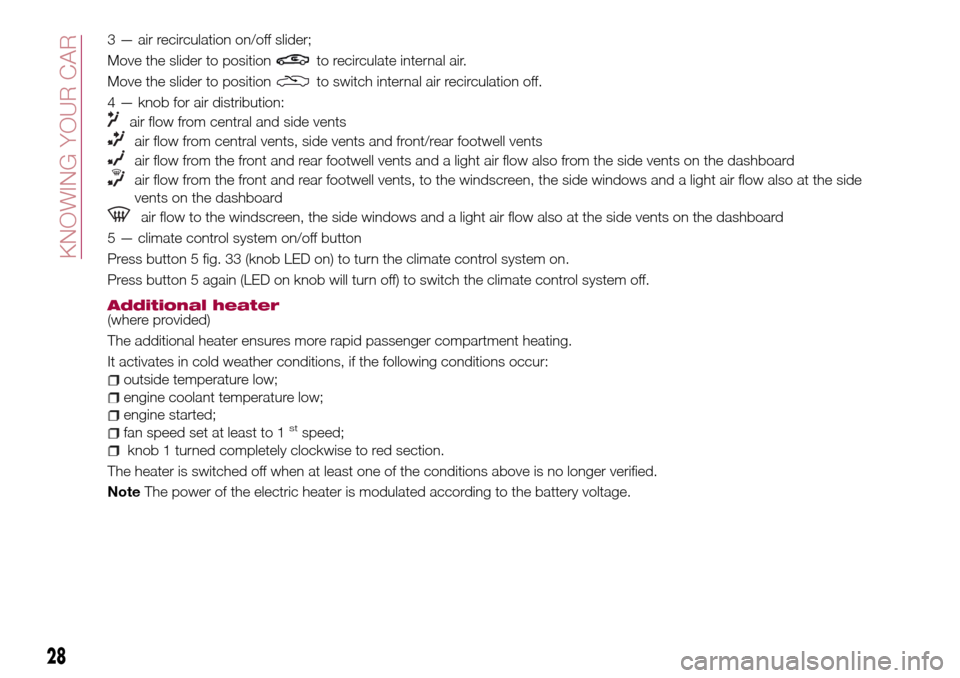
3 — air recirculation on/off slider;
Move the slider to position
to recirculate internal air.
Move the slider to position
to switch internal air recirculation off.
4 — knob for air distribution:
air flow from central and side vents
air flow from central vents, side vents and front/rear footwell vents
air flow from the front and rear footwell vents and a light air flow also from the side vents on the dashboard
air flow from the front and rear footwell vents, to the windscreen, the side windows and a light air flow also at the side
vents on the dashboard
air flow to the windscreen, the side windows and a light air flow also at the side vents on the dashboard
5 — climate control system on/off button
Press button 5 fig. 33 (knob LED on) to turn the climate control system on.
Press button 5 again (LED on knob will turn off) to switch the climate control system off.
Additional heater(where provided)
The additional heater ensures more rapid passenger compartment heating.
It activates in cold weather conditions, if the following conditions occur:
outside temperature low;
engine coolant temperature low;
engine started;
fan speed set at least to 1stspeed;
knob 1 turned completely clockwise to red section.
The heater is switched off when at least one of the conditions above is no longer verified.
NoteThe power of the electric heater is modulated according to the battery voltage.
28
KNOWING YOUR CAR
Page 32 of 240
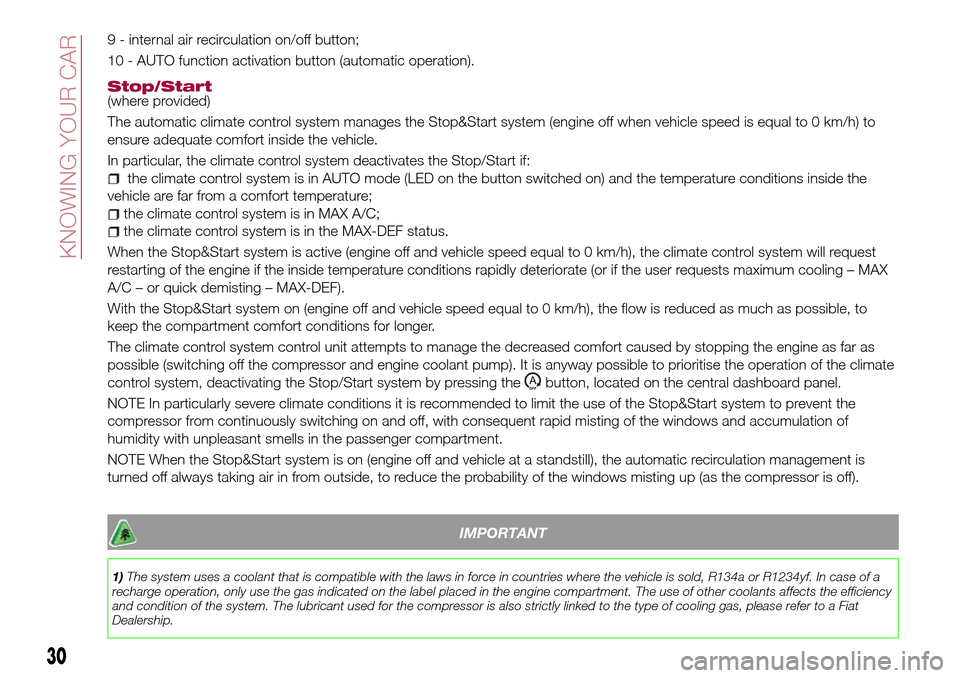
9 - internal air recirculation on/off button;
10 - AUTO function activation button (automatic operation).
Stop/Start(where provided)
The automatic climate control system manages the Stop&Start system (engine off when vehicle speed is equal to 0 km/h) to
ensure adequate comfort inside the vehicle.
In particular, the climate control system deactivates the Stop/Start if:
the climate control system is in AUTO mode (LED on the button switched on) and the temperature conditions inside the
vehicle are far from a comfort temperature;
the climate control system is in MAX A/C;
the climate control system is in the MAX-DEF status.
When the Stop&Start system is active (engine off and vehicle speed equal to 0 km/h), the climate control system will request
restarting of the engine if the inside temperature conditions rapidly deteriorate (or if the user requests maximum cooling – MAX
A/C – or quick demisting – MAX-DEF).
With the Stop&Start system on (engine off and vehicle speed equal to 0 km/h), the flow is reduced as much as possible, to
keep the compartment comfort conditions for longer.
The climate control system control unit attempts to manage the decreased comfort caused by stopping the engine as far as
possible (switching off the compressor and engine coolant pump). It is anyway possible to prioritise the operation of the climate
control system, deactivating the Stop/Start system by pressing the
button, located on the central dashboard panel.
NOTE In particularly severe climate conditions it is recommended to limit the use of the Stop&Start system to prevent the
compressor from continuously switching on and off, with consequent rapid misting of the windows and accumulation of
humidity with unpleasant smells in the passenger compartment.
NOTE When the Stop&Start system is on (engine off and vehicle at a standstill), the automatic recirculation management is
turned off always taking air in from outside, to reduce the probability of the windows misting up (as the compressor is off).
IMPORTANT
1)The system uses a coolant that is compatible with the laws in force in countries where the vehicle is sold, R134a or R1234yf. In case of a
recharge operation, only use the gas indicated on the label placed in the engine compartment. The use of other coolants affects the efficiency
and condition of the system. The lubricant used for the compressor is also strictly linked to the type of cooling gas, please refer to a Fiat
Dealership.
30
KNOWING YOUR CAR
Page 33 of 240
ELECTRIC WINDOWS
23)
Driver side front door controls
All windows can be controlled from the
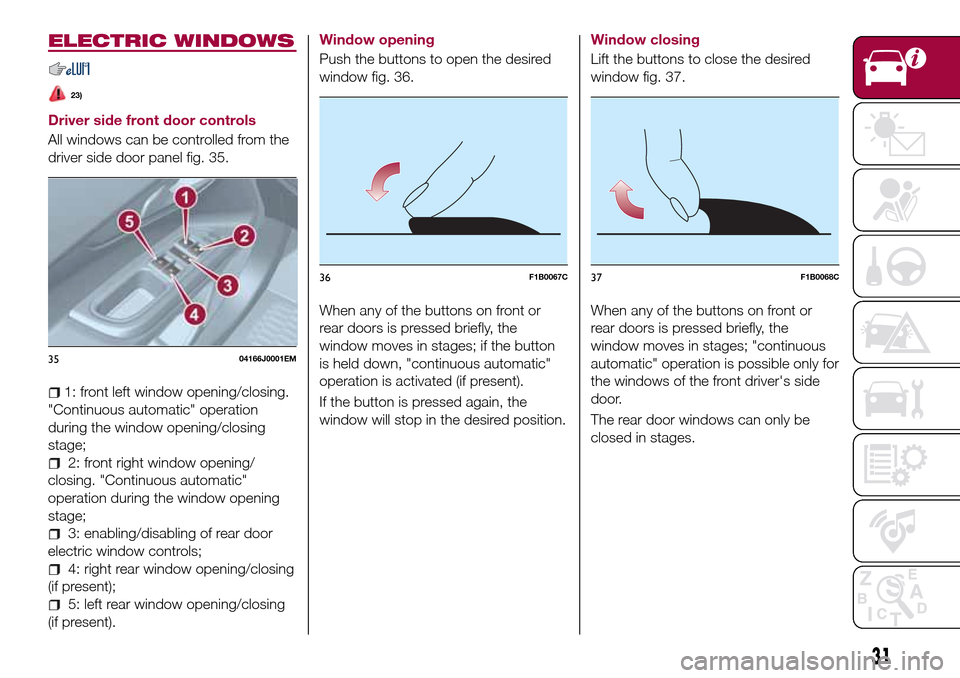
driver side door panel fig. 35.
1: front left window opening/closing.
"Continuous automatic" operation
during the window opening/closing
stage;
2: front right window opening/
closing. "Continuous automatic"
operation during the window opening
stage;
3: enabling/disabling of rear door
electric window controls;
4: right rear window opening/closing
(if present);
5: left rear window opening/closing
(if present).Window opening
Push the buttons to open the desired
window fig. 36.
When any of the buttons on front or
rear doors is pressed briefly, the
window moves in stages; if the button
is held down, "continuous automatic"
operation is activated (if present).
If the button is pressed again, the
window will stop in the desired position.Window closing
Lift the buttons to close the desired
window fig. 37.
When any of the buttons on front or
rear doors is pressed briefly, the
window moves in stages; "continuous
automatic" operation is possible only for
the windows of the front driver's side
door.
The rear door windows can only be
closed in stages.
3504166J0001EM
36F1B0067C37F1B0068C
31
Page 34 of 240
Rear manual
(for versions/markets, where provided)
To open and to close the window, use
the relevant handle 1 fig. 38.
WARNING
23)Incorrect use of the electric windows
may be dangerous. Before and during
operation, always check that nobody is
exposed to the risk of being injured either
directly by the moving window or through
objects getting caught or hit by it. When
leaving the vehicle (equipped with
mechanical key with remote control),
always remove the key from the ignition
device to prevent accidental operation of
the electric windows from being a hazard
for those still on board.
BONNET
OPENING
Proceed as follows:
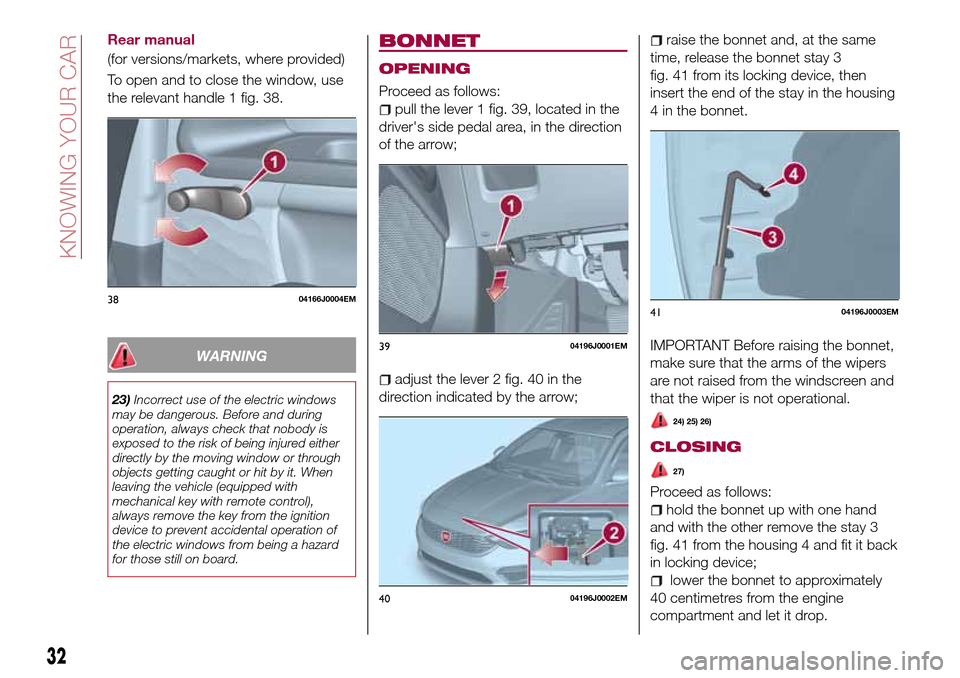
pull the lever 1 fig. 39, located in the
driver's side pedal area, in the direction
of the arrow;
adjust the lever 2 fig. 40 in the
direction indicated by the arrow;
raise the bonnet and, at the same
time, release the bonnet stay 3
fig. 41 from its locking device, then
insert the end of the stay in the housing
4 in the bonnet.
IMPORTANT Before raising the bonnet,
make sure that the arms of the wipers
are not raised from the windscreen and
that the wiper is not operational.
24) 25) 26)
CLOSING
27)
Proceed as follows:
hold the bonnet up with one hand
and with the other remove the stay 3
fig. 41 from the housing 4 and fit it back
in locking device;
lower the bonnet to approximately
40 centimetres from the engine
compartment and let it drop.
3804166J0004EM
3904196J0001EM
4004196J0002EM
4104196J0003EM
32
KNOWING YOUR CAR
Page 103 of 240

WARNING
89)Do not apply stickers or other objects
on the steering wheel, on the dashboard in
the passenger side airbag area, on side
upholstery on the roof or on the seats.
Never put objects (e.g. mobile phones) on
the passenger side of the dashboard since
they could interfere with correct inflation of
the passenger airbag and also cause
serious injury to the passengers.
90)Always drive with your hands on the
rim of the steering wheel so that the airbag
can inflate freely if required. Do not drive
with your body bent forward. Keep your
back straight against the backrest.
91)When there is an active passenger
airbag, DO NOT install rearward facing
child restraint systems on the front seat.
Deployment of the airbag in an accident
could cause fatal injuries to the child
regardless of the severity of the impact.
Therefore, always deactivate the passenger
side airbag when a rearward facing child
restraint system is installed on the front
passenger seat. The front passenger seat
must also be positioned back as far as
possible in order to prevent the child
restraint system from coming into contact
with the dashboard. Immediately reactivate
the passenger airbag as soon as the child
restraint system has been removed.
92)To deactivate the airbags using the
instrument panel menu, see the description
in the "Knowing the instrument panel"
chapter, "Menu Options" paragraph.
93)Do not affix rigid objects to the
garment hooks or support handles.94)Do not rest your head, arms or elbows
on the door, windows or the area in which
the Window bag is located to avoid
possible injury during airbag inflation.
95)Never lean your head, arms or elbows
out of the window.
96)If, when the ignition device is turned to
MAR, the
warning light does not switch
on or stays on whilst driving, a fault may
have occurred in the restraint systems. In
this case the airbags or pretensioners may
not be deployed in an impact or, in a lower
number of cases, they may be deployed
accidentally. Contact a Fiat Dealership
immediately to have the system checked.
97)In some versions, in case of a LED
failure (located on the plate of the
instrument panel), thewarning light on
the instrument panel turns on and the
passenger side airbags are deactivated.
98)On cars with side bags, do not cover
the front seat backrests with extra covers.
99)Do not travel carrying objects in your
lap, in front of your chest or between your
lips (pipe, pencils, etc.): they could cause
severe injury if the airbag is deployed.
100)If the car has been stolen or in the
case of attempt to steal it, if it has been
subjected to vandalism or floods, have the
airbag system checked by a Fiat
Dealership.101)If the ignition device is at MAR, even if
the engine is switched off, airbags may be
deployed when the vehicle is stationary
and hit by another vehicle. Therefore, even
if the vehicle is stationary, when an active
front passenger airbag is fitted, DO NOT
install rearward facing child restraint
systems on the front passenger seat.
Deployment of the airbag following an
impact could cause fatal injuries to the
child. Therefore, always deactivate the
passenger side airbag when a rearward
facing child restraint system is installed on
the front passenger seat. The front
passenger seat must also be positioned
back as far as possible in order to prevent
the child restraint system from coming into
contact with the dashboard. Immediately
reactivate the passenger airbag as soon as
the child restraint system has been
removed. Also remember that, if the
ignition device is set to STOP, none of the
safety devices (airbags or pretensioners)
will be deployed in the event of collision.
Non-deployment in such cases does not
indicate a system malfunction.
102)Malfunction of the
warning light is
indicated by the activation of an airbag
failure icon and a dedicated message on
the instrument panel display (or, for
versions where provided, by the activation
of a blinking generic failure warning light).
The pyrotechnic charges are not disabled.
Contact a Fiat Dealership immediately to
have the system checked.
103)The airbag deployment threshold is
higher than that of the pretensioners. For
collisions in the range between the two
thresholds, it is normal for only the
pretensioners to be activated.
101
Page 174 of 240
AIR FILTER
160)
Replacing the air cleaner
See the "Scheduled servicing plan" for
the correct servicing intervals.
It is advisable to replace it with a
genuine spare part, specifically
designed for this vehicle.
AIR CONDITIONING
SYSTEM MAINTENANCE
70) 71)
To ensure the best possible
performance, the air conditioning
system must be checked and undergo
maintenance at a Fiat Dealership at the
beginning of the summer.
WINDOWS
When cleaning the heated rear window
be careful, if the defrosting function is
active, regarding the temperature of the
window; also make sure that children
do not come into contact with the
heated surface. The window may be
hot.
Never use an abrasive detergent to
clean the surface of the windows.
Do not use scrapers or sharp items that
might scratch the windows.Spray the detergent on the cloth to be
used for cleaning the rear view mirror.
Do not spray the detergent directly on
the window.
Cleaning the window with hot water
could cause the removal of any labels.
WINDSCREEN WIPER
Replacing the windscreen wiper
blades
Proceed as follows:
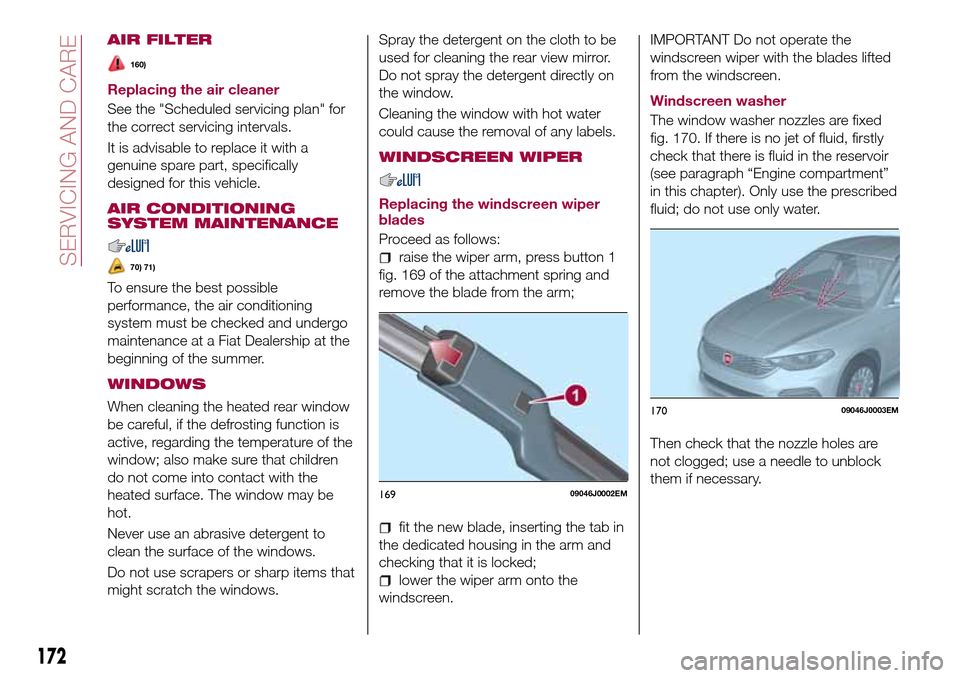
raise the wiper arm, press button 1
fig. 169 of the attachment spring and
remove the blade from the arm;
fit the new blade, inserting the tab in
the dedicated housing in the arm and
checking that it is locked;
lower the wiper arm onto the
windscreen.
IMPORTANT Do not operate the
windscreen wiper with the blades lifted
from the windscreen.
Windscreen washer
The window washer nozzles are fixed
fig. 170. If there is no jet of fluid, firstly
check that there is fluid in the reservoir
(see paragraph “Engine compartment”
in this chapter). Only use the prescribed
fluid; do not use only water.
Then check that the nozzle holes are
not clogged; use a needle to unblock
them if necessary.
16909046J0002EM
17009046J0003EM
172
SERVICING AND CARE