2017 FIAT SPIDER ABARTH service
[x] Cancel search: servicePage 196 of 292
Replacing Interior Light
Bulbs
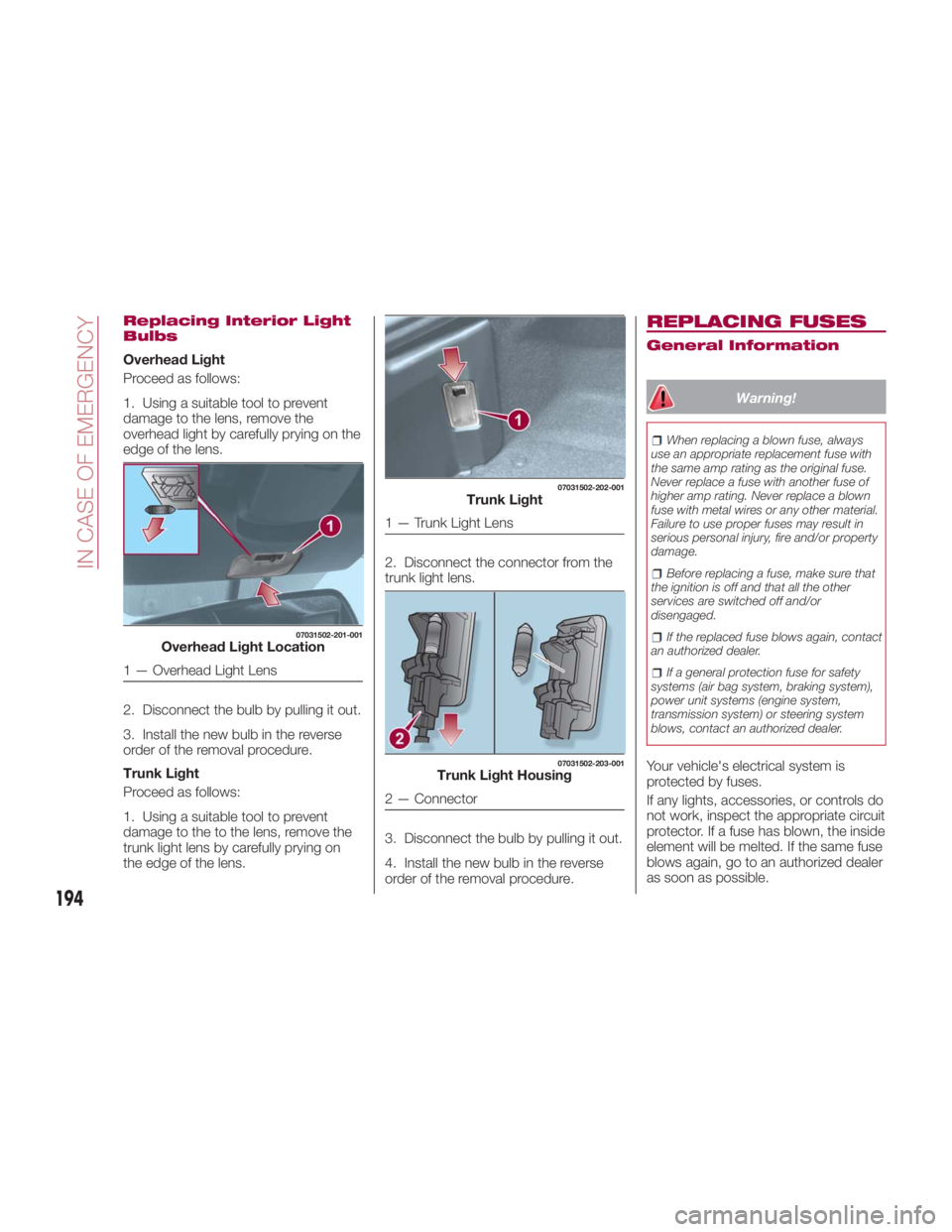
Overhead Light
Proceed as follows:
1. Using a suitable tool to prevent
damage to the lens, remove the
overhead light by carefully prying on the
edge of the lens.
2. Disconnect the bulb by pulling it out.
3. Install the new bulb in the reverse
order of the removal procedure.
Trunk Light
Proceed as follows:
1. Using a suitable tool to prevent
damage to the to the lens, remove the
trunk light lens by carefully prying on
the edge of the lens. 2. Disconnect the connector from the
trunk light lens.
3. Disconnect the bulb by pulling it out.
4. Install the new bulb in the reverse
order of the removal procedure. REPLACING FUSES General Information
Warning! When replacing a blown fuse, always
use an appropriate replacement fuse with
the same amp rating as the original fuse.
Never replace a fuse with another fuse of
higher amp rating. Never replace a blown
fuse with metal wires or any other material.
Failure to use proper fuses may result in
serious personal injury, fire and/or property
damage.
Before replacing a fuse, make sure that
the ignition is off and that all the other
services are switched off and/or
disengaged.
If the replaced fuse blows again, contact
an authorized dealer.
If a general protection fuse for safety
systems (air bag system, braking system),
power unit systems (engine system,
transmission system) or steering system
blows, contact an authorized dealer.
Your vehicle's electrical system is
protected by fuses.
If any lights, accessories, or controls do
not work, inspect the appropriate circuit
protector. If a fuse has blown, the inside
element will be melted. If the same fuse
blows again, go to an authorized dealer
as soon as possible.07031502-201-001
Overhead Light Location
1 — Overhead Light Lens 07031502-202-001
Trunk Light
1 — Trunk Light Lens 07031502-203-001
Trunk Light Housing
2 — Connector
194
IN CASE OF EMERGENCY
Page 205 of 292

JACKING AND TIRE
CHANGING Warning!Do not attempt to change a tire on the
side of the vehicle close to moving traffic.
Pull far enough off the road to avoid the
danger of being hit when operating the jack
or changing the wheel.
Being under a jacked-up vehicle is
dangerous. The vehicle could slip off the
jack and fall on you. You could be crushed.
Never put any part of your body under a
vehicle that is on a jack. If you need to get
under a raised vehicle, take it to a service
center where it can be raised on a lift.
The jack is designed to be used as a
tool for changing tires only. The jack should
not be used to lift the vehicle for service
purposes. The vehicle should be jacked on
a firm level surface only. Avoid ice or
slippery areas. Tools Location
Your vehicle may be equipped with a
spare tire, jack, lug wrench and tow
eyes. For details, contact an authorized
dealer.
Tools are stored in the trunk.
Preparations For
Jacking
To Remove The Jack
Proceed as follows:
1. In the right side of the trunk, pull the
cover tab to remove cover. 2. Turn the wing bolt and jack screw
counterclockwise. 08020100-122-002
Jack Tools
1 — Jack Lever
2 — Lug Wrench (If Equipped)
3 — Tow Eyes (If Equipped) 08020101-124-001
Jack Location
1 — Cover Tab
2 — Jack And Tools Cover 08020101-122-001
Jack Components
3 — Wing Bolt
4 — Jack Screw
203
Page 207 of 292

Removing A Tire
Warning!Carefully follow these tire changing
warnings to help prevent personal injury or
damage to your vehicle:
Always park on a firm, level surface as
far from the edge of the roadway as
possible before raising the vehicle.
Turn on the Hazard Warning flasher.
Block the wheel diagonally opposite the
wheel to be raised.
Set the parking brake firmly and set the
transmission in PARK.
Do not let any passenger sit in the
vehicle when it is on a jack.
Do not get under the vehicle when it is
on a jack. If you need to get under a raised
vehicle, take it to a service center where it
can be raised on a lift.
Only use the jack in the positions
indicated and for lifting this vehicle during a
tire change.
If working on or near a roadway, be
extremely careful of motor traffic.
Proceed as follows:
1. Loosen the lug nuts by turning them
counterclockwise one turn each, but do
not remove any lug nuts until the tire
has been raised off the ground. 2. Place the jack under the lift point
closest to the tire being changed with
the jack head squarely under the
jacking location.
3. Turn the jack screw in the direction
shown and adjust the jack head so that
it is close to the jacking location. 4. Continue raising the jack head
gradually by rotating the screw with
your hand until the jack head is inserted
into the lift point.
Caution!Do not attempt to raise the vehicle by
jacking on locations other than those
indicated in the Jacking Instructions for this
vehicle.
5. Insert the jack lever and attach the
lug wrench to tire jack. 08020301-123-001
Loosen Lug Nuts Counterclockwise 08020301-ALL-003
Raising The Jack
1 — Jack Head 08020301-121-001
Front Jacking Location
205
Page 208 of 292

Warning!Being under a jacked-up vehicle is
dangerous. The vehicle could slip off the
jack and fall on you. You could be crushed.
Never get any part of your body under a
vehicle that is on a jack. If you need to get
under a raised vehicle, take it to a service
center where it can be raised on a lift.
6. Turn the jack handle clockwise and
raise the vehicle high enough so that
the tire is just raised off the ground and
can be removed. Before removing the
lug nuts, make sure your vehicle is
firmly in position and that it cannot slip
or move. Warning!Raising the vehicle higher than necessary
can make the vehicle less stable. It could
slip off the jack and hurt someone near it.
Raise the vehicle only enough to remove
the tire.
7. Remove the lug nuts by turning
them counterclockwise, then remove
the wheel.
Locking Lug Nuts — If Equipped
If your vehicle has optional anti-theft
wheel lug nuts, one on each wheel will
lock the tires and you must use a
special key to unlock them. This key will
attach to the lug wrench.
Register them with the lock
manufacturer by filling out the card
provided in the glove compartment and
mailing it in the accompanying
envelope. If you lose this key, contact
an authorized dealer or use the lock
manufacturer's order form, which is
with the registration card.
Accessory wheel locks cannot be used
on steel wheels. This includes situations
when the spare tire is installed. If the
spare tire is installed, one of the original
lug nuts (which should still be in the
vehicle) must be installed in place of the
wheel lock. To Remove An Anti-theft Lug Nut
Proceed as follows:
1. Obtain the special key for the
anti-theft lug nut.
2. Place the special key on top of the
anti-theft lug nut, and be sure to hold
the key square to it. If you hold the key
at an angle, you may damage both key
and nut. Do not use a power impact
wrench.
3. Place the lug wrench on top of the
key and apply pressure. Turn the
wrench counterclockwise.
To Install The Anti-theft Lug Nut
Proceed as follows:
1. Place the special key on top of the
nut, and be sure to hold the key square
to it. If you hold the key at an angle, you
may damage both key and nut. Do not
use a power impact wrench.
2. Place the lug wrench on top of the
special key, apply pressure, and turn it
clockwise.
Mounting The Tire
Proceed as follows:
1. Remove dirt and grime from the
mounting surfaces of the wheel and
hub, including the hub bolts, with a
cloth.08020301-ALL-006
Jack With Lug Wrench Attached
206
IN CASE OF EMERGENCY
Page 209 of 292

2. Mount the tire and install the lug
nuts with the beveled edge inward, then
tighten them by hand.
Caution!Be sure to mount the spare tire with the
valve stem facing outward. The vehicle
could be damaged if the spare tire is
mounted incorrectly.
3. Turn the lug wrench
counterclockwise and lower the vehicle.
Use the lug wrench to tighten the nuts
in the order shown. Warning!To avoid the risk of forcing the vehicle off
the jack, do not tighten the wheel nuts fully
until the vehicle has been lowered. Failure
to follow this warning may result in serious
injury.
4. After tightening the lug nuts, have
them checked with a torque wrench by
your authorized dealer or service station
to verify correct tightness.
5. Remove the tire blocks and store
the tools and jack.
6. Check the inflation pressure. Refer
to “Recommended Tire Inflation
Pressure” in “Technical Specifications”
for more information. With TPMS
Do not push the tire pressure
monitoring system set switch after
installing the spare tire. The switch is
only to be pushed after installing the
repaired flat tire or installing a
replacement tire.
Note: To prevent the jack and tool from
rattling, store them properly.
Warning!A loose tire or jack thrown forward in a
collision or hard stop could endanger the
occupants of the vehicle. Always stow the
jack parts and the spare tire in the places
provided. Have the deflated (flat) tire
repaired or replaced immediately.08020303-XX4-001
Clean Mounting Surface 08020303-122-001
Lug Nut Tightening Order
207
Page 210 of 292

TIRE SERVICE KIT Tire Service Storage
The Tire Service Kit is located inside the
trunk.
The Tire Service Kit included with your
vehicle is for a temporary repair of a
slightly damaged flat tire resulting from
running over nails or similar sharp
objects on the road surface.
Perform the emergency flat tire repair
without removing the nail or similar
sharp object which punctured the tire.
Note: Your vehicle is not equipped with
a spare tire. In the event of a flat tire,
use the Tire Service Kit to repair the tire
temporarily. When doing the repair, refer
to the instructions included in the Tire
Service Kit. If an emergency repair was
performed on a flat tire using the Tire
Service Kit, contact an authorized
dealer to repair or replace the tire as
soon as possible. Tire Service Kit
Components And
Operation
The Tire Service Kit includes the
following items:
U.S.A. And Canada Markets: Mexico Market:08020202-121-003
Tire Service Kit Location 08070606457457
Tire Service Kit Components —
U.S.A. And Canada Markets
1— Sealant Bottle
2— Compressor
3— Speed Restriction Sticker
4— Repaired Tire Sticker
5— Instructions 08070606456456
Tire Service Kit Components —
Mexico Markets
1— Tire Sealant
2— Compressor
3— Valve Core Tool
4— Injection Hose
5— Spare Valve Core
6— Speed Restriction Sticker
7— Instructions
208
IN CASE OF EMERGENCY
Page 211 of 292

Tire Service Usage
Precautions
The tire sealant cannot be reused. If the
sealant has been used, or is expired,
purchase new tire sealant at an
authorized dealer.
Note: The Tire Service Kit cannot be
used in the following cases. Consult an
authorized dealer if any of these
conditions exist:
The period of effective use for the
tire sealant has expired (the period of
effectiveness is indicated on the bottle
label)
The tear or puncture in the tire
exceeds about 0.16 inches (4 mm)
The damage has occurred to an
area of the tire other than the tread
The vehicle has been driven with
nearly no air remaining in the tire
The tire has come off the wheel rim
Damage to the wheel rim has
occurred
The tire has two or more punctures Sealing A Tire With Tire
Service Kit
Warning!Do not attempt to seal a tire on the side
of the vehicle closest to traffic. Pull far
enough off the road to avoid the danger of
being hit when using the Tire Service Kit.
Do not use Tire Service Kit or drive the
vehicle under the following circumstances:
If the puncture in the tire tread is
approximately 1/4 inch (6 mm) or larger.
If the tire has any sidewall damage.
If the tire has any damage from driving
with extremely low tire pressure.
If the tire has any damage from driving
on a flat tire.
If the wheel has any damage.
If you are unsure of the condition of the
tire or the wheel.
Keep Tire Service Kit away from open
flames or heat sources.
A loose Tire Service Kit thrown forward
in a collision or hard stop could endanger
the occupants of the vehicle. Always stow
the Tire Service Kit in the place provided.
Failure to follow these warnings can result
in injuries that are serious or fatal to you,
your passengers, and others around you.
Take care not to allow the contents of
Tire Service Kit to come in contact with
hair, eyes, or clothing. Tire Service Kit
sealant is harmful if inhaled, swallowed, or absorbed through the skin. It causes skin,
eye, and respiratory irritation. Flush
immediately with plenty of water if there is
any contact with eyes or skin. Change
clothing as soon as possible, if there is any
contact with clothing.
Tire Service Kit Sealant solution contains
latex. In case of an allergic reaction or rash,
consult a physician immediately. Keep Tire
Service Kit out of reach of children. If
swallowed, rinse mouth immediately with
plenty of water and drink plenty of water.
Do not induce vomiting! Consult a
physician immediately.
U.S.A. And CANADA Markets:
Proceed as follows:
1. Pull over to a safe location and turn
on the vehicle’s Hazard Warning Lights.
2. Verify that the valve stem (on the
wheel with the deflated tire) is in a
position that is near to the ground. This
will allow the Tire Service Kit hoses to
reach the valve stem and keep the Tire
Service Kit flat on the ground. This will
provide the best positioning of the kit
when injecting the sealant into the
deflated tire and running the air pump.
Move the vehicle as necessary to place
the valve stem in this position before
proceeding.
3. Place the gear selector in REVERSE
for a manual transmission, and PARK
for automatic transmission.
209
Page 212 of 292

4. Apply the parking brake with the
brake pedal pressed and turn the
engine OFF.
5. Unload passengers and cargo, then
remove the Tire Service Kit.
6. Gently shake the sealant bottle to
mix the contents. Then extend the
injection hose. Note:
Do not shake the bottle
excessively. Otherwise, the sealant
could spray out of the injection hose. If
the sealant contacts clothing or other
objects, you may not be able to
remove it.
The sealant hardens easily, and
injecting it will be difficult under cold
weather conditions (32 °F (0 °C) or
below). Warm the sealant inside the
vehicle to facilitate injection.
7. Pull out the air compressor hose
and the air compressor plug from the
air compressor.
8. Install the air compressor hose,
which was pulled out of the air
compressor, into the injection valve of
the bottle. Note: Make sure that the air
compressor switch is off before
inserting the air compressor hose into
the injection valve of the bottle. If the air
compressor hose is not installed to the
injection valve of the bottle securely, the
sealant may leak.
9. Remove the valve cap from the valve
of the flat tire, install the injection hose
to the tire valve, and turn the sleeve to
the right to tighten.08020202-121-003
Tire Service Kit Location 08020202-03A-666
Sealant Bottle With Injection Hose
1 — Injection Hose 08020202-36A-004
Air Compressor With Hose And
Plug
2 — Air Compressor Hose 08020202-031-670
Install Air Compressor To Sealant
Bottle
3 — Air Compressor Hose
4 — Injection Valve
210
IN CASE OF EMERGENCY