2017 FIAT SPIDER ABARTH engine overheat
[x] Cancel search: engine overheatPage 221 of 292

IF YOUR ENGINE
OVERHEATS If Your Engine Overheats
In any of the following situations, you
can reduce the potential for overheating
by taking the appropriate action.
On highways — slow down.
In city traffic — while stopped, place
the transmission in NEUTRAL, but do
not increase engine idle speed.
Note: There are steps that you can
take to slow down an impending
overheat condition:
If your air conditioner (A/C) is on,
turn it off. The A/C system adds heat
to the engine cooling system and
turning the A/C off can help remove
this heat.
You can also turn the temperature
control to maximum heat, the mode
control to floor and the blower control
to high. This allows the heater core to
act as a supplement to the radiator
and aids in removing heat from the
engine cooling system. Warning!You or others can be badly burned by hot
engine coolant (antifreeze) or steam from
your radiator. If you see or hear steam
coming from under the hood, do not open
the hood until the radiator has had time to
cool. Never try to open a cooling system
pressure cap when the radiator or coolant
bottle is hot.
Caution!Driving with a hot cooling system could
damage your vehicle. If temperature gauge
reads “H”, pull over and stop the vehicle.
Idle the vehicle with the air conditioner
turned off until the pointer drops back into
the normal range. If the pointer remains on
the “H”, turn the engine off immediately,
and call for service. If Steam Is Coming From The
Engine Compartment:
Do not go near the front of the vehicle.
Stop the engine. Wait until the steam
dissipates, then open the hood and
start the engine.
If Neither Coolant Nor Steam Is
Escaping:
Open the hood and idle the engine until
it cools.
Note:
If the cooling fan does not operate
while the engine is running, the engine
temperature will increase. Stop the
engine and contact an authorized
dealer.
If the engine continues to overheat
or frequently overheats, have the
cooling system inspected. The engine
could be seriously damaged unless
repairs are made. Contact an
authorized dealer.
219
Page 235 of 292

Inspecting Coolant Level
Note: Changing the coolant should be
done by your authorized dealer.
Inspect the antifreeze protection and
coolant level in the coolant reservoir at
least once a year, at the beginning of
the winter season, and before traveling
where temperatures may drop below
freezing.
Inspect the condition and connections
of all cooling system and heater hoses.
Replace any that are worn or
deteriorated.
Warning!Do not open hot engine cooling system.
Never add engine coolant (antifreeze) when
the engine is overheated. Do not loosen or
remove the cap to cool an overheated
engine. Heat causes pressure to build up in
the cooling system. To prevent scalding or
injury, do not remove the pressure cap
while the system is hot or under pressure.
Do not use a pressure cap other than
the one specified for your vehicle. Personal
injury or engine damage may result.
The coolant should be at full in the
radiator and between the F (Full) and L
(Low) marks on the coolant reservoir
when the engine is cool. If it is at or near L (Low), add coolant by
mixing a minimum solution of 50%
Mopar Long Life Coolant Concentrate
for FIAT Spider. Use higher
concentrations (not to exceed 70%) if
temperatures below −34°F (−37°C) are
anticipated. Bring the level to F (Full).
Please contact your authorized dealer
for assistance.
Securely tighten the coolant reservoir
tank cap after adding coolant.
If the coolant reservoir is empty or new
coolant is required frequently, contact
your authorized dealer.
Brake/Clutch Fluid
Inspecting Brake/Clutch Fluid Level
The brakes and clutch draw fluid
from the same reservoir.
Inspect the fluid level in the reservoir
regularly. It should be kept between the MAX
and MIN lines.
The level normally drops with
accumulated use, a condition
associated with wear of brake and
clutch linings. If it is excessively low,
have the brake/clutch system
inspected. Contact your authorized
dealer.
Warning! Use only manufacturer's recommended
brake fluid. Refer to “Fluids And Lubricants”
in “Technical Specifications” for further
information. Using the wrong type of brake
fluid can severely damage your brake
system and/or impair its performance. The
proper type of brake fluid for your vehicle is
also identified on the original factory
installed hydraulic master cylinder reservoir. 07030501-121-001
Coolant Reservoir 07030601-121-002
Brake Fluid Reservoir
233
Page 287 of 292

Electronic Brake Control System
Traction Control System ..... .112
Electronic Speed Control (Cruise
Control) ................ .159
Emergency fuel filler door release . .176
Emergency Key ..............16
Emergency, In Case Of ........ .208
Hazard Warning Flasher ..... .184
Jacking ......... .203,204,237
Jump Starting ........... .217
Overheating ............ .219
Towing ............. .220,221
Emission control system .........74
Emission Control System
Maintenance ............. .110
Engine .................. .269
Exhaust Gas Caution ....... .175
Fails To Start ............ .218
Flooded, Starting ......... .218
Jump Starting ........... .217
Overheating ............ .219
Starting ............. .20,218
Engine compartment ......... .231
Engine coolant (level check) ..... .232
Engine oil (level check) ........ .232
Environment protection systems ....74
Essential information ............3
Ethanol .................. .173
Event Data Recorder ......... .145 Exhaust Gas Caution ......... .175
Exterior Lights ...............38
Flash-To-Pass ...............40
Flashers
Hazard Warning .......... .184
Turn Signal ...............41
Flooded Engine Starting ....... .218
Fluid And Lubricants ......... .276
Fluid Capacities ............ .275
Fog Lights ..................41
Follow Me Home .............40
Front lights (light bulbs) ........
.187
Fr
ont Wipers
Wiper Operation ...........42
Fuel
Additives .............. .174
Clean Air .............. .173
Ethanol ............... .173
Materials Added .......... .174
Methanol .............. .173
Fuel Consumption Display ........85
Fuel Economy Monitor ..........84
Fuel filler cap .............. .175
Fuel filler door .............. .175
Fuse block (engine compartment) . .197
Fuse block (interior) .......... .201
Fuses (interior) ............. .195
Fuses (underhood) ........... .196 Gasoline, Clean Air .......... .173
Gasoline, Reformulated ....... .173
Gear selector positions ........ .154
GVWR .................. .176
Hazard Warning Flasher ....... .184
Hazardous driving ........... .178
Head Restraints ..............34
Headlight ..................38
Headlights
Adjusting The Headlight Abroad .......................42
High Beam ...............40
Passing .................40
Heavy-duty use of the vehicle
(scheduled servicing) ....... .225
HomeLink (Garage Door Opener) . . .58
Hood Release ...............68
How to use this manual ..........3
Identification Data ........... .266
Inside Rearview Mirror ..........36
Instrument Cluster Display
Information Display ....... .76,77
Interior Lights ................62
Interiors ................. .262
Internal Equipment ............60
Jack Location .............. .203
Jack Operation ....... .203,204,237
Jump Starting .............. .217
Page 288 of 292
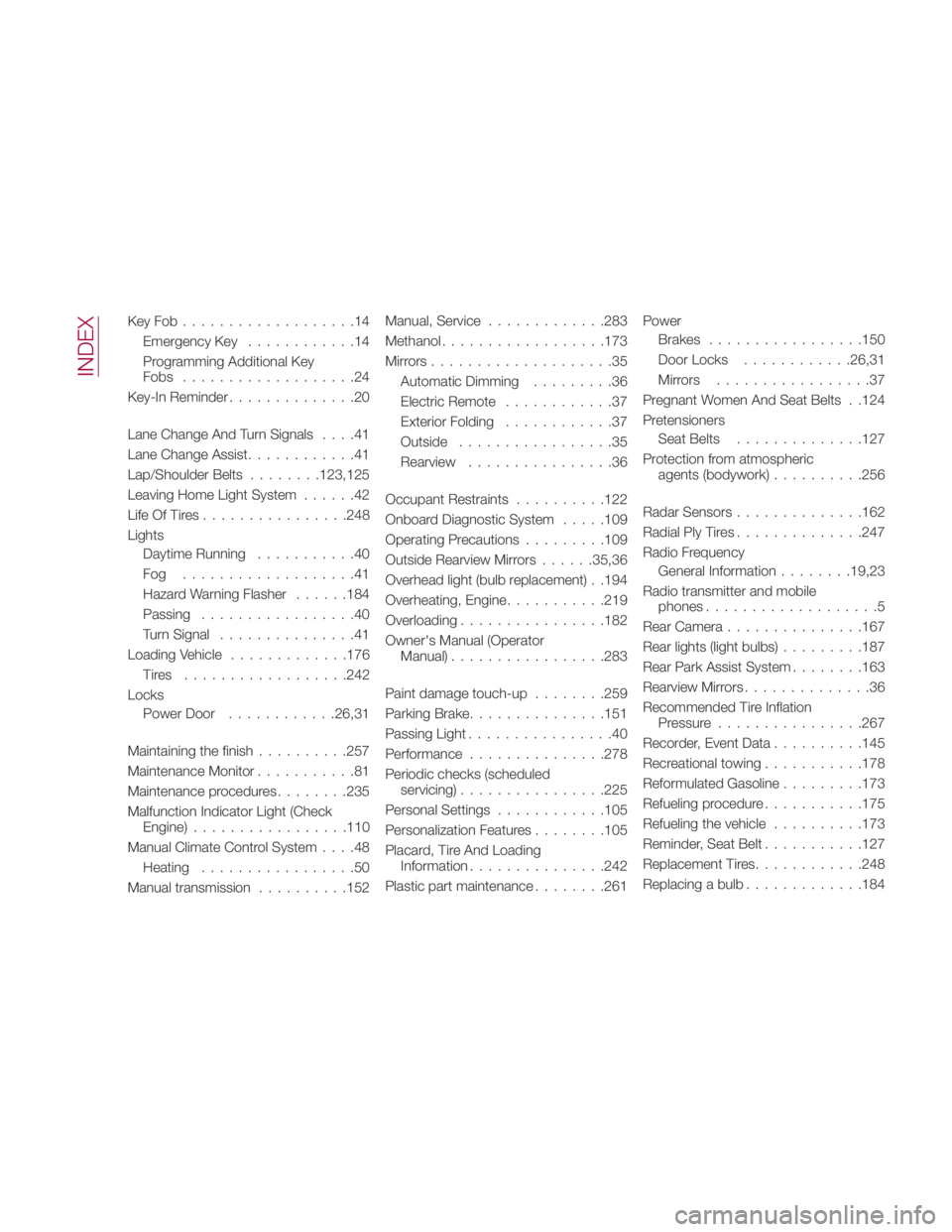
KeyFob...................14
Emergency Key ............14
Programming Additional Key
Fobs ...................24
Key-In Reminder ..............20
Lane Change And Turn Signals ....41
Lane Change Assist ............41
Lap/Shoulder Belts ....... .123,125
Leaving Home Light System ......42
Life Of Tires ............... .248
Lights
Daytime Running ...........40
Fog ...................41
Hazard Warning Flasher ..... .184
Passing .................40
Turn Signal ...............41
Loading Vehicle ............ .176
Tires ................. .242
Locks
PowerDoor ........... .26,31
Maintaining the finish ......... .257
Maintenance Monitor ...........81
Maintenance procedures ....... .235
Malfunction Indicator Light (Check
Engine) ................ .110
Manual Climate Control System ....48
Heating .................50
Manual transmission ......... .152 Manual, Service ............ .283
Methanol ................. .173
Mirrors....................35
Automatic Dimming .........36
Electric Remote ............37
Exterior Folding ............37
Outside .................35
Rearview ................36
Occupant Restraints ......... .122
Onboard Diagnostic System .... .109
Operating Precautions ........ .109
Outside Rearview Mirrors ..... .35,36
Overhead light (bulb replacement) . .194
Overheating, Engine .......... .219
Overloading ............... .182
Owner's Manual (Operator
Manual) ................ .283
Paint damage touch-up ....... .259
Parking Brake ..............
.151
Passing
Light ................ 40
Performance .............. .278
Periodic checks (scheduled
servicing) ............... .225
Personal Settings ........... .105
Personalization Features ....... .105
Placard, Tire And Loading
Information .............. .242
Plastic part maintenance ....... .261 Power
Brakes ................ .150
Door Locks ........... .26,31
Mirrors .................37
Pregnant Women And Seat Belts . .124
Pretensioners
Seat Belts ............. .127
Protection from atmospheric
agents (bodywork) ......... .256
Radar Sensors ............. .162
Radial Ply Tires ............. .247
Radio Frequency
General Information ....... .19,23
Radio transmitter and mobile
phones ...................5
Rear Camera .............. .167
Rear lights (light bulbs) ........ .187
Rear Park Assist System ....... .163
Rearview Mirrors ..............36
Recommended Tire Inflation
Pressure ............... .267
Recorder, Event Data ......... .145
Recreational towing .......... .178
Reformulated Gasoline ........ .173
Refueling procedure .......... .175
Refueling the vehicle ......... .173
Reminder, Seat Belt .......... .127
Replacement Tires ........... .248
Replacing a bulb ............ .184
INDEX