2017 FIAT QUBO oil temperature
[x] Cancel search: oil temperaturePage 132 of 260

SAVING FUEL
Some useful tips are given below for fuel saving and
reducing harmful emissions of CO2 and other
pollutants (nitrogen oxides, unburnt hydrocarbons,
Particulate Matter (PM) etc.).
GENERAL CONSIDERATIONS
The general factors that affect fuel consumption are
listed below.
Vehicle maintenance
Have checks and adjustments carried out in
accordance with the “Scheduled Servicing Plan”.
Ty r e s
Check the tyre pressure at least once every four
weeks: if the pressure is too low, consumption levels
increase as resistance to rolling is higher.
Unnecessary loads
Do not travel with an overloaded boot. The weight
of the vehicle (especially when driving in town)
and its trim greatly affect fuel consumption
and stability.
Roof rack/ski rack
Remove the roof rack or the ski rack from the roof
after use. These accessories reduce the aerodynamic
coefficient of the vehicle and have a negative effecton fuel consumption. It is better to use a trailer to
transport particularly bulky objects.
Electric devices
Only use electrical devices for the amount of time
needed. The heated rear window, additional
headlights, windscreen/rear window wipers and
heater fan need a considerable amount of energy,
therefore increasing fuel consumption (by up to 25%
in the urban cycle).
Climate control system
The air conditioner leads to higher fuel consumption
(on average up to +20%). If the temperature outside
is not too extreme, try and use the air vents.
Spoilers
The use of non-certified spoilers may adversely affect
aerodynamics and fuel consumption.
128
KNOWING YOUR
VEHICLE
SAFETY
STARTING AND
DRIVING
WARNING LIGHTS
AND MESSAGES
IN AN EMERGENCY
SERVICING AND
CARE
TECHNICAL DATA
INDEX
Page 141 of 260

On steady: LOW ENGINE OIL
PRESSURE (red) - Blinking:
DEGRADED ENGINE OIL (Multijet
E5 versions only - red)
When the ignition key is turned to MAR, the warning
light switches on, but it should go out as soon as
the engine is started.
Low engine oil pressure
The warning light turns on and stays on constantly
(in versions/markets, where provided) along with the
message on the display when the system detects
that engine oil pressure is low.
WARNING
If the warning lightturns on when
the car is travelling (on certain versions
together with the message on the display) stop
the engine immediately and contact a Fiat
Dealership.
Degraded engine oil (Multijet versions with
DPF only)
The warning light
blinks along with a message on
the display (for versions/markets, where provided)
when the system detects that engine oil pressure
is low.
If the warning light flashes, this does not mean that
the vehicle is defective, but simply informs the driver
that the oil needs to be changed as a result of regularvehicle use. If the oil is not changed, warning light
will also come on and engine operation is limited
to 3000 rpm when a second threshold is reached.
If the oil is not changed, the engine is limited to 1500
rpm to prevent damage when a third threshold is
reached.
Remember that the deterioration of the engine oil is
accelerated by:
mainly town use of the vehicle which makes the
DPF regeneration process more frequent;
use of the vehicle for short journeys, preventing
the engine from reaching operating temperature;
repeated interruption of the regeneration process,
signalled by the DPF warning light coming on.
If the warning light switches on, the
degraded engine oil must be changed as
soon as possible, and never more than 500
km from the first time that the warning light
switches on. Failure to observe the above
indications may result in severe damage to the
engine and invalidate the warranty.The activation
of this warning light is not related to the amount
of oil in the engine.Therefore, never top up with
oil when the warning light starts flashing.
137
KNOWING YOUR
VEHICLE
SAFETY
STARTING AND
DRIVING
WARNING LIGHTS
AND MESSAGES
IN AN EMERGENCY
SERVICING AND
CARE
TECHNICAL DATA
INDEX
Page 193 of 260

REGULAR CHECKS
Every 1,000 km or before long journeys, check and, if
necessary, top up the following:
engine coolant level;
brake fluid level;
windscreen washer fluid level;
tyre inflation pressure and condition;
operation of lighting system (headlamps, direction
indicators, hazard warning lights, etc.);
operation of screen wash/wipe system and
positioning/wear of windscreen/rear window
wiper blades.
Check and top up, if required, the engine oil level
every 3,000 km.
HEAVY USAGE OF THE VEHICLE
If the vehicle is used mainly under one of the
following conditions:
towing a trailer or caravan;
dusty roads;
short, repeated journeys (less than 7-8 km) at
sub-zero outside temperatures;
engine often idling or driving long distances at low
speeds or long periods of inactivity;
the following checks must be carried out more often
than indicated in the Scheduled Servicing Plan:
check front disc brake pad condition and wear;
check cleanliness of bonnet and boot locks,
cleanliness and lubrication of linkage;
visually inspect the conditions of: engine, gearbox,
transmission, pipes and hoses (exhaust/fuel
supply/brakes), rubber parts (boots/sleeves/
bushes, etc.);
check battery charge and battery fluid level
(electrolyte);
visually inspect condition of the auxiliary drive
belts;
check and, if necessary, change engine oil and
replace oil filter;
check and, if necessary, replace pollen filter;
check and, if necessary, replace air filter.
189
KNOWING YOUR
VEHICLE
SAFETY
STARTING AND
DRIVING
WARNING LIGHTS
AND MESSAGES
IN AN EMERGENCY
SERVICING AND
CARE
TECHNICAL DATA
INDEX
Page 197 of 260
IMPORTANT Always top up using engine oil of the
same specifications as that already in the engine.
WARNING
Be very careful working in the engine
compartment when the engine is hot :
you may get burned. Remember that the fan
may start up if the engine is hot : this could
injure you. Scarves, ties and other loose clothing
might be pulled by moving parts.
Used engine oil and replaced oil filters
contain substances which are harmful to
the environment .To change oil and filters,
we advise you to contact a Fiat Dealership.ENGINE COOLANT
The coolant level should be checked when the
engine is cold and should be between the MIN and
MAX lines on the vessel.
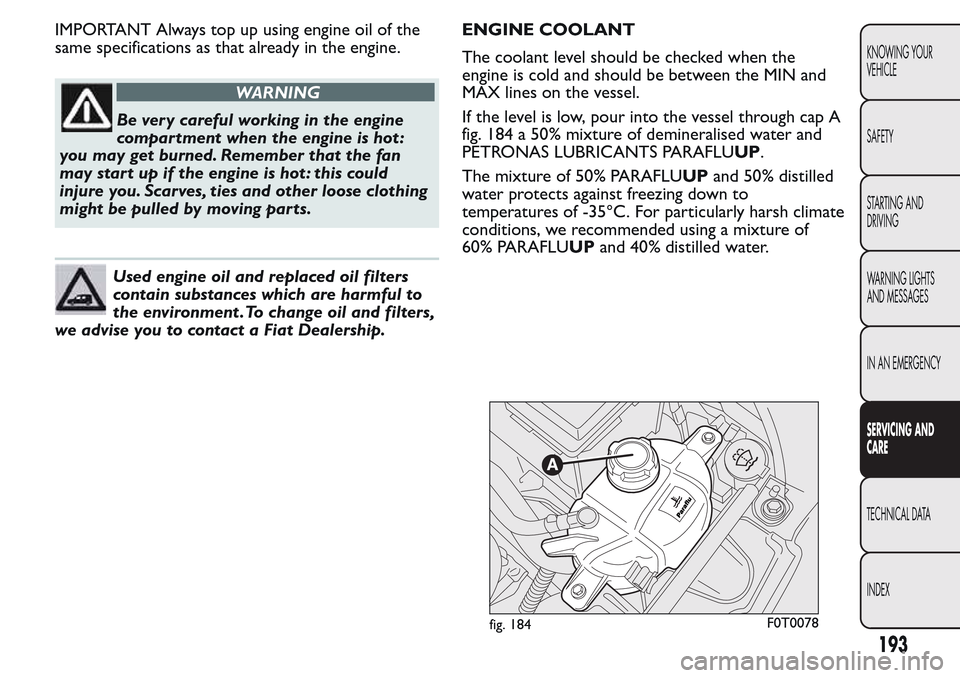
If the level is low, pour into the vessel through cap A
fig. 184 a 50% mixture of demineralised water and
PETRONAS LUBRICANTS PARAFLUUP.
The mixture of 50% PARAFLUUPand 50% distilled
water protects against freezing down to
temperatures of -35°C. For particularly harsh climate
conditions, we recommended using a mixture of
60% PARAFLUUPand 40% distilled water.
fig. 184F0T0078
193
KNOWING YOUR
VEHICLE
SAFETY
STARTING AND
DRIVING
WARNING LIGHTS
AND MESSAGES
IN AN EMERGENCY
SERVICING AND
CARE
TECHNICAL DATA
INDEX
Page 254 of 260

Controls........................................ 51
Coupling the tow ring............... 180
Cruise control ............................. 46
Cruise Control (warning
light) ............................................ 144
Cruise Control warning
light ............................................. 144
Dashboard .................................... 3
Dead lock ..................................... 9
Dead Lock .................................... 9
Degraded engine oil warning
light ............................................. 137
Dimensions ................................. 222
Dipped beam headlights ............ 42
Dipped/main beam
headlights ................................... 161
Dipped/main beam
headlights (changing a bulb)... 161
Direction indicators ................... 43
– Left direction indicator
warning light ......................... 145
– Right-hand indicator
warning light .......................... 145
Direction indicators
(changing a bulb) ...................... 161
Door open .................................. 138
Doors (unlocking/locking) ........ 55
Double rear wing doors............ 61DPF (particulate filter) .............. 96
Driver side armrest .................... 52
Driving style ................................ 129
EBD (fault warning light) .......... 136
EBD fault warning light............. 136
EBD system .................................. 72
Emergency starting.................... 124
Engine ........................................... 211
Engine bay fuse box ................... 170
Engine codes ............................... 210
Engine compartment fuse
box table .................................... 174
Engine coolant ............................ 193
Engine coolant fluid
(warning light)........................... 134
Engine coolant fluid warning
light ............................................. 134
Engine coolant temperature
indicator...................................... 14
Engine marking ........................... 209
Engine oil ..................................... 192
Engine oil (degraded oil
warning light) ............................ 137
Engine oil (low pressure
warning light) ............................ 137
EOBD (engine control
system fault warning light) ..... 138
EOBD system .............................. 82ESC (system) ............................... 73
Extending the boot .................... 63
Exterior lights .............................. 42
Fiat CODE (vehicle
protection system fault
warning light) ............................ 141
Fiat CODE system ..................... 6
Fiat CODE vehicle
protection system fault
warning light.............................. 141
Fix&Go automatic kit ............... 153
Fix&Go Automatic quick
tyre pressure restoration....... 154
Flashing the headlights ............... 42
Fluids and lubricants.................. 229
Fog lights ....................................... 51
– Warning light ......................... 144
Fog lights (changing a bulb)...... 162
Fog lights warning light ............. 144
Follow Me Home ........................ 43
Front airbags ............................... 113
– Front airbag driver's side .... 114
– Manually deactivating the
front airbag and side bag .... 115
– Passenger side front
airbag....................................... 114
Front ceiling light ....................... 166
KNOWING YOUR
VEHICLE
SAFETY
STARTING AND
DRIVING
WARNING LIGHTS
AND MESSAGES
IN AN EMERGENCY
SERVICING AND
CARE
TECHNICAL DATA
INDEX