2017 FIAT DOBLO PANORAMA handbrake
[x] Cancel search: handbrakePage 131 of 298
START&STOP
SYSTEM
IN BRIEF
The Start&Stop device automatically
stops the engine each time the
vehicle is stationary and starts it
again when the driver wants to move
off.
This improves the efficiency of the
vehicle by reducing fuel consumption,
the emission of harmful gases and
noise pollution.
OPERATING MODE
Engine stopping mode
WITH MANUAL GEARBOX
With the vehicle stationary, the engine
stops with the gearbox in neutral and
the clutch pedal released.
WITH ROBOTIZED GEARBOX
The engine cuts out if the vehicle stops
with the brake pedal pressed.
This condition can be maintained even
if the brake pedal is not depressed, if
the gear lever is in position N.NOTE: The engine can only be stopped
automatically after a speed of about
10 km/h is reached, to prevent the
engine from being repeatedly stopped
when driving at walking pace.
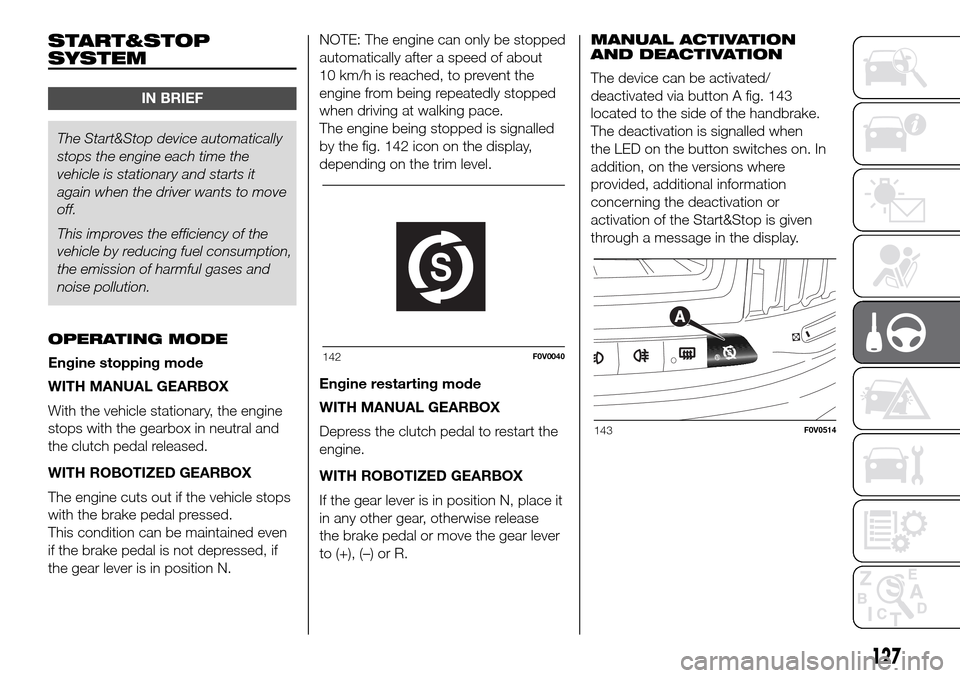
The engine being stopped is signalled
by the fig. 142 icon on the display,
depending on the trim level.
Engine restarting mode
WITH MANUAL GEARBOX
Depress the clutch pedal to restart the
engine.
WITH ROBOTIZED GEARBOX
If the gear lever is in position N, place it
in any other gear, otherwise release
the brake pedal or move the gear lever
to (+), (–) or R.MANUAL ACTIVATION
AND DEACTIVATION
The device can be activated/
deactivated via button A fig. 143
located to the side of the handbrake.
The deactivation is signalled when
the LED on the button switches on. In
addition, on the versions where
provided, additional information
concerning the deactivation or
activation of the Start&Stop is given
through a message in the display.
142F0V0040
143F0V0514
127
Page 162 of 298

CHANGING A WHEEL
The vehicle is originally equipped with
the Fix&Go automatic quick tyre repair
kit (see instructions in the next section).
As an alternative, the vehicle may
have a normal-sized spare wheel.
Wheel changing and correct use of the
jack and spare wheel call for some
precautions, as listed below.
125) 126) 127) 128)
Note for one-way tyres
One-way tyres have a few arrows on
the side indicating the rotation direction.
If a wheel is changed (when punctured,
for example) the direction of the arrows
on the spare wheel tyre may not
coincide with the rotation direction of
the wheel to be replaced.
In these conditions, too, the tyre still
maintains its safety features.
Anyway, it is recommended to have the
wheel repaired and refitted as soon as
possible, as the best performance is
achieved when the rotation direction of
all tyres coincides with the one
indicated by the arrows.
Please note that:
the jack weight is 4 kg;
the jack requires no adjustment;
the jack cannot be repaired and in
the event of a fault it must be replaced
by another original one;
no tool other than its cranking
device may be fitted on the jack.
To change a wheel, proceed as follows:
stop the vehicle in a position that is
not dangerous for oncoming traffic
where you can change the wheel safely.
The ground should be flat if possible,
and sufficiently firm;
stop the engine and pull the
handbrake;
engage first gear or reverse;
wear the reflective safety jacket
(compulsory by law in certain countries)
before getting out of the vehicle;
indicate that the vehicle has broken
down using the devices required by
the law in the current country (e.g.
warning triangle, hazard lights, etc.);
for Cargo versions fig. 182: move
the left front seat forward and operate
lever A to access the tool bag; take it to
the wheel that needs replacing;
for Doblò/Doblò Combi versions fig.
183: open the rear doors, inside the
compartment on the rear right side,
take the tool bag, unhooking the elastic
band from the buckle, and take it next
to the wheel to be changed;
take wheel spanner B fig. 184 and
the extension with pentagonal fitting C;
inside the load area, fit extension C
on bolt A; use spanner B to lower the
wheel by unwinding the wire;
use the wheel dismantling spanner B
to remove the wheel from the vehicle
fig. 185;
unscrew knob D fig. 186 and release
the rim from bracket E, removing it
from the hole of the rim;
182F0V0149
183F0V0148
158
IN AN EMERGENCY
Page 176 of 298

Thousands of kilometres 30 60 90 120 150 180
Months 24 48 72 96 120 144
Check handbrake lever travel and adjust, if necessary●●●●●●
Check exhaust emissions/smokiness●●●●●●
Inspect the conditions of toothed timing drive belt●●
Spark plug replacement (*)●●●●●●
Replace accessory drive belt/s●
Replace the toothed timing drive belt (**)●
Replace air cleaner cartridge●●●●●●
Check and, if necessary, top up fluid levels (brakes/hydraulic
clutch, windscreen washer, battery, engine cooling, etc.)●●●●●●
Check operation of engine management systems (using diagnosis
socket)●●●●●●
Check cleanliness of sliding side door lower guides (or every 6
months)●●●●●●
(*) For 1.4 Turbo Petrol versions, in order to guarantee correct operation and prevent serious damage to the engine, it is essential to observe the following: only use
spark plugs specifically certified for these engines; all spark plugs should be of the same type and brand (see the “Engine” paragraph in the "Technical
Specifications" section); strictly comply with the replacement intervals in the Scheduled Servicing Plan; you are advised to contact a Fiat Dealership to have plugs
replaced.
(**) Irrespective of the mileage, the timing drive belt must be changed every 4 years for heavy-duty use (cold climates, town use, long periods of idling) or at least
every 5 years.
172
SERVICING AND CARE
Page 178 of 298

DIESEL VERSIONS WITHOUT DPF (1.3 MultiJet - 1.6 MultiJet)
Thousands of kilometres 30 60 90 120 150 180
Months 24 48 72 96 120 144
Check tyre conditions/wear and adjust pressure, if necessary●●●●●●
Check operation of lighting system (headlights, direction
indicators, hazard warning lights, boot, passenger compartment,
glove compartment, instrument panel warning lights, etc.)●●●●●●
Check operation of the windscreen wiper/washer system and
adjust jets, if necessary●●●●●●
Check windscreen wiper blade position/wear●●●●●●
Check front disc brake pad condition and wear and operation of
brake pad wear indicator●●●●●●
Check rear drum brake lining condition and wear●●●
Visually inspect condition of: exterior bodywork, underbody
protection, pipes and hoses (exhaust - fuel system - brakes),
rubber elements (boots, sleeves, bushes, etc.)●●●●●●
Check cleanliness of bonnet and luggage compartment locks,
cleanliness and lubrication of linkage●●●●●●
Check and, if necessary, top up fluid levels (brakes/hydraulic
clutch, windscreen washer, battery, engine cooling, etc.)●●●●●●
Check tension of accessory drive belt (versions without automatic
tensioner)●●
Check handbrake lever travel and adjust, if necessary●●●●●●
Visually inspect condition of the accessory drive belt(s)●●
174
SERVICING AND CARE
Page 180 of 298

DIESEL VERSIONS WITH DPF (1.3 MultiJet - 1.6 MultiJet - 2.0 MultiJet)
Thousands of kilometres 35 70 105 140 175
Months 24 48 72 96 120
Check tyre conditions/wear and adjust pressure, if necessary●●●●●
Check operation of lighting system (headlights, direction
indicators, hazard warning lights, boot, passenger compartment,
glove compartment, instrument panel warning lights, etc.)●●●●●
Check operation of the windscreen wiper/washer system and
adjust jets, if necessary●●●●●
Check windscreen wiper blade position/wear●●●●●
Check front disc brake pad condition and wear and operation of
brake pad wear indicator●●●●●
Check rear drum brake lining condition and wear●●
Visually inspect condition of: exterior bodywork, underbody
protection, pipes and hoses (exhaust - fuel system - brakes),
rubber elements (boots, sleeves, bushes, etc.)●●●●●
Check cleanliness of bonnet and luggage compartment locks,
cleanliness and lubrication of linkage●●●●●
Check and, if necessary, top up fluid levels (brakes/hydraulic
clutch, windscreen washer, battery, engine cooling, etc.)●●●●●
Check tension of accessory drive belt (versions without automatic
tensioner)●●
Check handbrake lever travel and adjust, if necessary●●●●●
Visually inspect condition of the accessory drive belt(s)●●
176
SERVICING AND CARE
Page 199 of 298

If a tyre is changed, also change the
inflation valve;
to allow even wear between the
front and rear tyres, it is advisable to
change them over every 10-15
thousand kilometres, keeping them on
the same side of the vehicle so as
not to reverse the direction of rotation.
149) 150) 151) 152)
WARNING
149)Remember that the road holding
qualities of your vehicle also depend on the
correct inflation pressure of the tyres.
150)If tyre pressure is too low, the tire may
overheat and be severely damaged as a
result.
151)Do not switch tyres from the
righthand side of the vehicle to the
lefthand side, and vice versa.
152)Never submit alloy rims to repainting
treatments requiring the use of
temperatures exceeding 150°C. The
mechanical properties of the wheels could
be impaired.
RUBBER HOSES
As far as the maintenance of the brake
system and fuel supply system rubber
hoses is concerned, follow the
"Scheduled Servicing Plan" in this
chapter carefully.
Ozone, high temperatures and
prolonged lack of fluid in the system
may cause hardening and cracking of
the hoses, with possible leaks. Careful
checking is therefore necessary.
PROLONGED
VEHICLE INACTIVITY
If the vehicle needs to be off the road
for longer than one month, the following
precautions must be taken:
park the vehicle indoors in a dry
and, if possible, well-ventilated place;
engage a gear and check that
the handbrake is not engaged;
disconnect the negative terminal
from the battery pole (see paragraph
“Vehicle inactivity” in the "Dashboard
and controls" chapter) and check
the charge conditions (see paragraph
“Battery” in the “Care and
maintenance” chapter);
clean and protect the painted parts
using protective wax;
clean and protect the shiny metal
parts using special compounds
available commercially;
sprinkle talcum powder on the
windscreen and rear window wiper
rubber blades and lift them off the
glass;
slightly open the windows;
cover the vehicle with a piece of
fabric or perforated plastic sheet. Do
not use compact plastic tarpaulins,
which prevent humidity from
evaporating from the surface of the
vehicle;
195
Page 202 of 298

INTERIORS
Regularly check that water is not
trapped under the mats (due to water
dripping off shoes, umbrellas, etc.),
as this could cause oxidation of the
sheet metal.
153) 154)
SEATS AND FABRIC
PARTS
Remove dust with a soft brush or a
vacuum cleaner. It is advisable to use a
moist brush on velvet upholstery.
Rub the seats with a sponge moistened
with a solution of water and mild soap.
PLASTIC PARTS
It is advisable to clean interior parts with
a moist cloth and a solution of water
and non-abrasive mild soap. Use
specific products for cleaning plastic,
without solvents and specifically
designed to prevent damage to the
appearance and colour of the treated
parts, to remove grease and tough
stains.
IMPORTANT Do not use alcohol,
petrols or their derivatives to clean the
instrument panel glass.LEATHER STEERING
WHEEL/GEAR
KNOB/HANDBRAKE
(for versions/markets, where provided)
These components must be cleaned
with mild soap and water only. Never
use alcohol or alcohol-based products.
Read the product label carefully before
using specific products for cleaning
the interiors: make sure the product
does not contain spirits or alcohol-
based substances.
If, when cleaning the windscreen with
special products, window cleaner
accidentally drips onto the leather of
the steering wheel/gear lever
knob/hand brake, wipe away
immediately and then wash the affected
area with mild soap and water.
IMPORTANT Be careful when using a
steering wheel locking device, to avoid
damaging the leather upholstery
through abrasion.
WARNING
153)Never use flammable products, such
as petroleum ether or modified petrol, to
clean the inside of the vehicle. The
electrostatic charges which are generated
by rubbing during the cleaning operation
may cause a fire.154)Do not keep aerosol cans in the
vehicle: they might explode. Aerosol cans
must not be exposed to a temperature
exceeding 50°C. When the vehicle is
exposed to sunlight, the internal
temperature can greatly exceed this value.
198
SERVICING AND CARE
Page 295 of 298

Handbrake
.................................... 125
Hazard warning lights..................... 144
Head restraints............................... 29
Headlight washers ......................... 38
Headlights...................................... 64
Heating and ventilation ................... 39................... 41
Hill Holder system .......................... 102
Identification data
.......................... 200
Ignition device ................................ 16
Important notes.............................. 122
Inflation pressure ............................ 213
Installing electrical/electronic
devices ........................................ 5
Interior fittings ................................ 60
Interior lights .................................. 34
Interior mirror ................................. 31
Interiors .......................................... 198
Jump starting
................................ 165
Lifting the vehicle
.......................... 167
Load limiters .................................. 106
Luggage compartment light ........... 35
Main beam headlights
.................. 33 .................. 148
Manual climate control system ....... 44
Manual deactivation of
passenger side front airbag and
side bag for chest/head
protection .................................... 118
MSR system .................................. 103
Multifunction display....................... 73– Control buttons ......................... 74
– Set-up menu ............................. 74
Number plate lights (for
hatchback versions)
..................... 150
Number plate lights (for versions
with wing doors)........................... 150
Occupant protection systems
....... 104
Parking
......................................... 125
Parking sensors ............................. 136
Partitions........................................ 27
Passenger side front airbag ............ 117
Performance .................................. 253
Periodic checks ............................. 178
Plastic parts ................................... 198
Power Socket ................................ 60
Power steering fluid........................ 188
Practical advice for reducing fuel
consumption and harmful
emissions ..................................... 139
Pre-tensioners................................ 106
Preparation for Isofix child seat....... 112
Prescriptions for vehicle at end
of life ........................................... 278
Procedure for diesel versions ......... 124
Procedure for petrol versions.......... 124
Prolonged vehicle inactivity............. 195
Protecting the environment ............ 65
Protection against atmospheric
agents.......................................... 196
Radio (setup)....................................... 65
Radio transmitters and mobile
phones......................................... 5
Rear doors ..................................... 20
Rear fog lights ................................ 54
Rear light clusters .......................... 148
Rear roof light ................................ 151
Rear view mirrors ........................... 31
Rear window washer...................... 38
Rear window wiper ........................ 37........................ 38
Refuelling ....................................... 248
Refuelling the vehicle ...................... 138
Replacing a bulb ............................ 144
Replacing an exterior bulb .............. 147
Replacing an interior bulb ............... 150
Replacing fuses.............................. 152
Replacing the battery ..................... 190
Rim Protector................................. 210
Rims and tyres ............................... 209
Roof rack ....................................... 63
Rubber hoses ................................ 195
Saving fuel
.................................... 139
SBR system ................................... 106
Scheduled servicing ....................... 170
Scheduled Servicing Plan ............... 171
Seat belts....................................... 104
Seat belts maintenance .................. 107
Seat with storage compartment ..... 61
Seats ............................................. 22
INDEX