2017 FIAT DOBLO COMBI roof
[x] Cancel search: roofPage 128 of 300
SIDE BAGS
(for versions/markets, where provided)
On some versions, the vehicle may
be provided with side bags and window
bags.
Side bags protect occupants from
side-on crashes of medium/high
severity by placing the bag between the
occupant and the internal parts of the
side structure of the vehicle.
Non-activation of side bags in other
types of collisions (front collisions, rear
shunts, roll-overs, etc.) is not a system
malfunction.
An electronic control unit causes the
bags to inflate in the event of a side-on
collision. The bags inflate
instantaneously, placing themselves
between the occupant's body and the
structures which could cause injury.
They deflate immediately afterwards.
Side bags are not a replacement of, but
rather a complement to, seat belts,
which you are recommended to wear at
all times, as specified by law in Europe
and most non-European countries.
For this reason, the seat belt must be
worn at all times. In the case of side-on
collisions, the seat belts hold occupants
in the correct position in relation to the
airbag and prevent them from being
thrown out of the vehicle by a very
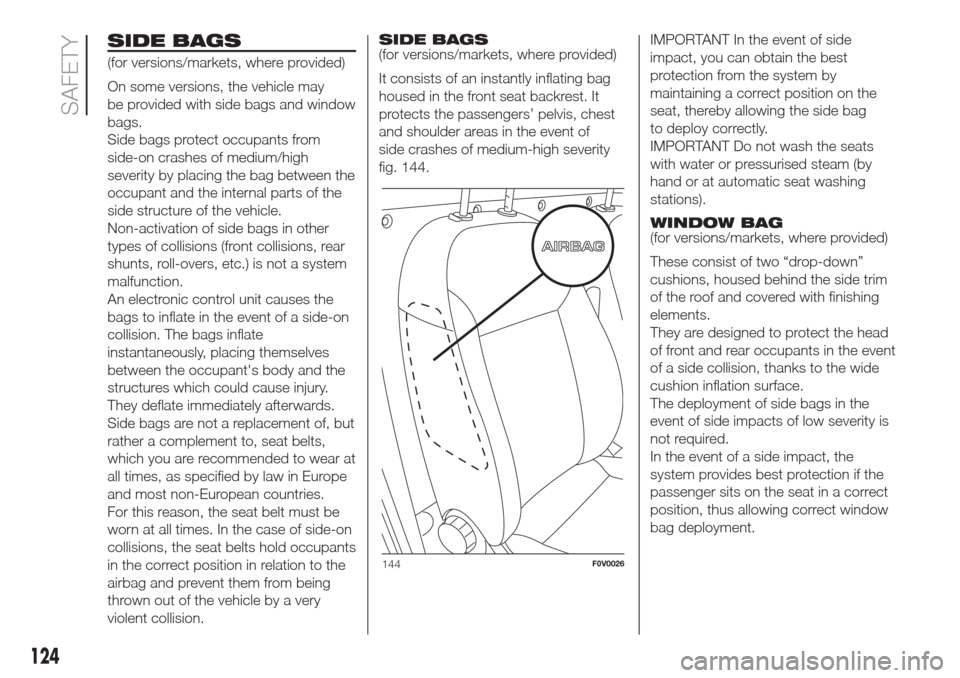
violent collision.SIDE BAGS
(for versions/markets, where provided)
It consists of an instantly inflating bag
housed in the front seat backrest. It
protects the passengers’ pelvis, chest
and shoulder areas in the event of
side crashes of medium-high severity
fig. 144.IMPORTANT In the event of side
impact, you can obtain the best
protection from the system by
maintaining a correct position on the
seat, thereby allowing the side bag
to deploy correctly.
IMPORTANT Do not wash the seats
with water or pressurised steam (by
hand or at automatic seat washing
stations).
WINDOW BAG
(for versions/markets, where provided)
These consist of two “drop-down”
cushions, housed behind the side trim
of the roof and covered with finishing
elements.
They are designed to protect the head
of front and rear occupants in the event
of a side collision, thanks to the wide
cushion inflation surface.
The deployment of side bags in the
event of side impacts of low severity is
not required.
In the event of a side impact, the
system provides best protection if the
passenger sits on the seat in a correct
position, thus allowing correct window
bag deployment.
144F0V0026
124
SAFETY
Page 147 of 300

WARNING
22)For diesel engines, use only diesel fuel
for motor vehicles in accordance with
EN590 European specifications. The use of
other products or mixtures may damage
the engine beyond repair and
consequently invalidate the warranty, due
to the damage caused. If you accidentally
introduce other types of fuel into the tank,
do not start the engine. Empty the tank.
If the engine has been run for even an
extremely limited amount of time, you must
not only drain the fuel tank, but the rest of
the supply circuit as well.
23)Do not approach naked flames or lit
cigarettes to the fuel tank filler: fire risk.
Keep your face away from the fuel filler to
prevent breathing in harmful vapours.
SAVING FUEL
Some useful tips are given below for
fuel saving and reducing harmful
emissions of CO2 and other pollutants
(nitrogen oxides, unburnt
hydrocarbons, Particulate Matter (PM),
etc.).
PRACTICAL ADVICE FOR
REDUCING FUEL
CONSUMPTION AND
HARMFUL EMISSIONS
Vehicle conditions
Have checks and adjustments for
vehicle maintenancecarried out
in accordance with the “Scheduled
servicing plan”.
Checktyrepressure regularly, at
least once every four weeks.
Excessively low pressures will increase
consumption because rolling resistance
will be higher. In addition, this wears
the tyre more quickly and impairs
performance.
Only usesnow tyreswhen the
weather conditions make them
absolutely necessary. They increase
consumption and noise.
Do not travel witha heavy load: the
weight of the vehicle (especially when
driving in town) and its geometry greatly
affect fuel consumption and stability.
Removeroof racks or ski racks
after use. These accessories reduce the
vehicle's aerodynamic penetration and
have a negative effect on fuel
consumption.
When transporting particularly large
objects, use atrailerif possible.
Use the vehicle's air vents if
possible: travelling with the windows
open impairs aerodynamics.
Use electrical devices only for the
amount of time needed. The vehicle’s
heated rear window, additional
headlights, screen wipers and heater
fan require a considerable amount
of energy; this increases fuel
consumption (by up to +25% in an
urban cycle).
Air conditioning leads to higher fuel
consumption (on average up to +30%).
If the temperature outside is not too
extreme, try and use the air vents.
Driving style
Afterstarting the engineyou
should drive away immediately and
slowly, avoiding high revs. Do not warm
up the engine at low or high revs when
the vehicle is stationary; this causes
the engine to warm up more slowly,
thereby increasing fuel consumption,
emissions and mechanical component
wear.
143
Page 157 of 300

for versions with wing doors, remove
the rubber caps B fig. 167 and
manoeuvre the holding tabs C, then
remove the unit;
for versions with high roof and swing
doors, remove the pressure-fit plastic
guard A fig. 168 and rubber cap B
fig. 168, using a screwdriver, release
the retaining tags as shown in the figure
and remove the unit;
manoeuvre the appropriate tabs and
remove the bulb holder;
remove the snap-fitted bulb and
replace.
165F0V0525
166F0V0163
167F0V0164
168F0V0231
153
Page 159 of 300

REPLACING AN
INTERIOR BULB
For the type of bulb and power rating,
see "Changing a bulb".
FRONT ROOF LIGHT
Roof light with movable lens
Proceed as follows to replace the
bulbs:
remove roof light A fig. 172 working
at the points indicated by the arrows;
open the cover B fig. 173 as
indicated;
replace the bulb C fig. 174 releasing
the side contacts, insert the new bulb
and make sure that it is correctly locked
between the contacts;
close the cover and secure the roof
light into its housing, making sure it
locks properly into place.Roof light with spot lights (where
provided)
Proceed as follows to replace the
bulbs:
operate in the points indicated by
the arrows and remove light A fig. 175;
open protective flap B fig. 176;
replace the bulbs C releasing them
from the side contacts making sure that
the new bulbs are correctly secured
between the contacts;
close flap B fig. 176 and fix roof light
A fig. 175 in its housing, making sure
that it locks into place.
REAR ROOF LIGHT
To replace the bulb, proceed as follows:
remove roof light A fig. 177 working
at the points indicated by the arrows;
open the cover B fig. 178 as
indicated;
172F0V0070
173F0V0071
174F0V0072
175F0V0073
176F0V0074
155
Page 160 of 300

replace the bulb C fig. 179 releasing
the side contacts, insert the new bulb
and make sure that it is correctly locked
between the contacts;
close the cover B fig. 178 and
secure the roof light into its housing,
making sure it locks properly into place.Removable roof light
To replace the bulb, proceed as follows:
press button A fig. 180 and extract
the removable roof light B;
remove the roof light, working at the
points indicated by the arrows;
replace bulb C fig. 181 releasing the
side contacts, insert the new bulb
and make sure that it is correctly locked
between the contacts;
177F0V0075
178F0V0071
179F0V0072
180F0V0176
181F0V0177
156
IN AN EMERGENCY
Page 199 of 300

BATTERY
The battery is of the “limited
maintenance” type: under normal
conditions of use, the electrolyte does
not need topping up with distilled water.
It does, however, need to be checked
periodically at a Fiat Dealership or
by specialist personnel to make sure it
is working correctly.
143) 144)
REPLACING THE
BATTERY
If required, replace the battery with an
original spare part with the same
specifications.
If a battery with different specifications
is fitted, the service intervals given in
the “Scheduled Servicing Plan” will no
longer be valid.
Follow the battery manufacturer's
instructions for maintenance.
37) 38)
6)
145)
USEFUL TIPS FOR
EXTENDING BATTERY
LIFE
To avoid draining your battery and
make it last longer, observe the
following instructions:
when you park the vehicle, ensure
that the doors, tailgate and bonnet are
closed properly, to prevent any roof
lights from remaining on inside the
passenger's compartment;
switch off all roof lights inside the
vehicle: the vehicle is however
equipped with a system which switches
all internal lights off automatically;
do not keep accessories (e.g. radio,
hazard warning lights, etc.) switched
on for a long time when the engine
is not running;
before performing any operation on
the electrical system, disconnect the
negative battery pole;
completely tighten the battery
terminals.
IMPORTANT If the charge level remains
under 50% for a long time, the battery
is damaged by sulphation, reducing
its capacity and efficiency at starting.The battery is also more prone to the
risk of freezing (already at temperatures
of -10°C). Refer to the paragraph
"Vehicle inactivity" in "Starting and
driving" if the vehicle is left parked for a
long time.
If, after buying the vehicle, you want to
install electric accessories which require
permanent electric supply (alarm, etc.)
contact a Fiat Dealership whose
qualified personnel, in addition to
suggesting the most suitable devices
from the Lineaccessori Fiat, will
evaluate the overall electric absorption,
checking whether the vehicle's
electrical system is capable of
withstanding the load required, or
whether it should be integrated with a
more powerful battery.
Since some of these devices continue
to consume electricity even when
the engine is off, they gradually run
down the battery.
WARNING
143)Battery fluid is poisonous and
corrosive. Avoid contact with skin and
eyes. Keep naked flames or possible
sources of sparks away from the battery:
risk of explosion or fire.
144)Using the battery when the fluid is too
low can damage it irreparably and generate
a risk of explosion.
195
Page 205 of 300

BODYWORK
PROTECTION AGAINST
ATMOSPHERIC AGENTS
The main causes of corrosion are the
following:
atmospheric pollution;
salty air and humidity (coastal areas,
or hot humid climates);
seasonal environmental conditions.
The abrasive action of wind-borne
atmospheric dust and sand, as well as
mud and gravel raised by other cars
is also not to be underestimated.
On your vehicle, Fiat has implemented
the best manufacturing technologies
to effectively protect the bodywork
against corrosion.
These include:
painting products and systems
which give the vehicle particular
resistance to corrosion and abrasion;
use of galvanised (or pretreated)
sheet metal, with high resistance to
corrosion;
spraying the underbody, engine
compartment, wheelhouse internal
parts and other parts with highly
protective wax products;
spraying of plastic parts, with a
protective function in the more exposed
points: underdoor, inner wing, edges,
etc.;
use of "open" boxed sections to
prevent condensation and pockets of
moisture from triggering rust inside.
VEHICLE EXTERIOR AND
UNDERBODY WARRANTY
Your vehicle is covered by warranty
against perforation due to corrosion of
any original element of the structure
or body.
For the general terms of this warranty,
refer to the Warranty Booklet.
ADVICE FOR
PRESERVING THE
BODYWORK
Paintwork
Paintwork does not only serve an
aesthetic purpose, but also protects the
underlying sheet metal.
Touch up abrasions and scratches
immediately to prevent rust formation.
Use only original paint products for
touch-ups (see “Bodywork paint
identification plate” in the “Technical
specifications” section).
Normal maintenance of paintwork
consists in washing the vehicle: the
frequency depends on the conditions
and environment where the vehicle
is used.
For example, it is advisable to wash the
vehicle more often in areas with high
levels of environmental pollution or on
roads spread with salt.To correctly wash the vehicle, proceed
as follows:
wash the bodywork using a low
pressure jet of water;
wipe a sponge with a slightly soapy
solution over the bodywork, frequently
rinsing the sponge;
rinse well with water and dry with a
jet of air or a chamois.
If you put the vehicle through a car
wash, follow these recommendations:
– remove the aerial from the roof so
it does not get damaged;
– water added to a soapy solution
should be used for washing;
– rinse thoroughly to avoid soap marks
staying on the bodywork or less visible
parts.
39)Dry the less visible parts with special
care, such as the door frames, bonnet
and the headlight frames, where water
may stagnate more easily. It is a good
idea to leave the vehicle outdoors
for a while after washing it to give water
time to evaporate.
Do not wash the vehicle after it has
been left in the sun or with the bonnet
hot: this may alter the shine of the
paintwork.
201
Page 224 of 300

DIMENSIONS
Short wheelbase versions
Dimensions are expressed in mm and refer to the vehicle fitted with standard tyres.
Height is measured with vehicle unladen.
ABCDE FGH
4406 911 2755 740
1832/1905(*)1510 1832 1530
(*) With roof bars (for versions/markets, where provided)
Small variations in size are possible depending on the dimensions of the rims.
233F0V0555
220
TECHNICAL DATA