2017 FIAT 124 SPIDER maintenance
[x] Cancel search: maintenancePage 248 of 300
Run Flat Tires — If Equipped
Run Flat tires allow you the capability to
drive 50 miles (80 km) at 50 mph
(80 km/h) after a rapid loss of inflation
pressure. This rapid loss of inflation is
referred to as the Run Flat mode. A Run
Flat mode occurs when the tire inflation
pressure is of/or below 14 psi (96 kPa).
Once a Run Flat tire reaches the run flat
mode it has limited driving capabilities
and needs to be replaced immediately.
A Run Flat tire is not repairable.
It is not recommended driving a vehicle
loaded at full capacity or to tow a trailer
while a tire is in the run flat mode.
See the tire pressure monitoring section
for more information.
Tire Spinning
When stuck in mud, sand, snow, or ice
conditions, do not spin your vehicle's
wheels above 30 mph (48 km/h) or for
longer than 30 seconds continuously
without stopping.
Refer to “Freeing A Stuck Vehicle” in “In
Case Of Emergency” for further
information.
Warning!
Fast spinning tires can be dangerous.
Forces generated by excessive wheel
speeds may cause tire damage or failure.
A tire could explode and injure someone.
Do not spin your vehicle's wheels faster
than 30 mph (48 km/h) for more than
30 seconds continuously when you are
stuck, and do not let anyone near a
spinning wheel, no matter what the speed.
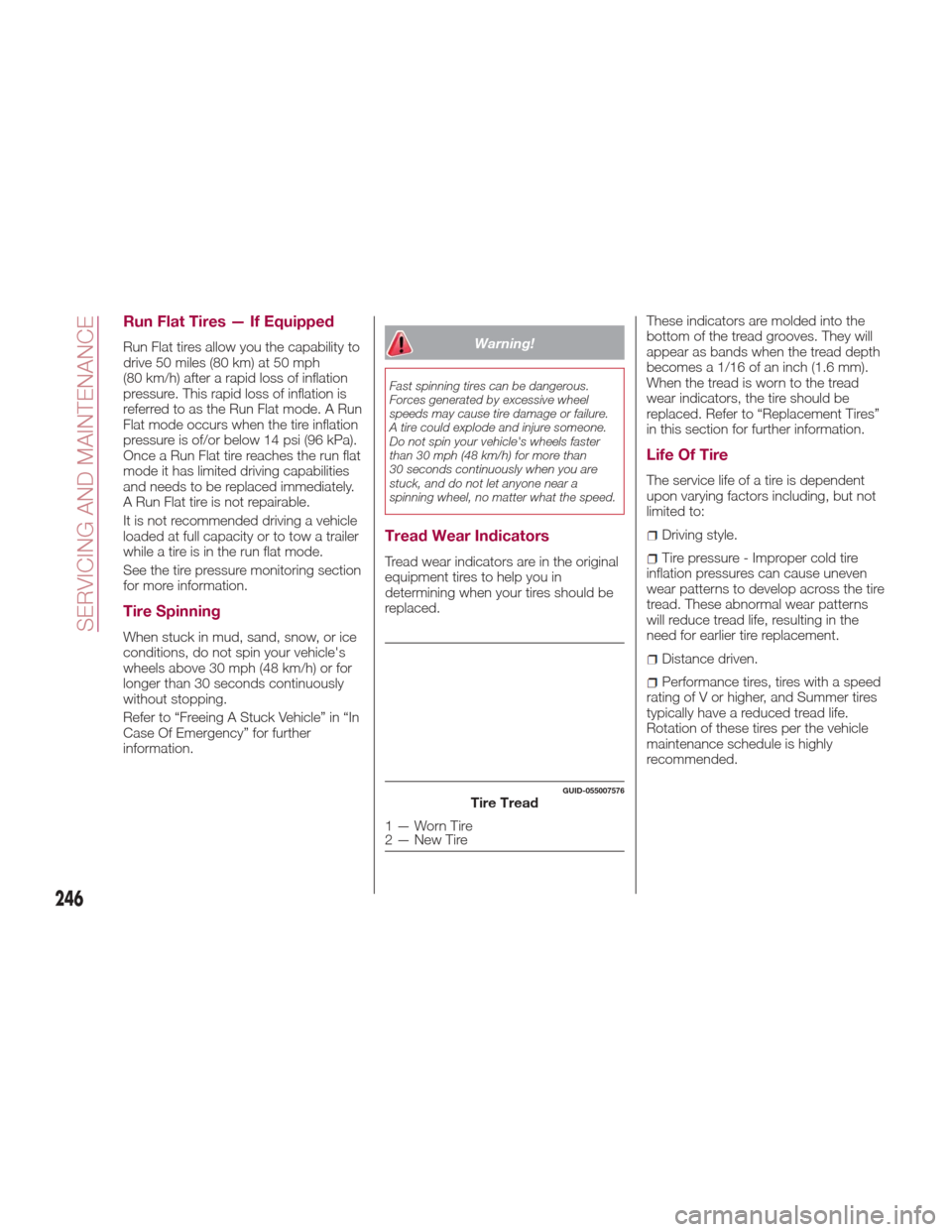
Tread Wear Indicators
Tread wear indicators are in the original
equipment tires to help you in
determining when your tires should be
replaced.These indicators are molded into the
bottom of the tread grooves. They will
appear as bands when the tread depth
becomes a 1/16 of an inch (1.6 mm).
When the tread is worn to the tread
wear indicators, the tire should be
replaced. Refer to “Replacement Tires”
in this section for further information.
Life Of Tire
The service life of a tire is dependent
upon varying factors including, but not
limited to:
Driving style.
Tire pressure - Improper cold tire
inflation pressures can cause uneven
wear patterns to develop across the tire
tread. These abnormal wear patterns
will reduce tread life, resulting in the
need for earlier tire replacement.
Distance driven.
Performance tires, tires with a speed
rating of V or higher, and Summer tires
typically have a reduced tread life.
Rotation of these tires per the vehicle
maintenance schedule is highly
recommended.
GUID-055007576Tire Tread
1—WornTire
2—NewTire
246
SERVICING AND MAINTENANCE
Page 250 of 300

Summer Or Three Season Tires
— If Equipped
Summer tires provide traction in both
wet and dry conditions, and are not
intended to be driven in snow or on ice.
If your vehicle is equipped with Summer
tires, be aware these tires are not
designed for Winter or cold driving
conditions. Install Winter tires on your
vehicle when ambient temperatures are
less than 40°F (5°C) or if roads are
covered with ice or snow. For more
information, contact an authorized
dealer.
Summer tires do not contain the all
season designation or mountain/
snowflake symbol on the tire sidewall.
Use Summer tires only in sets of four;
failure to do so may adversely affect the
safety and handling of your vehicle.
Warning!
Do not use Summer tires in snow/ice
conditions. You could lose vehicle control,
resulting in severe injury or death. Driving
too fast for conditions also creates the
possibility of loss of vehicle control.
Snow Tires
Some areas of the country require the
use of snow tires during the Winter.
Snow tires can be identified by a
“mountain/snowflake” symbol on the
tire sidewall.If you need snow tires,
select tires equivalent
in size and type to the
original equipment
tires. Use snow tires
onlyinsetsoffour;
failure to do so may
adversely affect the
safety and handling of your vehicle.
Snow tires generally have lower speed
ratings than what was originally
equipped with your vehicle and should
not be operated at sustained speeds
over 75 mph (120 km/h). For speeds
above 75 mph (120 km/h) refer to
original equipment or an authorized tire
dealer for recommended safe operating
speeds, loading and cold tire inflation
pressures.
While studded tires improve
performance on ice, skid and traction
capability on wet or dry surfaces may
be poorer than that of non-studded
tires. Some states prohibit studded
tires; therefore, local laws should be
checked before using these tire types.
Spare Tires — If
Equipped
Note:
For vehicles equipped with Tire Service
Kit instead of a spare tire, please refer
to “Tire Service Kit” in “In Case Of
Emergency” for further information.
Caution!
Because of the reduced ground clearance,
do not take your vehicle through an
automatic car wash with a compact or
limited use temporary spare installed.
Damage to the vehicle may result.
Spare Tire Matching Original
Equipped Tire And Wheel — If
Equipped
Your vehicle may be equipped with a
spare tire and wheel equivalent in look
and function to the original equipment
tire and wheel found on the front or rear
axle of your vehicle. This spare tire may
be used in the tire rotation for your
vehicle. If your vehicle has this option,
refer to an authorized tire dealer for the
recommended tire rotation pattern.
248
SERVICING AND MAINTENANCE
Page 252 of 300

Limited Use Spare — If
Equipped
The limited use spare tire is for
temporary emergency use only. This tire
is identified by a label located on the
limited use spare wheel. This label
contains the driving limitations for this
spare. This tire may look like the original
equipped tire on the front or rear axle of
your vehicle, but it is not. Installation of
this limited use spare tire affects vehicle
handling. Since it is not the same as
your original equipment tire, replace (or
repair) the original equipment tire and
reinstall on the vehicle at the first
opportunity.
Warning!
Limited use spares are for emergency use
only. Installation of this limited use spare
tire affects vehicle handling. With this tire,
do not drive more than the speed listed on
the limited use spare wheel. Keep inflated
to the cold tire inflation pressures listed on
your Tire and Loading Information Placard
located on the driver’s side B-Pillar or the
rear edge of the driver’s side door. Replace
(or repair) the original equipment tire at the
first opportunity and reinstall it on your
vehicle. Failure to do so could result in loss
of vehicle control.
Snow Chains
The use of snow chains should be in
compliance with local regulations of
each country. In certain countries, tires
marked with code M+S (Mud and
Snow) are considered as winter
equipment; therefore their use is
equivalent to that of the snow chains.
The snow chains may be applied only
to the front wheel tires. Check the
tension of the snow chains after the first
few feet have been driven.
Warning!
Using tires of different size and type (M+S,
Snow) between front and rear axles can
cause unpredictable handling. You could
lose control and have a collision.
Caution!
To avoid damage to your vehicle or tires,
observe the following precautions:
Because of restricted traction device
clearance between tires and other
suspension components, it is important
that only traction devices in good condition
are used. Broken devices can cause
serious damage. Stop the vehicle
immediately if noise occurs that could
indicate device breakage. Remove the
damaged parts of the device before further
use.
Install device as tightly as possible and
then retighten after driving about ½ mile
(0.8 km).
Do not exceed 30 mph (48 km/h).
Drive cautiously and avoid severe turns
and large bumps, especially with a loaded
vehicle.
Do not drive for a prolonged period on
dry pavement.
Observe the traction device
manufacturer’s instructions on the method
of installation, operating speed, and
conditions for use. Always use the
suggested operating speed of the device
manufacturer’s if it is less than 30 mph
(48 km/h).
Do not use traction devices on a
compact spare tire.
Caution!
Using snow chains with tires with
non-original dimensions may damage the
vehicle.
Using different size or type (M+S, snow,
etc.) tires between front and rear axle may
adversely affect vehicle driveability, with the
risk of losing control of the vehicle and
resulting accidents.
250
SERVICING AND MAINTENANCE
Page 254 of 300

DEPARTMENT OF
TRANSPORTATION
UNIFORM TIRE
QUALITY GRADES
The following tire grading categories
were established by the National
Highway Traffic Safety Administration.
The specific grade rating assigned by
the tire's manufacturer in each category
is shown on the sidewall of the tires on
your vehicle.
All passenger vehicle tires must
conform to Federal safety requirements
in addition to these grades.
Treadwear
The Treadwear grade is a comparative
rating, based on the wear rate of the
tire when tested under controlled
conditions on a specified government
test course. For example, a tire graded
150 would wear one and one-half times
as well on the government course as a
tire graded 100. The relative
performance of tires depends upon the
actual conditions of their use, however,
and may depart significantly from the
norm due to variations in driving habits,
service practices, and differences in
road characteristics and climate.
Traction Grades
The Traction grades, from highest to
lowest, are AA, A, B, and C. These
grades represent the tire's ability to
stop on wet pavement, as measured
under controlled conditions on specified
government test surfaces of asphalt
and concrete. A tire marked C may
have poor traction performance.
Warning!
The traction grade assigned to this tire is
based on straight-ahead braking traction
tests, and does not include acceleration,
cornering, hydroplaning, or peak traction
characteristics.
Temperature Grades
The temperature grades are A (the
highest), B, and C, representing the
tire's resistance to the generation of
heat and its ability to dissipate heat,
when tested under controlled
conditions on a specified indoor
laboratory test wheel.Sustained high temperature can cause
the material of the tire to degenerate
and reduce tire life, and excessive
temperature can lead to sudden tire
failure. The grade C corresponds to a
level of performance, which all
passenger vehicle tires must meet
under the Federal Motor Vehicle Safety
Standard No. 109. Grades B and A
represent higher levels of performance
on the laboratory test wheel, than the
minimum required by law.
Warning!
The temperature grade for this tire is
established for a tire that is properly
inflated and not overloaded. Excessive
speed, under-inflation, or excessive
loading, either separately or in
combination, can cause heat buildup and
possible tire failure.
252
SERVICING AND MAINTENANCE
Page 256 of 300

Preserving The
Paintwork
Touch up abrasions and scratches
immediately to prevent the formation of
rust.
Maintenance of paintwork consists of
washing the vehicle: the frequency
depends on the conditions and
environment in which the vehicle is
used.
For example, it is advisable to wash the
vehicle more often in areas with high
levels of atmospheric pollution or salted
roads.
To correctly wash the vehicle, follow
these instructions:
If high pressure jets or cleaners are
used to wash the vehicle, keep a
distance of at least 1.3 ft (40 cm) from
the bodywork to avoid damage or
alteration. Build up of water could
cause damage to the vehicle in the long
term.
Wash the vehicle using a low
pressure jet of water if possible.
Wipe a sponge with a slightly soapy
solution over the bodywork, frequently
rinsing the sponge.
Rinse well with water and dry with a
jet of air or a chamois leather.
Dry the less visible parts (e.g. door
frames, hood, headlight frames, etc.)
with special care, as water may
stagnate more easily in these areas.
Do not wash the vehicle after it has been
left in the sun or with the hood hot: this
may alter the shine of the paintwork.
Exterior plastic parts must be cleaned
in the same way as the rest of the
vehicle.
Note:
Avoid parking under trees; the sap
dropped by trees makes the paint
work go dull and increases the
possibility of corrosion.
Bird droppings must be washed off
immediately and thoroughly as the acid
they contain is particularly aggressive.
Etching caused by acid rain or
industrial fallout
Cause:
Industrial pollutants and vehicle
emissions drift into the air and mix with
rain or dew to form acids. These acids
can settle on a vehicle's finish. As the
water evaporates, the acid becomes
concentrated and can damage the finish.
The longer the acid remains on the
surface, the greater the chance is for
damage.
Prevention:
It is necessary to wash and wax your
vehicle to preserve its finish according
to the instructions in this section. These
steps should be taken immediately after
you suspect that acid rain has settled
on your vehicle's finish. Damage caused by bird
dropping/insects/tree sap
Problem:
Bird droppings contain acids. If these
are not removed they can eat away the
clear and color base coat of the
vehicle's paintwork.
When insects stick to the paint surface
and decompose, corrosive compounds
form. These can erode the clear and
color base coat of the vehicle's
paintwork if they are not removed.
Tree sap will harden and adhere
permanently to the paint finish. If you
scratch the sap off while it is hard,
some vehicle paint could come off with
it.
Prevention:
It is necessary to have your vehicle
washed and waxed to preserve its finish
according to the instructions in this
section. This should be done as soon
as possible.
Bird droppings can be removed with a
soft sponge and water. If you are
travelling and these are not available, a
moistened tissue may also take care of
the problem. The cleaned area should
be waxed according to the instructions
in this section. Insects and tree sap are
best removed with a soft sponge and
water or a commercially available
chemical cleaner.
254
SERVICING AND MAINTENANCE
Page 258 of 300
left running) this is particularly
important when clearing ice and snow.
Do not spray water in the engine
compartment. Otherwise, it could
result in engine-starting problems or
damage to electrical parts.
When washing and waxing the
vehicle, be careful not to apply
excessive force to any single area of
the vehicle hood. Otherwise, you could
dent the vehicle.
Do not use automatic car washing
machines and car washing devices
using high water pressure.
Make sure that the fuel door is
closed and lock the doors. Otherwise,
the fuel flap may be forcefully opened
by water pressure causing damage to
the vehicle or fuel door.
To minimize scratches on the vehicle's
paint finish:
Rinse off any dirt or other foreign
matter using lukewarm or cold water
before washing.
Use plenty of lukewarm or cold water
and a soft cloth when washing the
vehicle. Do not use a nylon cloth.
Rub gently when washing or drying
the vehicle.
Take your vehicle only to a car wash
that keeps its brushes well maintained.
Do not use abrasive cleansers or
wax that contain abrasives.
Caution!
Do not use steel wool, abrasive cleaners, or
strong detergents containing highly alkaline
or caustic agents on chrome plated or
anodized aluminium parts. This may
damage the protective coating; also,
cleaners and detergents may discolor or
deteriorate the paint.
Pay special attention to removing salt,
dirt, mud, and other foreign material
from the underside of the fenders, and
make sure the drain holes in the lower
edges of the doors and rocker panels
are clean.
Insects, tar, tree sap, bird droppings,
industrial fallout, and similar deposits
can damage the finish if not removed
immediately. When prompt washing
with plain water is ineffective, use a mild
soap made for use on vehicles.
Thoroughly rinse off all soap with
lukewarm or cold water. Do not allow
soap to dry on the finish.
After washing the vehicle, dry it with a
clean chamois to prevent water spots
from forming.
Waxing
Your vehicle needs to be waxed when
water no longer beads on the finish. Always wash and dry the vehicle before
waxing it. In addition to the vehicle
body, wax the metal trim to maintain its
lustre:
Use wax which contains no
abrasives. Waxes containing abrasive
will remove paint and could damage
bright metal parts.
Use a good grade of natural wax for
metallic, mica, and solid colors.
When waxing, coat evenly with the
sponge supplied or a soft cloth.
Wipe off the wax with a soft cloth.
Note: A spot remover to remove oil,
tar, and similar materials will usually also
take off the wax. Rewax these areas
even if the rest of the vehicle does not
need it.
Repairing Damage To
The Finish
Deep scratches or chips on the finish
should be repaired promptly. Exposed
metal quickly rusts and can lead to
major repairs.
Note:
If your vehicle is damaged and needs
metal parts repaired or replaced, make
sure the body shop applies corrosion
prevention materials to all parts, both
repaired and new. This will prevent
them from rusting.
256
SERVICING AND MAINTENANCE
Page 259 of 300
Bright-Metal
Maintenance
Use tar remover to remove road tar and
insects. Never do this with a knife or
similar tool.
To prevent corrosion on brigh-tmetal
surfaces, apply wax or chrome
preservative and rub it to a high lustre.
During cold weather or in coastal areas,
cover bright-metal parts with a coating
of wax or preservative heavier than
usual. It would also help to coat them
with noncorrosive petroleum jelly or
some other protective compound.
Caution!
Do not use steel wool, abrasive cleaners, or
strong detergents containing highly alkaline
or caustic agents on chrome plated or
anodized aluminium parts. This may result in
damage to the protective coating and cause
discoloration or paint deterioration.
Underbody Maintenance
Road chemicals and salt used for ice
and snow removal and solvents used
for dust control may collect on the
underbody. If not removed, they will
speed up rusting and deterioration of
such underbody parts as fuel lines,
frame, floor pan, and exhaust system,
even though these parts may be coated
with anti-corrosive material.Thoroughly flush the underbody and
wheel housings with lukewarm or cold
water at the end of each winter. Try also
to do this every month.
Pay special attention to these areas
because they easily hide mud and dirt.
It will do more harm than good to wet
down the road grime without removing
it.
The lower edges of doors, rocker
panels, and frame members have drain
holes that should not be clogged.
Water trapped there will cause rusting.
Aluminium Wheel
Maintenance
A protective coating is provided over
the aluminium wheels. Special care is
needed to protect this coating.
Note:
Do not use any detergent other
than mild detergent. Before using any
detergent, verify the ingredients.
Otherwise, the product could discolor
or stain the aluminium wheels.
Caution!
Do not use a wire brush or any abrasive
cleaner, polishing compound, or solvent on
aluminium wheels. They may damage the
coating.
Note:
Always use a sponge or soft cloth to
clean the wheels. Rinse the wheels
thoroughly with lukewarm or cold water.
Also, be sure to clean the wheels after
driving on dusty or salted roads to help
prevent corrosion.
Convertible Top
Maintenance
The convertible top is made of a special
high-grade material, but if it's not taken
good care of, hardening, staining, and
loss of lustre will result. Maintain it
under these guidelines.
Washing
Do not wait until the convertible top
gets really dirty before cleaning it. Dirt
that's there too long will cause
deterioration.
Before washing, remove dust and
coarse particulate with a soft brush.
Gently clean the convertible top with
a synthetic neutral detergent, lots of
water, and a soft brush.
Rinse it thoroughly with clean water
to remove all the soap.
Wipe it as dry as you can before the
water dries on it.
Then allow it to dry completely before
lowering it.
257
Page 260 of 300
Caution!
Automatic and high-pressure car
washes are harmful to a convertible top.
Avoid them.
Do not spray water directly on the area
where the window glass and the
convertible top meet. This would probably
cause water to enter the interior.
Do not spray water directly on the seam
area of the body and the convertible top as
it could result in water penetrating the
interior.
Do not wipe the convertible top using
alcohol, chlorine bleach, or organic
solvents such as thinner, benzene, or
gasoline. Otherwise, they may cause
discoloration or stains.
Too much treatment on the convertible
top can be as damaging as too little. Follow
the manufacturer's directions. Do not over
do it!
Note:
Some leather treatment products
can ruin the convertible top's gloss. Be
careful of the one you choose.
Test on an inconspicuous, small
corner of the convertible top if you are
not sure.
Do not get any car wax on the
convertible top.
If you do, remove it with a good
leather cleaner or mild detergent
(about 5% solution).
Let the convertible top dry
completely before lowering after
applying treatment or dressing.
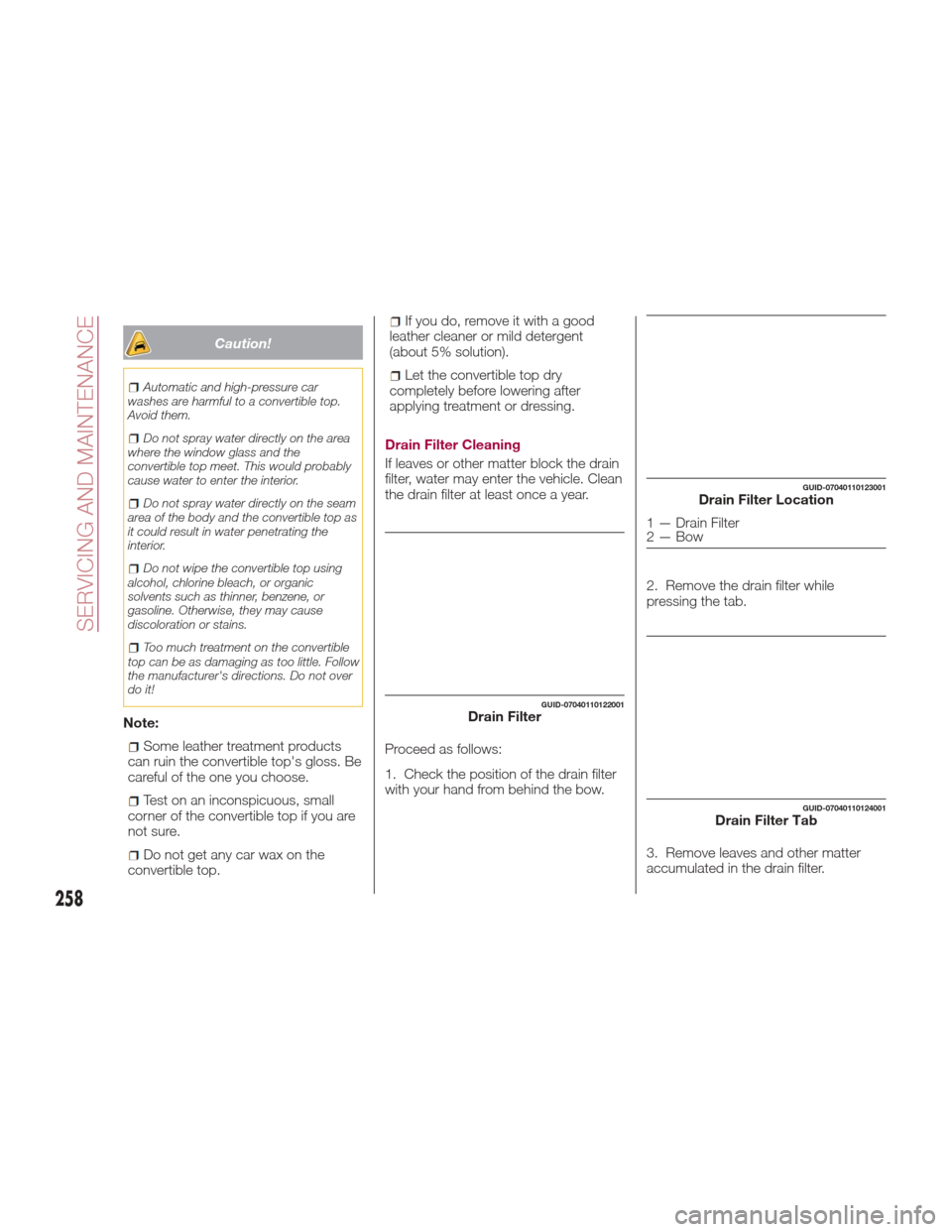
Drain Filter Cleaning
If leaves or other matter block the drain
filter, water may enter the vehicle. Clean
the drain filter at least once a year.
Proceed as follows:
1. Check the position of the drain filter
with your hand from behind the bow. 2. Remove the drain filter while
pressing the tab.
3. Remove leaves and other matter
accumulated in the drain filter.
GUID-07040110122001Drain Filter
GUID-07040110123001Drain Filter Location
1 — Drain Filter
2 — Bow
GUID-07040110124001Drain Filter Tab
258
SERVICING AND MAINTENANCE