2017 FIAT 124 SPIDER TPMS
[x] Cancel search: TPMSPage 210 of 300
To Install The Antitheft Lug Nut
Proceed as follows:
1. Place the special key on top of the
nut, and be sure to hold the key square
to it. If you hold the key at an angle, you
may damage both key and nut. Do not
use a power impact wrench.
2. Place the lug wrench on top of the
special key, apply pressure, and turn it
clockwise.
Mounting The Tire
Proceed as follows:
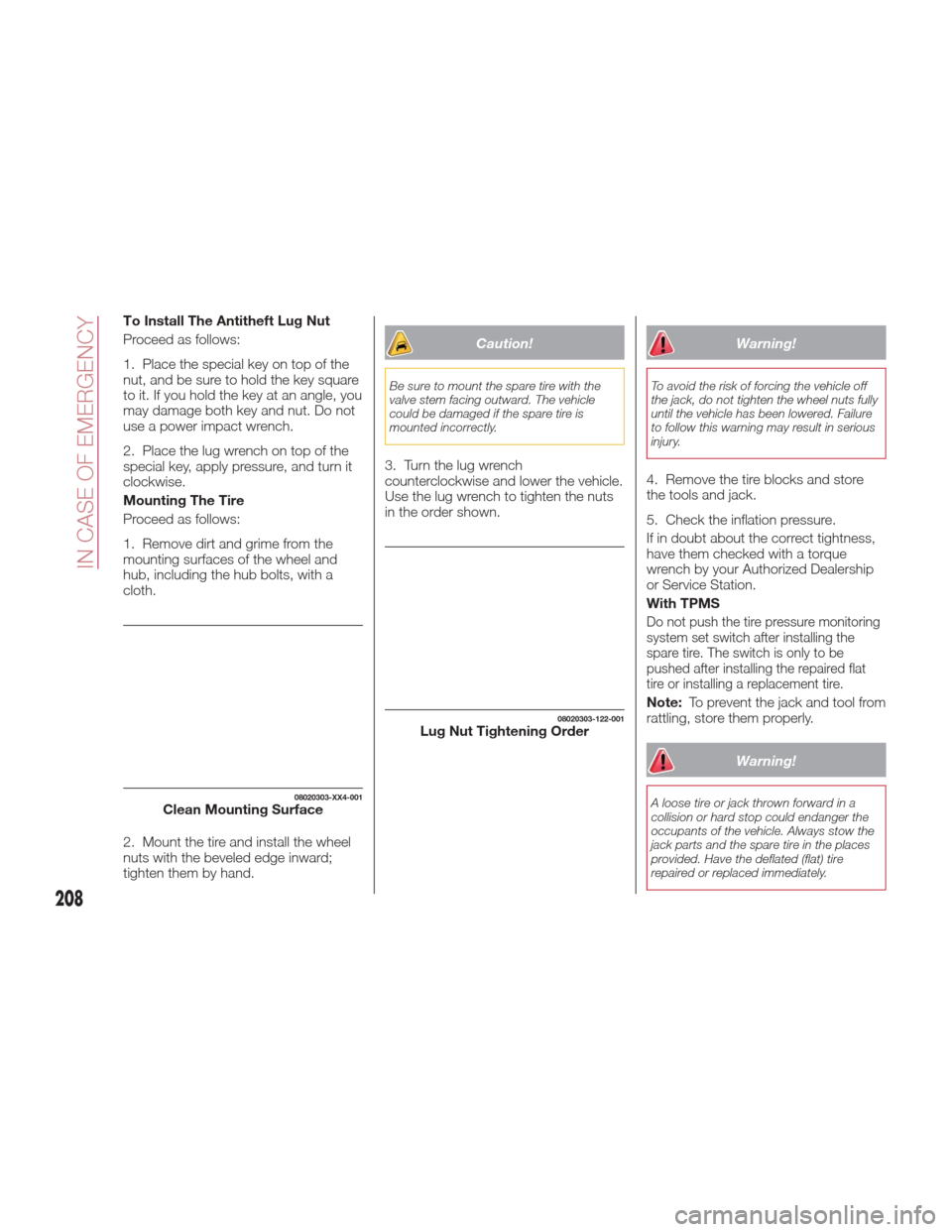
1. Remove dirt and grime from the
mounting surfaces of the wheel and
hub, including the hub bolts, with a
cloth.
2. Mount the tire and install the wheel
nuts with the beveled edge inward;
tighten them by hand.
Caution!
Be sure to mount the spare tire with the
valve stem facing outward. The vehicle
could be damaged if the spare tire is
mounted incorrectly.
3. Turn the lug wrench
counterclockwise and lower the vehicle.
Use the lug wrench to tighten the nuts
in the order shown.
Warning!
To avoid the risk of forcing the vehicle off
the jack, do not tighten the wheel nuts fully
until the vehicle has been lowered. Failure
to follow this warning may result in serious
injury.
4. Remove the tire blocks and store
the tools and jack.
5. Check the inflation pressure.
If in doubt about the correct tightness,
have them checked with a torque
wrench by your Authorized Dealership
or Service Station.
With TPMS
Do not push the tire pressure monitoring
system set switch after installing the
spare tire. The switch is only to be
pushed after installing the repaired flat
tire or installing a replacement tire.
Note:To prevent the jack and tool from
rattling, store them properly.
Warning!
A loose tire or jack thrown forward in a
collision or hard stop could endanger the
occupants of the vehicle. Always stow the
jack parts and the spare tire in the places
provided. Have the deflated (flat) tire
repaired or replaced immediately.08020303-XX4-001Clean Mounting Surface
08020303-122-001Lug Nut Tightening Order
208
IN CASE OF EMERGENCY
Page 216 of 300
Note:Carefully drive the vehicle at a
speed of 50 mph (80 km/h) or less. If
the vehicle is driven at a speed of
50 mph (80 km/h) or more, the vehicle
may vibrate.
Note: With TPMS system: if the tire is
not properly inflated, the
warning
light will illuminate.
After driving the vehicle for about
10 minutes or 3 miles (5 km), connect
the air compressor to the tire using
Step 9 of the procedure, and check the
tire inflation pressure using the tire
pressure gauge on the air compressor.
If the tire inflation pressure is lower than
the specified tire inflation pressure, turn
the air compressor on and wait until it
reaches the specified tire inflation
pressure.
the tire service kit is completed
successfully if the tire inflation pressure
does not decrease. Carefully drive the
vehicle to the nearest Authorized Dealer
immediately and have the flat tire
replaced. Replacement with a new tire
is recommended. If the tire is to be
repaired or reused, consult an
Authorized Dealer.
Note:
If an emergency flat tire repair has
been performed using the tire service
kit, FCA recommends that the tire be
replaced with a new one as soon as possible. If the tire is to be repaired or
reused, contact an Authorized Dealer.
The wheel can be reused if the
sealant adhering to it is removed.
However, replace the valve with a new
one.
Sealing A Tire With Tire
Service
Warning!
Do not attempt to seal a tire on the side
of the vehicle closest to traffic. Pull far
enough off the road to avoid the danger of
being hit when using the Tire Service Kit.
Do not use Tire Service Kit or drive the
vehicle under the following circumstances:
If the puncture in the tire tread is
approximately 1/4 inch (6 mm) or larger.
If the tire has any sidewall damage.
If the tire has any damage from driving
with extremely low tire pressure.
If the tire has any damage from driving
on a flat tire.
If the wheel has any damage.
If you are unsure of the condition of the
tire or the wheel.
Keep Tire Service Kit away from open
flames or heat source.
A loose Tire Service Kit thrown forward
in a collision or hard stop could endanger
the occupants of the vehicle. Always stow
the Tire Service Kit in the place provided.
Failure to follow these warnings can result
in injuries that are serious or fatal to you,
your passengers, and others around you.
Take care not to allow the contents of
Tire Service Kit to come in contact with
hair, eyes, or clothing. Tire Service Kit
sealant is harmful if inhaled, swallowed, or
absorbed through the skin. It causes skin,
eye, and respiratory irritation. Flush
immediately with plenty of water if there is
any contact with eyes or skin. Change
clothing as soon as possible, if there is any
contact with clothing.
Tire Service Kit Sealant solution contains
latex. In case of an allergic reaction or rash,
consult a physician immediately. Keep Tire
Service Kit out of reach of children. If
swallowed, rinse mouth immediately with
plenty of water and drink plenty of water.
Do not induce vomiting! Consult a
physician immediately.
214
IN CASE OF EMERGENCY
Page 220 of 300
Note:If the tire has been over
inflated, loosen the screw cap on the air
compressor and bleed some of the air
out.
20. When the tire inflates to the
specified tire inflation pressure, turn the
air compressor switch off, turn the
sleeve of the air compressor hose to
the left, and pull it out of the tire valve.
21. Install the tire valve cap.
22. Place the tire service kit back into
its storage location.
23. Start driving immediately to spread
the sealant in the tire.
Note:
Carefully drive the vehicle at a
speed of 50 mph (80 km/h) or less. If
the vehicle is driven at a speed of
50 mph (80 km/h) or more, the vehicle
may vibrate.
With TPMS system: if the tire is not
properly inflated, thewarning light
will illuminate.
After driving the vehicle for about
10 minutes or three miles (5 km),
connect the air compressor to the tire
using Step 9 of the procedure, and
check the tire inflation pressure using
the tire pressure gauge on the air
compressor. If the tire inflation pressure
is lower than the specified tire inflation
pressure, turn the air compressor on and wait until it reaches the specified
tire inflation pressure;
The emergency flat tire repair is
completed successfully if the tire
inflation pressure does not decrease.
Carefully drive the vehicle to the
nearest Authorized Dealer and have
the flat tire replaced. Replacement with
a new tire is recommended. If the tire is
to be repaired or reused, contact a
Authorized Dealer.
If an emergency flat tire repair has
been performed using the tire service
kit, FCA recommends that the tire be
replaced with a new one as soon as
possible. If the tire is to be repaired or
reused, contact an Authorized Dealer.
The tire can be reused if the sealant
adhering to it is removed. However,
replace the valve with a new one.
Replacing The Bottle
Note: The tire sealant has a period of
effective use. Check the period of
effective use indicated on the bottle
label and do not use it if it has expired.
Have the tire sealant replaced at an
Authorized Dealer before the period of
effective use has expired.
Inspect the tire service kit at regular
intervals as well as the operation of the
tire compressor.
JUMP STARTING
Preparations For Jump
Starting
If the battery is discharged, a jump
starting can be performed using the
battery and the cables of another
vehicle, or using a booster battery.
Jump-starting is dangerous if done
incorrectly, so follow the procedure in
this section carefully. If you feel unsure
about jump-starting, it is strongly
recommend that you have a competent
service technician do the work.
Note: When a booster battery is being
used, comply with the utilization and
precaution instructions specified by the
manufacturer.
218
IN CASE OF EMERGENCY
Page 253 of 300
Tire Rotation
Recommendations
The front and rear tires are subject to
different loads and stress due to
steering, maneuver and braking. For
this reason they are subject to uneven
wear. To resolve this problem, tires
should be rotated at the appropriate
time.
The following rotation methods must
NOT be used with one-way
unidirectional tires! This type of tires can
only be switched from the front axle to
the rear axle and vice versa, keeping
them on the same side of the vehicle.
Rotate one-way unidirectional tires
and radial tires that have an
asymmetrical tread pattern only from
front to rear, not from side to side. Tire
performance will be reduced if rotated
from side to side.
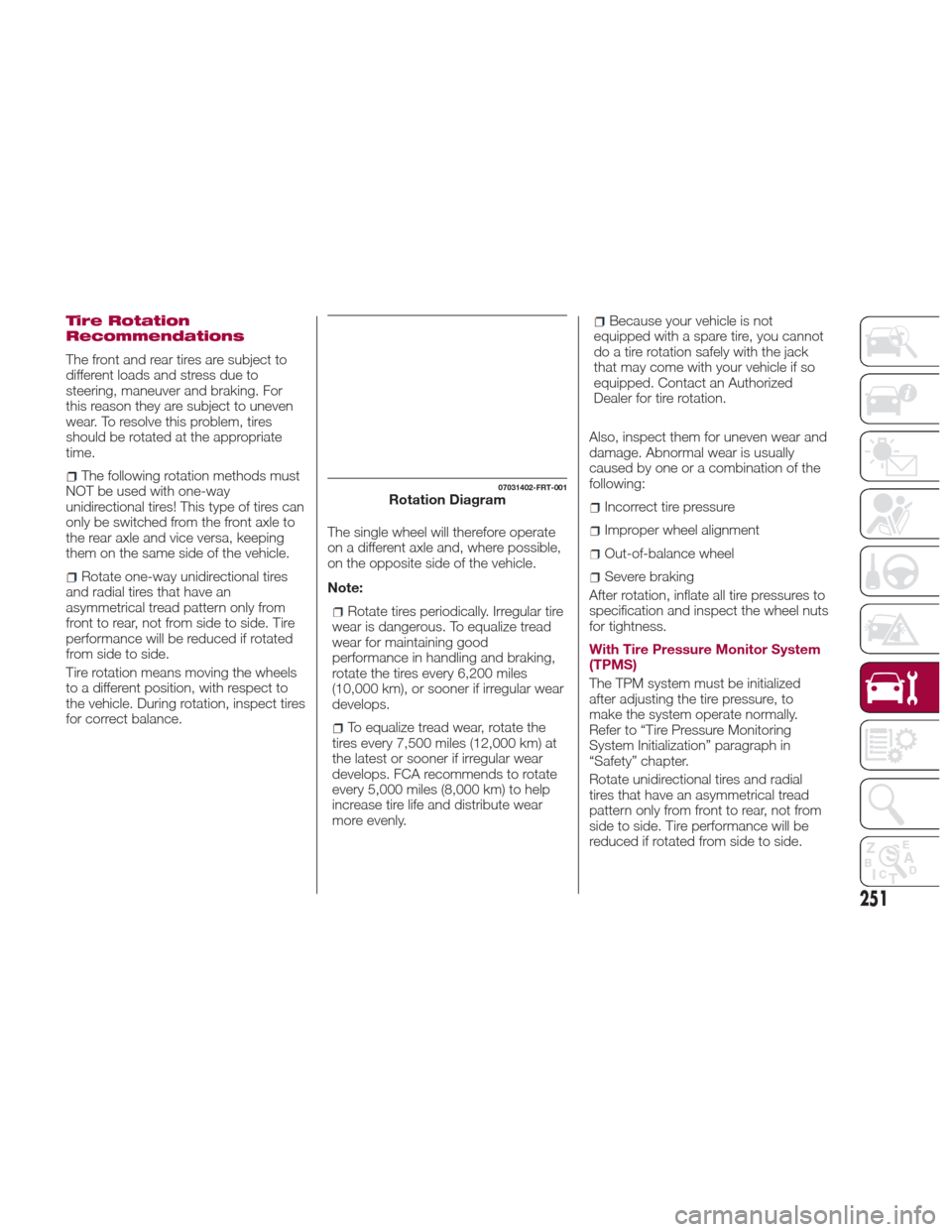
Tire rotation means moving the wheels
to a different position, with respect to
the vehicle. During rotation, inspect tires
for correct balance. The single wheel will therefore operate
on a different axle and, where possible,
on the opposite side of the vehicle.
Note:
Rotate tires periodically. Irregular tire
wear is dangerous. To equalize tread
wear for maintaining good
performance in handling and braking,
rotate the tires every 6,200 miles
(10,000 km), or sooner if irregular wear
develops.
To equalize tread wear, rotate the
tires every 7,500 miles (12,000 km) at
the latest or sooner if irregular wear
develops. FCA recommends to rotate
every 5,000 miles (8,000 km) to help
increase tire life and distribute wear
more evenly.
Because your vehicle is not
equipped with a spare tire, you cannot
do a tire rotation safely with the jack
that may come with your vehicle if so
equipped. Contact an Authorized
Dealer for tire rotation.
Also, inspect them for uneven wear and
damage. Abnormal wear is usually
caused by one or a combination of the
following:
Incorrect tire pressure
Improper wheel alignment
Out-of-balance wheel
Severe braking
After rotation, inflate all tire pressures to
specification and inspect the wheel nuts
for tightness.
With Tire Pressure Monitor System
(TPMS)
The TPM system must be initialized
after adjusting the tire pressure, to
make the system operate normally.
Refer to “Tire Pressure Monitoring
System Initialization” paragraph in
“Safety” chapter.
Rotate unidirectional tires and radial
tires that have an asymmetrical tread
pattern only from front to rear, not from
side to side. Tire performance will be
reduced if rotated from side to side.
07031402-FRT-001Rotation Diagram
251
Page 291 of 300
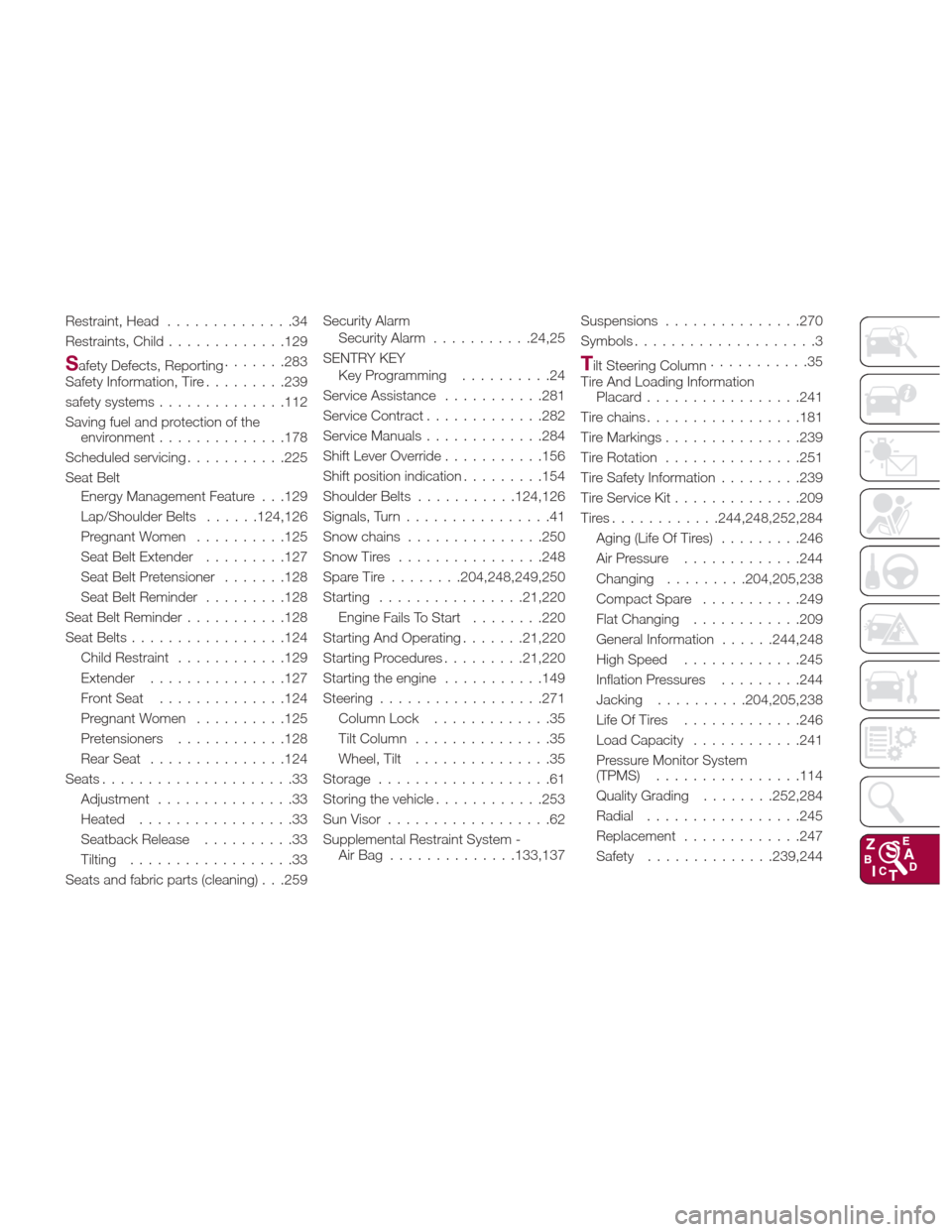
Restraint, Head..............34
Restraints, Child .............129
Safety Defects, Reporting .......283
Safety Information, Tire .........239
safety systems ..............112
Saving fuel and protection of the environment ..............178
Scheduled servicing ...........225
Seat Belt Energy Management Feature . . .129
Lap/Shoulder Belts ......124,126
Pregnant Women ..........125
Seat Belt Extender .........127
Seat Belt Pretensioner .......128
Seat Belt Reminder .........128
Seat Belt Reminder ...........128
Seat Belts ................ .124
Child Restraint ............129
Extender ...............127
Front Seat ..............124
Pregnant Women ..........125
Pretensioners ............128
Rear Seat ...............124
Seats .....................33
Adjustment ...............33
Heated .................33
Seatback Release ..........33
Tilting ..................33
Seats and fabric parts (cleaning) . . .259 Security Alarm
Security Alarm ...........24,25
SENTRY KEY Key Programming ..........24
Service Assistance ...........281
Service Contract .............282
Service Manuals .............284
Shift Lever Override ...........156
Shift position indication .........154
Shoulder Belts ...........124,126
Signals, Turn ................41
Snow chains ...............250
Snow Tires ............... .248
Spare Tire ........204,248,249,250
Starting ............... .21,220
Engine
Fails To Start ........220
Starting And Operating .......21,220
Starting Procedures .........21,220
Starting the engine ...........149
Steering ................. .271
Column Lock .............35
Tilt Column ...............35
Wheel, Tilt ...............35
Storage ...................61
Storing the vehicle ............253
Sun Visor ..................62
Supplemental Restraint System - AirBag ............. .133,137Suspensions
...............270
Symbols ....................3
Tilt Steering Column ...........35
Tire And Loading Information Placard ................ .241
Tire chains ................ .181
Tire Markings ...............239
Tire Rotation ...............251
Tire Safety Information .........239
Tire Service Kit ..............209
Tires............244,248,252,284 Aging (Life Of Tires) .........246
Air Pressure .............244
Changing .........204,205,238
Compact Spare ...........249
Flat Changing ............209
General Information ......244,248
High Speed .............245
Inflation Pressures .........244
Jacking ..........204,205,238
Life Of Tires .............246
Load Capacity ............241
Pressure Monitor System
(TPMS) ............... .114
Quality Grading ........252,284
Radial ................ .245
Replacement .............247
Safety ..............239,244
Page 292 of 300
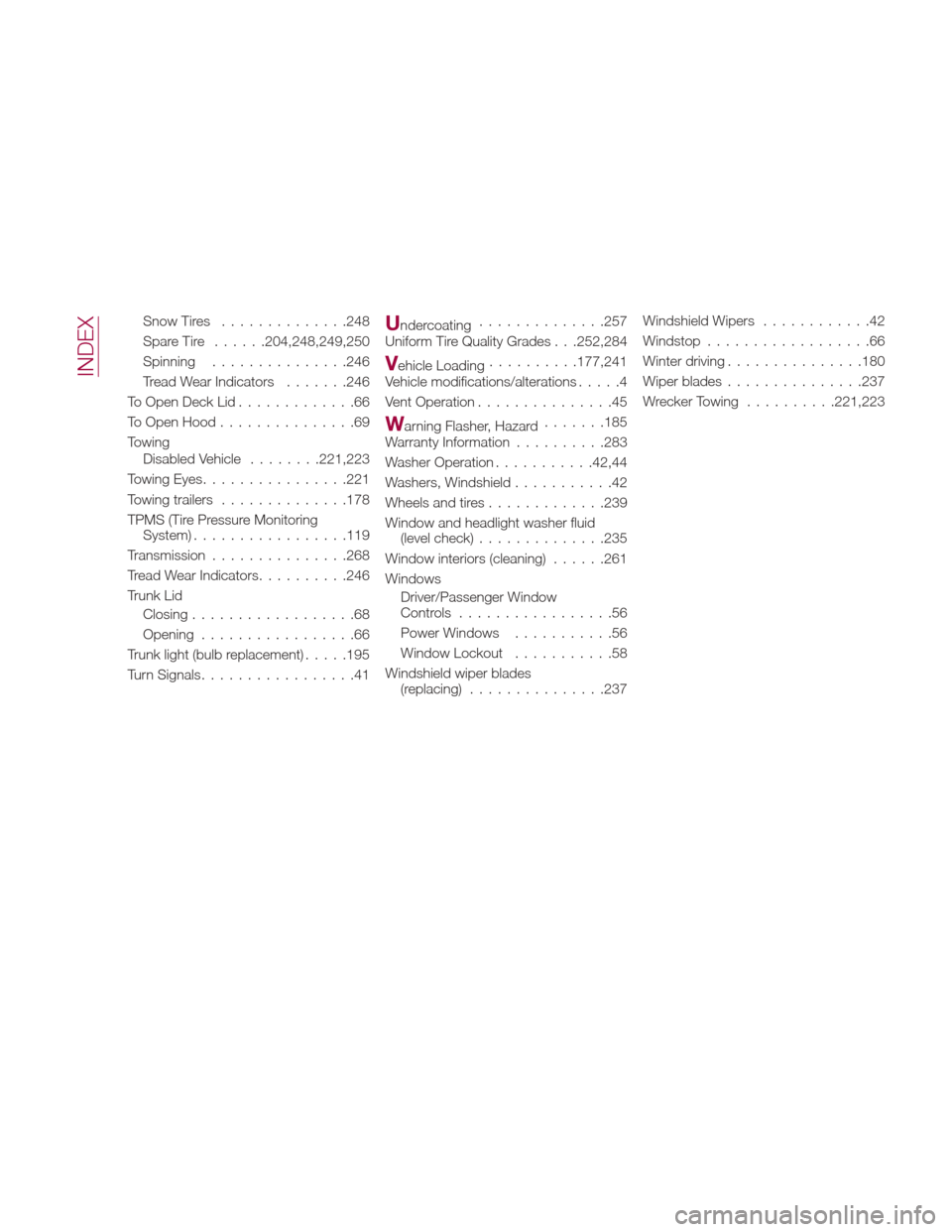
Snow Tires..............248
Spare Tire ......204,248,249,250
Spinning ...............246
Tread Wear Indicators .......246
ToOpenDeckLid.............66
ToOpenHood...............69
Towing Disabled Vehicle ........221,223
Towing Eyes ............... .221
Towing trailers ..............178
TPMS (Tire Pressure Monitoring System) ................ .119
Transmission ...............268
Tread Wear Indicators ..........246
Trunk Lid Closing ..................68
Opening .................66
Trunk light (bulb replacement) .....195
Turn Signals .................41Undercoating ..............257
Uniform Tire Quality Grades . . .252,284
Vehicle Loading ..........177,241
Vehicle modifications/alterations .....4
Vent Operation ...............45
Warning Flasher, Hazard .......185
Warranty Information ..........283
Washer Operation ...........42,44
Washers, Windshield ...........42
Wheels and tires .............239
Window and headlight washer fluid (level check) ..............235
Window interiors (cleaning) ......261
Windows Driver/Passenger Window
Controls .................56
Power Windows ...........56
Window Lockout ...........58
Windshield wiper blades (replacing) ...............237 Windshield Wipers
............42
Windstop ..................66
Winter driving ...............180
Wiper blades ...............237
Wrecker Towing ..........221,223
INDEX